Private-Label Chutney and Pickles in Sri Lanka: The Playbook
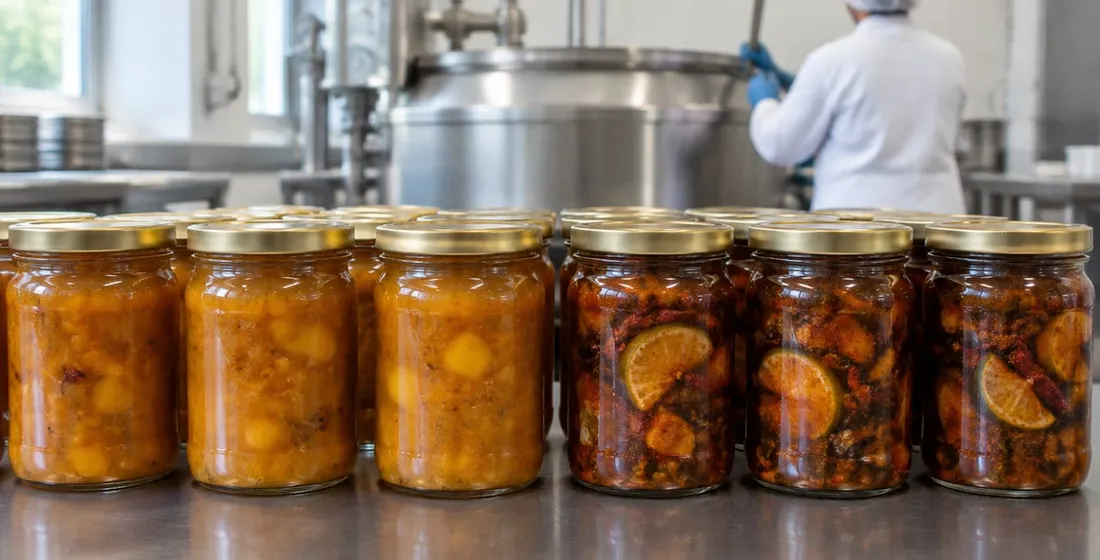
Unlabelled glass jars of mango chutney and lime pickle in oil on a stainless steel table, with a steam-jacketed kettle and a gloved worker in the background of a food factory.
Buyer’s snapshot
- Farm-gate Karthakolomban mango prices fell about 70 per cent between the September off-season and the December peak, from Rs 252.1 to Rs 71.2 per kg, per the Institute of Policy Studies (2024).
- For a chutney range, the month you buy fruit moves the ingredient cost per jar more than the recipe does.
- Silk Foods Ceylon (SFC) runs a first-run MOQ of 1,500 jars per SKU on a semi-liquid line that fills 3,000 jars of 300 g a day.
- The costing table below shows where the LKR goes at that first volume.
A chutney and pickle range looks like the easiest private-label launch on the Sri Lankan shelf. The recipes are familiar, the raw materials grow within a day’s drive of any factory, and the category already sits in every supermarket condiment aisle. The difficulty shows up later, in three places most first briefs skip: the acidity that decides the heat process, the jar and closure that decide the fill, and the season that decides what the fruit costs. This playbook works through each one for a brand owner planning a first range of two to four SKUs.
What makes a chutney a chutney, and a pickle a pickle?
Codex Alimentarius standard CXS 160-1987 defines mango chutney as a heat-processed product containing not less than 40 per cent mango fruit ingredient by mass, with total soluble solids of at least 50 per cent. Pickles fall under CXS 260-2007, which requires an acid or acidified product with an equilibrium pH below 4.6.
Those two numbers carry most of the specification. The 40 per cent fruit floor means a 300 g jar of mango chutney holds at least 120 g of mango. The 50 per cent soluble solids floor means sugar and cook-down do a large share of the preserving, which is why a chutney is closer to a jam than to a sauce on the production floor. The same Codex standard allows citric and acetic acid to hold the pH at or below 4.6 where the product is pasteurised.
Pickles work differently. CXS 260-2007 allows preservation by natural fermentation or by acidulants, packed in oil, brine or an acidic medium such as vinegar. A Sri Lankan range usually mixes both families: a sweet mango or pineapple chutney, a lime pickle in oil, and a vinegar-based mixed vegetable achcharu (Sinhala for pickle). Each of those runs a slightly different process, and it pays to know which before the jar is chosen.
| Product type | What preserves it | Typical heat step | Main spec to hold | Where it goes wrong |
|---|---|---|---|---|
| Sweet fruit chutney (mango, pineapple) | Sugar, acid, cook-down | Hot fill and seal, or pasteurise | Fruit 40 per cent min, soluble solids 50 per cent min, pH 4.6 max | Fruit ripeness shifts the pH between seasons |
| Vinegar pickle (mixed vegetable achcharu) | Acetic acid in the packing medium | Pasteurise after sealing | Equilibrium pH below 4.6 across the jar | Dense vegetable pieces equilibrate slowly |
| Oil pickle (lime, chilli) | Salt, acid, oil barrier | Hot fill or pasteurise | Lime acidity plus salt level, oil cover | Pieces above the oil line mould |
| Onion or fish sambol | Often low acid | Retort needed if pH is above 4.6 | Documented thermal process | Treated as a pickle when it is not |
The last row is where the category catches brand owners out. A seeni sambol or a Maldive fish sambol is sold in the same aisle but is often not an acidified product at all. If the pH sits above 4.6, the product needs a validated retort process, which is a different line time, a different cost and a different conversation with the manufacturer.
Steam-kettle batch economics: why the minimum is 1,500 jars
A chutney is cooked in a steam-jacketed kettle, and the kettle sets the economics. At the Matale facility the first-run MOQ for a chutney or pickle in a 300 g glass jar is 1,500 jars per SKU, described internally as a half-day production block on a semi-liquid line that fills 3,000 jars a day.
That number is an equipment number before it is a commercial one. A 1,500-jar run is 450 kg of finished product. Chutney loses water in the cook as it climbs towards 50 per cent soluble solids, so the raw charge going into the kettle is heavier than the finished mass. As a planning assumption, allow 15 to 25 per cent more raw charge than finished weight, depending on how wet the fruit is and how far the brix has to climb.
Two consequences follow for the range plan:
- Each SKU carries its own cleaning and changeover. Moving from a mango chutney to a lime pickle in oil means a full kettle clean, because oil and sugar residues do not mix well with a vinegar product that follows.
- Flavours per production block move the cost per jar more than the size of any single batch. Three SKUs at 1,500 jars each is roughly two and a quarter production days once changeovers are counted.
The same kettle and colloid mill arithmetic for pourable sauces and thick pastes is set out in the first-run maths for a contract-manufactured sauce.
Service snapshot: Private Labelling for a chutney and pickle range
- First-run MOQ: 1,500 jars per SKU (300 g glass jar), a half-day production block
- Line capacity: 3,000 jars of 300 g per day on the semi-liquid line
- Sample to first PO: 2 to 4 weeks for a locked recipe; 6 to 10 weeks if R&D / NPD (Co-Development on the SFC brochure) is needed first
- Cert coverage: BRCGS- and FSSC 22000 V6-audited, with SLSI clearance and Sri Lanka Food Act compliance on every retail SKU
Which glass-jar format fits each SKU?
The jar is usually treated as a brand decision and settled last. For chutneys and pickles it should be settled early, because it fixes the fill weight, the label panel, the closure and, for oil pickles, whether the pieces stay covered.
| Jar format (SFC stock) | Typical fill | Best fit in the range | Constraint it introduces |
|---|---|---|---|
| 220 ml round | About 200 g | Gift sets, trial size, hotel retail | Small label panel for a compliant back label |
| 330 ml round | 300 g, the SFC standard fill | Core supermarket SKU | Standard case packing, the costing baseline below |
| 420 ml square | About 380 g | Shelf standout for a hero SKU | Square jars cost more and pack less densely |
| 500 ml round | About 450 g | Family size, food service | Longer cooling time after hot fill |
| 50 ml | About 45 g | Sampling, in-room amenity | Highest glass and label cost per gram |
Closures need the same attention. Vinegar and lime acid attack bare metal, so lids for pickles need an acid-resistant lacquer and a liner suited to hot fill. Oil pickles need a wide enough mouth for the pieces to be packed below an oil layer, with headspace set so the oil still covers everything once the jar cools and the contents settle. A jar that looks full at the filling head and shows dry lime above the oil a week later is a customer complaint and, sometimes, a mould problem.
Label panels are the other constraint. The Sri Lankan food labelling regulations require storage instructions and the expiry date in at least two of the three national languages. On a 220 ml jar that, plus an ingredient list and allergen declaration, uses most of the wrap before the brand gets any room.
How long can a chutney or pickle last on a Sri Lankan shelf?
Shelf life in this category comes from acidity, sugar or salt, and a clean hot fill, rather than from preservative alone. Codex CXS 160-1987 permits benzoates up to 250 mg/kg and sorbic acid up to 1,000 mg/kg in mango chutney, but the pH at or below 4.6 is what makes a pasteurised product safe.
For a local brand the practical routes are three:
- Hot fill and seal: the product leaves the kettle hot, fills into clean jars and is capped immediately. This suits high-sugar chutneys well inside the pH limit.
- Pasteurise after sealing: jars are filled, sealed and held in hot water or steam. This suits vinegar pickles, where the pieces need time to reach an equilibrium pH.
- Retort: a validated pressure-heat process for products above pH 4.6. It suits low-acid sambols and some coconut-based products, and it adds line time and cost.
The R&D and production planning team at the Matale facility sees one gap on most first chutney briefs, and it is rarely the flavour. A home recipe is made with whatever mangoes are in the market that week. A Yala-season fruit in June and a Maha-season fruit in December do not carry the same sugar or acid, so the same recipe lands at a different pH and a different brix. The fix is to write the recipe against measured targets (brix at the end of the cook, pH at fill) and adjust the acid and sugar to hit them, rather than follow fixed quantities. That usually takes two to four sample iterations, and it is the step most worth finishing before artwork is committed.
A declared shelf life still has to be established, not assumed. How that is done, and what an accelerated study can and cannot show, is covered in shelf life and accelerated stability testing in Sri Lanka. For the reformulation step itself, see reformulating a kitchen recipe for a 1,500-jar run.
What does a first chutney run cost in LKR?
Less on ingredients than most brand owners expect, and more on glass. The model below is a planning estimate for a mango chutney in a 330 ml jar at 1,500 jars, not a quotation. Material rates are stated assumptions for a 2026 first run so the table can be rebuilt with other inputs.
| Cost line | Per jar, Maha-season fruit | Per jar, off-season fruit | Assumption used |
|---|---|---|---|
| Mango, about 150 g of flesh before cook-down | LKR 20 | LKR 68 | Fruit at Rs 71 and Rs 252 per kg, about 55 per cent flesh yield |
| Sugar, about 110 g | LKR 26 | LKR 26 | Industrial white sugar at LKR 240 per kg |
| Vinegar, spices, ginger, garlic, salt | LKR 25 | LKR 25 | Blended estimate |
| Ingredients subtotal | LKR 71 | LKR 119 | |
| Glass jar and lacquered lid | LKR 120 | LKR 120 | 330 ml flint jar at a 1,500-unit order quantity |
| Self-adhesive label, four colour | LKR 24 | LKR 24 | Short-run rate, origination excluded |
| Shipper carton share, 12 jars per case | LKR 15 | LKR 15 | LKR 180 per case |
| Packaging subtotal | LKR 159 | LKR 159 | |
| Materials total | LKR 230 | LKR 278 | Before conversion, QA release and margin |
| Artwork and print origination, one off | LKR 30 to 60 | LKR 30 to 60 | LKR 45,000 to 90,000 across 1,500 jars |
Two lines change the decision. The first is packaging: at 1,500 jars the glass, lid, label and carton cost more than everything inside the jar, in either season. The second is timing. Buying fruit at the December peak rather than the September off-season takes about LKR 48 off every jar, a 17 per cent cut in materials cost for no change to the recipe.
The Institute of Policy Studies noted in 2024 that turning peak-season surplus mango into pulp, jams and chutneys helps meet year-round demand. For a brand, that points to a simple lever: schedule the mango chutney run into the October to January Maha peak, or agree to buy processed pulp at that point in the year. The lime pickle and vegetable achcharu can then fill the months when mango is expensive.
Volume is the other lever. At 6,000 jars across a range, origination falls to roughly LKR 8 to 15 per jar and the glass usually moves onto a better price tier. Reaching 6,000 across three SKUs at 2,000 each is an easier ask than reaching it on one flavour. The sequencing logic is set out in launching a three-SKU private-label range.
Build the range brief before you brief a manufacturer
A chutney and pickle brief that arrives with these answers usually reaches a first sample in two weeks. One without them usually spends the first month finding them.
Buyer’s checklist
- The SKU list, with the product family of each (sweet chutney, vinegar pickle, oil pickle, low-acid sambol)
- Target pH and brix per SKU, or a reference product to match
- Jar size and closure for each SKU, with the label panel measured
- Jars per SKU for the first run, and the planned repeat interval
- The fruit season each SKU depends on, and whether pulp is acceptable
- Claims planned for the label (no added preservative, no artificial colour), since each one narrows the process options
- The target shelf date, allowing six to ten weeks for SLSI clearance
Where SFC walks away
Silk Foods Ceylon declines briefs that ask for a low-acid fish or onion sambol with an 18-month shelf life, no retort and no preservative. That combination does not exist safely. It also declines first runs below 1,500 jars per SKU; a brand still testing flavours is better served by a few more kitchen rounds before a line slot is booked.
The SLSI step itself, from sample to clearance, is set out in the SLSI packaged-food submission, step by step. For a comparable glass-jar range on the same line, see the private-label jam and fruit-preserve playbook.
Frequently asked questions
What is the minimum fruit content for mango chutney?
Codex standard CXS 160-1987 sets mango chutney at not less than 40 per cent mango fruit ingredient by mass of the finished product, with total soluble solids of at least 50 per cent. In a 300 g jar that is at least 120 g of mango. Total ash must stay under 5 per cent and acid-insoluble ash under 0.5 per cent.
Does a pickle or chutney need a retort?
Not if it is properly acidified. Codex CXS 260-2007 defines pickles as acid or acidified products with an equilibrium pH below 4.6, and the chutney standard allows pasteurised products held at pH 4.6 or lower. Products above that line, such as many fish or onion sambols, need a validated retort process instead.
What is the private-label MOQ for chutney or pickle at Silk Foods Ceylon?
The first-run MOQ at Silk Foods Ceylon is 1,500 jars per SKU in a 300 g glass jar, a half-day block on a semi-liquid line that fills 3,000 jars a day. A three-SKU range at MOQ is about two and a quarter production days including changeovers. The facility is BRCGS- and FSSC 22000 V6-audited.
When is the cheapest time to make mango chutney in Sri Lanka?
The Maha-season peak, from October to January. The Institute of Policy Studies recorded Karthakolomban mango falling about 70 per cent from Rs 252.1 per kg in September to Rs 71.2 in December (2024). In the costing model above, that difference is about LKR 48 per 330 ml jar.
How Silk Foods Ceylon can help
For a brand owner building a first chutney and pickle range, Silk Foods Ceylon runs Private Labelling and contract manufacturing from a cellular-manufacturing facility at Silk AgTech Park in Hapugasyaya, Matale. The first-run MOQ is 1,500 jars per SKU on a semi-liquid line that fills 3,000 jars of 300 g a day, with steam-jacketed kettles, hot fill and retort available on the same site. The in-house R&D team sets brix, pH and the heat process for each SKU over two to four sample iterations before a recipe locks. The facility is BRCGS- and FSSC 22000 V6-audited, with SLSI clearance and Sri Lanka Food Act compliance built into a standard engagement.
To brief a chutney or pickle range, email brands@esilkroute.com.lk or call +94 76 441 0389 / +94 76 918 5744.
Sources
- Codex Alimentarius Commission, Standard for Mango Chutney CXS 160-1987, on the 40 per cent fruit minimum, 50 per cent soluble solids minimum, pH 4.6 limit for pasteurised product, ash limits and permitted preservatives. fao.org (retrieved 24 September 2026).
- Codex Alimentarius Commission, Standard for Pickled Fruits and Vegetables CXS 260-2007, on the equilibrium pH below 4.6 and packing media of oil, brine and vinegar. fao.org (retrieved 24 September 2026).
- Chandula Idirisinghe, Seasonal Swings in Sri Lanka’s Mango Market: A Balancing Act with Economic Insights, Institute of Policy Studies of Sri Lanka, Talking Economics, 9 July 2024, on Yala and Maha harvest peaks, the Rs 252.1 to Rs 71.2 per kg price fall and value-added processing. ips.lk (retrieved 24 September 2026). Also published in the Daily FT.
- Further reading: Sri Lanka Export Development Board, ready-to-eat food products, on achcharu, sambols and wambatu moju. srilankabusiness.com (retrieved 24 September 2026).
Written by the Silk Foods Ceylon Team. Silk Foods Ceylon (Pvt) Ltd. is a BRCGS- and FSSC 22000 V6-audited contract manufacturer in Matale, Sri Lanka, offering contract manufacturing, private labelling, co-packing, and in-house R&D for local Sri Lankan brand owners, FMCG companies, hotel and restaurant groups, and distributors. To brief a project: brands@esilkroute.com.lk, +94 76 441 0389, or +94 76 918 5744.