Private-Label Curry Paste in Sri Lanka: A Range Launch Playbook
Buyer’s snapshot
- A first commercial run of a private-label curry paste at Silk Foods Ceylon starts at 1,500 jars per SKU in 300 g glass, about half a day on a line rated at 3,000 jars per day.
- Acidity decides the process, not the pack. A paste acidified below pH 4.6 can be hot filled. Above it, the paste needs a validated retort schedule.
- Three SKUs is 4,500 jars and roughly a day and a half of line time. Five SKUs is 7,500 jars, two extra clean-downs, and the same unmeasured sell-through.
- File SLSI clearance per SKU in parallel across the range, confirm the current window with SLSI at submission, and hold a buffer between QA sign-off and the shelf date.
Most Sri Lankan brand owners arrive at a curry paste range with the recipes already settled. Four or five pastes, tested in a home kitchen, liked by everyone who tried them. What is not settled is the batch, and the batch is what sets the cost per jar.
The category is worth the trouble. The Sri Lanka Export Development Board reported in July 2026 that processed food earnings grew 44.07 percent year on year in the first half of 2026, while spices and essential oils slipped 0.10 percent. That divergence is the private-label argument in two numbers.
This playbook follows the sequence a mid-sized local FMCG brand meets when it moves a paste range out of a kitchen: kettle economics, format choice, thermal process, minimum order quantity per SKU, and the label-approval window that quietly decides the launch date.
Start with the kettle, not the SKU list
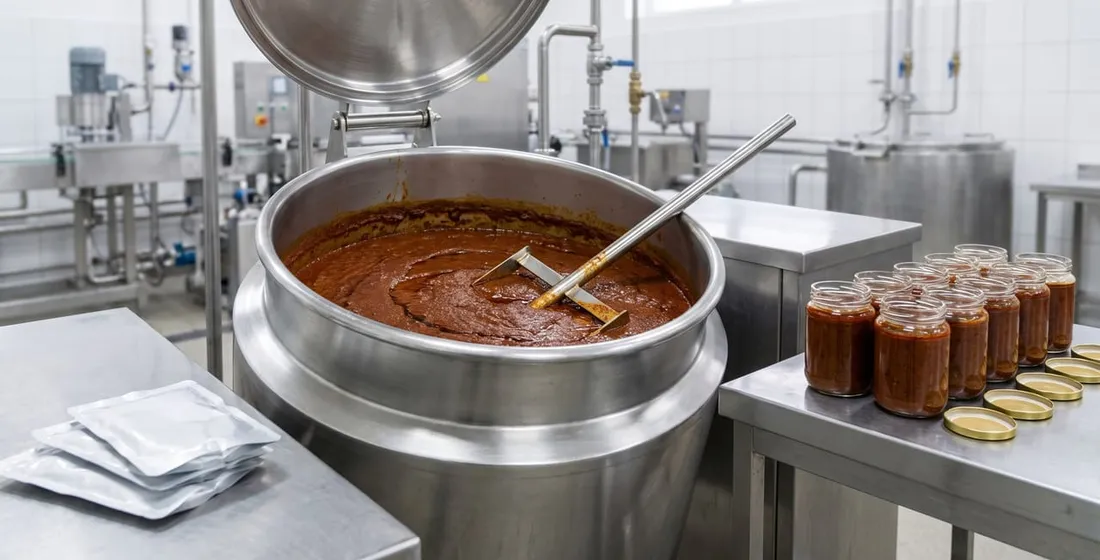
A jacketed steam kettle cooks and discharges one charge at a time, so batch size is fixed by the vessel rather than by the order. At a 300 litre working volume, one charge fills roughly 1,000 jars at a 300 g net weight before line losses, which makes the kettle, not the purchase order, the real unit of production planning.
The second variable is changeover. Every recipe change between charges is a full clean-down of kettle, pump, filler and lines, because a chilli-heavy paste carries into the next batch otherwise. A day running one paste yields more sellable jars than a day running three, on identical equipment. Silk Foods Ceylon runs its semi-liquid line at 3,000 jars per day and prices a first private-label run from 1,500 jars per SKU, a half-day charge plus its clean-down.
Ingredient specification feeds straight back into this. The tolerance bands set when specifying garlic, mustard and fenugreek for condiment SKUs are what let a second charge match the first without a fresh round of adjustment on the floor.
How many pastes should a first range carry?
Three. At the 1,500-jar minimum per SKU, three pastes is 4,500 jars and about a day and a half of line time. Five pastes is 7,500 jars, two additional clean-downs, and 3,000 extra jars of finished inventory carrying a sell-through rate nobody has measured yet.
A brand asking for nine pastes in a first run is usually solving a shelf-facing problem rather than a demand problem, and that is a conversation worth having before the artwork goes to plate. The second run is where the economics improve, and a brand sitting on unsold SKU seven rarely gets to one.
The arithmetic behind that call is set out in the founder’s maths on contract manufacturing costs, which walks the same trade between run size and unit cost.
Jar or pouch, and what the format actually costs
Format choice is a cost-floor decision made before the first sample, because it fixes the thermal process, the freight weight per unit, and the print minimum on the packaging. The four formats a local paste range realistically chooses between behave quite differently.
| Format | Typical fill | Thermal process | Ambient shelf life (planning figure) | Where it fits |
| 300 g glass jar, lug cap | 250 to 380 g | Hot fill if acidified, retort if not | 12 to 18 months | Supermarket condiment shelf, gifting, hotel table use |
| Retort pouch, printed laminate | 100 to 250 g | Full retort | 12 to 18 months | Price-led shelf, e-commerce, lower freight per unit |
| Food-service pouch or pail | 1 to 5 kg | Full retort | 9 to 12 months | Hotel and restaurant kitchens, central production units |
| Single-portion sachet | 30 to 60 g | Full retort | 9 to 12 months | Trial size, on-pack promotion, tourist retail |
Those shelf-life figures are planning numbers for scheduling and artwork lead time. The life declared on the label comes from a study on the finished pack, not from a category average.
Glass carries a higher packaging cost per unit and far more freight weight than an equivalent pouch, and it reads as a gift-ready pack in a way laminate does not. The pouch wins on cost and freight, and loses on one detail that catches brands out: printed laminate carries a converter print minimum commonly well above 1,500 units, so the packaging order can be several times the size of the first product run. The jar route splits that exposure across a plain jar, a stock cap and a printed label, each with a smaller minimum of its own.
The glass-jar route at first-run scale is worked through in more detail for glass-jar retail SKUs from a 1,500-jar first run. For dry blends and refill formats alongside a wet paste range, the spice and herb co-packing capability one-pager covers the sack and pouch side.
What actually sets the shelf life
Shelf life is not a number chosen at the artwork stage. It is an output of four things: pH, water activity, the thermal process the pack receives, and the barrier the pack provides. Of those, pH decides the process, and the process decides most of the cost. The Codex Alimentarius code of hygienic practice for low-acid and acidified low-acid canned foods, adopted in 1979 with editorial corrections in 2011, puts the line at an equilibrium pH of 4.6.
A paste held below 4.6 by tamarind, lime or added acetic acid counts as an acidified food and can be hot filled. A paste above 4.6 is a low-acid food in a hermetically sealed container and needs a validated retort schedule. The University of Georgia Cooperative Extension stated the practical difference in 2025: a product at or above pH 4.6 requires a thermal process under pressure at 240 to 260 degrees Fahrenheit, roughly 116 to 127 Celsius. That single measurement moves the capital requirement, the cycle time per batch, and the shelf life the brand can print.
The clause worth reading twice is the Codex definition of a low-acid food, which bites where any component has a pH above 4.6 and a water activity above 0.85. A paste with an acidified continuous phase but low-acid particulates, coconut, dhal or dried fish, is still a low-acid food. Measuring the blended sample and stopping there is one of the more common ways a brand specifies the wrong process.
One local brand brought a chilli and garlic paste that measured pH 4.4 in its kitchen and drifted to 4.7 at pilot scale, because the kitchen version used close to twice the lime juice per kilo and nobody had written that down. The fix was a formulation change, not a process change, and it cost two sample iterations. Catching it after 1,500 jars were filled would have cost the run.
That gap between a kitchen recipe and a validated batch is the usual reason a first range needs formulation work at all, and reformulating a kitchen recipe for retort runs covers what changes and why.
MOQ per SKU, and why a range multiplies it
Minimum order quantity at Silk Foods Ceylon is set per SKU, not per order, because each SKU is its own kettle charge and its own clean-down. A three-paste range therefore starts at 4,500 jars, not 1,500.
| Item | Minimum at Silk Foods Ceylon | Note |
| Finished paste, 300 g glass jar | 1,500 jars per SKU | About half a day on a 3,000 jars per day line |
| Bulk spice or herb raw material | 50 kg per SKU | Volume tiers at 500, 1,000 and 2,500 kg |
| R&D iterations before recipe lock | 2 to 4 samples | Iterations run inside the 3 to 4 week R&D window, signed brief to approved formulation |
| Sample dispatch, existing recipe | 1 to 2 weeks | No formulation work required |
| Purchase order to dispatch, existing recipe | 2 to 3 weeks | Packaging already at the facility |
| Purchase order to dispatch, new formulation | Roughly 5 to 7 weeks in total | R&D 3 to 4 weeks maximum (iterations and pilot validation), then the 2 to 3 week production run |
The multiplication bites hardest on packaging rather than product. Jars, caps, labels and cartons each carry a supplier minimum set by the converter, not by the manufacturer, so a brand ordering exactly 4,500 jars usually ends up holding label stock for a second run whether it planned one or not.
The same MOQ-versus-lead-time trade shows up on the hospitality side, where MOQ and lead time for a HORECA private label sets out how a food-service pack changes the arithmetic.
The label-approval window is where range launches slip
Sri Lanka Standards Institution certification is what gates a packaged paste onto a national retail shelf, and it runs per SKU. SLSI publishes no processing time, so confirm the current window at submission and hold a buffer between manufacturer QA sign-off and the target shelf date. The mistake that costs range launches a month is filing SKU one, waiting, then filing SKU two. Filed together, three SKUs take one window. Filed in sequence, they take three.
Underneath SLSI certification sits the Sri Lanka Food Act No. 26 of 1980 and the labelling regulations made under it. The 2005 regulations, gazetted as Extraordinary No. 1376/9, require the common name of the contents on the main panel in at least two of the three languages and the net contents in metric symbols, and on any panel a complete ingredient list in descending order of proportion, storage instructions, a batch or code marking, the date of manufacture and the date of expiry. That descending-order clause is what ties artwork to the recipe. An R&D iteration that raises the garlic above the onion reorders the declaration, and a declaration change after plates are cut is a reprint.
Two numbers in the same gazette decide how much of the jar the designer actually gets. The main panel must be at least 20 percent of the total surface area excluding the bottom of the container, and the common-name lettering must be at least one third the height of the brand-name lettering, with a minimum of 3 millimetres. Prepackaged food under 25 grams is exempt, which matters if the range carries a trial sachet. The regime is also moving: the USDA Foreign Agricultural Service reported in February 2025 that implementation of the 2022 labelling regulations, which require the common name in bold in all three languages rather than two, moved to 1 July 2025 by gazette Extraordinary No. 2416/51.
Silk Foods Ceylon runs a BRCGS-audited site operating to FSSC 22000 V6, which no local shelf requires. SLSI certification and Food Act compliance are the floor. The audited stack is what a premium private-label programme, a hotel-group listing or a first export enquiry asks for, so it matters to a brand that expects to be somewhere else in two years.
One conditional worth settling early: a culinary paste sold without a traditional-medicine claim sits outside Department of Ayurveda registration. Add claim language drawn from an Ayurvedic monograph to the pack and it does not, which is a different path on a different timeline.
For a worked example of the submission window on a comparable jarred SKU, see the SLSI clearance window for private-label jars.
A fourteen-week sequence from brief to shelf
The sequence below assumes three SKUs, a 300 g glass format, and formulation work on at least one paste. A stable existing recipe with packaging already in hand compresses this to the 2 to 3 week purchase-order window instead.
| Week | Step | Owner |
| 1 | Brief, format choice, target retail price and channel confirmed | Brand |
| 2 to 5 | R&D iterations, pH and viscosity checks at pilot scale, 2 to 4 samples | Silk Foods Ceylon |
| 5 | Recipe and ingredient declaration locked for all three SKUs | Joint |
| 5 to 7 | Artwork built on the locked declaration, print plates ordered | Brand |
| 6 to 13 | SLSI submissions filed in parallel across the range | Joint |
| 8 | Jars, caps, labels and cartons delivered to the facility | Brand |
| 12 | First commercial run, 1,500 jars per SKU | Silk Foods Ceylon |
| 13 to 14 | QA release, shelf-life study started on finished pack, dispatch | Silk Foods Ceylon |
Two dependencies break this schedule more often than anything else: artwork committed to plate before the declaration locked, and SLSI submissions filed one after another. Both are calendar problems rather than manufacturing problems, and both are fixed at week one for free.
Frequently asked questions
What is the private-label MOQ for a curry paste at Silk Foods Ceylon?
A first commercial run starts at 1,500 jars per SKU in 300 g glass, about half a day on a line rated at 3,000 jars per day. Bulk spice and herb raw material carries a separate 50 kg per SKU minimum, with volume tiers opening at 500, 1,000 and 2,500 kg.
Does a Sri Lankan curry paste need retort processing?
It depends on acidity. pH 4.6 is the recognised boundary between acid and low-acid foods, so a paste acidified below 4.6 with tamarind, lime or acetic acid can be hot filled, while a coconut-rich or low-acid paste above 4.6 needs a validated retort schedule.
How long does SLSI clearance take for a private-label SKU?
SLSI publishes no turnaround time, so confirm the current window at submission and hold a buffer between manufacturer QA sign-off and the target shelf date. Filing a multi-SKU range together rather than one SKU at a time is what stops those windows stacking end to end.
Glass jar or retort pouch for a first paste range?
Glass suits the supermarket condiment shelf and gifting, and allows hot fill if the paste is acidified. Retort pouches cut packaging cost and freight per unit, but printed laminate carries a converter print minimum often several times the 1,500-jar product minimum, so the format sets the packaging inventory too.
Can Silk Foods Ceylon develop a new paste recipe for a local brand?
Yes. The in-house R&D team typically runs 2 to 4 sample iterations inside a 3 to 4 week maximum R&D window, signed brief to approved formulation, with pH and viscosity confirmed at pilot scale rather than kitchen scale. A purchase order carrying new formulation work dispatches in roughly 5 to 7 weeks in total, R&D first, then the 2 to 3 week production run.
How Silk Foods Ceylon can help
For local FMCG brands shifting from in-house production to professional contract manufacturing, Silk Foods Ceylon (SFC) operates a 10,000 sq ft cellular-manufacturing facility in Matale with the line flexibility to run 50+ ready-to-go SKUs on a single BRCGS- and FSSC 22000 V6-audited cert stack. Capacity ranges across formats: 3,000 jars/day on semi-liquids, 2,500 x 200 ml bottles/day on beverages, 200,000 capsules/day, 15,000 patties/day, 30,000 nuggets/day. The in-house R&D team works alongside production planning, which means a multi-SKU launch can run in parallel rather than serial. SLSI submission support sits inside the standard engagement.
To brief a project, email brands@esilkroute.com.lk or call +94 77 157 7294.
Sources
FAO and WHO Codex Alimentarius Commission, Code of Hygienic Practice for Low-Acid and Acidified Low-Acid Canned Foods, CAC/RCP 23-1979, editorial corrections 2011. fao.org. Retrieved 17 August 2026.
University of Georgia Cooperative Extension, Preserving Acidified Foods Using the Hot-Fill-Hold Process, publication C1328-03, 2025. caes.uga.edu. Retrieved 17 August 2026.
Ministry of Health, Sri Lanka, Food (Labelling and Advertising) Regulations 2005, Gazette Extraordinary No. 1376/9 of 19 January 2005, made under the Food Act No. 26 of 1980. eohfs.health.gov.lk. Retrieved 17 August 2026.
USDA Foreign Agricultural Service, Sri Lanka Extends Implementation of the Food Labeling and Advertising Regulations-2022 by Additional Six Months, GAIN report CE2025-0003, 26 February 2025. apps.fas.usda.gov. Retrieved 17 August 2026.
Sri Lanka Export Development Board, Sri Lanka’s Exports Cross US$ 9 Billion Milestone in the First Half of 2026, 22 July 2026. srilankabusiness.com. Retrieved 17 August 2026.