Vegan Cashew Cheese Contract Manufacturing in Sri Lanka
Buyer’s snapshot
- A fermented cashew cheese has to show an active ferment dropping below pH 4.4 by the end of the second day, verified by pH tests at 0, 24 and 48 hours (BC Centre for Disease Control, 2024).
- So the half-day figure describes the filling block, not the production cycle. Budget five working days per batch and price the SKU off that.
- Sri Lanka’s annual cashew demand sits near 25,000 tonnes against a crop expected below 10,000 tonnes, with Cabinet approval to import up to 15,000 tonnes (The Morning, February 2024).
- Silk Foods Ceylon (SFC) runs a 1,500-jar first commercial run in glass, with SLSI submission support inside the engagement.
A cultured cashew cheese is one of the few plant-based products a Sri Lankan brand owner can develop at home and taste-test honestly. Soak, blend, culture, wait. The kitchen version usually works. The commercial version usually stalls, and the reason is almost never the recipe.
The gap sits in the calendar and in the control points. A first commercial run of 1,500 jars is a half-day block on the filling line, which is what the MOQ figure describes. The batch feeding that block takes most of a working week and carries three verification steps a kitchen never runs. Both numbers matter, because pricing a SKU off the wrong one is how a launch loses its margin before the first pallet moves.
What does a half-day cashew cheese run actually produce?
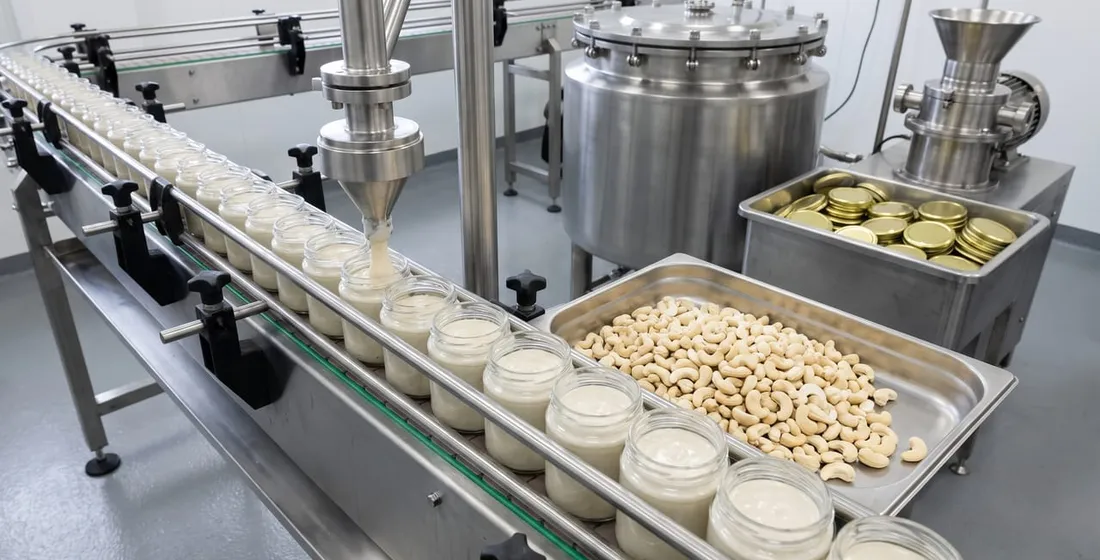
A first commercial contract manufacturing run of vegan cashew cheese at Silk Foods Ceylon is 1,500 jars in a 300 g glass format, filled in a half-day block on the line. Glass jar tooling adds roughly one week of lead time ahead of that block. Larger volume tiers step up from there once the SKU has a sales history.
The 1,500-jar floor is not a commercial preference. Line changeover, pre-run sanitation, and the sampling that goes with a new SKU cost the same whether the run is 1,500 jars or 15,000. Below roughly 1,500 units those fixed costs stop spreading, and the per-jar figure starts telling a brand owner something misleading about the product’s real economics at volume.
| Format | First-run MOQ | What sets it |
| Glass jar, spread or semi-liquid, 300 g | 1,500 jars | Half-day filling block; glass tooling adds about one week of lead time |
| Glass bottle, beverage, 200 ml | 1,250 bottles | Separate fill line and closure set |
| Frozen patty or nugget | 5,000 to 10,000 units | Cold chain from the line onward |
| Capsule bottle | 180 bottles | Shown for scale; not a route for spreads |
Two of those decisions are made before the first sample, not after. The jar size fixes the fill weight and the headspace the texture has to survive, and the texture target fixes the grind. Both are covered in more detail in the note on vegan cheese spread R&D on the colloid mill.
Why the half-day block is not the production calendar
The filling block is half a day. The batch behind it is not. Guidance published by the BC Centre for Disease Control in December 2024 requires a fermented nut cheese to show an active fermentation dropping below pH 4.4 by the end of the second day, with pH tests recorded at 0, 24 and 48 hours. Soaking and cooling carry their own controlled windows on either side of that.
The same guidance sets out what those windows look like. Nuts should receive a log reduction step before soaking, by heat pasteurisation or a chemical sanitiser. After heat pasteurisation they are cooled from 60 degrees C to 20 degrees C within two hours, then from 20 degrees C to 4 degrees C within four hours. Nuts soaked in water need a further control: refrigeration, or soak water acidified below pH 4.6, or a lactic acid bacteria starter verified to have pulled the pH to 4.6 or lower within four hours.
| Working day | What happens | What gets recorded |
| Day 0 | Kernel intake, supplier COA check, heat pasteurisation, controlled cool | Cooling curve, 60 to 20 degrees C in two hours |
| Day 1 | Controlled soak, grind, starter inoculation | Soak control method, pH at 0 hours |
| Day 2 | Fermentation | pH at 24 hours |
| Day 3 | Fermentation close | pH at 48 hours, below 4.4 |
| Day 4 | Filling block, capping, coding, hold | Fill weights, seal integrity, batch code |
| Day 5 | Release testing and palletising | Release COA |
That table is the answer to the question most local brand owners actually mean when they ask about a half-day run. The line time is half a day. The batch is five working days. A brand owner planning a promotion around a delivery date should count from day zero, and should expect the first commercial batch to sit at the longer end while the acid curve is being characterised on the plant’s own equipment rather than a kitchen’s.
Where the cashews come from, and what that does to the costing
Kernel is the dominant input cost in a cashew cheese, and the local supply behind it is tight. The Morning reported in February 2024 that annual national cashew demand runs near 25,000 tonnes against a crop expected below 10,000 tonnes that year, with Cabinet approval to import up to 15,000 tonnes. Sri Lanka Cashew Corporation volumes quoted in the same report ran 5,396 tonnes in 2019, 4,989 tonnes in 2020, 1,579 tonnes in 2021 and 2,828 tonnes in 2022.
For a brand owner, that has a specific commercial consequence. A cashew SKU’s input cost is partly import-linked and partly weather-linked, so a fixed twelve-month retail price list on a cashew product is a position, not a plan. The workable answer is to agree kernel grade in the specification and set a re-quote trigger tied to kernel cost, rather than discovering the problem at the second production run.
Food prices are moving under that. Central Bank of Sri Lanka figures put year-on-year food inflation at 6.3% in July 2026, up from 3.6% in June, against headline inflation of 7.3%. A margin structure that only survives at a flat kernel price is a thin one.
There is a second, quieter cost line hiding in the kernel decision. The BC Centre for Disease Control guidance allows an ingredient to be exempted from an in-house process control only where the supplier can verify the product tests free of Salmonella, Listeria and E. coli, with a COA supplied against the lot. A cheaper kernel bought without that documentation is not cheaper. It moves the pasteurisation step, and its cost, onto the production plan.
What has to change about a kitchen recipe
Most home cultured cashew cheese is started with rejuvelac, the water drawn off sprouted grain. The BC Centre for Disease Control guidance does not recommend rejuvelac for commercial plant-based cheese, because biological hazards are difficult to control in sprouted seeds. It also advises against back-slopping from a previous batch, and against using kombucha, yoghurt, miso paste, probiotic capsules or pickling brine as a starter. A commercial lactic acid bacteria starter culture is the recommendation.
That single change is where most kitchen recipes come apart. Swap the culture and the acid curve moves, and when the acid curve moves the set, the mouthfeel and the flavour move with it. The recipe a founder has tasted for a year is a recipe built on an uncontrolled starter. It has to be rebuilt on a controlled one before it can be run at 1,500 jars.
In practice that is two to four sample iterations with an in-house R&D team before the recipe locks for production. The sequencing and the cost of those iterations are set out in the notes on the R&D iteration budget for food product development in Sri Lanka and the iteration cycle behind a vegan cheese spread.
One local founder arrived at the Matale plant with a chilled jar wrapped in a tea towel and a printed costing built on the home yield. The cheese was good. The costing assumed a three-day cycle and a kernel price from a wholesale market run six months earlier. The reformulation itself took three iterations, which was the easy part. Re-pricing the SKU against a five-day cycle and a documented kernel lot moved the shelf price by more than the recipe work ever did, and it moved it before a single jar had been filled.
The pattern is common enough to have its own note on reformulating a kitchen recipe for 1,500-jar batch consistency. It is also why this category has a safety history worth knowing: the BC Centre for Disease Control opened its first review of fermented cashew nut cheese in 2017 after Salmonella illnesses at a restaurant serving a similar product.
Can the label say cheese?
Dairy terms are protected internationally. The Codex Alimentarius General Standard for the Use of Dairy Terms, CXS 206-1999, adopted in 1999 and amended in 2022, exists to keep dairy names attached to milk and milk products and to stop consumers being misled by dairy terms used on non-dairy products. The practical read for a local SKU is that the plant qualifier has to do real work on the front of pack, not sit in small type on the back.
Locally, the parent statute is the Food Act No. 26 of 1980. The Food (Labelling and Advertising) Regulations 2022 were gazetted on 14 February 2023, replacing the 2005 regulations, and the enforcement date has been extended more than once since, as reported by the USDA Foreign Agricultural Service in 2025. Any brand owner drafting artwork now should be drafting against the 2022 text.
Allergen declaration is not optional here. Cashew is a tree nut. The BC Centre for Disease Control notes that fermentation has been shown to reduce allergenicity by up to half in finished products, which changes nothing about the requirement to declare it.
| Label element | What decides it | Who owns it |
| Product descriptor | Codex dairy-term protection; plant qualifier prominent | Brand owner, with manufacturer review |
| Allergen declaration | Cashew is a tree nut; declaration required regardless of ferment | Brand owner |
| Ingredient list and net weight | Food (Labelling and Advertising) Regulations 2022 | Brand owner |
| Storage and date marking | Chilled or ambient decision; validated shelf life | Manufacturer sets, brand owner prints |
| Manufacturer details | Food Act No. 26 of 1980 compliance | Manufacturer |
One point is worth stating plainly, because it saves projects a wasted month. The SLS mark is a product certification scheme, and the Sri Lanka Standards Institution requires an existing Sri Lanka Standard for the product as a prerequisite for applying. A cultured cashew spread has no dedicated Sri Lanka Standard, so the realistic compliance route for this SKU runs through Food Act compliance and product testing rather than an SLS permit. The submission sequence is set out in the note on SLSI clearance for a private-label glass jar SKU, and the audit stack behind it in the certification stack inside a contract manufacturing engagement.
Chilled or ambient, and what that choice costs
A fermented cashew cheese is a high-moisture acidified product. Left as fermented, it is a chilled SKU with a short tail, a cold chain to fund, and fewer doors that can take it. Making it ambient means adding a thermal step, and a thermal step on a nut emulsion changes texture, which sends the formulation back to R&D. Neither route is wrong. They are different businesses.
The demand case for taking the harder ambient route is stronger than it was. Sri Lanka recorded 2.36 million tourist arrivals in 2025, a record year reported by Daily FT in 2026, and hospitality buyers ask for plant-based spreads in shelf-stable formats they can hold across properties. On the retail side, roughly 40% of national liquid milk demand is met from domestic production, with the balance arriving as imported milk powder, per the National Research Council of Sri Lanka. A dairy alternative is competing against an import line, not against a local dairy surplus.
| Service | What it covers on this SKU | Where it fits |
| Contract Manufacturing | Brand owner’s recipe, run on the SFC line under the SFC cert stack, with SLSI submission support | A brand with a locked or nearly locked formulation |
| R&D and NPD | Two to four sample iterations to move the recipe onto a commercial starter and a validated cycle | A kitchen recipe that has never run on plant equipment |
| Private Labelling | An SFC formulation carrying the buyer’s brand | A brand that wants the category without funding development |
| Co-Packing | Fill, seal, code and label an existing bulk product into retail jars | A brand already holding bulk product |
Silk Foods Ceylon runs the relevant equipment in one place: a cheese vat and press on the non-dairy cheese line, a colloid mill for the grind, and a glass jar fill line in the same 10,000 sq ft cellular-manufacturing layout in Matale. The plant is BRCGS- and FSSC 22000 V6-audited, with USDA Organic and EU Organic on relevant SKUs, plus SLSI clearance and Sri Lanka Food Act compliance for retail SKUs sold locally. A comparable glass jar build is described in the note on private labelling a vegan condiment in glass jars.
Frequently asked questions
Does Silk Foods Ceylon offer contract manufacturing for vegan cashew cheese?
Yes. Vegan cashew cheese runs on the non-dairy cheese line at the Matale plant, which carries a cheese vat, a cheese press and a colloid mill. The first commercial run is 1,500 jars in a 300 g glass format, and SLSI submission support sits inside the standard engagement.
What is the MOQ for a private-label vegan cheese spread in Sri Lanka?
At Silk Foods Ceylon the first-run minimum for a spread in a 300 g glass jar is 1,500 jars. Glass jar tooling adds roughly one week of lead time before the run. Volume tiers step up once the SKU has a sales history to justify the larger batch.
How many jars does a half-day production run produce?
A half-day filling block on the glass jar line covers the 1,500-jar first-run minimum. The filling block is only part of the cycle: the fermented batch feeding it takes a further four working days across pasteurisation, controlled soak, fermentation and release testing.
How long does cashew cheese fermentation take?
Guidance from the BC Centre for Disease Control, published in December 2024, requires an active fermentation dropping below pH 4.4 by the end of the second day, with pH recorded at 0, 24 and 48 hours. Two days of fermentation is the working assumption for a commercial batch.
Can a vegan cashew product be labelled as cheese in Sri Lanka?
Dairy terms are protected under Codex Alimentarius CXS 206-1999, which exists to stop consumers being misled by dairy terms on non-dairy products. In practice the plant qualifier has to be prominent on the descriptor, and the cashew allergen declaration is required under the Food (Labelling and Advertising) Regulations 2022.
How Silk Foods Ceylon can help
For local FMCG brands shifting from in-house production to professional contract manufacturing, Silk Foods Ceylon (SFC) operates a 10,000 sq ft cellular-manufacturing facility in Matale with the line flexibility to run 50+ ready-to-go SKUs on a single BRCGS- and FSSC 22000 V6-audited cert stack. Capacity ranges across formats: 3,000 jars/day on semi-liquids, 2,500 x 200 ml bottles/day on beverages, 200,000 capsules/day, 15,000 patties/day, 30,000 nuggets/day. The in-house R&D team works alongside production planning, which means a multi-SKU launch can run in parallel rather than serial. SLSI submission support sits inside the standard engagement.
To brief a project, email brands@esilkroute.com.lk or call +94 76 441 0389 / +94 76 918 5744.
Sources
- McIntyre, L. (author), “Section 3.7 Plant-based cheese made from nuts,” in McIntyre, L. (editor) and the Fermented Foods working group, Safety of Fermented Foods, Environmental Health Services, BC Centre for Disease Control, December 2024. http://www.bccdc.ca/resource-gallery/Documents/Educational%20Materials/EH/FPS/Food/Fermented/Fermented%20Foods%20Guideline%20-%203.7%20Plant-based%20cheese.pdf (retrieved 8 August 2026)
- Environmental Health Services, BC Centre for Disease Control, “Fermented nut cheese,” Food Issue Notes from the Field, August 2017. https://www.bccdc.ca/resource-gallery/Documents/Educational%20Materials/EH/FPS/Food/Fermented_Nut_Cheese.pdf (retrieved 8 August 2026)
- FAO/WHO Codex Alimentarius Commission, “General Standard for the Use of Dairy Terms, CXS 206-1999,” adopted 1999, amended 2022. https://www.fao.org/input/download/standards/332/CXS_206e.pdf (retrieved 8 August 2026)
- The Morning, “Cashew cultivation challenges amidst weather changes,” 18 February 2024. https://www.themorning.lk/articles/etqM80954vjGdWt3xnFP (retrieved 8 August 2026)
- Central Bank of Sri Lanka, “CCPI-based headline inflation accelerated in July 2026,” August 2026. https://www.cbsl.gov.lk/en/news/ccpi-inflation-july-2026 (retrieved 8 August 2026)
- Sri Lanka Standards Institution, “SLS Mark Product Certification Scheme: Quality Management System Requirements,” 2025. https://slsi.lk/wp-content/uploads/2025/07/GL-CP-01-QMS-requirements2025.pdf (retrieved 8 August 2026)
- USDA Foreign Agricultural Service, “Sri Lanka Extends Implementation of the Food Labeling and Advertising Regulations-2022 by Additional Six Months,” 2025. https://apps.fas.usda.gov/newgainapi/api/Report/DownloadReportByFileName?fileName=Sri+Lanka+Extends+Implementation+of+the+Food+Labeling+and+Advertising+Regulations-2022+by+Additional+Six+Months_Colombo_Sri+Lanka_CE2025-0009.pdf (retrieved 8 August 2026)
- Daily FT, “Tourism arrivals grow by 15% to 2.36 m record high in 2025,” 2026. https://www.ft.lk/top-story/Tourism-arrivals-grow-by-15-to-2-36-m-record-high-in-2025/26-786582 (retrieved 8 August 2026)
- National Research Council of Sri Lanka, “Improving dairy industry to achieve self-sufficiency in milk.” https://www.nrc.gov.lk/index.php/improving-dairy-industry-to-achieve-self-sufficiency-in-milk/ (retrieved 8 August 2026)
Written by the Silk Foods Ceylon Team. Silk Foods Ceylon (Pvt) Ltd. is a BRCGS- and FSSC 22000 V6-audited contract manufacturer in Matale, Sri Lanka, offering contract manufacturing, private labelling, co-packing, and in-house R&D for local Sri Lankan brand owners, FMCG companies, hotel and restaurant groups, and distributors. To brief a project: brands@esilkroute.com.lk, +94 76 441 0389, or +94 76 918 5744.