Contract Manufacturing a Vegan Burger Patty With Local Sourcing
Buyer’s snapshot
- The global plant-based meat market reached roughly USD 10.2 billion in 2025, growing near 19-20% a year (IMARC Group, 2025).
- For a Sri Lankan FMCG brand, the bottleneck is rarely the recipe. It is sourcing consistent raw material and booking a line that can run a first batch without re-tooling.
- Silk Foods Ceylon (SFC) runs a 15,000-patty-per-day forming line in Matale with an adjoining plantation supplying part of the raw-material mix for R&D and pilot batches.
- See the in-house kitchen vs contract manufacturing comparison below, and the closing section on how SFC can help with a first commercial run.
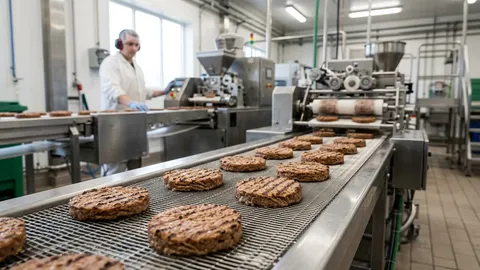
A vegan burger patty production line at Silk Foods Ceylon’s Matale facility, showing the forming line used for plant-based patty manufacturing.
- The global plant-based meat market reached roughly USD 10.2 billion in 2025, growing near 19-20% a year (IMARC Group, 2025).
- For a Sri Lankan FMCG brand, the bottleneck is rarely the recipe. It is sourcing consistent raw material and booking a line that can run a first batch without re-tooling.
- Silk Foods Ceylon (SFC) runs a 15,000-patty-per-day forming line in Matale with an adjoining plantation supplying part of the raw-material mix for R&D and pilot batches.
- See the in-house kitchen vs contract manufacturing comparison below, and the closing section on how SFC can help with a first commercial run.
Sri Lanka’s plant-based category has moved past the early-adopter phase. A local wellness or F&B brand testing a jackfruit-and-legume patty recipe at home now competes for shelf space against imported frozen alternatives. The local market for meat substitutes is projected to keep expanding through 2031 (6Wresearch, 2025). The question most brand owners bring to a contract manufacturer is not whether to launch a patty SKU. It is whether their current recipe, raw-material supply, and production volume can survive the jump from a home kitchen to a retail freezer aisle.
Silk Foods Ceylon (SFC) is a BRCGS- and FSSC 22000 V6-audited contract manufacturer at Silk AgTech Park, Hapugasyaya, Matale. It offers contract manufacturing, private labelling, co-packing, and in-house R&D for local Sri Lankan brand owners. The facility’s burger-patty forming line sits inside a cellular-manufacturing layout, alongside the frying, battering, and breading machinery used for nuggets and other plant-based formats. This piece walks through what “adjoining-plantation raw materials” actually means for a vegan patty formulation, what the contract manufacturing spec looks like, and where the local sourcing argument holds up against the broker layer.
The plant-based patty opportunity for Sri Lankan brand owners
The plant-based meat category is no longer a niche import shelf. The global market reached an estimated USD 10.2 billion in 2025 and is forecast to grow at roughly 19.5% a year through 2035, reaching close to USD 61 billion (IMARC Group, 2025). Locally, the meat-substitute segment is expected to keep expanding through 2031 as flexitarian and health-conscious buying grows (6Wresearch, 2025). For a Sri Lankan brand owner, that growth curve matters less than one operational question: whether the recipe scales past a kitchen batch.
Most patty SKUs that reach a Sri Lankan brand owner’s desk start as a soy, legume, or jackfruit-based recipe tested in small volumes. The formulation usually works at 20 to 50 units. It rarely survives unchanged at 5,000 units, where binding consistency, freeze-thaw stability, and forming-machine compatibility become real constraints rather than theoretical ones. That gap, not the underlying idea, is what a contract manufacturer is actually hired to close.
What does adjoining-plantation sourcing mean for a vegan patty formulation?
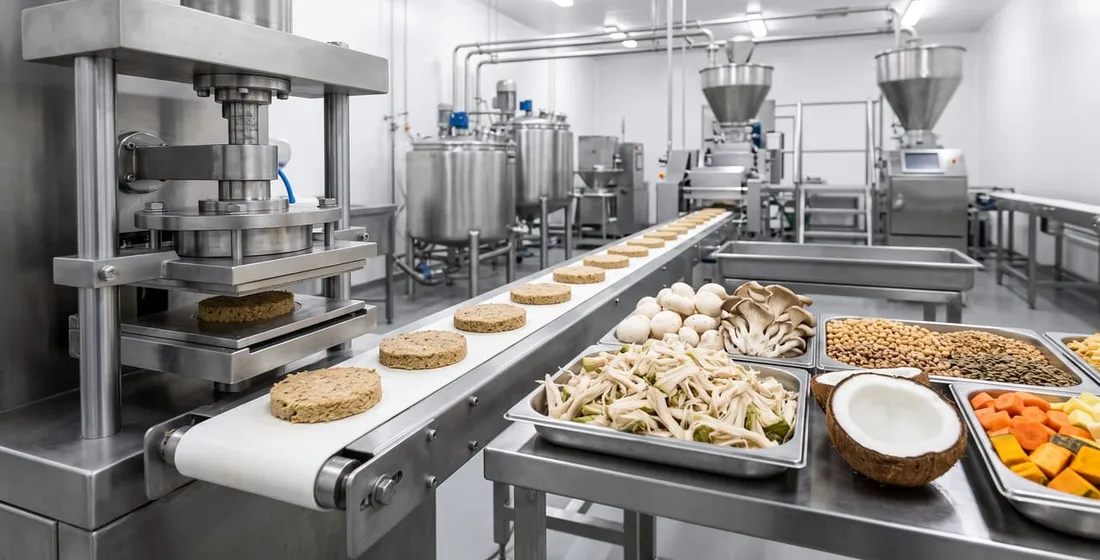
“Adjoining-plantation raw materials” is not a heritage story. It is a sourcing radius that shortens the distance between harvest and forming-line input for jackfruit, mushroom, legumes, coconut derivatives, and seasonal local vegetables. That proximity matters for a patty formulation, where texture depends on consistent moisture content batch to batch. A grower five minutes from the facility can supply a same-week replacement batch if a delivery falls short of spec; an imported soy protein concentrate cannot.
The property adjoining the Matale facility supplies part of the raw material used in R&D pilot batches, including hydroponically grown produce and seasonal vegetables. For a patty formulation built on jackfruit or a legume-and-mushroom blend, that proximity lets the R&D team pull a fresh comparison batch mid-week. There is no waiting on an import shipment or a broker’s delivery schedule. It shortens the iteration loop, not just the supply chain.
This is also where the anti-broker argument for local plant-based sourcing holds up best. Most Sri Lankan brand owners default to a single wholesale supplier or an informal broker for legumes, soy, and seasonal produce. That adds a markup and a quality-consistency risk neither party controls closely. A contract manufacturer sourcing part of its raw material from an adjoining or nearby property removes one link in that chain. It gives the brand owner a name to call when a batch runs short, not a broker’s voicemail.
Contract manufacturing spec: capacity, MOQ, and lead time for a patty SKU
Contract manufacturing in Sri Lanka means the brand owner brings a working recipe and the manufacturer produces it at scale on its own line. The Matale burger-patty forming line runs 15,000 patties per day at full utilisation. The first-run MOQ for a new patty SKU sits at 5,000 to 10,000 units, deliberately below export-scale volumes. That keeps a first commercial batch economical for a brand that has not yet proven retail demand.
Service snapshot: Contract Manufacturing at Silk Foods Ceylon Service: SFC manufactures the buyer's patty recipe at the Matale facility on the burger-patty forming line Capacity: 15,000 patties per day at full utilisation First-run MOQ: 5,000 to 10,000 units per SKU Sample to first PO: 2 to 4 weeks for a locked recipe; 6 to 10 weeks if R&D is needed first Cert coverage: BRCGS- and FSSC 22000 V6-audited, plus SLSI clearance and Sri Lanka Food Act compliance on every retail SKU Local sourcing: part of the raw material for R&D pilot batches drawn from the adjoining plantation and nearby growers |
For a local FMCG brand budgeting a first run, a 5,000 to 10,000-unit patty batch typically prices in the LKR 800,000 to LKR 1.8 million range (roughly USD 2,500 to USD 5,600), depending on formulation complexity and packaging format. Frozen storage and cold-chain dispatch are quoted separately, since reefer capacity and freezer-pack logistics differ from the jar and bottle lines.
Is R&D needed before the first commercial run?
Most patty briefs that reach Silk Foods Ceylon’s R&D team are not blank-page requests. They are a home-kitchen recipe that needs adjustment for a forming machine, a longer freezer shelf life, or batch-to-batch binding consistency at 5,000 units. R&D / NPD (Co-Development on the SFC brochure) exists for exactly that gap, and it typically runs 2 to 4 sample iterations before a recipe locks for contract manufacturing.
The pattern the R&D team sees most often with jackfruit-and-legume patty briefs is a recipe that binds well by hand but falls apart on the forming machine. The moisture ratio that works for a pan-fried home batch does not hold under mechanical pressing. The fix is usually a small adjustment to the binder and a change in how the jackfruit is pre-processed, not a full reformulation. It costs one extra sample round, not a restart.
The comparison below sets out what changes when a brand owner moves a patty recipe from a home kitchen to a professional line.
| Dimension | Home-kitchen production | Contract manufacturing at Matale |
| Daily output | Roughly 50 to 200 units, labour-limited | Up to 15,000 patties per day on the forming line |
| Batch consistency | Varies by cook, by day | Controlled binder ratio and forming-machine calibration |
| Cert coverage | None; not SLSI-eligible for retail | BRCGS, FSSC 22000 V6, SLSI clearance, Sri Lanka Food Act compliance |
| Cold-chain handling | Domestic freezer, no reefer logistics | Reefer storage and freezer-pack dispatch built into the line |
| Raw-material sourcing | Ad hoc, often a single local supplier | Adjoining plantation and nearby growers plus wholesale backup |
| Cost structure | Low fixed cost, high labour cost per unit at scale | Fixed MOQ cost, lower marginal cost per unit past 5,000 units |
The table makes the trade-off concrete: a home kitchen is cheaper at 100 units and structurally incapable of running 5,000. The line exists for the volume a kitchen physically cannot reach, not as an upgrade for its own sake.
What certifications does a vegan patty SKU need for local retail?
A packaged plant-based patty sold on a Sri Lankan retail shelf needs the same certification floor as any other packaged food, plus one extra labelling detail specific to plant-based claims. BRCGS- and FSSC 22000 V6-audited manufacturing, SLSI clearance, and Sri Lanka Food Act 1980 compliance apply in that order, with SLSI and the Food Act sitting at the local floor every retail SKU needs regardless of category.
The Food (Labelling and Advertising) Regulations, effective from January 2024 under the Sri Lanka Food Act, require the common product name to appear in bold across all three languages used on a Sri Lankan label (USDA Foreign Agricultural Service, 2022). Ingredient listing and allergen disclosure follow the same rule. For a vegan or plant-based patty, that means the “vegan” or “plant-based” descriptor sits inside the same labelling framework as any allergen claim, not as an unregulated marketing word. SLSI clearance for a packaged-food SKU typically runs 4 to 8 weeks. Most brand owners plan a 6 to 10 week buffer between manufacturer QA sign-off and a retail shelf date.
The broker layer in local plant-based sourcing
Sri Lanka’s export-facing food sector has already shown one version of a local out-grower model working at scale. One large diversified Sri Lankan conglomerate’s food division has built a farmer network of over 800 growers, more than half of them women, to supply jackfruit for its own plant-based meat exports, according to the company’s own published account. That is a different scale than a first-time local brand needs. But the underlying logic, a direct and traceable link to the grower rather than a wholesale broker, is the same one an adjoining-plantation sourcing model applies at a smaller, brand-launch scale.
For a local FMCG founder pricing out a first patty run, the broker layer is usually invisible until a batch falls short. A wholesale legume or jackfruit broker with no fixed relationship to a specific farm cannot guarantee same-week replacement stock. A formulation that depends on consistent moisture content suffers first when that happens. Sourcing part of the raw material from a facility’s own adjoining plantation, or from growers close enough to visit, removes that single point of failure without adding an extra layer of markup.
Sri Lanka’s food and beverage export sector has flagged plant-based and clean-label demand as one of its clearer growth trends for the back half of the decade (Sri Lanka Export Development Board, 2025). That makes the sourcing-radius argument more relevant for brands with an eye on export later, not less.
Frequently asked questions
Does Silk Foods Ceylon offer contract manufacturing for vegan burger patties?
Yes. The Matale facility runs a dedicated burger-patty forming line at up to 15,000 patties per day, with a first-run MOQ of 5,000 to 10,000 units per SKU. The line sits on the same BRCGS- and FSSC 22000 V6-audited cert stack as SFC’s other plant-based formats.
What is the MOQ for a private-label or contract-manufactured patty SKU?
The first-run MOQ is 5,000 to 10,000 units per SKU, set below export-scale volume so a first commercial batch is economical for a brand that has not yet proven retail demand. Lead time runs 2 to 4 weeks on a locked recipe, or 6 to 10 weeks if R&D adjustment is needed first.
Can Silk Foods Ceylon develop a jackfruit or legume-based patty recipe from scratch?
Yes, through the R&D / NPD service (Co-Development on the SFC brochure). Most briefs need 2 to 4 sample iterations to adjust a home-kitchen recipe for forming-machine compatibility and freezer shelf stability before it locks for a commercial run at the Matale facility.
How long does SLSI clearance take for a plant-based patty SKU?
SLSI clearance for a packaged-food SKU with a stable formulation typically takes 4 to 8 weeks (per SLSI’s standard packaged-food submission framework). Brand owners generally plan a 6 to 10 week buffer between manufacturer QA sign-off and a target retail shelf date.
Where does the raw material for a vegan patty formulation come from?
Part of the raw material for R&D pilot batches, including seasonal vegetables and hydroponically grown produce, comes from the plantation adjoining the Matale facility. Commercial-scale runs combine that supply with vetted local growers and wholesale backup for volumes beyond the adjoining property’s capacity.
How Silk Foods Ceylon can help
For local FMCG brands shifting from in-house production to professional contract manufacturing, Silk Foods Ceylon (SFC) operates a 10,000 sq ft cellular-manufacturing facility in Matale with the line flexibility to run 50-plus ready-to-go SKUs on a single BRCGS- and FSSC 22000 V6-audited cert stack. The burger-patty forming line runs up to 15,000 units a day, with a first-run MOQ of 5,000 to 10,000 units for a new patty SKU. The in-house R&D team works alongside production planning, and part of the raw material for R&D pilot batches comes from the plantation adjoining the facility, which shortens the loop between a formulation adjustment and a fresh sample batch. SLSI submission support sits inside the standard engagement.
To brief a project, email b2b@esilkroute.com.lk or call +94 76 441 0389 / +94 76 918 5744.
Sources
- IMARC Group (2025), “Plant-Based Meat Market Size, Share and Growth Report”, https://www.imarcgroup.com/plant-based-meat-market (retrieved 2026-07-25).
- 6Wresearch (2025), “Sri Lanka Meat Substitutes Market (2025-2031)”, https://www.6wresearch.com/industry-report/sri-lanka-meat-substitutes-market (retrieved 2026-07-25).
- USDA Foreign Agricultural Service (2022), “Sri Lanka Enacts New Legislation for Food Labeling and Advertising”, https://www.fas.usda.gov/data/sri-lanka-sri-lanka-enacts-new-legislation-food-labeling-and-advertising (retrieved 2026-07-25).
- Sri Lanka Export Development Board (2025), “Latest Trends in the Food and Beverage Industry”, https://www.srilankabusiness.com/food-and-beverages/exporter-information/latest-trends.html (retrieved 2026-07-25).
- Sri Lanka Standards Institution (SLSI), packaged-food certification and SLS submission framework, https://www.slsi.lk/ (retrieved 2026-07-25).
- HJS Condiments (Hayleys PLC food division), published account of its jackfruit out-grower farmer network for plant-based meat exports, https://www.hjs-srilanka.com/jackfruit-plant-based-meat-substitutes-with-versatile-flavour/ (retrieved 2026-07-25).
*Written by the Silk Foods Ceylon Team. Silk Foods Ceylon (Pvt) Ltd. is a BRCGS- and FSSC 22000 V6-audited contract manufacturer in Matale, Sri Lanka, offering contract manufacturing, private labelling, co-packing, and in-house R&D for local Sri Lankan brand owners, FMCG companies, hotel and restaurant groups, and distributors. To brief a project: b2b@esilkroute.com.lk, +94 76 441 0389, or +94 76 918 5744.*