Contract Manufacturing Frozen Vegan Sausage and Mince in Sri Lanka
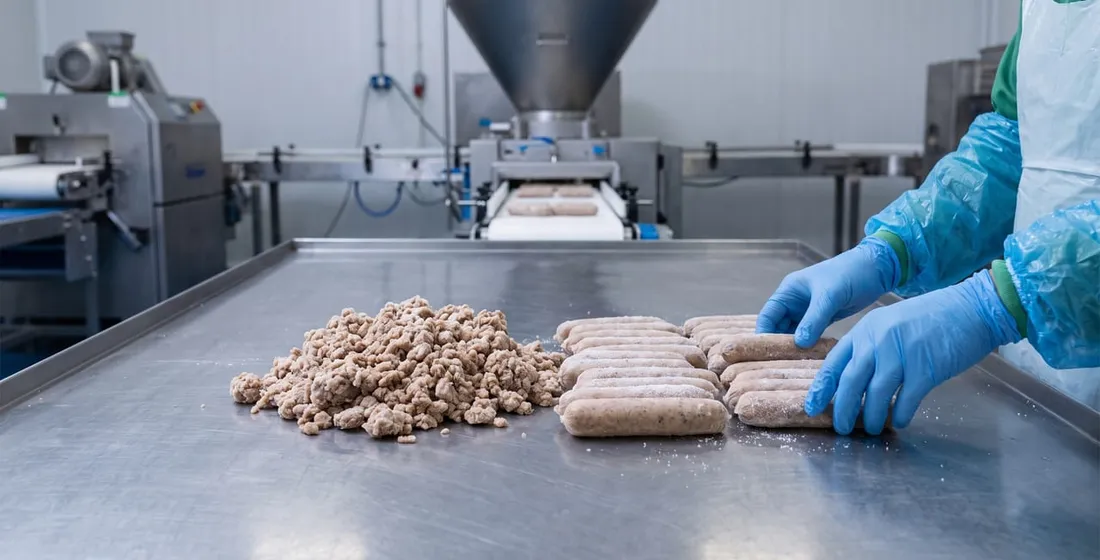
A PPE-gloved worker portions frozen plant-based sausage links beside a pile of pre-minced plant-protein mix on a stainless-steel production table at a contract manufacturing facility, with a sausage-filling machine in the background.
Buyer’s snapshot
- The global frozen plant-based food segment was valued at USD 16.4 billion in 2025 and is projected to reach USD 38.9 billion by 2030 (HTF Market Insights, 2025).
- Frozen format adds a reefer-storage and cold-chain cost line that a fresh or ambient SKU does not carry, which changes the first-run economics for a Sri Lankan brand.
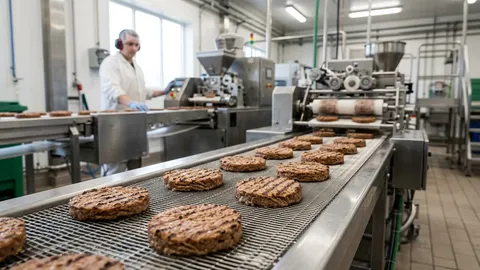
- Silk Foods Ceylon (SFC) runs the burger-patty and nugget forming lines that a sausage link or a pre-minced protein mix shares; first-run MOQ starts at 5,000 units per SKU, on a BRCGS- and FSSC 22000 V6-audited line.
- Compare Contract Manufacturing, Private Labelling, and R&D/NPD for a frozen SKU in the table below before briefing a first run.
Frozen plant-based sausage and a pre-minced protein mix are still uncommon on Sri Lankan retail shelves, even though burger patties and nuggets have filled local freezer space since 2023. The global frozen plant-based segment was valued at USD 16.4 billion in 2025 and is projected to reach USD 38.9 billion by 2030, with frozen already holding the largest revenue share within the wider plant-based meat category (HTF Market Insights, 2025; Towards FnB, 2026). For a Sri Lankan FMCG brand weighing a sausage link against a pre-minced format, the frozen-format economics differ from a fresh or ambient launch mainly because of what cold-chain logistics add to the cost base before a single unit reaches a retail freezer.
Why frozen format changes the sausage and mince economics
The global plant-based frozen food market was valued at USD 16.4 billion in 2025 and is forecast to reach USD 38.9 billion by 2030, a compound annual growth rate near 11.4 percent (HTF Market Insights, 2025). Frozen already holds the largest revenue share of the broader plant-based meat category, ahead of fresh and ambient formats (Towards FnB, 2026).
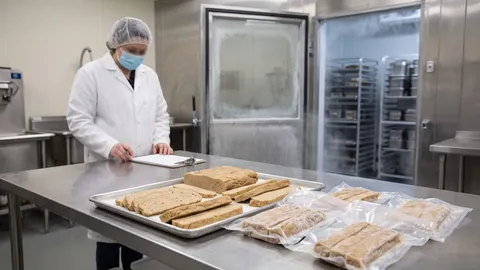
A frozen SKU adds three cost lines that a fresh or ambient product skips: blast-freezing or IQF (individually quick frozen) dwell time on the line, reefer storage between production and dispatch, and cold-chain transport to the retail freezer. Sri Lanka’s established cold-storage operators report facility capacities running to 500 tons and roughly 14,000 pallet positions at the largest sites (Frigo Systems, 2025), which signals real but finite reefer capacity nationally. For a first-run frozen SKU, the practical consequence is that batch size and reefer-slot booking need to be planned together, not one after the other.
Format matters here. A pre-minced protein mix freezes faster and more evenly than a formed sausage link, because there is no casing trapping moisture unevenly around a denser core. A stuffed link needs a longer blast-freeze cycle to bring the centre down to temperature without ice-crystal damage to the texture. That difference in freeze time shows up directly in how many units a single production block can clear before the reefer slot changes over.
Sri Lanka’s food processing sector has been flagged for continued growth as the domestic economy stabilises after 2022 (Daily FT, 2025), and modern-trade grocery revenue has picked up pace over the past two years. Frozen plant-based is a small slice of that growth so far, which is exactly why the cost structure question matters before a brand commits a first batch.
The practical planning question for a Sri Lankan brand owner is rarely whether the recipe works. It is whether the first-run batch size is large enough to make efficient use of a reefer slot without sitting in cold storage longer than the shelf-life economics justify. A batch that is too small pays a disproportionate share of the reefer-storage cost per unit; a batch that is too large ties up storage capacity the facility needs for the next SKU in the production schedule.
What Silk Foods Ceylon’s frozen plant-based line actually produces
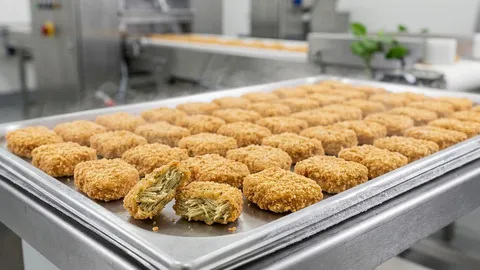
Silk Foods Ceylon runs a 15,000-unit-per-day vegan burger patty line and a 30,000-unit-per-day nugget line at its Matale facility, both on cellular-manufacturing equipment that reconfigures for a sausage-forming or pre-minced batch without a separate line build.
The same forming and battering equipment behind a vegan burger patty production run and a frozen nugget production run at the Matale facility extends to a stuffed sausage link with a casing-filling attachment, or to a loose pre-minced mix using the colloid mill without the forming step at all. Cellular manufacturing means the changeover between a patty run and a sausage run is a line reconfiguration, not a new capital purchase, which keeps the first-run MOQ closer to the buyer’s actual volume need.
For a brand whose base recipe already works as a mince (for a bolognese-style filling, a curry base, or a dumpling filling), the pre-minced format skips the casing and portioning step entirely. For a brand that wants shelf identity as a standalone plant-based sausage, the formed link carries more retail presence but adds a casing-sourcing and portioning decision to the brief.
Service snapshot: Contract Manufacturing at Silk Foods Ceylon Service: SFC manufactures the buyer's frozen sausage or pre-minced recipe at the Matale facility First-run MOQ: 5,000 to 10,000 units per SKU (frozen format, sized to a single reefer-storage block) Sample to first PO: 2 to 4 weeks for an existing recipe; 6 to 10 weeks if R&D/NPD is needed first Cert coverage: BRCGS- and FSSC 22000 V6-audited, plus SLSI clearance and Sri Lanka Food Act 1980 compliance on every retail SKU Line: cellular-manufacturing forming and battering equipment, reconfigurable between patty, nugget, sausage, and pre-minced formats |
Contract manufacturing vs private labelling vs R&D/NPD for a frozen SKU
Three Silk Foods Ceylon services fit a frozen plant-based sausage or mince brief depending on the state of the recipe: Contract Manufacturing for a locked formulation, R&D/NPD for a recipe that still needs freeze-stability work, and Private Labelling for a buyer using an existing SFC frozen SKU under their own brand instead of developing one.
| Service | Fits a frozen sausage or mince SKU when | First-run MOQ | Lead time | Cert anchor |
| Contract Manufacturing | The recipe is locked and freeze-tested | 5,000 to 10,000 units per SKU | 2 to 3 weeks, PO to dispatch | BRCGS, FSSC 22000 V6, SLSI submission support included |
| R&D / NPD (Co-Development) | The recipe needs binder or freeze-stability adjustment first | Sample-based, no unit MOQ | 6 to 10 weeks, including 2 to 4 sample iterations | Same cert stack; QA sign-off gates the handover to Contract Manufacturing |
| Private Labelling | The buyer wants an existing SFC frozen SKU under their own brand | 1,500 to 5,000 units depending on format | 2 to 4 weeks, no formulation step | Same cert stack; label approval is the main scheduling variable |
What does SLSI clearance require for a frozen vegan sausage SKU?
Sri Lanka Food Act No. 26 of 1980 sets the labelling floor for a packaged frozen SKU: storage instructions, a date code and expiry date, a batch or lot number, and the manufacturer’s name and address on the pack (Food Act No. 26 of 1980, via FAOLEX). SLSI clearance certifies compliance with the derived product standard on top of that floor.
For a frozen SKU specifically, the label carries an explicit storage instruction (a “keep frozen” statement with the holding temperature), alongside the same date-code, batch-number, and manufacturer-address requirements that apply to any packaged retail food under the Food Act. SLSI clearance is the certifying step for the standard the product is submitted against; the Food Act is the statutory floor underneath it. Both apply regardless of format, but a frozen SKU has one more line item on the storage instruction than an ambient one.
The Matale facility carries BRCGS and FSSC 22000 V6 audits, with SLSI clearance and Sri Lanka Food Act 1980 compliance built into every retail SKU, and this is where the full SFC certification stack applies regardless of whether the format is fresh, ambient, or frozen. For a brand that has not yet worked through an SLSI submission, budgeting a six-to-ten-week buffer between manufacturer QA sign-off and a target shelf date is the same planning discipline that applies across every SFC-manufactured category.
The R&D team at the Matale facility logs a recurring pattern on frozen plant-based briefs: a recipe that holds its shape and bite at fridge temperature often loses texture after a freeze-thaw cycle, especially in a formed sausage link where the casing traps moisture unevenly around the core. Adjusting the binder ratio and testing it through a blast-freeze cycle before the first retail sample, rather than after a failed one, is usually the difference between a two-iteration R&D cycle and a five-iteration one. The same freeze-stability question comes up on a frozen plant-based seitan brief, which points to the same underlying fix: test for the freeze, not just the flavour.
Is a pre-minced mix or a formed sausage link the better first SKU?
A pre-minced protein mix skips the casing-sourcing and portioning step entirely, which shortens both the R&D cycle and the freeze-dwell time on the production line. A formed sausage link carries stronger standalone retail identity but adds a casing decision and a longer blast-freeze cycle to the brief.
For a brand’s first frozen SKU, the pre-minced mix is usually the lower-friction start: no casing sourcing, a shorter freeze-dwell cycle, and a format that a buyer can position across multiple use cases (a curry base, a filling, a bolognese-style mince) rather than one fixed product form. A formed sausage link reads as a more finished consumer product on a shelf, which matters for a brand building a standalone plant-based sausage identity, but it commits the recipe to one shape and adds the casing-and-portioning variable to the brief.
Brands that have already worked through a jackfruit-based plant meat run at SFC sometimes use the same base protein blend as a starting point for a pre-minced SKU, since the texture and binder work already carries over. For a brand still deciding, the practical move is to brief both formats to R&D/NPD (Co-Development on the SFC brochure) in the same intake conversation, since the freeze-stability testing overlaps regardless of which format ships first. Founders working out what that iteration cycle actually costs in time and sample units can start with the R&D iteration budgeting guide, and brands still comparing a professional line against an in-house kitchen setup should also weigh what the broker layer in Sri Lankan FMCG actually costs once a frozen SKU is in the mix.
Frequently asked questions
Does Silk Foods Ceylon offer contract manufacturing for frozen vegan sausage?
Yes. Silk Foods Ceylon manufactures frozen vegan sausage links and pre-minced plant-protein mix on its cellular-manufacturing line at the Matale facility. First-run MOQ runs 5,000 to 10,000 units per SKU, with a 2 to 3 week lead time from PO to dispatch on an existing, freeze-tested recipe.
What is the MOQ for a pre-minced plant-protein mix at Silk Foods Ceylon?
The first-run MOQ for a pre-minced plant-protein mix sits in the same 5,000 to 10,000 unit band as a formed sausage link, since both run on the same frozen-format production block. The exact figure depends on pack size and whether the SKU ships retail-ready or as a foodservice bulk format.
How long does SLSI clearance take for a frozen private-label SKU?
SLSI clearance for a packaged food SKU with a stable formulation typically takes 4 to 8 weeks. For a frozen SKU, plan a 6 to 10 week buffer between manufacturer QA sign-off and a target shelf date, since the storage-instruction line on the label is reviewed alongside the standard Sri Lanka Food Act 1980 requirements.
What is the difference between contract manufacturing and R&D/NPD for a frozen sausage recipe?
Contract manufacturing applies once a recipe is locked and freeze-tested. R&D/NPD (Co-Development on the SFC brochure) applies when a home-kitchen or fridge-stable recipe has not yet been tested through a blast-freeze cycle, which typically takes 2 to 4 sample iterations over 6 to 10 weeks before the recipe locks for scale production.
Does Silk Foods Ceylon handle reefer storage for a frozen SKU before dispatch?
Yes, reefer storage between production and dispatch is part of a standard frozen-format contract manufacturing engagement at the Matale facility. Batch size for a first run is planned around what a single reefer-storage block can hold, which is why frozen SKUs use a 5,000 to 10,000 unit first-run MOQ rather than a smaller ambient-format MOQ.
How Silk Foods Ceylon can help
For local FMCG brands shifting from in-house production to professional contract manufacturing, Silk Foods Ceylon (SFC) operates a cellular-manufacturing facility in Matale with the line flexibility to move between a vegan burger patty run, a nugget run, and a frozen sausage or pre-minced mix run without a separate capital build. Frozen-format first-run MOQs sit at 5,000 to 10,000 units per SKU, on a BRCGS- and FSSC 22000 V6-audited line with SLSI submission support built into the engagement. The in-house R&D team tests new formulations through a blast-freeze cycle before a recipe locks for scale production, which keeps a multi-SKU frozen launch on a predictable schedule.
To brief a project, email b2b@esilkroute.com.lk or call +94 76 441 0389 / +94 76 918 5744.
Sources
HTF Market Insights (2025), “Plant Based - Frozen Food Market Report”, https://www.htfmarketinsights.com/report/4421690-plant-based-frozen-food-market (retrieved 2026-07-29).
Towards FnB (2026), “Plant-Based Meat Market Size to Hit USD 12.24 Bn in 2026”, https://www.towardsfnb.com/insights/plant-based-meat-market (retrieved 2026-07-29).
Daily FT (2025), “Growth prospects in the food processing industry in Sri Lanka”, https://www.ft.lk/article/390385/Growth-prospects-in-the-food-processing-industry-in-Sri-Lanka (retrieved 2026-07-29).
Sri Lanka Export Development Board (2025), “Ready to Eat Vegan Food from Sri Lanka”, https://www.srilankabusiness.com/food-and-beverages/vegan-food.html (retrieved 2026-07-29).
Food Act No. 26 of 1980 (Sri Lanka), via FAOLEX (1980), “Food Act No. 26 of 1980”, https://www.fao.org/faolex/results/details/en/c/LEX-FAOC014452/ (retrieved 2026-07-29).
Frigo Systems (2025), “Sri Lanka Cold Storage Plant, Industrial Cold Room and Equipment”, https://www.frigosys.com/references/sri-lanka-cold-storege-plant/ (retrieved 2026-07-29).
Silk Foods Ceylon (internal), “Capabilities Flyer and Food & Beverage Contract Manufacturing brochure (capacity, MOQ, and lead-time figures)” (internal data, no external link).
Written by the Silk Foods Ceylon Team. Silk Foods Ceylon (Pvt) Ltd. is a BRCGS- and FSSC 22000 V6-audited contract manufacturer in Matale, Sri Lanka, offering contract manufacturing, private labelling, co-packing, and in-house R&D for local Sri Lankan brand owners, FMCG companies, hotel and restaurant groups, and distributors. To brief a project: b2b@esilkroute.com.lk, +94 76 441 0389, or +94 76 918 5744.