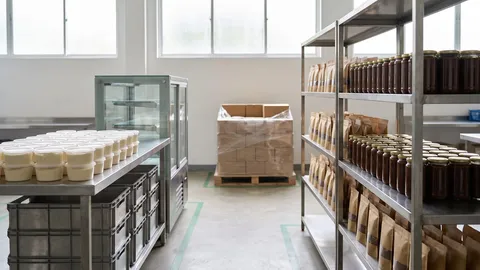
Chilled and frozen SKUs on a Sri Lankan modern-trade shelf

By the Silk Foods Ceylon Editorial Team
Channel snapshot
- Codex CXC 8-1976 puts quick frozen food at minus 18 degrees Celsius or colder at every point in the cold chain, and says a retail display cabinet should never let the warmest package go above minus 12 degrees Celsius. Those two numbers are the listing spec.
- The Food (Labelling and Advertising) Regulations 2026 require instructions for storage and use in at least two of the three languages. For a chilled or frozen SKU that instruction is not optional decoration, it is the handling contract with the retailer.
- Product life, not filling capacity, decides whether a first run pencils. A 15-outlet chilled listing absorbs roughly 350 packs per delivery cycle. Silk Foods Ceylon (SFC) frozen first-run MOQ is 5,000 to 10,000 units.
- The gap between those two numbers is the real gate on a first chilled or frozen listing, and the way through it is distribution width, not a smaller batch. See the cover table below.
A distributor or brand owner taking a chilled or frozen SKU into the supermarket multiples usually arrives with the product and the price settled. The formulation holds. The costing works. What arrives with it is a listing form asking for a case configuration, a storage temperature, a declared product life and a remaining-life percentage at delivery.
Those four fields decide more about the launch than the recipe does. A frozen SKU that cannot state its cabinet class does not get a planogram slot. A chilled SKU with a 21 day life and a national listing ambition is a returns problem waiting to be discovered in week five. The cold categories are the ones where the commercial conversation and the operational conversation cannot be held separately.
The temperature spec is the listing spec
Codex Alimentarius CXC 8-1976, the Recommended International Code of Practice for the Processing and Handling of Quick Frozen Foods, adopted in 1976 and last revised in 2008, sets the number the whole category runs on. Quick frozen food should be maintained at minus 18 degrees Celsius or colder at all points in the cold chain, subject to permitted tolerances, and the code defines a tolerance narrowly: a short term fluctuation that does not affect safety or quality. It is not a licence to run warm.
The retail end of the code is the part most first-time suppliers have never read. Display cabinets should be capable of holding a product temperature of minus 18 degrees Celsius, and a rise above that may be tolerated only for short periods, and in no case should the warmest package be warmer than minus 12 degrees Celsius. The code also asks that cabinets carry a temperature measuring device, sit away from draughts and direct sunlight, never be stocked beyond the load line, and run defrost cycles outside peak shopping hours.
Read as a supplier, that is a specification for the pack as much as for the cabinet. A pack loaded above the load line because the case is the wrong height is a pack outside the refrigerated air pattern. A pack that cannot survive a short excursion to minus 12 degrees Celsius without visible ice crystal growth or freezer burn is a pack that will generate complaints from the retailer even when the cabinet is running correctly.
Formulation choices decide how much excursion a frozen product can absorb before it looks wrong on the shelf. The formulation side of that trade-off is worked through in R&D for a frozen plant-based seitan SKU, which covers ice crystal management and cold-chain planning at the recipe stage rather than the listing stage.
Which pack format survives the freezer cabinet?
Frozen and chilled are not one specification with two temperatures. They fail differently, and the pack has to be chosen against the failure mode rather than against the shelf photograph.
Frozen packs fail on moisture migration and abrasion. Product going in and out of a cabinet, restacked by staff during a defrost cycle, needs a film with a low moisture vapour transmission rate and a seal that survives handling at low temperature. Some films that seal cleanly at ambient go brittle in a freezer. Chilled packs fail on seal integrity and on time. A chilled ready-to-cook SKU with a 21 to 45 day life is running against the calendar from the moment it leaves the plant, and every day held at a distribution centre is a day the retailer will not get back.
| Format | Best fit | What it needs to survive | Where it fails |
| Flow-wrapped tray, frozen | Patties, nuggets, portioned items | Low moisture vapour transmission film, cold-set seal, rigid base for stacking | Seal splits when handled below minus 15 degrees Celsius |
| Printed laminate pouch, frozen | Loose frozen pieces, vegetables, blends | Gusset that stands in a cabinet, thick enough film to resist abrasion | Slumps flat in an island freezer and loses the facing |
| Vacuum pack, chilled | Marinated or cured items | Verified seal integrity, controlled product life, remaining-life discipline | Life runs out inside the distribution cycle |
| Modified atmosphere tray, chilled | Fresh prepared, cut items | Gas flush validation, lidding film consistency, unbroken chilled chain | Any excursion above the declared band voids the life claim |
| Rigid tub, chilled | Spreads, dips, dairy-adjacent items | Tamper-evident closure, fill temperature control | Headspace condensation on temperature swing |
For frozen formed products specifically, the run economics and the first-order arithmetic are set out in contract manufacturing for plant-based patties and the first run and in frozen vegan nugget contract manufacturing in Sri Lanka. This post takes the step after those two: what the retail channel asks for once the product exists.
Case configuration is the first number a category buyer checks
A listing form asks for units per case, case dimensions and cases per pallet layer. Suppliers frequently treat those as three separate answers to be filled in later. The buyer reads them as one number, because together they decide how much cabinet space one case fills and how often the outlet has to be replenished.
The arithmetic that matters is simple. Take facings per outlet, multiply by cabinet depth per facing, and that is the shelf holding. A case that holds more than the shelf holding forces the outlet to keep an opened case in back-of-store, which for a frozen SKU means a second cold storage location and a second opportunity for temperature abuse. A case that holds less than a third of the shelf holding means the outlet is opening three cases per replenishment, which is a labour objection the buyer will raise before a price objection.
For a frozen SKU on two facings at eight packs deep, the shelf holding is 16 packs. A 12-pack case fits that pattern cleanly. A 24-pack case does not, and the difference is invisible in a costing sheet and very visible in a store audit.
The R&D and production planning team at the Matale facility sees the same gap on most first chilled or frozen briefs: the product spec is complete and the channel spec is empty. Roughly two thirds of cold-category inquiries arrive with a locked recipe, a target price and no case configuration, no cabinet class and no declared remaining-life percentage. The recipe work is usually the shorter half of that project. Reverse-engineering a case count after the film has been ordered is what adds four to six weeks.
Where does the cold chain actually break?
Not in the cold store, and rarely in the vehicle. Codex CXC 8-1976 is direct about the weak points: loading and unloading should be as fast as practicable, vehicle compartments should be pre-cooled before loading, and product temperature should be at minus 18 degrees Celsius or colder at the start of transport. The code singles out the moments when product moves between one refrigerated environment and another. Cold store to vehicle. Vehicle to holding store. Holding store to display cabinet.
For a Sri Lankan listing those handovers usually cross a company boundary as well as a temperature boundary. The plant hands to a transporter. The transporter hands to a retailer distribution centre. The distribution centre hands to a store. Each handover is a point where nobody is contractually holding the temperature record unless somebody was made to hold it in the supply agreement.
| Handover point | Target product temperature | Who normally holds it | The common failure |
| Plant cold store to loading bay | Minus 18 degrees Celsius or colder, frozen | Manufacturer | Staged on an unrefrigerated bay while paperwork is completed |
| Loading bay to vehicle | No rise above the declared band | Manufacturer and transporter jointly | Vehicle not pre-cooled before loading begins |
| Vehicle to distribution centre | Minus 18 degrees Celsius or colder, frozen | Transporter | No temperature record handed over at the change of custody |
| Distribution centre to store | Declared band held | Retailer | Consolidation with ambient lines on the same drop |
| Back-of-store to display cabinet | Minus 18 degrees Celsius, warmest package no warmer than minus 12 | Retailer | Cabinet stocked above the load line, or filled during a defrost cycle |
The practical instruction for a supplier is short. Write the temperature record into the supply agreement at every change of custody rather than at dispatch alone. A supplier who can produce a continuous record is a supplier who can win a quality dispute. A supplier who cannot will absorb the credit note.
What a chilled or frozen label has to carry in Sri Lanka
The Food (Labelling and Advertising) Regulations 2026, gazetted as Extraordinary No. 2494/47 of 26 June 2026 under the Food Act, No. 26 of 1980, carry one clause that matters more for cold SKUs than for any ambient product. Instructions for storage and use, where they apply, must appear in a minimum of two of the three languages, with an exception available from the Chief Food Authority on a case by case basis only where the pack surface is small.
For a frozen SKU that clause is the handling contract. The storage instruction states the temperature the product was designed for, whether it may be refrozen after thawing, and what preparation is required. It is the line a retailer will point to in a dispute, and it is the line a consumer complaint will be measured against. It needs to be drafted alongside the product life claim, not copied from a competitor pack.
The date rules apply as they do to any packaged food. The date of expiry has to appear on any panel in two of Sinhala, Tamil and English, declared numerically and printed at not less than 1.5 millimetres, preceded by Expiry, Use before, Use by or Best Before. Bulk material moving business to business is exempt from most labelling requirements but keeps ten mandatory particulars, including the date of manufacture, the date of expiry and the batch number. A distributor buying frozen bulk for repacking inherits that marking rather than resetting it.
One category-specific point is worth checking early. Frozen confections sit inside the SLSI import inspection scheme against SLS 967 under HS code 2105.00, so an importer bringing in a frozen dessert line faces a certification step that a locally manufactured equivalent does not. That difference is frequently the reason a distributor moves from importing to local manufacture in the first place.
The clearance pathway that runs in parallel with all of this is covered in the SLSI step-by-step for a first packaged-food submission, and the print and panel-space consequences of a trilingual compliance block are set out in artwork and print lead time as the private-label gate.
What MOQ does a first chilled or frozen listing actually need?
This is where most first cold-category projects stall, and the reason is arithmetic rather than ambition. A first listing is usually narrow. Fifteen outlets is a normal starting point for a regional trial. Two facings per outlet at eight packs deep is 16 packs on shelf, and one shelf holding in back-up cover makes 32 packs per outlet. That is an initial fill of 480 packs across the listing.
Now apply a rate of sale. Six packs per outlet per week across 15 outlets is 90 packs a week. That number, not the plant, is what decides how large a first run can usefully be, because the run has to clear inside the product life with the retailer’s remaining-life requirement taken off the top.
| Line | Chilled SKU | Frozen SKU |
| Outlets in first listing | 15 | 15 |
| Facings per outlet, cabinet depth per facing | 2 at 8 deep | 2 at 8 deep |
| Shelf holding plus back-up per outlet | 32 packs | 32 packs |
| Initial fill across the listing | 480 packs | 480 packs |
| Rate of sale per outlet per week | 6 packs | 6 packs |
| Weekly offtake across the listing | 90 packs | 90 packs |
| Declared product life from manufacture | 21 to 45 days | 12 to 18 months |
| Typical remaining life required at delivery | About 60 per cent | About 75 per cent |
| Volume that clears inside the usable window | About 350 packs per cycle | About 5,000 packs over 12 to 13 months |
| Silk Foods Ceylon first-run MOQ, formed frozen items | Not applicable | 5,000 to 10,000 units |
The table is built from stated assumptions rather than from a retailer data feed, and the method is given so a buyer can rebuild it against a real listing. Change the outlet count and every line below it moves.
Two conclusions follow, and they are the honest ones. A chilled first run at 15 outlets cannot absorb a 5,000-unit batch and should not try: chilled first listings need either a much narrower run, a wider footprint, or a second channel such as food service or hotel kitchens taking volume in parallel. A frozen first run at 15 outlets clears 5,000 units in roughly 55 weeks, which is inside an 18 month life and outside a 12 month one. Widen the same listing to 45 outlets and the offtake triples to 270 packs a week, which clears 5,000 units in about 19 weeks and turns a marginal project into a straightforward one.
The lever is distribution width. Suppliers keep asking manufacturers to shrink the batch, and for formed frozen items that request runs into a physical floor: the forming line, the freezer tunnel and the changeover cost do not scale down past a point. Adding 30 outlets is usually easier than halving an MOQ, and it produces a better business on the other side.
Where the volume genuinely cannot be found in modern trade alone, the hotel and gift-shop channel often takes the balance. That route is set out in co-packing for supermarket and hotel gift-shop channels. The product-life side of the same question, and how a life claim is actually established rather than assumed, is covered in shelf life and accelerated stability testing in Sri Lanka.
What to lock before submitting the listing form
Buyer's checklist
|
Sri Lanka’s processed food base is expanding fast enough that the cold categories are getting more competitive rather than less. Food and beverage exports reached USD 583.89 million in 2025, up 24.23 per cent, largely on a 40.4 per cent rise in processed food, according to the Sri Lanka Export Development Board in January 2026. The manufacturing capability and the cold storage behind that growth is the same capability the local shelf now draws on, which means a first listing is competing against suppliers who have already learned these numbers.
Frequently asked questions
What temperature must a frozen SKU hold in a Sri Lankan retail cabinet?
Codex CXC 8-1976, revised in 2008, sets minus 18 degrees Celsius or colder at every point in the cold chain. At retail, a display cabinet should hold minus 18 degrees Celsius, and any rise should be short and never leave the warmest package warmer than minus 12 degrees Celsius. Cabinets should also carry a temperature measuring device.
How long does a chilled private-label SKU last, and what does that do to a first run?
Chilled prepared products typically declare 21 to 45 days from manufacture, and retailers commonly ask for about 60 per cent of that life remaining at delivery. On a 15-outlet listing selling six packs per outlet per week, that limits a delivery cycle to roughly 350 packs. Frozen life of 12 to 18 months removes that constraint.
Does Silk Foods Ceylon produce chilled or frozen SKUs under a private label?
Yes. Silk Foods Ceylon runs formed frozen production at the Matale facility at 15,000 patties and 30,000 nuggets per day, with first-run MOQs of 5,000 to 10,000 units on formed items. The facility is BRCGS- and FSSC 22000 V6-audited, with SLSI clearance support inside a standard private-label engagement.
What case configuration should a first frozen listing use?
Match the case to the shelf holding. Two facings at eight packs deep gives a 16-pack shelf holding, which a 12-pack case fills cleanly and a 24-pack case does not. Oversized cases force an opened case into back-of-store, adding a second cold location and a second chance of temperature abuse.
How Silk Foods Ceylon can help
For distributors and brand owners taking a chilled or frozen SKU into the supermarket multiples, Silk Foods Ceylon (SFC) runs private labelling and co-packing from a cellular-manufacturing facility in Matale, with formed frozen capacity at 15,000 patties and 30,000 nuggets per day and first-run MOQs of 5,000 to 10,000 units on formed items. Case configuration, pallet pattern and storage-instruction wording are set during the engagement rather than after the film is ordered, which is where most cold-category schedules lose four to six weeks. The facility is BRCGS- and FSSC 22000 V6-audited, with SLSI clearance and Sri Lanka Food Act labelling support built into a standard engagement. The in-house R&D team adjusts a formulation for freeze-thaw behaviour before a commercial run books a slot.
To brief a chilled or frozen listing plan, email brands@esilkroute.com.lk or call +94 76 441 0389 / +94 76 918 5744.
Sources
Codex Alimentarius Commission, Recommended International Code of Practice for the Processing and Handling of Quick Frozen Foods, CXC 8-1976, adopted 1976 and revised 1978, 1983 and 2008, on the minus 18 degrees Celsius requirement, permitted tolerances, transport and retail display. fao.org (retrieved 24 August 2026).
Food (Labelling and Advertising) Regulations 2026, Gazette Extraordinary No. 2494/47 of 26 June 2026, made under the Food Act, No. 26 of 1980, Ministry of Health, on instructions for storage and use, the date of expiry declaration and the business-to-business exemption list. eohfs.health.gov.lk (retrieved 24 August 2026).
Food Act, No. 26 of 1980, Ministry of Health, Sri Lanka, the enabling statute for the labelling regulations. eohfs.health.gov.lk (retrieved 24 August 2026).
Sri Lanka Standards Institution, Items Covered Under Import Inspection Scheme, on frozen confections against SLS 967 under HS code 2105.00. slsi.lk (retrieved 24 August 2026).
Sri Lanka Standards Institution, SLS Mark Product Certification Scheme, requirements document GL-CP-01, 2025 revision, on the certification route for a locally manufactured packaged food. slsi.lk (retrieved 24 August 2026).
Sri Lanka Export Development Board, Policy and Strategic Planning Division, Sri Lanka Export Performance Exceeded USD 17.2 Billion in 2025, published 26 January 2026, on food and beverage exports of USD 583.89 million and the 40.4 per cent rise in processed food. srilankabusiness.com (retrieved 24 August 2026).