Private-Label Coconut Jam for a Hotel's Signature Gift Line
Buyer’s snapshot
- Sri Lanka logged 1,313,974 tourist arrivals between 1 January and 26 July 2026 (Newsfirst, reporting Sri Lanka Tourism Development Authority data, 2026).
- A signature gift-shop SKU is a production brief before it is a marketing word: a capped batch size, one exclusive flavour, and a jar tier the base range does not use.
- A jar that leaves the property in a guest’s suitcase carries a different shelf-life obligation than an in-room amenity consumed on-site.
- Silk Foods Ceylon (SFC) private-labels a signature-tier coconut jam alongside its base gift-shop range on the same BRCGS- and FSSC 22000 V6-audited line.
Sri Lanka logged 1,313,974 tourist arrivals between 1 January and 26 July 2026, on Sri Lanka Tourism Development Authority reporting carried by Newsfirst, with January and February each running ahead of the prior year. Every one of those arrivals passes a hotel gift shop at least once, and the shop’s best-performing shelf is rarely the widest one. It is the shelf with one product a guest cannot buy anywhere else on the island.
A hotel group that already private-labels a coconut jam for its gift shop, the shelf-stable base SKU covered separately in the note on private-label coconut spread for hotel gift shops, is often looking for something narrower next: a single signature flavour that sits above the base range, sold in smaller numbers, priced higher, and built to be the thing a guest remembers the property by. That is a different production brief from the base SKU, not a bigger version of it.
”Signature” is a production brief, not a marketing word
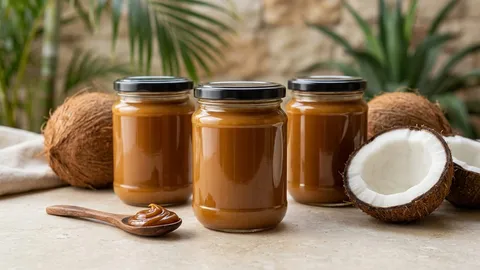
A base gift-shop jam and a signature gift-shop jam can share a recipe and still be two different manufacturing decisions. The base SKU restocks on a normal cadence, in a catalogue jar, at the standard private-label MOQ. A signature SKU is deliberately capped: a fixed batch ceiling that is not reordered mid-season, one flavour the base catalogue does not carry, and a jar and closure tier the base range does not use. The scarcity is the point, and scarcity has to be planned into the production schedule, not announced after the fact on a shelf card.
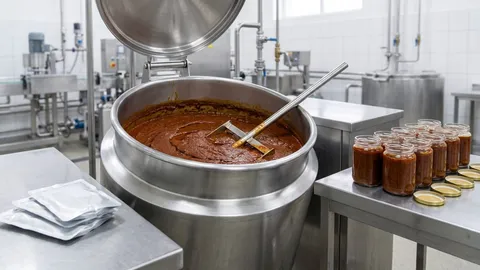
The two SKUs can, and usually should, run through the same facility and the same cert stack. What changes is the run size, the flavour brief, and the packaging spec, not the manufacturer.
A boutique property that already stocks a standard private-label coconut jam is a typical starting point for this brief. The front desk wants one product it can point to as the property’s own, distinct from the jam sitting on every other hotel’s gift shelf a few kilometres down the coast. The answer is rarely a new SKU built from nothing; it is usually a single flavour variant, a smaller batch, and a jar finish that reads as deliberately scarce rather than simply restocked.
Sizing a batch that has to stay small on purpose
SFC’s standard private-label MOQ for a gift-shop jam is 1,500 jars per SKU. A signature run held to a genuinely small batch, in the low hundreds rather than the low thousands, does not clear that threshold as a standalone order. It clears it as an addition to a production block the facility is already running.
| Decision factor | Base gift-shop jam | Signature small-batch jam |
| Standalone MOQ | 1,500 jars (SFC private-label catalogue minimum) | Below standalone MOQ; runs as an addition inside a scheduled block |
| Flavour | From the ready-to-go catalogue | One exclusive flavour, not shared with the base range |
| Restock cadence | Ongoing, against gift-shop sell-through | Fixed batch, not reordered mid-season |
| Per-unit cost | Lower, spread across the full 1,500-jar run | Higher per jar; the changeover and premium components cost the same whether the run is 300 jars or 1,500 |
| Where it wins | Steady gift-shop volume, price-sensitive shelf | A flagship shelf position, a story the front desk can tell |
The practical route to an affordable signature run is scheduling, not volume. Booking the signature batch onto the same production block as the base SKU’s next restock, or alongside another private-label order already on the calendar, spreads the line changeover and sanitation cost across a larger total run even though the signature portion of it stays small. Booked as a standalone order on its own line day, the same 300-jar batch carries the full changeover cost alone, and the per-jar price moves accordingly.
What leaves the building changes the shelf-life brief
An in-room amenity is consumed on-site, usually within days, and the shelf-life brief can be conservative. A gift-shop jar is different: a guest buys it on checkout day and it may sit in a suitcase, a departure lounge, and a connecting flight before it reaches a kitchen shelf on the other side of the world. The product has to be genuinely shelf-stable at ambient temperature for that entire window, not just stable enough to survive a week in a minibar.
Sri Lanka’s Food (Labelling and Advertising) Regulations 2022, which replaced the 2005 framework, require a clear end-of-shelf-life declaration, using the words date of expiry, best before, use by, or use before, on the reporting of the regulations by the United States Department of Agriculture’s Foreign Agricultural Service. For a product designed to travel, the best-before date is not a formality: it is the number a guest, or a customs officer on the way back into their own country, will actually read.
A signature flavour built around an imported accent ingredient, an imported spirit reduction or an imported spice extract, adds one more check. Imported food entering Sri Lanka must carry a minimum of sixty percent of its unexpired shelf life at the point of entry, on the same USDA reporting, which sets a hard ceiling on how much runway that imported component has left by the time it reaches a production run in Matale. Sourcing the accent ingredient locally, where a local equivalent exists, removes that ceiling entirely.
SLSI clearance for a coconut jam SKU follows its own document sequence, set out in the note on SLSI clearance for a private-label coconut jam.
The jar and closure tier that visually signals “signature”
A guest standing in front of a gift shop shelf reads packaging before price. The base SKU and the signature SKU should look like two different tiers from across the room, not two labels on the same jar.
| Element | Base gift-shop jam | Signature gift-shop jam |
| Jar | Standard glass jar, catalogue size | Same glass base or a taller format, held apart visually from the base row |
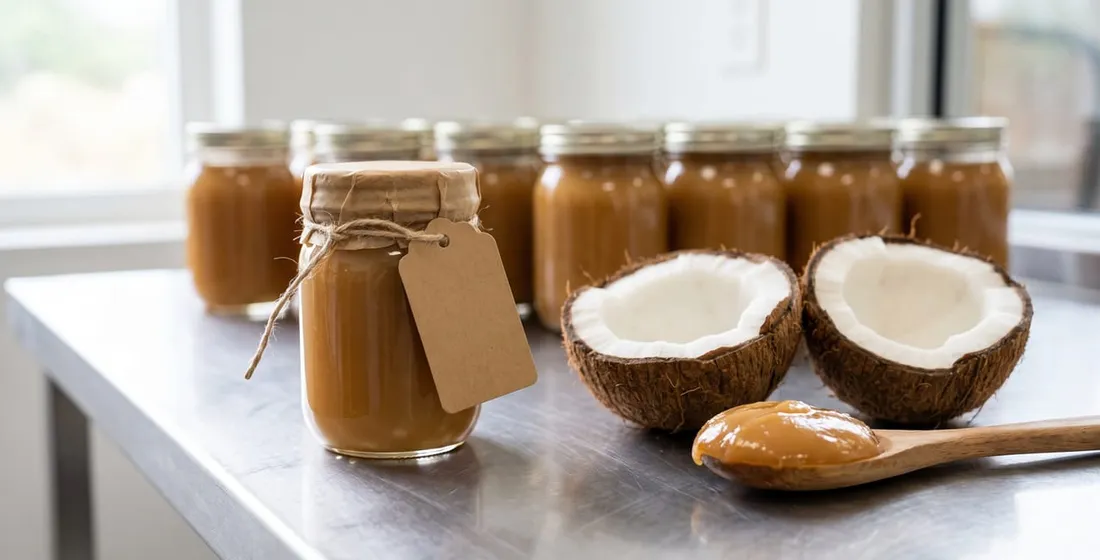
| Closure | Plain metal twist lid | Twist lid finished with a tied wrap or seal band |
| Label / tag | Printed adhesive label, catalogue artwork | Kraft swing tag or wrap band, single flavour name, minimal print run |
| Print run | Runs with the standard restock quantity | Matched exactly to the capped batch size, no leftover stock |
None of that changes the production line. It changes the bill of materials for the batch, and the closure and tag stage of the pack-out has to be scheduled as its own step, because a hand-finished closure runs slower than an automated cap and does not share a changeover with the base SKU’s standard lid.
Keeping a small run inside the existing production block
Consolidation is what makes a capped, low-volume batch commercially sane. A hotel group running a base gift-shop jam, an in-room amenity range, and a signature flavour is really running three related SKUs through one facility. Scheduling the signature batch to land in the same production week as a base-SKU restock, rather than on its own calendar date, is the single biggest lever on the per-jar cost of staying small.
The same consolidation logic applies across a hotel group’s wider gift-shop and minibar range, covered separately in the note on private-label coconut chips for the hotel minibar, and the audit chain a signature SKU inherits from the base facility is set out in the note on contract manufacturing certifications in Sri Lanka. Where the signature jar is also sold beyond the property, through a wider gift-retail channel, the format and consolidation questions are covered in the note on co-packing for the hotel and gift-shop channel.
Frequently asked questions
What is the difference between a base gift-shop coconut jam and a signature-tier jam?
The base SKU runs from the private-label catalogue at the standard 1,500-jar MOQ, restocked on an ongoing cadence. A signature SKU is a capped, low-volume batch built around one exclusive flavour and a distinct jar and closure tier, scheduled inside an existing production block rather than as a standalone order.
What is the minimum batch size for a hotel’s signature gift SKU at Silk Foods Ceylon?
A signature batch held to a genuinely small run does not clear the standalone 1,500-jar private-label MOQ on its own. It becomes commercially viable when scheduled as an addition to an existing production block, such as a base-SKU restock, which spreads the line changeover cost across the combined run.
Does a gift-shop jar that guests take home need a different shelf-life declaration than an in-room amenity?
Yes. Sri Lanka’s Food (Labelling and Advertising) Regulations 2022 require a clear best-before or expiry date on every packaged food item. A gift jar has to remain genuinely shelf-stable through weeks of travel at ambient temperature, a longer and less controlled window than an in-room amenity consumed on-site.
Can Silk Foods Ceylon develop an exclusive flavour for a hotel’s signature line?
Yes. SFC’s in-house R&D team develops single-flavour variants ahead of a locked production spec, the same process used for the wider flavour range covered in the note on coconut jam R&D. An exclusive signature flavour is scoped and costed separately from the base catalogue formulation.
How Silk Foods Ceylon can help
For hotel and restaurant groups running in-room amenity, gift-shop, or minibar SKU programmes, Silk Foods Ceylon (SFC) offers a private-label catalogue of 50+ ready-to-go products across spice blends, coconut SKUs, herbal teas, capsules, jams, and vegan formats, plus in-house R&D for a genuinely exclusive signature flavour. Custom branding is applied to existing SFC formulations; first-run MOQs sit at 1,500 jars or 1,250 bottles per SKU, and a capped signature batch is scheduled inside an existing production block to keep the per-jar cost workable below that threshold. The Matale facility is BRCGS- and FSSC 22000 V6-audited, with SLSI clearance on every retail SKU.
To brief an in-room, gift-shop, or signature-tier programme, email brands@esilkroute.com.lk or call +94 76 441 0389 / +94 76 918 5744.
Sources
Newsfirst, “Tourism Surge Continues As Sri Lanka Welcomes 1.3 Million Visitors in 2026 So Far”, reporting Sri Lanka Tourism Development Authority data (2026). https://english.newsfirst.lk/2026/07/29/tourism-surge-continues-as-sri-lanka-welcomes-1-3-million-visitors-in-2026-so-far
United States Department of Agriculture, Foreign Agricultural Service, GAIN report on Sri Lanka’s Food (Labelling and Advertising) Regulations 2022 (2023). https://apps.fas.usda.gov/newgainapi/api/Report/DownloadReportByFileName?fileName=Sri+Lanka+Enacts+New+Legislation+for+Food+Labeling+and+Advertising_Colombo_Sri+Lanka_CE2023-0011.pdf
Ministry of Health, Food Control Administration Unit, food labelling and import guidance (accessed 2026). https://eohfs.health.gov.lk/food/index.php?option=com_content&view=article&id=2&Itemid=136&lang=en
Food Act No. 26 of 1980 (Sri Lanka), consolidated text. https://www.srilankalaw.lk/YearWisePdf/1980/FOOD%20ACT,%20NO.%2026%20OF%201980.pdf
Sri Lanka Standards Institution, standards and certification schemes (accessed 2026). https://slsi.lk/
The Economic Times LK, “Cumulative export earnings record strong growth in 1H-2026”, citing Daily News on coconut-based product export earnings (2026). https://economictimes.lk/index.php/2026/07/24/cumulative-export-earnings-record-strong-growth-in-1h-2026/
All sources retrieved 10 August 2026.
Written by the Silk Foods Ceylon Team. Silk Foods Ceylon (Pvt) Ltd. is a BRCGS- and FSSC 22000 V6-audited contract manufacturer in Matale, Sri Lanka, offering contract manufacturing, private labelling, co-packing, and in-house R&D for local Sri Lankan brand owners, FMCG companies, hotel and restaurant groups, and distributors. To brief a project: brands@esilkroute.com.lk, +94 76 441 0389, or +94 76 918 5744.