Existing Recipe to First PO: Sample, Costing and Sign-Off
By the Silk Foods Ceylon Editorial Team
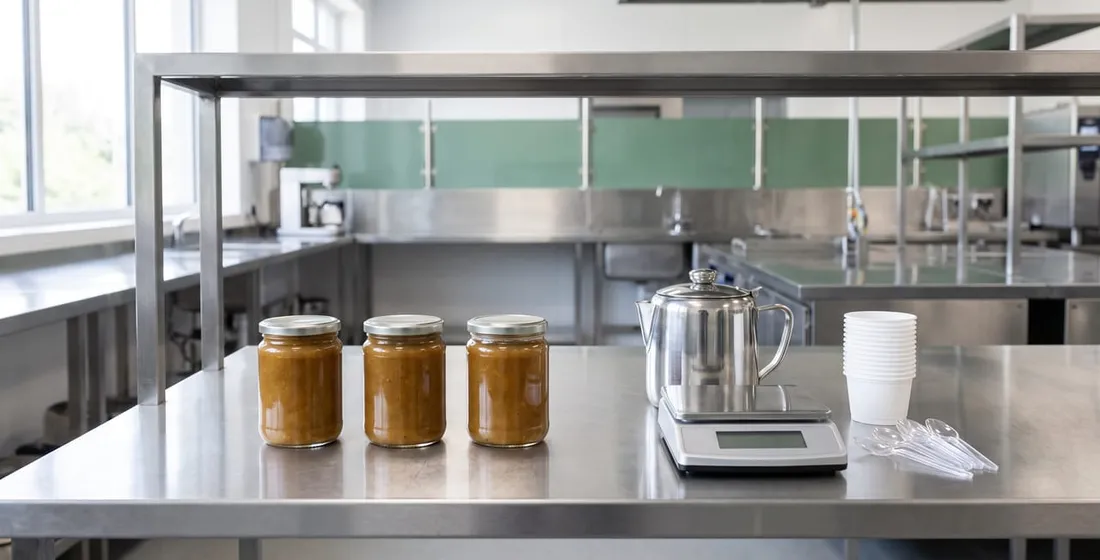
A stainless steel pass table in a clean pilot kitchen, with three plain glass jars of golden-brown fruit chutney, a small mixing kettle, a digital scale and a stack of white sample cups.
Buyer’s snapshot
- A brand that already sells a recipe does not need a new formulation. It needs that recipe moved onto a contract line, which takes three decisions: sample approval, a costed quote and a signed specification.
- From a transfer-ready recipe, Silk Foods Ceylon (SFC) typically runs these steps in 2 to 4 weeks, quoted per project. If the recipe must be reworked first, the R&D clock is 3 to 4 weeks at most.
- Scaled batches can differ in taste, texture, aroma or appearance from the small batch, and an identical match may not be possible (Oklahoma State University, 2015).
- The table below sets out what each step needs from the brand and what usually delays it.
Most Sri Lankan brands that contact a contract manufacturer already have a product. It sells at a market stall, through a shop or online, made in a rented kitchen by a team that knows the recipe by feel. The question is not what to make but how to make the same thing, in volume, to a standard a retail buyer will accept.
This guide is for the owner of that kind of product. It follows the path from handing over a recipe to issuing the first purchase order (PO), and it names the points where the path stalls. It does not cover building a recipe from a blank page, which is a different brief, set out in how to brief an R&D team on a new food product.
What does a recipe need before it can be transferred?
A recipe needs to be written as a formula: ingredients by weight, a stated order of addition, times, temperatures and a description of the finished product. University extension guidance on scale-up says a home recipe is not suitable for commercial processing as written and should be converted to weights, since weighing is more repeatable than measuring by volume (University of Maryland Extension, 2020).
A transfer pack should hold five things:
- The formula in grams or kilograms, with the supplier and grade of each ingredient.
- The method as actually practised, including the steps the cook does by eye or taste.
- A retained reference sample, ideally from the most recent batch the brand is happy with.
- The current label and the claims it makes, such as “no preservatives” or “traditional recipe”.
- The target pack: jar or bottle size, closure and any shelf-life the brand already promises.
The method line is the one most often thin. A cook who stirs “until it looks right” has a control point nobody has written down, and the sample round has to find it. The related case of changing a recipe once a product is on the shelf is in clean-label reformulation of an existing SKU.
How do sample rounds work on a transfer?
The manufacturer makes a sample on its own equipment from the transfer pack, and the brand compares it with its reference. Expect more than one round. Batches made at larger volume behave differently from kitchen batches because heating, cooling and mixing change with size, and the aim is a close match, not a perfect copy (Oklahoma State University, 2015).
SFC’s in-house R&D team typically needs two to four sample iterations before a recipe locks for contract manufacturing. Each round answers a narrow question: is the taste close, is the texture close, does the colour hold, and does the product stay stable in its pack. Changing one thing per round keeps the cause of any difference visible.
Agree the approval test before the first sample arrives. A brand that says “it should taste like ours” will reject a good sample on a bad day. A brand that has written down four attributes and a side-by-side tasting with the reference can approve in one sitting.
Where does the cost in a quote come from?
A costed quote starts from the locked formula. It prices ingredients at the yield the line actually achieves, then adds packaging, labour and the line’s running cost. Producers often discover their true cost per unit only when they ask for help, and scale-up often swaps a home-style ingredient for a cheaper commercial equivalent (Oklahoma State University, 2015).
That swap is a decision for the brand, not a quiet substitution. A store-bought thickener replaced by a starch can change mouthfeel and the ingredient list in one move. A good sample round puts each proposed swap on the table, with its cost effect, so the brand chooses with both facts in view.
| Step | What the brand supplies | What the manufacturer supplies | What usually delays it |
|---|---|---|---|
| Transfer pack | Formula by weight, method, reference sample, label | Gap list: missing weights, unclear steps | Recipe held in volume measures or in the cook’s head |
| Sample rounds | A written approval test; a decision-maker who can taste | Samples on production equipment, with notes on each change | Approval by several people who disagree |
| Costing | Target price band and pack format | Costed quote from the locked formula | Pack or ingredient swaps still open |
| Specification sign-off | Final label text and artwork | Written product specification | Label changes after the sample is approved |
| First PO | Purchase order against the signed specification | Production slot and delivery date | PO raised before sign-off, then revised |
The quoting approach for a first order, and the levers that move the price, are covered in four levers that lower a co-manufacturing quote.
What does sign-off lock in?
Sign-off turns an approved sample into a written specification: formula, method, pack, label and the checks the product must pass. After it, any change to an ingredient, a supplier or the label text is a change request, not a tweak. That protects the brand, because the second batch must match the first, and it protects the manufacturer from chasing a moving target.
The label is part of the lock. Sri Lanka’s Food (Labelling and Advertising) Regulations 2026 came into operation on 1 July 2026 under section 32 of the Food Act No. 26 of 1980, and they do not apply to food manufactured before that date (Government of Sri Lanka, Gazette 2494/47, 2026; ChemLinked, 2026). A recipe moved to a new producer is food made after that date, so the label text should be checked against the current rules before artwork is approved, not after cartons arrive.
A brand that wants the SLS mark should raise it early. SLSI operates the SLS mark product certification scheme, which needs a published Sri Lanka Standard for the product and involves desktop evaluation and sampling before a permit is issued (SLSI, 2026). The scheme is generally voluntary, though the mark can be made mandatory for some categories. Quality records that support any of this are listed in the SLSI quality records a food maker keeps before launch, and premises questions are in Food Act premises registration for a brand owner.
Checklist: before asking for samples
- Convert the recipe to weights and write the method as it is really done.
- Keep a reference sample from a batch you would sell again.
- Write the approval test: the attributes, and who decides.
- Decide which ingredient swaps you would accept and which you would not.
- Fix the pack format and the shelf-life you want to claim.
- Check the label text against the 2026 labelling regulations.
What slows the path from sample to first PO?
Three things cause most of the delay, and none of them is on the production line. The first is approval that waits on a person who is not available. The second is a change to the pack, the recipe or the label after the sample was approved, which sends the work back a step. The third is a PO raised ahead of sign-off, then revised when the specification moves.
The calendar impact is easy to see in the wider plan. A new product with a new recipe is mapped week by week in the 12-week timeline for a new food product, and the R&D portion is explained in how the R&D clock works. A transfer of an existing recipe skips most of the formulation work, which is why it typically takes less time. A kitchen product moving to retort or larger batches has extra checks, set out in reformulating a kitchen recipe for retort.
Once the first PO is in, the next risk moves to the buyer’s side. Sample order to full pallet PO covers the mistakes distributors make at that point.
Frequently asked questions
Can I move an existing recipe to a contract manufacturer without reformulating it?
Usually yes, with adjustments. The recipe is converted to weights and run on production equipment, and small changes are common because larger batches heat, cool and mix differently. Scaled batches can differ in taste or texture from the original (Oklahoma State University, 2015).
How many sample rounds does a recipe transfer need?
Plan for two to four. Silk Foods Ceylon’s R&D team typically runs that many iterations before a recipe locks for contract manufacturing. A written approval test and one decision-maker reduce the count, because each round can answer a single question.
What do I need to give a manufacturer before samples start?
A formula in weights, the method as practised, a reference sample, the current label and the target pack. Extension guidance says a home recipe must be converted to weights for commercial processing (University of Maryland Extension, 2020).
Does the 2026 labelling regulation apply to my product?
The Food (Labelling and Advertising) Regulations 2026 took effect on 1 July 2026 and do not apply to food manufactured before that date (Government of Sri Lanka, Gazette 2494/47, 2026). A product made after it on a new line should be checked against the current text.
Can Silk Foods Ceylon take over production of a recipe I already sell?
Yes. Silk Foods Ceylon offers Contract Manufacturing at its Matale facility, with in-house R&D to run the sample rounds. From a transfer-ready recipe, the sample, costing and sign-off steps typically take 2 to 4 weeks, quoted per project. Small runs are welcome, quote on request.
How Silk Foods Ceylon can help
For local brands shifting a working recipe from a kitchen to professional contract manufacturing, Silk Foods Ceylon (SFC) runs sample rounds, costing and specification sign-off at its Matale facility. In-house R&D works alongside production planning, so a multi-SKU move can run in parallel rather than one product at a time. From a transfer-ready recipe the path to a first PO typically runs 2 to 4 weeks, and small runs are welcome, quoted on request. The facility is BRCGS- and FSSC 22000 V6-audited, with SLSI submission support inside the standard engagement.
To brief a project, email b2b@esilkroute.com.lk or call +94 77 157 7294.
Sources
- University of Maryland Extension (2020), “Product Development, Part 2: Scaling”, on converting recipes to weights and scale-up. extension.umd.edu (retrieved 1 November 2026).
- Oklahoma State University (2015), “Scratch market”, on scaled batches differing from small batches and on cost and ingredient swaps. news.okstate.edu (retrieved 1 November 2026).
- Government of Sri Lanka (2026), Extraordinary Gazette No. 2494/47, Food (Labelling and Advertising) Regulations 2026. documents.gov.lk (retrieved 1 November 2026).
- ChemLinked (2026), “Sri Lanka enforces new food labelling rules”. food.chemlinked.com (retrieved 1 November 2026).
- Sri Lanka Standards Institution (2026), “SLS Mark Product Certification”. slsi.lk (retrieved 1 November 2026).
Written by the Silk Foods Ceylon Team. Silk Foods Ceylon (Pvt) Ltd. is a BRCGS- and FSSC 22000 V6-audited contract manufacturer in Matale, Sri Lanka, offering contract manufacturing, private labelling, co-packing, and in-house R&D for local Sri Lankan brand owners, FMCG companies, hotel and restaurant groups, and distributors. To brief a project: b2b@esilkroute.com.lk or +94 77 157 7294.