Signed Brief to Approved Formulation: How the R&D Clock Works
By the Silk Foods Ceylon Editorial Team
Buyer’s snapshot
- Tuesday 24 November 2026 is Il Full Moon Poya Day, a public holiday (Government of Sri Lanka, 2026 holiday calendar). A four-week R&D window signed on 2 November holds 19 working days, not 20.
- Silk Foods Ceylon (SFC) caps R&D at 3 to 4 weeks from signed brief to approved formulation, typically in 2 to 4 sample iterations.
- If every sample verdict takes the full 3 working days, up to 12 of those 19 days sit with the buyer.
- For brand owners about to sign a first brief. Not for anyone who cannot name who approves samples.
A brand owner signs a brief on Monday 2 November 2026 and reads that R&D takes 3 to 4 weeks. Counting forward, they expect an approved formulation by Friday 27 November. Counting honestly, that window holds 19 working days, because 24 November is a public holiday (Government of Sri Lanka, 2026). And a large share of those 19 days is spent waiting on the buyer’s verdicts, not on the bench.
The promise is real. What it needs from the buyer is rarely written down. This post sets out when the clock starts, how the days are spent, and what “approved” has to mean for the clock to stop.
When does the 3 to 4 week clock start?
The clock starts on a signed brief, and for planning purposes a signed brief means three things are in hand: every target field is answered, one named person has authority to approve samples, and a contact is available to give verdicts within 3 working days. A brief with open fields is a conversation, not a start date.
The target fields are covered in how to brief an R&D team for a new food product: buyer and price, taste reference, texture, shelf life, pack, cost ceiling, claims and volume. This post assumes those are done. The two additions here are about people, not product: who signs, and who answers.
Ask the R&D team to confirm the start date in writing when the brief is signed. A shared date removes the most common disagreement at week four, which is not about the recipe but about when week one began.
How many working days is the window?
Four weeks from a Monday signing is 20 working days before holidays. Saturdays and Sundays are bank holidays, and Poya days are public holidays (Government of Sri Lanka, 2026 holiday calendar), so any window that crosses a Poya loses a day. The table counts one such window.
| Week | Dates (brief signed Mon 2 Nov 2026) | Working days | Typical activity |
|---|---|---|---|
| 1 | 2 to 6 Nov | 5 | First sample iteration; buyer verdict due within 3 working days |
| 2 | 9 to 13 Nov | 5 | Second iteration from the verdict |
| 3 | 16 to 20 Nov | 5 | Third iteration if needed; a 3-week window ends here |
| 4 | 23 to 27 Nov | 4 | Final adjustment and formulation approval; 24 Nov is a public holiday |
| Total | 19 |
The activity column follows the calendar in the 12-week timeline for a new food product, where formulation approval lands by the end of week 4. Deepavali on Sunday 8 November falls on a weekend and costs nothing. A window that starts in a different month will meet different holidays, so count yours from the official calendar.
Where do the 19 days go?
Each sample iteration has a bench stage run by the R&D team and a verdict stage run by the buyer. SFC asks for verdicts within 3 working days of each sample. That is a request, and the arithmetic shows why it matters: if every verdict takes the full three days, the buyer holds 6 of 19 working days across two iterations, 9 across three and 12 across four.
| Iterations in the window | Buyer verdict days at 3 days each | Share of 19 working days | Days left for bench work |
|---|---|---|---|
| 2 | 6 | 32% | 13 |
| 3 | 9 | 47% | 10 |
| 4 | 12 | 63% | 7 |
This is planning arithmetic, not an SFC schedule, since the R&D team can start the next variant while a verdict is pending. It still shows the shape. Four iterations only fit when verdicts are quick. A buyer who answers in one working day gets back eight days across four rounds.
Service snapshot: R&D / NPD (Co-Development on the SFC brochure) at Silk Foods Ceylon
Service: in-house formulation from a signed brief at the Matale facility
Window: 3 to 4 weeks maximum, signed brief to approved formulation
Iterations: typically 2 to 4 samples, with a verdict requested within 3 working days of each
After approval: 2 to 3 weeks from purchase order to dispatch on a locked recipe, from first-run minimums of 1,500 jars (300 g glass spread), 1,250 bottles (200 ml beverage) or 180 bottles (capsules)
Audit coverage: BRCGS- and FSSC 22000 V6-audited, with SLSI submission support inside the engagement
What counts as an approved formulation?
An approved formulation is a sample the buyer has signed off against the targets written in the brief, with the pass marks agreed before the first sample arrived. Without written pass marks, “approved” becomes a mood, and the clock cannot stop on a mood.
Sensory practice treats it the same way. Structured assessment relies on agreed vocabulary, scoring scales, reference standards and acceptance criteria that can be recorded and challenged (SG Systems Global, 2026). Difference tests ask whether two samples are perceptibly different, and hedonic tests ask whether people like a sample (Food Research Lab, 2026), so the brief should say which question each round answers.
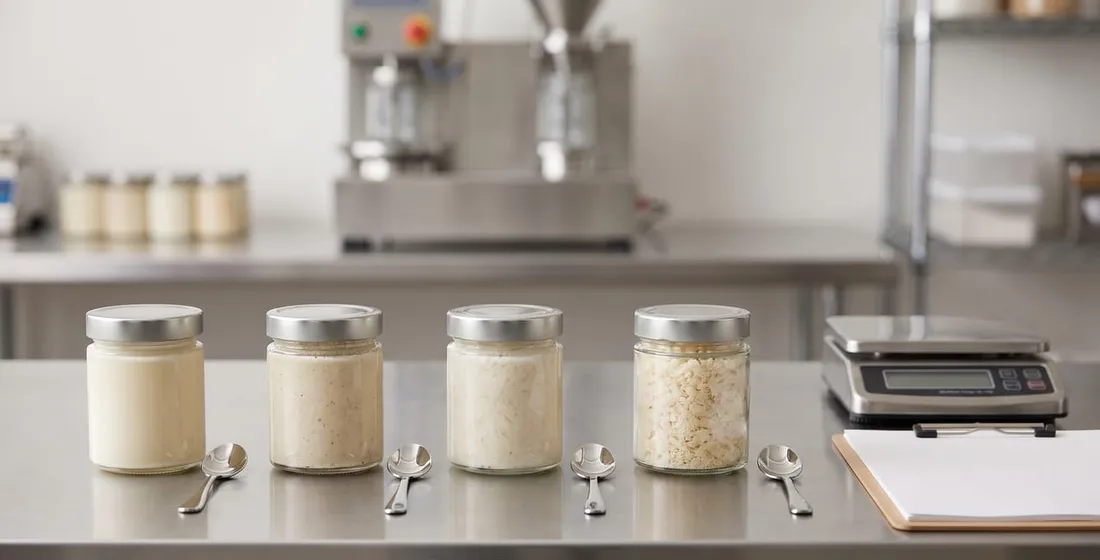
For a coconut spread, pass marks might read: sweetness no higher than the named reference, spreads straight from the fridge, no separation at day 10, cost per jar under the ceiling. Those four lines are illustrative. What matters is that each can be checked with a spoon, a fridge and a calculator. Why one R&D trial almost never locks a recipe explains why a locked recipe still needs the iterations to find the failure points.
One brief, two verdicts: a worked example
Take a composite case, not a named client: a 300 g coconut spread, brief signed on a Monday, first sample delivered on Thursday of week 1.
In the first version, the verdict comes back the following Tuesday: “not quite right”. Three working days gone, no attribute named. The R&D team has to guess between sweetness, texture and colour, so the second sample changes all three. It misses on two of them. By the end of week 2, the project has used a round and a half and learned almost nothing.
In the second version, the verdict arrives on Monday, one working day after the sample, and reads: “sweetness one notch lower, spreadable from 4 degrees C, colour fine”. The second sample changes two variables, both named. It lands.
The difference is about a week. That matches the point in the 8 October brief guide: each vague field tends to cost a sample round. A specific verdict is the same discipline applied after the sample instead of before it.
What pushes a formulation past the window?
Four things move the date more than the recipe does: a brief changed after sample one, slow or vague verdicts, no single approver, and a claim that needs separate approval.
- A changed brief: switching pack size, adding a claim or moving the cost ceiling after the first sample resets the targets the R&D team is testing against. Treat it as a new brief and agree the new start date.
- Slow or vague verdicts: the arithmetic above covers the first, the worked example the second.
- No single approver: two people giving different verdicts on the same sample produce a third iteration nobody planned.
- A claim that needs approval: under the Food (Labelling and Advertising) Regulations 2026, in operation from 1 July 2026, label content is regulated (Ministry of Health, 2026). Any health or nutrient-function claim runs as a separate track and is best left out of a first brief.
Where SFC walks away. The 3 to 4 week window suits a brand owner who has validated the concept and can name an approver. For a founder still choosing between three flavours, or a team where nobody owns the final yes, the better first step is a week of internal decisions before any brief is signed.
Frequently asked questions
How long does Silk Foods Ceylon R&D take from signed brief to approved formulation?
Three to four weeks at most, typically in 2 to 4 sample iterations. In a window signed on 2 November 2026 that is 15 to 19 working days, since 24 November is a public holiday (Government of Sri Lanka, 2026). Verdicts within 3 working days of each sample keep the work inside the window.
When does the R&D clock start?
For planning, it starts when the brief is signed with every target field answered, a named approver and a verdict contact. Ask the R&D team to confirm the start date in writing. A brief with open fields means the start date is still open, and so is the end date.
Do public holidays count inside the window?
Plan on working days. Saturdays and Sundays are bank holidays, and Poya days are public holidays (Government of Sri Lanka, 2026 holiday calendar). A four-week window crossing Il Full Moon Poya on 24 November 2026 holds 19 working days. Count yours against the official calendar when you sign.
Can Silk Foods Ceylon develop a new recipe for a local brand?
Yes. The in-house R&D team at the Matale facility formulates from a signed brief in 3 to 4 weeks at most, typically in 2 to 4 sample iterations. The same BRCGS- and FSSC 22000 V6-audited site then runs the first commercial batch, with 2 to 3 weeks from purchase order to dispatch.
How Silk Foods Ceylon can help
For a brand owner without a finished recipe, Silk Foods Ceylon runs R&D / NPD and Contract Manufacturing on one site at Silk AgTech Park in Hapugasyaya, Matale. R&D takes a signed brief to an approved formulation in 3 to 4 weeks at most, and the first commercial run follows 2 to 3 weeks after the purchase order, from 1,500 jars on a 300 g spread. The facility is BRCGS- and FSSC 22000 V6-audited, with SLSI submission support inside the engagement. To book a start date, send a signed brief to b2b@esilkroute.com.lk or call +94 76 441 0389.
Sources
Government of Sri Lanka, official 2026 holiday calendar, approved under the Holidays Act, listing Deepavali (8 November), Il Full Moon Poya (24 November), Unduwap Full Moon Poya (23 December) and Christmas Day (25 December). documents.gov.lk. Retrieved 21 October 2026.
Government of Sri Lanka, Food (Labelling and Advertising) Regulations 2026, Gazette Extraordinary No. 2494/47 of 26 June 2026, made under the Food Act No. 26 of 1980, in operation from 1 July 2026. eohfs.health.gov.lk. Retrieved 21 October 2026.
SG Systems Global, “Finished Product Sensory Evaluation” (glossary), 2026, on agreed vocabulary, scoring scales, reference standards and acceptance criteria. sgsystemsglobal.com. Retrieved 21 October 2026.
Food Research Lab, “Sensory Evaluation Methods for Food and Beverage Products,” 2026, on difference tests and hedonic tests. foodresearchlab.com. Retrieved 21 October 2026.
Silk Foods Ceylon, internal capability data for the Matale facility: R&D 3 to 4 weeks maximum from signed brief to approved formulation; typically 2 to 4 sample iterations; a buyer verdict requested within 3 working days of each sample; first-run minimums of 1,500 jars (300 g glass spread), 1,250 bottles (200 ml beverage) and 180 bottles (capsules); 2 to 3 weeks from purchase order to dispatch on a locked recipe. The working-day shares, the coconut spread pass marks and the worked example are illustrative planning examples, not SFC schedule or recipe data.
Written by the Silk Foods Ceylon Team. Silk Foods Ceylon (Pvt) Ltd. is a BRCGS- and FSSC 22000 V6-audited contract manufacturer in Matale, Sri Lanka, offering contract manufacturing, private labelling, co-packing, and in-house R&D for local Sri Lankan brand owners, FMCG companies, hotel and restaurant groups, and distributors. To brief a project: b2b@esilkroute.com.lk, +94 76 441 0389, or +94 76 918 5744.