White vs Black Capsule Bottles: The Label Cost Trade-Off
Buyer’s snapshot
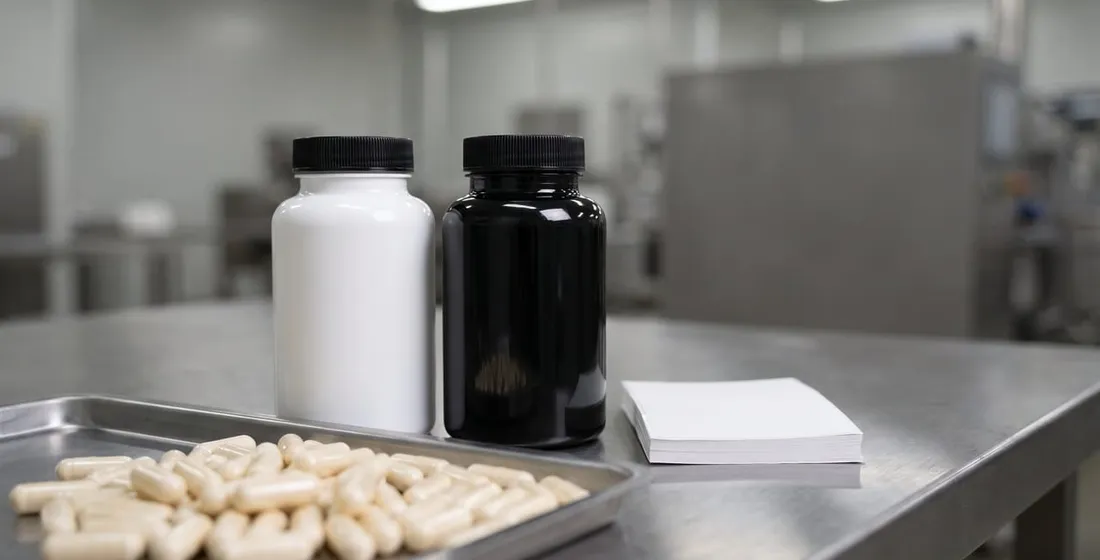
- USP chapter 671 sets one bar for a plastic container holding an oral dosage form: spectral transmission must not exceed 10% at any wavelength between 290 and 450 nanometres. An opaque white HDPE bottle and an opaque black HDPE bottle both clear it at normal wall thickness.
- ICH Q1B, Step 4 dated 6 November 1996, is the test that tells you whether the barrier is needed at all: not less than 1.2 million lux hours of visible light plus not less than 200 watt hours per square metre of near ultraviolet.
- Because both colours clear the light bar, the decision stops being a protection question and becomes a label question. Black shifts cost onto the label; white leaves it on the bottle.
- Silk Foods Ceylon (SFC) runs capsule contract manufacturing from a first-run MOQ of 180 bottles on a line rated at 200,000 capsules a day, at a BRCGS- and FSSC 22000 V6-audited facility in Matale.
- The three tables below cover what each bottle option blocks, where the label cost moves, and which choice fits which SKU.
The bottle colour is usually the last thing decided on a capsule programme and the first thing a brand owner regrets. It arrives after the formulation is locked, after the capsule shell is chosen, often after the artwork brief has already gone to a designer. By then it reads like a shelf-presence question. It is not.
Bottle colour is two decisions wearing one name. One is a light-barrier decision, and it is largely already settled by the material. The other is a label decision, and that is where the money actually moves.
Does bottle colour actually protect the capsules inside?
Less than most briefs assume, because the material is doing the work rather than the colour. USP chapter 671 sets the operative threshold for a plastic container holding an oral dosage form: the observed spectral transmission must not exceed 10% at any wavelength in the range of 290 to 450 nanometres. High-density polyethylene pigmented to full opacity clears that in white and in black alike.
| Bottle option | How it blocks light | Where it fails |
| Opaque white HDPE | Titanium dioxide scatters incident light; the wall is opaque at normal pigment loading | Thin wall sections or a light pigment loading, where scattering leaves residual transmission |
| Opaque black HDPE | Carbon black absorbs broadly across visible and near ultraviolet wavelengths | Rarely on light; it fails on label cost and on shelf legibility instead |
| Amber PET or amber HDPE | Wavelength-selective filtering, strongest in the ultraviolet | Visible-light-sensitive actives, since amber passes more of the visible band than an opaque wall does |
| Clear PET | No meaningful barrier | Any light-sensitive active; the contents are visible, which is the whole reason buyers ask for it |
Read the first two rows together, because that is the finding most briefs miss. Carbon black absorbs; titanium dioxide scatters. Both give an opaque wall at normal loadings, so both normally clear the 10% bar. Where a wall runs thin or a loading runs light, the white bottle is the one more likely to move first on a transmission test. That is a test result to ask a supplier for, not an assumption to carry into a costing sheet.
The prior question is whether the formulation needs the barrier at all. ICH Q1B, the photostability guideline whose current Step 4 version is dated 6 November 1996, sets the confirmatory exposure at not less than 1.2 million lux hours in the visible range plus not less than 200 watt hours per square metre of near ultraviolet, from a lamp running 320 to 400 nanometres. Run the product through that in its proposed pack and the answer stops being a matter of opinion.
Botanical actives are where this matters most, because the degradation is compositional rather than cosmetic. A turmeric capsule specified on curcuminoid content has a number on the certificate of analysis that light exposure can move. A capsule specified only on fill weight does not.
Where the black bottle actually costs money
On the label, and specifically on the print stack rather than the bottle unit price. A clear film label applied to a white bottle prints against a white background for free, because the bottle supplies it. The same clear film on a black bottle has no background at all, so every colour on the artwork needs an opaque white layer printed underneath it before the colour goes down.
| Cost driver | White bottle | Black bottle |
| Label substrate | Clear film or white paper both work | Clear film needs a white underprint; white paper or film avoids it but leaves a visible label edge |
| Print stations used | Process colours only | Process colours plus a dedicated opaque white station, sometimes run twice for opacity |
| Setup waste | Standard makeready | Higher, because white opacity has to be dialled in before the colours register |
| Reorder economics | Repeat runs price close to the first | The white layer stays on every reorder, so the gap does not close with volume |
| Scuff and handling | Marks are hard to see | Marks and dust show on a gloss black wall through the whole distribution chain |
None of that makes black the wrong answer. It makes black a decision that has to be quoted as a bottle-plus-label pair rather than as a bottle line item. Ask the label printer to quote the same artwork twice, once on clear film over white and once on clear film over black with the underprint included. The difference is the real price of the colour.
The R&D and packaging side at the Matale facility sees the same sequence often enough to predict it. A brand signs off artwork against a white bottle mockup, then switches to black late for shelf differentiation, then discovers the label has to be re-originated rather than re-printed. The artwork file is not the problem. The colour separations are, and re-separating for an underprint layer puts a week back into a schedule that had no week left in it.
The same logic applies in reverse for a distributor bringing in bulk capsules and having them filled locally. In a co-packing run into retail-ready bottles, the bottle is often already bought before the label brief exists, which is exactly the wrong order.
Service snapshot: Capsule contract manufacturing at Silk Foods Ceylon Service: SFC manufactures the buyer's capsule formulation at the Matale facility and fills into retail-ready bottles Capacity: 200,000 capsules per day on the capsule line First-run MOQ: 180 bottles, set for a local brand's first commercial run rather than for export volumes Formats: 60-count capsule bottles, with pack-size decisions taken alongside label artwork rather than after it Lead time: 2 to 3 weeks from PO to dispatch on a locked formulation, 6 to 10 weeks when R&D and NPD work comes first Cert coverage: BRCGS- and FSSC 22000 V6-audited, with SLSI clearance and Sri Lanka Food Act 1980 compliance on every retail SKU, plus Department of Ayurveda registration where the SKU carries an Ayurvedic claim |
What has to fit on a 60-count bottle label in Sri Lanka?
The full declaration set, unchanged by how small the bottle is. The Food (Labelling and Advertising) Regulations 2022, made under the Food Act No. 26 of 1980 and published in Gazette Extraordinary No. 2319/40 of 14 February 2023, were amended twice, by No. 2364/24 of 27 December 2023 and No. 2416/51 of 28 December 2024. The second amendment moved regulations 2 to 13(15) and regulation 15, together with schedules I to IX, into operation on 1 July 2025, with regulations 13(16) to 13(18) and regulation 14 in force from 1 January 2025.
Two of those requirements collide with a small bottle. The product name has to appear in Sinhala, Tamil, and English, so the naming block occupies roughly three times the panel space a single-language label would need. The rest of the set, ingredients in descending order, net contents, manufacture and expiry dates, manufacturer name and address, and storage conditions, does not shrink to fit either.
A 60-count bottle is the smallest wrap panel in a typical capsule range, which makes it the format where type size, not design taste, decides the layout. On a black bottle that squeeze gets tighter again, because the contrast rules that keep small type legible push the designer toward a solid white panel behind the declarations. At that point a good deal of the black bottle is covered by a white label, which is worth noticing before the tooling is committed.
If the SKU carries a traditional claim, a second register applies on top of the food one. The Department of Ayurveda registration route governs the claim language itself, and claim wording that changes during registration changes the label after the artwork was signed off.
Build the regulatory calendar underneath the artwork calendar rather than beside it. The SLSI submission typically runs 4 to 8 weeks, so a 6 to 10 week buffer between quality sign-off and a target shelf date is the working assumption, and a late bottle-colour switch spends that buffer.
The imported-component exposure sitting under both options
Pigment masterbatch, label stock, adhesive, and ink are imported inputs, and the black option carries more of them per bottle than the white one does. That exposure is not theoretical for a Sri Lankan brand costing a programme in rupees. Daily FT reported in May 2026 that the rupee had weakened by roughly 3.6% to 4.5% against the US dollar since the end of the previous year, with spot rates around Rs. 321 to Rs. 325, and that spending on intermediate goods reached 1.26 billion dollars in March 2026, the highest monthly level since December 2021.
The practical consequence is a sequencing rule rather than a sourcing one. Lock the bottle colour before artwork origination, not after, because a switch afterwards re-opens the label at whatever the input cost is on that day rather than the day the programme was priced. A brand that fixed its colour at brief stage pays the quoted difference. A brand that switched at artwork stage pays the difference plus a re-origination plus a schedule slip.
Raw material behaves the same way one step earlier in the chain. Locking herb sourcing and traceability early is the equivalent move on the formulation side, and for the same reason.
Which bottle fits which SKU?
Match the colour to what the SKU is being judged on, then price the label against that choice rather than against the bottle.
| SKU situation | Bottle to specify | Why |
| First commercial run, single SKU, budget-led | Opaque white HDPE | Cleared on light, cheapest print stack, easiest reorder economics |
| Multi-SKU range needing shelf differentiation | White bottles, colour carried by the label | The differentiation lives in artwork, which is cheaper to vary than tooling |
| Single hero SKU positioned above the range | Opaque black HDPE | The label premium is affordable on one SKU and buys visible separation |
| Light-sensitive botanical active with a numeric assay | Opaque white or black, chosen after ICH Q1B testing | The photostability result decides the barrier; colour is then a commercial call |
| Buyer wants the capsules visible | Clear PET, only after photostability testing | Visibility and light protection are in direct conflict, so the test has to come first |
Wellness retail SKUs sit mostly in the first two rows, where the format decision and the channel decision are the same conversation. A moringa capsule SKU built for wellness retail earns nothing from a black bottle that its label could not have earned on a white one.
Whichever row a programme lands in, the volume floor is the same. The 180-bottle first-run capsule MOQ is small enough that a brand can run a white pilot, see the SKU on a shelf, and commit to the black tooling later with real data rather than a mockup.
Frequently asked questions
Does Silk Foods Ceylon offer contract manufacturing for capsule SKUs in 60-count bottles?
Yes. Capsule contract manufacturing runs from a first-run MOQ of 180 bottles on a line rated at 200,000 capsules per day at the Matale facility, which is BRCGS- and FSSC 22000 V6-audited. Bottle format and label artwork are specified together rather than in sequence.
Do black capsule bottles protect the contents better than white ones?
Not materially. USP chapter 671 requires spectral transmission not exceeding 10% between 290 and 450 nanometres, and opaque HDPE clears that in white and black alike at normal wall thickness. Carbon black absorbs and titanium dioxide scatters, so only thin walls separate them.
Why does a black bottle make the label more expensive?
A clear film label on a white bottle prints against the bottle’s own white background. On a black bottle every colour needs an opaque white layer printed underneath first, which adds a print station, raises setup waste, and stays on the cost of every reorder.
What does a capsule bottle label have to carry under Sri Lankan regulations?
The Food (Labelling and Advertising) Regulations 2022, in operation from 1 July 2025 under Gazette Extraordinary No. 2416/51, require the product name in Sinhala, Tamil, and English, plus ingredients, net contents, dates, manufacturer details, and storage conditions.
How do I know whether my formulation needs a light barrier at all?
Run ICH Q1B confirmatory photostability testing, whose Step 4 version is dated 6 November 1996. It specifies not less than 1.2 million lux hours of visible light and not less than 200 watt hours per square metre of near ultraviolet, tested in the proposed commercial pack.
How Silk Foods Ceylon can help
For local FMCG brands moving a capsule SKU from an outsourced or in-house arrangement to professional contract manufacturing, Silk Foods Ceylon operates a cellular-manufacturing facility in Matale with a capsule line rated at 200,000 capsules per day and a first-run MOQ of 180 bottles. Bottle format, closure, and label artwork are specified as one packaging decision at brief stage, which is what keeps a late colour switch from re-originating a label and spending a schedule buffer. The facility is BRCGS- and FSSC 22000 V6-audited, with SLSI clearance and Sri Lanka Food Act 1980 compliance on every retail SKU, and Department of Ayurveda registration handled where the SKU carries an Ayurvedic claim. The in-house R&D team runs the formulation work when a recipe still needs iteration before a first commercial run.
To brief a project, email b2b@esilkroute.com.lk or call +94 76 441 0389 or +94 76 918 5744.
Sources
- International Council for Harmonisation of Technical Requirements for Registration of Pharmaceuticals for Human Use, “Stability Testing: Photostability Testing of New Drug Substances and Products Q1B”, current Step 4 version dated 6 November 1996, section II.C Procedure. https://database.ich.org/sites/default/files/Q1B%20Guideline.pdf (retrieved 2026-08-04)
- United States Pharmacopeia, General Chapter 671 “Containers, Performance Testing”, spectral transmission limits for plastic containers, as summarised by CS Analytical Laboratory, “USP Spectral Transmission Testing” (2020). https://csanalytical.com/usp-spectral-transmission-testing/ (retrieved 2026-08-04)
- Ministry of Health and Mass Media Sri Lanka, regulations under the Food Act No. 26 of 1980 amending the Food (Labelling and Advertising) Regulations 2022, Gazette Extraordinary No. 2416/51 of 28 December 2024, amending Gazette Extraordinary No. 2319/40 of 14 February 2023 and No. 2364/24 of 27 December 2023. https://eohfs.health.gov.lk/food/images/Labelling_and_Advertising_English.pdf (retrieved 2026-08-04)
- The Morning, “Food manufacturers question new advertising, labelling rules” (2025), on the trilingual naming requirement and the shift of full implementation to 1 July 2025. https://www.themorning.lk/articles/vuIR0ZhX5tuwqpyHNFUU (retrieved 2026-08-04)
- Daily FT, “Beyond the Exchange Rate: Import dependency hurts exporters”, 21 May 2026, on rupee movement and March 2026 intermediate goods imports. https://www.ft.lk/columns/Beyond-the-Exchange-Rate—Import-dependency-hurts-exporters/4-792196 (retrieved 2026-08-04)
- LMD (Lanka Monthly Digest), “LANKAPAK 2024” (2024), on the Sri Lanka Institute of Packaging and the local packaging and printing sector. https://lmd.lk/lankapak-2024/ (retrieved 2026-08-04)
Written by the Silk Foods Ceylon Team. Silk Foods Ceylon (Pvt) Ltd. is a BRCGS- and FSSC 22000 V6-audited contract manufacturer in Matale, Sri Lanka, offering contract manufacturing, private labelling, co-packing, and in-house R&D for local Sri Lankan brand owners, FMCG companies, hotel and restaurant groups, and distributors. To brief a project: b2b@esilkroute.com.lk, +94 76 441 0389, or +94 76 918 5744.