Co-packing capsule bottles: bulk capsules to retail-ready SKUs
Buyer’s snapshot - Under Sri Lanka’s Food (Labelling and Advertising) Regulations 2022, in force since 1 January 2024, every retail bottle must carry a batch or code number, manufacture date, expiry date, and the name and address of the manufacturer, packer, or distributor (Ministry of Health). - A 2025 peer-reviewed survey found 78.4% of local herbal products lacked the manufacturer registration number on the label, the exact gap a compliant co-packer closes (PMC). - Silk Foods Ceylon co-packs capsule SKUs from a 180-bottle first-run MOQ, with an encapsulation line rated at 100,000 capsules per single shift. - See the packaging and MOQ table below, and the co-packing versus private-label comparison, before you brief a run.
Most distributors do not have a capsule problem. They have a bottle problem. The capsules already exist, either imported in bulk or produced by a manufacturer that stops at the finished dosage form and hands over a drum of loose capsules. What stands between that drum and a paying retail order is the bottling, the label, the carton, and the compliance paperwork that a modern-trade buyer or a pharmacy chain asks for before a listing goes live. That conversion step is co-packing.
Silk Foods Ceylon (SFC) runs that step as a dedicated service at its Matale facility. The buyer supplies the finished goods, in this case bulk capsules, and the SFC team handles counting, bottling, sealing, labelling, cartoning, and the SLSI and labelling support that makes the SKU retail-legal. This post walks a distributor through what the service covers, what the label must carry, the MOQ and packaging options, and when co-packing is the right call versus a private-label build.
What co-packing capsule bottles actually means
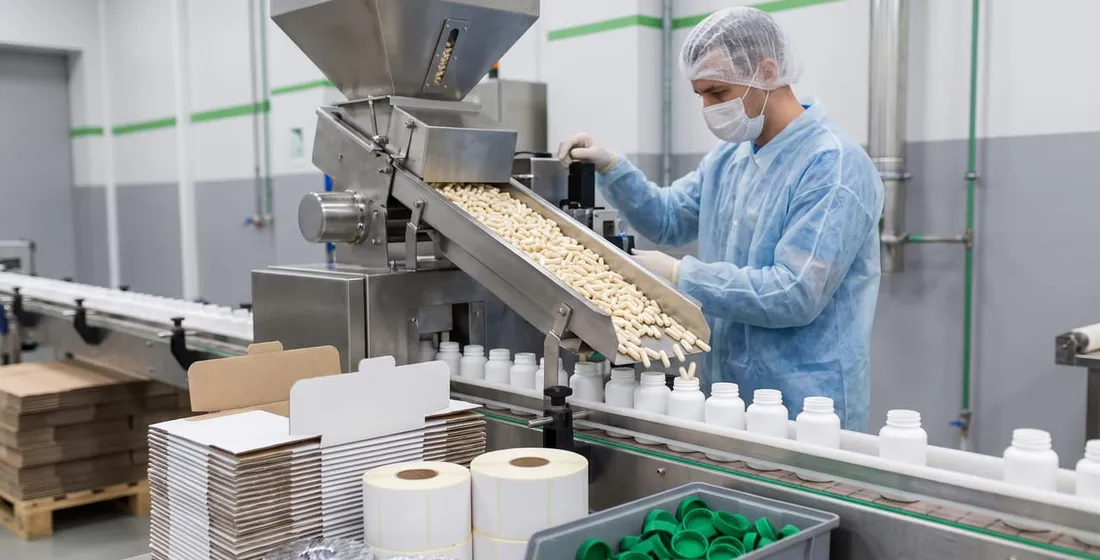
Co-packing takes finished goods a buyer already owns and turns them into shelf-ready units. For capsules, that means bulk stock is counted into bottles at a set fill (30, 60, or 90 count), induction-sealed, labelled to the approved artwork, capped, and cartoned. SFC’s encapsulation and packing hall is rated at 100,000 capsules per single shift, and a typical co-packing block for buyer-supplied capsules runs one to two weeks once the finished goods reach the facility.
The distinction that matters for a distributor is ownership. In co-packing, the formulation, the capsule, and the raw material risk stay with the buyer. SFC is not developing a recipe or sourcing the herb; it is applying an audited packing line and a compliance pathway to stock that already exists. That keeps the engagement fast and the cost predictable, because the expensive and slow parts, formulation and stability, are already behind you.
What a retail-ready capsule bottle must legally carry in Sri Lanka
A capsule bottle sold on a Sri Lankan shelf answers to two rule sets at once, and the first job is deciding which registration authority the SKU falls under. Products carrying Ayurvedic or traditional claims register with the Department of Ayurveda; dietary supplements with health or therapeutic claims are treated as borderline products by the National Medicines Regulatory Authority (NMRA). The claim on the label, not the capsule inside, decides the route.
The classification fork is the part distributors most often get wrong. Under the Ayurveda (Amendment) Act No. 19 of 2023, Ayurvedic products are classed as health supplements, food supplements, cosmeceuticals, or devices, which sets the registration path. A 2025 survey published in a peer-reviewed journal (PMC) found only 18.2% of sampled local herbal products displayed the Department of Ayurveda product registration number, and 78.4% carried no manufacturer registration number at all. That is a compliance gap, and it is also a re-listing risk every time a buyer audits the shelf.
Must-carry checklist for a retail-ready capsule bottle
| Requirement | Applies to | Authority / source |
|---|---|---|
| Batch or code number | Every SKU | Food (Labelling and Advertising) Regulations 2022 |
| Manufacture date and expiry date | Every SKU | Food (Labelling and Advertising) Regulations 2022 |
| Manufacturer, packer, or distributor name and address | Every SKU | Food (Labelling and Advertising) Regulations 2022 |
| Ingredient and nutrition declaration | Food-classed supplement | Food (Labelling and Advertising) Regulations 2022 |
| Department of Ayurveda product or manufacturer registration number | Ayurvedic-claim SKU | Department of Ayurveda |
| NMRA label on released batches | Borderline / medicinal-claim SKU | NMRA (recommended on all batches from 1 November 2024) |
The batch, date, and manufacturer-identity block is universal. The registration number is what changes with the classification. A co-packing engagement that includes labelling support builds that block into the artwork before the run, rather than leaving a distributor to discover the gap at a buyer’s audit.
Packaging and MOQ options for capsule co-packing
Capsule co-packing at SFC is built for a distributor’s first commercial run, not export-scale volumes. The first-run MOQ is 180 bottles per SKU, which is low for the category and lets a distributor test a format on the shelf without committing to tens of thousands of units. Bottles are supplied in 60-count as the standard retail fill, in white or black, with 30-count and 90-count available on request.
| Format | First-run MOQ | Typical fill | Lead time once goods arrive |
|---|---|---|---|
| Capsule bottle | 180 bottles / SKU | 60-count (30 or 90 on request) | 1 to 2 weeks |
| Kraft pouch | Set per format | 50 g to 1 kg | 1 to 2 weeks |
| Glass jar | Set per format | 50 ml to 1 L | 1 to 2 weeks |
For a distributor consolidating several imported lines, the same co-packing block can run multiple SKUs back to back, which spreads the changeover cost across the order. The economics of the 180-bottle threshold are worked through in more detail in the capsule contract manufacturing MOQ post.
How SLSI and registration fit inside a co-packing engagement
SLSI clearance is the gating step for a packaged supplement going onto a modern-trade shelf, and it runs in parallel with the packing schedule, not after it. SLSI submission for a stable, correctly-labelled SKU typically takes four to eight weeks, so the practical planning rule is a six-to-ten-week buffer between the packed stock being ready and a confirmed shelf date. A co-packer that submits the SLSI file while the run is booked saves the distributor that gap.
The audit chain behind the packer is what a serious buyer checks. SFC’s repacking side is BRCGS- and FSSC 22000 V6-audited, with SLSI clearance and Sri Lanka Food Act 1980 compliance on every retail SKU, and Department of Ayurveda registration support where the claim requires it. For a distributor, that audit stack is not a nice-to-have. It is the difference between a listing that clears procurement in one pass and one that bounces back for a manufacturer that cannot show a current certificate.
Service snapshot: Co-packing capsule bottles at Silk Foods Ceylon Service: buyer supplies bulk capsules; SFC counts, bottles, seals, labels, and cartons to a retail-ready SKU First-run MOQ: 180 bottles per SKU (60-count standard; 30 or 90 on request) Line capacity: 100,000 capsules per single shift Lead time: 1 to 2 weeks once finished goods reach the Matale facility Compliance: BRCGS- and FSSC 22000 V6-audited packing line, with SLSI and Sri Lanka Food Act labelling support, plus Department of Ayurveda registration support for Ayurvedic-claim SKUs
One local wellness brand at Silk Foods Ceylon scaled from a 180-bottle pilot run of an ashwagandha capsule SKU in 2024 to a multi-SKU monthly programme by the first quarter of 2026. The unlock was not price. It was that the same audited cert stack that cleared the first bottle carried the next three SKUs without re-auditing the packer, so each new listing moved through procurement on the strength of a certificate the buyer had already accepted.
Co-packing versus private labelling for capsule SKUs
The choice between the two services comes down to one question: do you already own finished capsules? If bulk stock exists, co-packing is the faster and cheaper route because it skips formulation entirely. If you have a brand but no product, private labelling puts your label on an SFC-formulated SKU drawn from a portfolio of more than 50 ready-to-go products.
| Co-packing | Private labelling | |
|---|---|---|
| You supply | Finished bulk capsules | Brand and artwork only |
| SFC supplies | Packing, labelling, compliance | Formulation, capsule, packing, compliance |
| Best for | Distributors with imported or third-party bulk | Brand owners with no formulation |
| Speed | Fastest (no R&D) | Fast (recipe already exists) |
| First-run MOQ | 180 bottles / SKU | 180 bottles / SKU |
A distributor holding imported bulk almost always wants co-packing. A distributor who wants to launch a capsule line but has no product to start from is a private-label conversation, and the two can be combined across a multi-SKU order.
Frequently asked questions
What does the co-packing service at SFC include for capsule bottles? It covers counting, bottling, induction sealing, labelling to approved artwork, capping, and cartoning of buyer-supplied bulk capsules, plus SLSI submission and Sri Lanka Food Act labelling support. The first-run MOQ is 180 bottles per SKU, and the line is rated at 100,000 capsules per single shift.
What is the minimum order for capsule bottle co-packing in Sri Lanka? The first-run MOQ at Silk Foods Ceylon is 180 bottles per SKU, deliberately low for the category so a distributor can test a format on the shelf. Bottles are standard 60-count, with 30-count and 90-count fills available on request.
What must a herbal capsule bottle carry to be retail-legal here? Every bottle needs a batch or code number, manufacture and expiry dates, and the manufacturer, packer, or distributor name and address under the Food (Labelling and Advertising) Regulations 2022. Ayurvedic-claim SKUs also need a Department of Ayurveda registration number; medicinal-claim SKUs fall under NMRA.
How long before co-packed capsules can reach a shelf? Packing runs one to two weeks once finished goods arrive. SLSI clearance for a compliant SKU typically takes four to eight weeks, so plan a six-to-ten-week buffer between packed stock and a confirmed shelf date rather than assuming same-week availability.
How Silk Foods Ceylon can help
For distributors converting bulk capsules into Sri Lankan retail-ready SKUs, Silk Foods Ceylon (SFC) operates a dedicated co-packing capability at the Matale facility. The buyer supplies the finished capsules; the SFC team handles counting, bottling, labelling, and SLSI submission support under the Sri Lanka Food Act labelling framework. First-run MOQ is 180 bottles per SKU, on an encapsulation and packing line rated at 100,000 capsules per single shift. The BRCGS- and FSSC 22000 V6-audited packing side gives modern-trade and pharmacy procurement the audit chain they ask for.
To brief a co-packing or consolidation plan, email b2b@esilkroute.com.lk or call +94 76 441 0389 or +94 76 918 5744.
Sources
- Ministry of Health, Food (Labelling and Advertising) Regulations 2022 (effective 1 January 2024). https://eohfs.health.gov.lk/food/index.php?option=com_content&view=article&id=18 (retrieved 19 July 2026).
- Department of Ayurveda, Regulation of local Ayurveda products registration (current). https://ayurveda.gov.lk/docs/regulation-of-local-ayurveda-drugs-products-registration/ (retrieved 19 July 2026).
- Peer-reviewed survey of herbal product labelling compliance in Sri Lanka, 2025, PubMed Central. https://pmc.ncbi.nlm.nih.gov/articles/PMC12522797/ (retrieved 19 July 2026).
- Sunday Times Business, NMRA label requirement for medicines, 2024. https://www.sundaytimes.lk/240714/news/all-medicines-will-require-nmra-label-from-august-1-564163.html (retrieved 19 July 2026).
- Food Act No. 26 of 1980 (consolidated 2024), Laws of Sri Lanka. https://lankalaw.net/wp-content/uploads/2025/03/Food-Act-Consolidated-2024.pdf (retrieved 19 July 2026).
- GM Insights, Contract Packaging Market, 2024. https://www.gminsights.com/industry-analysis/contract-packaging-market (retrieved 19 July 2026).
Written by the Silk Foods Ceylon Team. Silk Foods Ceylon (Pvt) Ltd. is a BRCGS- and FSSC 22000 V6-audited contract manufacturer in Matale, Sri Lanka, offering contract manufacturing, private labelling, co-packing, and in-house R&D for local Sri Lankan brand owners, FMCG companies, hotel and restaurant groups, and distributors. To brief a project: b2b@esilkroute.com.lk, +94 76 441 0389, or +94 76 918 5744.
Related reading: capsule contract manufacturing and the 180-bottle MOQ, private-label Ayurvedic capsules, Ayurveda and SLSI, the contract-manufacturing certification stack, co-packing kraft pouches for distribution, co-packing imported cashews and dates for e-commerce, the SLSI packaged-food submission, step by step, private-label moringa capsules for wellness retail.