Co-packing imported pasta, vermicelli, and noodles into Sri Lankan retail packaging
Buyer’s snapshot
- Sri Lanka’s wheat and meslin flour imports are set to reach roughly 1.2 million metric tonnes in 2026 (IndexBox, 2026).
- Imported pasta, vermicelli, and noodles fall under SLS 420, SLS 1534, and SLS 858 (SLSI import inspection scheme).
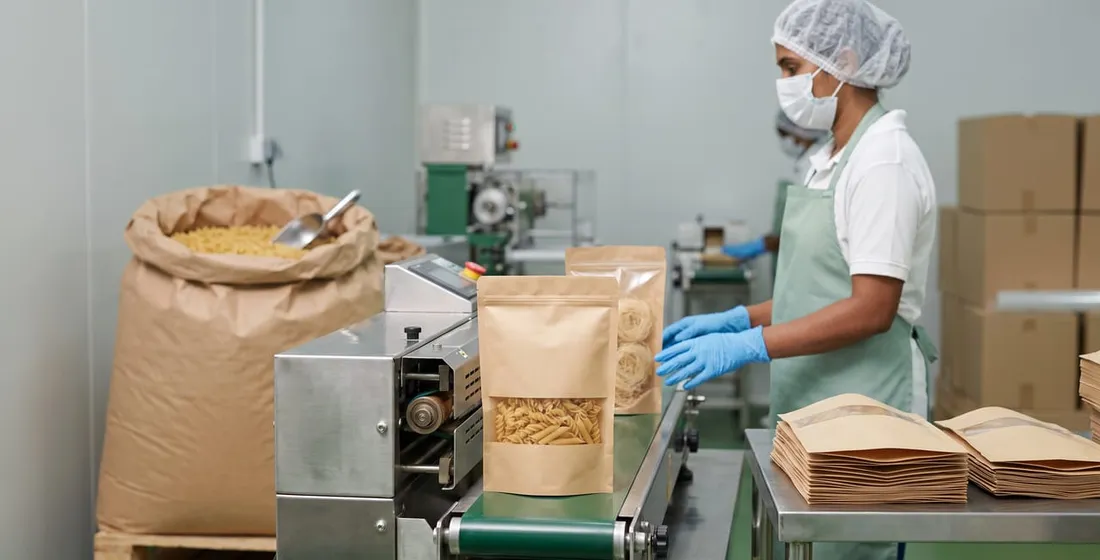
- Silk Foods Ceylon (SFC) fills, seals, and labels buyer-supplied bulk stock into kraft pouches from 50 g to 1 kg at Matale.
- A consolidated multi-SKU run typically clears in 1 to 2 weeks; see the bulk-import-vs-local-repack table below.
- Written for distributors already landing bulk pasta or noodles in Sri Lanka, not for brands sourcing their first container.
Sri Lanka’s wheat and meslin flour imports are on track for roughly 1.2 million metric tonnes in 2026, the third straight year of growth, with tourism-linked flour consumption adding to the household baseline (IndexBox, 2026; Daily Mirror Business, 2025). A meaningful share of that volume lands as dry pasta, vermicelli, and instant noodles, most of it still in bulk sacks or catering cartons rather than the retail pouch a shopper picks off a shelf.
For a distributor who has already landed the container, the bottleneck is rarely the import itself. It is finding a manufacturer who can fill, seal, and label that bulk stock into an SLSI-compliant retail SKU without triggering a second import declaration for pre-packed goods.
What counts as pasta, vermicelli, or noodles under Sri Lankan import rules?
Dry pasta, vermicelli, and instant noodles fall under HS heading 1902, split further into HS codes 1902.11 through 1902.30 by shape and preparation. Sri Lanka Standards Institution (SLSI) gazettes these items under its mandatory import inspection scheme: SLS 420 covers pasta products, SLS 1534 covers instant noodles, and SLS 858 covers rice vermicelli (SLSI, 2024). A co-packer repacking any of these locally should already carry current submission experience against the specific standard, not just a general food-safety audit.
The reason repacking matters at all: a 25 kg bulk sack or a catering-format carton is not retail packaging. It has no unit label, no tri-lingual name, and no shelf-ready format for the major supermarket chains or a Sri Lankan e-commerce marketplace. Converting that bulk stock into a 50 g to 1 kg retail pouch is the step between a cleared shipment and a sellable SKU.
Co-packing bulk imported pasta and noodles into retail-ready SKUs
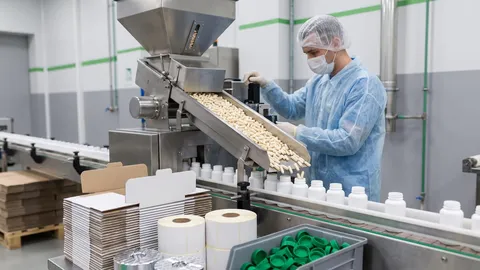
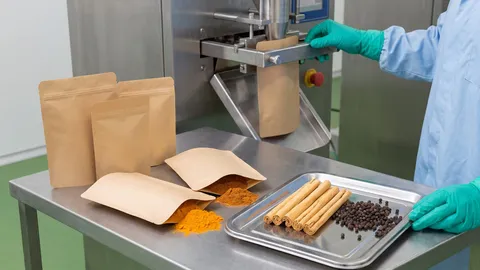
Co-packing at Silk Foods Ceylon (SFC) starts once the buyer’s finished goods, imported dry pasta, vermicelli, or noodles, arrive at the Matale facility. The SFC team fills, seals, and labels into kraft pouches at 50 g, 100 g, 250 g, 500 g, and 1 kg, or into clear-window pouches when the product itself is the sell, the pasta shape or the noodle strand visible through the pack. A consolidated run packs pasta, vermicelli, and a noodle SKU through one production block, so a distributor running three import lines does not need three separate co-packing bookings.
One Sri Lankan distributor bringing in a mid-size container of imported vermicelli and dry pasta in 2025 ran its first SLSI submission through Silk Foods Ceylon’s co-packing line rather than through the importer’s own packing shed. The unlock was not price. It was that the same SLSI submission chain and label review covered both the pasta pouch and the vermicelli pouch in one pass, instead of two separate first-time filings with two different reviewers.
The category is growing on both sides of that decision. Globally, the instant noodles market alone was valued at USD 64.67 billion in 2025 and is projected to reach USD 111.71 billion by 2034, with Asia Pacific accounting for roughly 85% of volume (Fortune Business Insights, 2026). Locally, Sri Lanka’s own instant noodles market has grown steadily since 2020 and is expected to keep expanding through 2031 (6Wresearch, 2025), which is part of why more distributors are bringing in new SKUs rather than resting on one established line.
Should a distributor land pasta and noodles already packed for retail, or import in bulk and co-pack locally? The answer usually turns on SKU count and submission overhead, not on the invoice price per kilogram.
| Dimension | Import retail-ready packs directly | Import bulk, co-pack at SFC locally |
|---|---|---|
| Freight basis | Paid on retail-packaging volume (pouches, cartons) | Paid on bulk weight only; packaging added locally |
| SLSI submission | One submission per pre-packed SKU, per shipment | One submission per SKU; repeat runs reuse the same cert file |
| Label control | Fixed at origin; changes need a new print run abroad | Country of origin, manufacture date, and repack date printed locally, adjustable per batch |
| Multi-SKU consolidation | Each SKU ships and clears separately | Pasta, vermicelli, and noodles run through one production block |
| Typical lead time | Set by origin production and shipping schedule | 1 to 2 weeks once bulk goods reach the Matale facility |
| Best fit | A single high-volume SKU on a stable annual order | 3 or more SKUs, or a distributor testing new lines |
A distributor comparing landed cost per unit should convert freight and duty quotes at the prevailing rate, roughly LKR 335 to 336 per USD as of July 2026 (Central Bank of Sri Lanka), before comparing the two routes side by side. For one stable high-volume SKU, importing retail-ready packs can still make sense. Once the SKU count climbs past two or three, or demand shifts month to month, co-packing locally usually wins on submission overhead alone.
What does the Sri Lanka Food Act require on a repacked pasta or noodle label?
The Food (Labelling and Advertising) Regulations 2022, administered under the Sri Lanka Food Act, set the labelling floor for any packaged food sold locally, including goods repacked from bulk. For imported bulk repacked in Sri Lanka, the label must carry the country of origin, the importer’s name and address, and both the original manufacture date and the local repackaging date (USDA FAS, 2025). Gluten allergen disclosure and the tri-lingual product name apply on top of that floor.
None of this is optional at the SLSI submission stage. A repacker that has not built the manufacture-date-plus-repack-date convention into its standard label template will lose time at review, which is the single most common delay a first-time co-packing client raises.
Certification coverage that satisfies procurement on the repacker side
Silk Foods Ceylon’s Matale facility is BRCGS- and FSSC 22000 V6-audited, with SLSI clearance and Sri Lanka Food Act compliance built into every co-packing engagement. For a distributor’s own procurement conversation with the major supermarket chains, having a repacker that already carries a current FSSC audit removes a step the retailer’s buying team would otherwise chase separately.
First-run co-packing pricing is quoted in LKR and improves at consolidated-batch volume. A distributor pricing out a single-SKU trial run should expect a materially better per-unit fill, seal, and label cost once two or more SKUs share the same production day.
Which Sri Lankan retail channels ask for what on a repacked pasta SKU?
Retail buyers a distributor works with generally fall into three groups. The major supermarket chains ask for SLSI clearance plus a current food-safety audit on the manufacturer before listing a private-label or house-repacked SKU. E-commerce marketplaces typically require SLS certification or an equivalent before a packaged food goes live on the platform. HORECA wholesale buyers ask more about allergen disclosure and shelf life than about the audit itself, since the product usually moves through a kitchen rather than a retail shelf.
Packaging format shifts with the channel too. Modern trade favours the 250 g and 500 g pouch sizes; an e-commerce marketplace often wants a smaller 50 g or 100 g trial size alongside the standard pack; HORECA wholesale usually orders the 1 kg format or larger case packs.
Service snapshot: Co-Packing at Silk Foods Ceylon
- Service: buyer supplies imported finished goods; SFC fills, seals, and labels
- Packaging: kraft pouches from 50 g to 1 kg; clear-window pouches on request
- Lead time: typically 1 to 2 weeks once goods arrive at the Matale facility
- Cert coverage: BRCGS- and FSSC 22000 V6-audited, plus SLSI clearance and Sri Lanka Food Act compliance on every repacked SKU
- Consolidation: pasta, vermicelli, and noodle SKUs can run through one production block
Frequently asked questions
Does Silk Foods Ceylon co-pack imported vermicelli under my own brand?
Yes. Silk Foods Ceylon (SFC) packs, seals, and labels buyer-supplied bulk vermicelli into retail-ready kraft pouches from 50 g to 1 kg, then applies the buyer’s own label artwork under the co-packing and private-labelling services. SLSI submission support (SLS 858 for rice vermicelli) sits inside the standard engagement.
What SLSI standard covers imported instant noodles in Sri Lanka?
Imported instant noodles fall under Sri Lanka Standard SLS 1534, one of the items gazetted under the SLSI mandatory import inspection scheme alongside SLS 420 for pasta products (SLSI, 2024). A co-packer handling the repack should already hold current submission experience against both standards.
How long does a co-packing run take once imported pasta or noodles arrive at the facility?
A single-SKU or consolidated multi-SKU co-packing run at Silk Foods Ceylon typically clears in 1 to 2 weeks once the finished bulk goods reach the Matale facility, per the standard co-packing lead-time band. Multi-SKU consolidation (pasta, vermicelli, and a noodle line together) usually fits inside the same production block.
What does the Sri Lanka Food Act require on a repackaged pasta or noodle label?
The Food (Labelling and Advertising) Regulations 2022 require country-of-origin, the importer’s name and address, and, for bulk goods repacked locally, both the original manufacture date and the repackaging date on the label, per the Ministry of Health framework documented by USDA FAS (2025). Gluten allergen disclosure and tri-lingual naming apply as well.
Is it cheaper to import retail-ready pasta packs directly, or import bulk and co-pack locally?
It depends on volume and SKU count. Bulk import plus local co-packing usually wins once a distributor is running 3 or more SKUs through one production block, since freight is paid on bulk weight rather than retail packaging bulk, and the SLSI submission sits with one local co-packer rather than a chain of pre-packed import declarations.
How Silk Foods Ceylon can help
For distributors converting imported bulk pasta, vermicelli, and noodles into Sri Lankan retail-ready SKUs, Silk Foods Ceylon (SFC) operates a dedicated co-packing capability at the Matale facility. The buyer supplies the finished goods; the SFC team handles filling, sealing, labelling, and SLSI submission support against the SLS 420, SLS 1534, and SLS 858 standards. Packaging options span 50 g to 1 kg kraft pouches, with a consolidated run covering multiple SKUs in one production block, typically clearing in 1 to 2 weeks once stock reaches the facility. The BRCGS and FSSC 22000 V6 cert stack on the repacker side reassures procurement teams at the major supermarket chains and e-commerce marketplaces alike.
To brief a co-packing or consolidation plan, email b2b@esilkroute.com.lk or call +94 76 441 0389 or +94 76 918 5744.
Sources
- Sri Lanka Standards Institution (SLSI) (2024), “Items Covered Under Import Inspection Scheme”, https://slsi.lk/wp-content/uploads/2024/04/QA-ITEMS-COVERED-UNDER-IMPORT-INSPECTION-SCHEME.pdf (retrieved 2026-07-24).
- USDA Foreign Agricultural Service (FAS GAIN) (2025), “Sri Lanka Extends Implementation of the Food Labeling and Advertising Regulations”, https://apps.fas.usda.gov/newgainapi/api/Report/DownloadReportByFileName?fileName=Sri+Lanka+Extends+Implementation+of+the+Food+Labeling+and+Advertising+Regulations-2022+by+Additional+Six+Months_Colombo_Sri+Lanka_CE2025-0003.pdf (retrieved 2026-07-24).
- IndexBox (2026), “Sri Lanka’s Wheat and Meslin Flour Market Report 2026”, https://www.indexbox.io/store/sri-lanka-wheat-or-meslin-flour-market-analysis-forecast-size-trends-and-insights/ (retrieved 2026-07-24).
- Daily Mirror Business (2025), “Sri Lanka’s wheat consumption rises on economic and tourism revival”, https://www.dailymirror.lk/business-main/Sri-Lanka%E2%80%99s-wheat-consumption-rises-on-economic-and-tourism-revival/245-340024 (retrieved 2026-07-24).
- Fortune Business Insights (2026), “Instant Noodles Market Size, Share and Growth”, https://www.fortunebusinessinsights.com/industry-reports/instant-noodles-market-101452 (retrieved 2026-07-24).
- 6Wresearch (2025), “Sri Lanka Instant Noodles Market: Size, Share and Volume 2020-2031”, https://www.6wresearch.com/industry-report/sri-lanka-instant-noodles-market-2020-2026 (retrieved 2026-07-24).
- Central Bank of Sri Lanka (2026), “Indicative US Dollar SPOT Exchange Rate (LKR per 1 USD)”, https://www.cbsl.gov.lk/en/rates-and-indicators/exchange-rates/daily-indicative-usd-spot-exchange-rates (retrieved 2026-07-24).
Written by the Silk Foods Ceylon Team. Silk Foods Ceylon (Pvt) Ltd. is a BRCGS- and FSSC 22000 V6-audited contract manufacturer in Matale, Sri Lanka, offering contract manufacturing, private labelling, co-packing, and in-house R&D for local Sri Lankan brand owners, FMCG companies, hotel and restaurant groups, and distributors. To brief a project: b2b@esilkroute.com.lk, +94 76 441 0389, or +94 76 918 5744.