Co-Packing Sri Lanka: A 200ml Glass-Bottle Beverage Launch Scenario
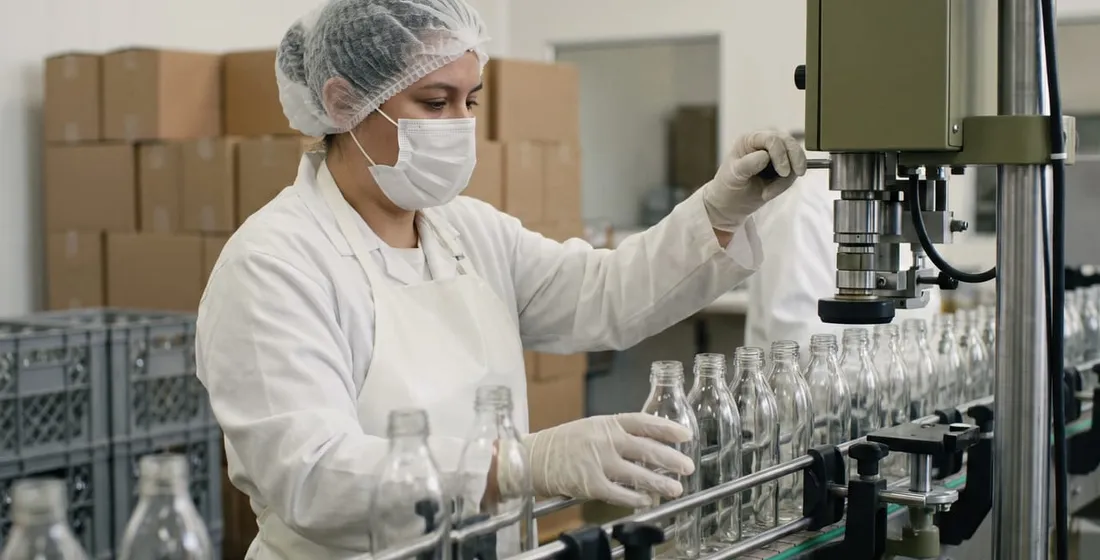
A gloved worker in full PPE caps a row of empty 200ml glass bottles moving along Silk Foods Ceylon’s beverage co-packing line at the Matale facility.
Buyer's snapshot Beverages made up 60.64% of Sri Lanka's container glass market in 2025, and a 2023 restriction on selected single-use plastics has pushed brand owners toward glass (Mordor Intelligence, 2025). For a founder with a tested 200ml recipe, the bottleneck is usually the bottling line and SLSI clearance, not the recipe. SFC's Matale beverage line runs 2,500 x 200ml glass bottles a day, with a 1,250-bottle first-run threshold on the capping tooling. The table below compares co-packing against contract manufacturing for a beverage SKU. Written for a founder whose recipe is already locked and shelf-stable; if the formulation is still in flux, R&D/NPD comes first. |
Beverages accounted for 60.64% of Sri Lanka’s container glass market in 2025, and a 2023 Central Environment Authority restriction on selected single-use plastics has pushed several local brand owners toward glass as the default format for a first bottled SKU (Mordor Intelligence, 2025). For a founder who has already tested a 200ml recipe, the question isn’t whether the market wants the product. It’s which manufacturer can turn a finished liquid into a shelf-ready glass bottle on a schedule that holds.
What does a co-packing run for a 200ml glass-bottle beverage involve?
Co-packing at Silk Foods Ceylon (SFC) means the buyer supplies an already-formulated, shelf-stable beverage; the Matale facility fills, caps, seals, and labels it into retail-ready glass bottles. The line running the format is the same one used for contract-manufactured beverages: a pipe-type duplex filter, a homogenizer, a liquid filling machine, and a glass bottle capping machine. For a single-serve 200ml SKU, a founder whose recipe is already tested doesn’t need SFC’s R&D team involved at all.
What the brief needs to include is the finished liquid (or the raw ingredients with a fixed formulation ratio), the bottle and cap specification, and approved label artwork. First-run co-packing batches on the beverage line typically start at the same 1,250-bottle threshold as a contract-manufactured beverage SKU, since the glass-bottle capping tooling change-over is a fixed cost regardless of who formulated the liquid.
The scenario: an emerging beverage brand’s first 1,250-bottle run
One emerging Sri Lankan beverage brand brought a cold-brew concentrate to the Matale facility in 2025, after two years of kitchen-scale batches sold through direct orders. The recipe was stable and shelf-life tested; what the founder didn’t have was a bottling line, a capping machine, or an SLSI submission history. The first commercial run was 1,250 x 200ml bottles, produced in under a single shift on SFC’s beverage line, with the founder’s own label supplied as print-ready artwork.
The maths behind that number matters more than the number itself. At 2,500 bottles a day, a 1,250-bottle run is half a production shift; the other half is reserved for line clean-down and the next SKU’s change-over. For a founder budgeting a first commercial run, that’s the difference between a manufacturer quoting a full-day minimum and one who can run a smaller batch without idling the line.
The choice between the two services comes down to one question: is the recipe already locked?
| Dimension | Co-packing | Contract manufacturing |
| Who formulates the recipe | The buyer, before the brief | Silk Foods Ceylon’s R&D team, from a brief |
| What SFC does | Fills, caps, seals, and labels the buyer’s finished liquid | Formulates, produces, fills, caps, seals, and labels |
| Typical first-run MOQ (200ml glass bottle) | 1,250 bottles | 1,250 bottles |
| Lead time | 1 to 2 weeks once the finished beverage arrives | 2 to 4 weeks on an existing recipe; 6 to 10 weeks if R&D is needed first |
| Best fit | A tested, shelf-stable recipe with no bottling capacity | A working idea or home-kitchen recipe that needs retort or shelf-stability work first |
For the emerging beverage brand in the scenario above, co-packing was the right call because the recipe was already stable. A founder still adjusting sweetness, acidity, or shelf life at the kitchen-table stage is better served starting with R&D/NPD (Co-Development on the SFC brochure), then moving into either service once the formulation locks.
How does the beverage-line throughput break down, from bulk liquid to shelf-ready bottle?
The Matale beverage line moves through four stages for a co-packed SKU: incoming liquid quality control, filling, capping, and labelling, followed by case-packing. At 2,500 x 200ml bottles a day, the physical run for a 1,250-bottle order takes half a shift. The one-to-two week lead time SFC quotes for co-packing covers scheduling, incoming QC, and label proofing around that run, not the machine time itself.
Service snapshot: Co-Packing at Silk Foods Ceylon Service: Fills, caps, seals, and labels a buyer-supplied finished beverage Format: 200ml glass bottle (beverage-line spec); other glass and pouch formats available First-run MOQ: 1,250 bottles Beverage-line capacity: 2,500 x 200ml bottles per day Lead time: 1 to 2 weeks once the finished beverage arrives at the Matale facility Cert coverage: BRCGS- and FSSC 22000 V6-audited, plus SLSI clearance and Sri Lanka Food Act compliance on every retail SKU |
What certifications matter for a Sri Lankan glass-bottle beverage SKU?
For a beverage SKU sold locally, two certifications sit at the floor: SLSI clearance and Sri Lanka Food Act 1980 compliance. Neither is negotiable for a bottled drink going onto a local shelf or a Sri Lankan e-commerce marketplace listing. Beyond the floor, BRCGS- and FSSC 22000 V6-audited manufacturers clear premium private-label procurement gates faster, even for a purely domestic launch.
SLSI submission for a packaged beverage typically runs four to eight weeks; the practical planning move is a six-to-ten-week buffer between manufacturer QA sign-off and a target shelf date, per SLSI’s standard certification framework for packaged food and beverages. The label itself has to carry the product name in Sinhala, Tamil, and English, net volume, ingredient list by descending weight, allergen disclosure, and the manufacturer’s SLS number, per the Sri Lanka Food Act No. 26 of 1980 (and amendments), the statutory framework the Ministry of Health administers for packaged food and beverage labelling. None of that is co-packing-specific; it applies whether the SKU is co-packed or contract-manufactured.
Where Silk Foods Ceylon draws the line on a beverage co-packing brief
Where SFC walks away A co-packing brief that shows up without a stable, shelf-tested formulation isn't ready for the beverage line; that's an R&D/NPD conversation first. A brief with no SLSI plan, no understanding of ambient-stability requirements for the format, or an expectation of a sub-500-bottle run doesn't pencil against the tooling change-over cost. For a founder still adjusting the recipe at kitchen scale, another round of testing is the better next step before booking a line slot. |
Frequently asked questions
What is the MOQ for co-packing a glass-bottle beverage at Silk Foods Ceylon?
The first-run co-packing MOQ for a 200ml glass-bottle beverage is 1,250 bottles, the same threshold used for a contract-manufactured beverage SKU on the same line. At 2,500 bottles a day capacity, that’s roughly half a production shift.
Does Silk Foods Ceylon fill and cap glass bottles for a beverage brand’s own recipe?
Yes. Co-packing at Silk Foods Ceylon (SFC) fills, caps, seals, and labels a buyer-supplied, already-formulated beverage on the Matale beverage line. The buyer supplies the finished liquid or a fixed formulation; SFC handles the bottling, certification, and SLSI submission support.
How long does SLSI clearance take for a bottled beverage SKU?
SLSI submission for a packaged beverage typically takes four to eight weeks. Most local brands plan a six-to-ten-week buffer between manufacturer QA sign-off and a target shelf date, per SLSI’s standard certification framework for packaged food and beverages.
Can Silk Foods Ceylon co-pack a beverage that still needs formulation work?
Not directly. A recipe that isn’t yet shelf-stable or ambient-tested needs Silk Foods Ceylon’s R&D/NPD team first, typically two to four sample iterations, before it qualifies for a co-packing or contract-manufacturing run on the beverage line.
What size glass bottles does the SFC beverage line run?
The Matale beverage line’s core format is a 200ml glass bottle for single-serve beverages, with other glass bottle and jar sizes available under contract manufacturing and private labelling. Line capacity is 2,500 x 200ml bottles a day.
How Silk Foods Ceylon can help
For a Sri Lankan beverage founder with a tested recipe and no bottling line of their own, Silk Foods Ceylon (SFC) co-packs a buyer-supplied beverage into 200ml glass bottles at the Matale facility, at a first-run MOQ of 1,250 bottles and a beverage-line capacity of 2,500 bottles a day. Lead time typically runs one to two weeks once the finished beverage arrives on site. The Matale facility is BRCGS- and FSSC 22000 V6-audited, with SLSI submission support built into the standard co-packing engagement. For a recipe that isn’t shelf-stable yet, SFC’s in-house R&D team can take it there first.
To brief a project, email b2b@esilkroute.com.lk or call +94 76 441 0389 / +94 76 918 5744.
Sources
- Mordor Intelligence (2025), “Sri Lanka Container Glass Market Size & Growth to 2031”, https://www.mordorintelligence.com/industry-reports/srilanka-container-glass-market (retrieved 2026-09-21).
- Sri Lanka Standards Institution (SLSI), packaged-food certification and submission framework, https://www.slsi.lk/ (retrieved 2026-09-21).
- Sri Lanka Food Act No. 26 of 1980 (and amendments), Ministry of Health, Sri Lanka, https://www.health.gov.lk/ (retrieved 2026-09-21).
- Further reading: Sri Lanka Export Development Board (EDB), food and beverage exporter portal, https://www.srilankabusiness.com/ (retrieved 2026-09-21).
- Further reading: Sri Lanka Customs, HS classification and import declarations, https://www.customs.gov.lk/ (retrieved 2026-09-21).
Written by the Silk Foods Ceylon Team. Silk Foods Ceylon (Pvt) Ltd. is a BRCGS- and FSSC 22000 V6-audited contract manufacturer in Matale, Sri Lanka, offering contract manufacturing, private labelling, co-packing, and in-house R&D for local Sri Lankan brand owners, FMCG companies, hotel and restaurant groups, and distributors. To brief a project: b2b@esilkroute.com.lk, +94 76 441 0389, or +94 76 918 5744.