Herbal Tea Bagging and Small-Run Co-Packing for New Brands
By the Silk Foods Ceylon Editorial Team
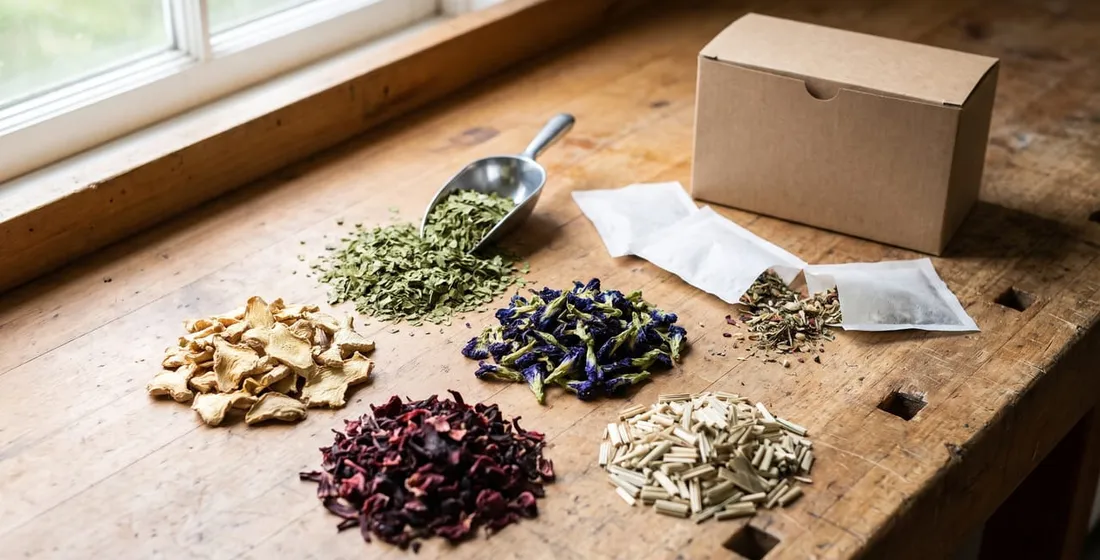
Small heaps of dried cut ginger, moringa leaf, blue butterfly pea flowers, hibiscus and lemongrass on a wooden bench, beside plain unprinted paper tea bags and a blank kraft carton.
Buyer’s snapshot
- A new herbal tea brand has two routes at Silk Foods Ceylon (SFC): an SFC blend under its own label, or its own blend cut, bagged and cartoned by SFC.
- Cut size matters. In a 2017 study of black tea in bags, cutting particles from 2.21 mm to 0.36 mm lifted final swelling from 41 percent to 84 percent (Yadav et al., 2017).
- Small runs are welcome and quoted on request. R&D takes 3 to 4 weeks at most.
A café group, a wellness studio or a small hotel brand usually reaches the same point. The ginger and coriander blend that guests ask for in the cup is now wanted in a box. The recipe works. What is missing is a way to cut, blend, bag and carton it to a repeatable standard, under a label that will pass a Sri Lankan retail check.
This guide is for founders planning a first herbal or functional tea range.
Which route fits: private label or co-packing?
A new tea brand has two routes at Silk Foods Ceylon. In private labelling, SFC supplies a blend from its herbal range and the brand supplies the label. In co-packing, the brand supplies its own finished blend and SFC cuts, bags and cartons it. The difference is who owns the recipe and who buys the herbs.
A brand with an idea but no recipe can first brief the R&D team (Co-Development on the SFC brochure), which takes 3 to 4 weeks at most from signed brief to approved formulation.
| Question | Private label (SFC blend, your brand) | Co-packing (your blend, SFC bags it) |
|---|---|---|
| Who owns the recipe | SFC formulation sold under your brand; ownership terms are set in the agreement | The brand |
| Who supplies the herbs | SFC, from its herb range | The brand, to an agreed incoming specification |
| Time to first run | Sample dispatch 1 to 2 weeks, then 2 to 3 weeks from purchase order to dispatch | 2 to 3 weeks from purchase order to dispatch once the recipe and sample are approved |
| First run size | Small runs welcome, quote on request | Small runs welcome, quote on request |
| Best for | A fast launch without a formulator | A café or studio with a proven in-house blend |
Choose private label when speed matters more than a signature recipe, and co-packing when the blend itself is the brand. The herb range includes ginger, True Ceylon cinnamon, coriander, moringa, polpala, gotukola, butterfly pea, lemongrass and hibiscus. Both routes use the tea cutting and tea bagging capability, under private labelling or co-packing.
What does cutting herbs to tea-bag size involve?
Cutting to tea-bag size means reducing dried leaf, flower, root and bark to an even particle size that fits a bag, infuses at a useful speed and leaves little dust. Four things are controlled: particle size, dust and fines, moisture, and foreign matter. Each is written into the blend specification before the first run.
Particle size comes first. A 2017 study in the Journal of Food Science and Technology tested CTC black tea in bags and loose. Reducing particle size from 2.21 mm to 0.36 mm raised final swelling in a bag from 41 percent to 84 percent, and extraction at 15 minutes rose about 1.3 times (Yadav et al., 2017). That is black tea, so the numbers do not transfer to a ginger and gotukola blend. The direction does: a finer cut infuses faster and fuller.
The trade-off is dust. Very fine particles sift through bag paper and settle as sludge in the cup. Woody pieces such as ginger tend to shatter, while moringa leaf crumbles and butterfly pea flowers stay bulky, so each ingredient usually needs its own cut size, agreed per ingredient and then blended.
Moisture is the quiet variable. Very dry material makes more fines when cut, and damp material clumps and can spoil in the carton. The spec should state a moisture target per ingredient, agreed on the quote.
Foreign matter is where brand-supplied herbs most often need attention. A 2022 quality-control study cited a 2 percent allowance for undeclared plant parts in teas sold in the European Union, and found one commercial blend at 10.4 percent (Prpa et al., 2022). A brand supplying its own herbs should agree an incoming specification with a foreign-matter limit, so failing material is caught before cutting.
Silk Foods Ceylon cuts and bags herbal and functional blends in-house on a tea cutter and a tea bagging machine at the Matale facility.
How is a blend kept consistent from batch to batch?
Consistency comes from a written blend specification and a batch record. The specification names each ingredient, its cut, its share of the blend and its moisture target. The batch record ties every finished lot to the ingredient lots used, the weights and the date, so a complaint can be traced to specific herbs.
Herbs vary by harvest, and butterfly pea colour shifts with the source. The usual answer is a reference sample: the approved first-run blend is kept, and later batches are checked against it by eye, aroma and taste.
Ask what the batch record holds: each ingredient lot and weight, the cut applied, the bag fill weight set for the run, the operator and the date. Traceability is part of the audited systems at a BRCGS certified, FSSC 22000 V6 site.
Service snapshot: herbal tea bagging at Silk Foods Ceylon
Service: herbal and functional blends cut and bagged in-house, for private label or co-packing
First runs: small runs welcome, quote on request
Formats: tea bags cartoned for retail or hospitality, and loose-leaf pouches; bag style confirmed per quote
Certifications: BRCGS, FSSC 22000 V6, GMP and HACCP
Which pack suits a new brand: tea bags or loose-leaf pouches?
Silk Foods Ceylon packs herbal blends as tea bags, cartoned for retail or hospitality, and as loose-leaf pouches. The bag style is confirmed per quote, so brief the use first: a retail box for shelves, a sachet for room service, or a pouch for customers who brew in a pot.
| Pack | Best for | Decide early | Watch for |
|---|---|---|---|
| Tea bags, cartoned for retail | Shelf sales, gift shops, online | Carton artwork, bags per carton, label content | Dust through the bag, so the cut must suit the bag |
| Tea bags, cartoned for hospitality | Rooms, cafés, guest services | Bag count per carton, outer pack for housekeeping | Stock rotation in humid rooms |
| Loose-leaf pouch | Brew-at-home customers, larger cut pieces | Pouch size and barrier, resealing | Coarse pieces settle, so the label should say how to brew |
Loose leaf suits blends with large pieces, such as whole butterfly pea flowers, that would not fit a bag well. Bags suit finer cut blends sold for convenience. One blend can run in both, though the cut differs.
Whatever the pack, barrier matters in Sri Lanka’s humidity, a point set out in private-label herbal tea shelf life in Sri Lanka’s humidity.
What does the label need, and when does Ayurveda registration apply?
A herbal tea sold in Sri Lanka is a packaged food, so it follows the Food Act labelling rules. Department of Ayurveda approval applies only when the product is positioned as an Ayurvedic or healthcare product. Any “functional” wording needs care, because health claims need written approval before they appear on a pack.
Sri Lanka replaced its 2005 and 2022 labelling rules with the Food (Labelling and Advertising) Regulations 2026. The Ministry’s draft notice said they would enter into force on 1 July 2026 (USDA FAS, 2026). A trade report on the final gazette, No. 2494/47 of 26 June 2026, says product names must appear in several languages and that health and nutrient-function claims need prior written approval from the Chief Food Authority (ChemLinked, 2026). Read the gazette for the exact wording before artwork is final.
The Ayurveda route is separate. The Export Development Board states that finished herbal products should be approved by the Drug Formulator Committee under the Department of Ayurveda before they are marketed as healthcare products (EDB, 2026). A blend sold as a plain food, named by its ingredients and described by taste, stays on the food side.
In briefs, describe a blend by style: a digestion-style, immunity-style, sleep-style or detox-style blend. On the pack, name the ingredients and describe flavour, and keep outcome wording off until the claim route is confirmed with the regulator. A blend with no Camellia sinensis is a herbal infusion, which affects the common name, as covered in the hibiscus, lemongrass and gotukola blend post. The certifications page lists the standards behind the facility.
Why do small first runs suit a new brand?
A first run is a test, not a launch. Silk Foods Ceylon welcomes small runs and quotes them on request, so a new brand can put a few blends on sale, see which sell, and scale only those. That limits risk. The approach is set out on the small brands capability page.
One Sri Lankan café group came to the R&D team with five blends, all hand-mixed in its kitchen. The plan changed after the first call. The team suggested a first run of the two blends guests ordered most, kept the other three as samples, and fixed the cut for each ingredient in writing. Locking the recipes took inside the usual two to four sample iterations.
The two blends went to the café counters. The other three were adjusted from guest feedback before a second run, and the second batch matched the first because the cut and the reference sample were already on paper.
Where SFC walks away
Silk Foods Ceylon returns briefs that ask for health outcomes on the pack, and briefs where the blend is still changing weekly at kitchen scale. Those brands do better with more testing before a run is booked.
Frequently asked questions
Does Silk Foods Ceylon bag tea for other brands?
Yes. Silk Foods Ceylon cuts and bags herbal and functional tea blends in-house at the Matale facility, for private label or co-packing. Tea bags are cartoned for retail or hospitality, and loose-leaf pouches are also available. Small runs are welcome and quoted on request, and the bag style is confirmed per quote.
What is the difference between private label and co-packing for herbal tea?
In private label, Silk Foods Ceylon supplies a blend from its herbal range and the brand supplies the label. In co-packing, the brand supplies its own finished blend and Silk Foods Ceylon cuts, bags and cartons it. The first is faster to launch, and the second keeps the recipe with the brand.
How long does it take to go from brief to a first run?
With an existing recipe, a first run typically takes 2 to 3 weeks from purchase order to dispatch, after a sample is approved. A new blend adds R&D, which takes 3 to 4 weeks at most from signed brief to approved formulation.
Does a herbal tea need Department of Ayurveda registration?
Only when the product is positioned as an Ayurvedic or healthcare product. The Export Development Board says finished herbal products marketed that way are approved by the Drug Formulator Committee under the Department of Ayurveda (EDB, 2026). A plain food blend, named by its ingredients, follows the Food Act labelling rules instead.
Can a new brand start with a small run?
Yes. Small runs are welcome and quoted on request, and they suit a brand testing a few blends before scaling. The quote depends on the blend, the pack format and how the run fits the line schedule, so share the brief early.
How Silk Foods Ceylon can help
For founders launching a first herbal or functional tea range, Silk Foods Ceylon (SFC) cuts and bags blends in-house at its Matale facility, as private label or as co-packing of a brand’s own blend. Small runs are welcome and quoted on request. R&D takes 3 to 4 weeks at most from signed brief to approved formulation. The facility is BRCGS certified and FSSC 22000 V6 certified, with GMP and HACCP in place; USDA Organic, EU Organic and Vegan (Control Union) are available for qualifying recipes.
To brief a project, email b2b@esilkroute.com.lk or call +94 77 157 7294.
Sources
- Yadav, G. U., Joshi, B. S., Patwardhan, A. W. and Singh, G. (2017), “Swelling and infusion of tea in tea bags”, Journal of Food Science and Technology. pmc.ncbi.nlm.nih.gov (retrieved 30 October 2026).
- Prpa, B., Bijeli, K., Kladar, N. and Bozin, B. (2022), “Utilization of microscopic and macroscopic characteristics as part of quality control of herbal teas and tea mixtures and authentication of individual components”, Biologia Serbica 44(2). ojs.pmf.uns.ac.rs (retrieved 30 October 2026).
- USDA Foreign Agricultural Service (2026), “Sri Lanka Invites WTO Members to Comment on Draft Food Labelling and Advertising Regulations 2026”, GAIN report CE2026-0002, 7 May 2026. agriexchange.apeda.gov.in (retrieved 30 October 2026).
- ChemLinked (2026), “Sri Lanka enforces new food labelling rules”, 17 August 2026, on Gazette Extraordinary No. 2494/47 and the claims approval requirement. food.chemlinked.com (retrieved 30 October 2026).
- Sri Lanka Export Development Board (2026), “Ayurvedic and herbal products: overview”, undated web page, on approval of finished herbal products by the Drug Formulator Committee. srilankabusiness.com (retrieved 30 October 2026).
Written by the Silk Foods Ceylon Team. Silk Foods Ceylon (Pvt) Ltd. is a BRCGS certified and FSSC 22000 V6 certified contract manufacturer in Matale, Sri Lanka, offering contract manufacturing, private labelling, co-packing, and in-house R&D for local Sri Lankan brand owners, FMCG companies, hotel and restaurant groups, and distributors. To brief a project: b2b@esilkroute.com.lk or +94 77 157 7294.