Marketplace-Ready Food SKUs in Sri Lanka: A Co-Packing Buyer's Guide
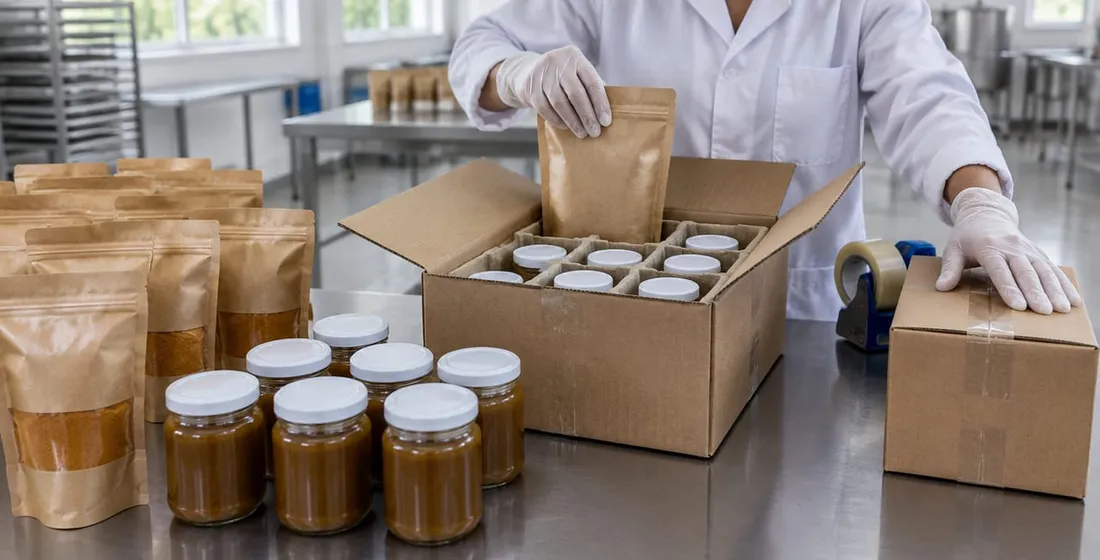
Unprinted kraft spice pouches and jars of coconut jam on a stainless steel packing table, with a gloved worker placing a pouch into a divided corrugated shipping carton.
Buyer’s snapshot
- 52 per cent of Sri Lankan online shoppers prefer cash on delivery, up from 48 per cent a year earlier, according to the Digital Outlook Sri Lanka 2025 report reported by the Daily Mirror (2025).
- Cash on delivery lets the customer refuse a parcel at the door, so a dented pouch or a leaking jar costs the sale, the courier fee and the return leg.
- Silk Foods Ceylon (SFC) co-packs buyer-supplied finished goods into online-ready packs, typically one to two weeks from goods arriving to despatch.
- The format table and the MOQ plan below are the two sections to take into a supplier meeting.
A food SKU that sells well in a supermarket can still fail online. On a shelf, the pack travels on a pallet, then in a case, then sits still under a store light. In a parcel network, the same pack travels alone. It is dropped at a sorting hub, stacked under heavier boxes in a van, and handed over at a doorstep where the customer can inspect it and refuse to pay. This guide works through what changes when a Persona D (local distributor or importer) plans a food SKU for a Sri Lankan e-commerce marketplace first and a retail shelf second: the secondary pack, the label, the case count, and a co-pack run sized for an online launch.
What does “marketplace-ready” mean for a food SKU?
A marketplace-ready food SKU is one that survives single-parcel handling, carries a label that is legal to sell under the Food (Labelling and Advertising) Regulations 2026, arrives at the marketplace warehouse in cases it can receive and pick from, and is produced in a first run small enough to sell through before its expiry date.
Most first briefs treat those as one problem. They are four, and each has a different owner. The courier-safe pack belongs to the packing line. The label belongs to the brand owner and the artwork studio. The case count belongs to whoever negotiates with the marketplace’s inbound team. The run size belongs to the buyer’s cash flow. A co-packer can hold the first and help with the other three, but the brief has to separate them.
The reason it matters in Sri Lanka specifically is payment. According to the US International Trade Administration’s Sri Lanka country commercial guide (2025), about 43 per cent of the country’s estimated 11 million internet users have bought online, and the Western Province accounts for around half of all orders. Many of those orders are paid at the door, which turns packaging damage into a refused delivery rather than a complaint email.
How much handling does a courier parcel take?
More than a retail case. The International Safe Transit Association’s parcel test, ISTA 3A (2018 edition), puts a single packed product through 17 drops, nine before a vibration stage and eight after it, including a drop onto a hazard, and adds an eight-hour leak test for liquids.
ISTA 3A is a laboratory simulation, not a Sri Lankan legal requirement, and no local marketplace asks a small brand for a certificate. It is still the most useful way to think about the journey. The test exists because parcel networks handle each packed product individually, through sortation belts, van loading and manual handoffs. A retail case of 24 jars shares the shock of a drop between 24 units and a corrugated wall. A single jar in a courier satchel takes it alone.
The standard also defines a “small” package as one under 13,000 cm³, no longer than 350 mm and no heavier than 4.5 kg. Almost every single-unit food order falls inside that box, which is why the small-package sequence is the one worth copying as an in-house check. A practical version needs no lab: pack ten units exactly as they will ship, drop each from table height onto a concrete floor on its corners, edges and faces, shake the liquid packs upside down, and open them. If one in ten shows a crack, a seal leak or a crushed corner, the secondary pack is not ready.
Which pack formats survive the courier network?
Pouches survive better than jars, and jars survive better than most brand owners expect once they are properly sleeved. The table below is the format matrix the co-packing team uses when a distributor asks which of the Matale facility’s stock packs to put online first.
| Format (SFC stock) | Courier risk | Secondary pack that works | Common failure | Suggested case count to the marketplace |
|---|---|---|---|---|
| Kraft stand-up pouch, 50 g to 250 g, with zip | Low | Padded mailer or a small carton for multi-unit orders | Zip splits when the pouch is overfilled | 24 or 48 per case |
| Kraft pouch, 500 g to 1 kg | Low to medium | Carton, not a satchel, above 500 g | Heat seal peels under stacking weight | 12 or 24 per case |
| Glass jar, 220 ml to 330 ml | Medium | Moulded pulp sleeve or corrugated divider inside a carton | Jar-to-jar contact in multi-unit orders | 12 or 24 per case, divided |
| Glass jar, 500 ml to 1 L | High | Individual carton with pulp ends | Base crack from a flat drop | 6 or 12 per case, divided |
| Capsule bottle, 60 count | Low | Padded mailer | Cap backs off without an induction seal | 24 or 48 per case |
| Glass bottle, 200 ml, liquid | High | Individual sleeve plus a leak-proof inner bag | Closure weeps after vibration | 12 or 24 per case, divided |
Three rules sit behind that table. First, no glass travels loose in a satchel, whatever the courier’s rate card allows. Second, liquids get an induction seal under the cap and an inner bag, because a single leaking bottle ruins every other item in a multi-product order. Third, the case count should divide cleanly into the bundles the listing will sell. A 12-unit case suits a listing that sells singles, twin packs and six-packs. A 10-unit case forces the warehouse to split and re-tape, and every re-tape is a chance to lose a unit or a batch code.
Service snapshot: Co-Packing for an online-first SKU
- Service: the buyer supplies finished goods; SFC packs, seals, labels and prepares cases (Co-Packing on the SFC brochure)
- Pack range: kraft pouches 50 g to 1 kg, glass jars 50 ml to 1 L, 60-count capsule bottles
- Run size: planned as a one-day production block, often consolidated across two to four SKUs
- Lead time: typically one to two weeks from finished goods arriving to despatch
- Cert coverage: BRCGS- and FSSC 22000 V6-audited, with Sri Lanka Food Act labelling compliance on every retail SKU
What does the label need for an online listing?
The same as a supermarket label. The Food (Labelling and Advertising) Regulations 2026, gazetted as No. 2494/47 and in operation from 1 July 2026, apply to any food product manufactured from that date, whichever channel sells it. There is no lighter e-commerce version.
In practice that means the common name in bold in Sinhala, Tamil and English, consumer warnings in all three languages, the expiry date in at least two, and a bold date of manufacture and expiry on the main panel in one of the prescribed formats. The full element-by-element checklist, with regulation numbers, is in Sri Lanka’s food labelling regulations for 2026.
Online selling adds two practical points that the regulations do not spell out. The listing photographs have to match the pack that ships, so a mid-run label change needs new listing images before the new stock goes live. And the batch code and expiry date should be readable without opening the outer carton, because a marketplace warehouse picks by expiry and a picker who cannot see the date will pick by guesswork. Where a category also carries a compulsory Sri Lanka Standard, the SLSI mark question is separate from the label and is covered in which retail categories make the SLSI mark mandatory.
Where do online-first SKUs actually go wrong?
The packing team at the Matale facility sees one pattern more than any other on first online briefs, and it is rarely the primary pack. A distributor arrives with a well-sealed pouch or a properly capped jar that has already sold in a shop. The failures happen in the space between the product and the courier: a jar that shares a carton with two others and no divider, a 1 kg pouch sent in a satchel that splits along the side seam, a bottle cap that loosens after a day in a hot van.
The fix is usually cheaper than the loss. Take a first-run plan of 1,200 units across three SKUs and a refusal-and-return rate that doubles from two per cent to four per cent because of visible damage. That is 24 extra failed deliveries, each carrying a lost sale, a courier fee and a return leg. A pulp sleeve or divider at LKR 25 to 40 per glass unit, an assumption for small-run 2026 pricing rather than a quote, usually costs less across a run than those 24 returns.
The Digital Outlook Sri Lanka 2025 report, as covered by the Daily Mirror in May 2025, names the ability to reject an order on delivery as one of the reasons shoppers stay with cash on delivery. That is the commercial logic in one line: in a cash-on-delivery market, the customer inspects the pack before paying for it.
| Secondary pack line (per unit shipped) | Pouch, 100 g | Glass jar, 330 ml | Assumption used |
|---|---|---|---|
| Padded mailer or small carton | LKR 35 | LKR 70 | Small-run 2026 rates, not a quotation |
| Pulp sleeve or divider share | Not needed | LKR 30 | Moulded pulp at low volume |
| Void fill and tape | LKR 5 | LKR 10 | Paper void fill |
| Induction seal (liquids and capsules only) | Not needed | Not needed | Add about LKR 8 for bottles |
| Secondary pack total | LKR 40 | LKR 110 | Before courier fee |
The numbers are planning estimates so the table can be rebuilt with real quotes. The point they make holds at most price levels: a jar costs nearly three times as much to ship safely as a pouch, before the courier fee, which is why many online-first ranges launch in pouches and add jars later.
How big should a first co-pack run be for an online launch?
Smaller than a supermarket launch, and split across more SKUs. Silk Foods Ceylon plans co-packing as a one-day production block rather than a fixed per-SKU unit floor, so an online-first distributor can put two to four SKUs through the same day and keep each quantity close to what the listing can sell before expiry.
The sell-through maths drives the number. A marketplace warehouse typically wants enough stock for several weeks of orders, and it will not accept stock with too little shelf life left. Work backwards from three numbers: the expected weekly orders per SKU, the declared shelf life, and the portion of that shelf life the marketplace requires on receipt. A spice pouch with a 12-month shelf life can carry a larger first run than a coconut jam with six months. If the shelf life has not yet been established, accelerated stability testing is the step that sets it.
A worked example, using planning assumptions rather than a quote, shows the shape:
- SKU A, a 100 g spice pouch, 12-month shelf life, expected 60 orders a week: first run of 600 pouches, about ten weeks of stock.
- SKU B, a 250 g pouch of the same spice, 30 orders a week: 300 pouches.
- SKU C, a 330 ml coconut jam jar, six-month shelf life, 30 orders a week: 300 jars, divided 12 to a case.
That is 1,200 units across one consolidated day, with each SKU sized to sell through well inside its date. The same day on a single SKU would push the jam past its useful shelf life before it sold. Who holds that stock after packing, and on whose books, is covered in warehousing, despatch and stock ownership with a co-packer.
Where SFC walks away
Silk Foods Ceylon does not repack goods for a seller who has no documentation for where the finished goods came from, because the batch code on an online pack still has to trace back to a supplier. It also declines glass-in-satchel packing specifications, whoever the courier is.
Build the online brief before you brief a co-packer
A brief that arrives with these answers usually reaches a packed sample within a week of the finished goods landing. One without them usually spends that week finding them.
Buyer’s checklist
- The SKU list, with pack format and net weight for each
- Where the finished goods come from, with batch documentation
- The marketplace’s inbound case requirements and minimum remaining shelf life on receipt
- Expected weekly orders per SKU for the first ten weeks
- Which SKUs will ship as bundles, and the bundle sizes
- Label artwork status against the 2026 regulations, and who approves the proof
- A ten-unit drop and shake test result on the current pack, if one has been done
For the format decisions behind a smaller spice pack, see co-packing 50 g and 100 g spice pouches for the e-commerce tier. For imported bulk that has to become an online SKU first, see co-packing for online grocery and marketplace fulfilment and co-packing imported cashews and dates for e-commerce.
Frequently asked questions
Does a food product sold online in Sri Lanka need the same label as one sold in a shop?
Yes. The Food (Labelling and Advertising) Regulations 2026, in operation from 1 July 2026 under Gazette No. 2494/47, apply to food manufactured from that date regardless of sales channel. The common name must appear in bold in Sinhala, Tamil and English, and the expiry date in at least two of the three languages.
How do I know if my food packaging is safe for courier delivery?
ISTA 3A (2018), the International Safe Transit Association’s parcel test, puts a packed product through 17 drops and a vibration stage, with an eight-hour leak test for liquids. A simple in-house version is to pack ten units as they will ship, drop each from table height on corners, edges and faces, then inspect.
Why does packaging damage cost more online in Sri Lanka?
Because most orders are paid at the door. The Digital Outlook Sri Lanka 2025 report, covered by the Daily Mirror in May 2025, found 52 per cent of online shoppers prefer cash on delivery and cited the option to reject orders on delivery. A damaged pack is often refused, adding a courier fee and a return leg.
What is the co-packing MOQ at Silk Foods Ceylon for an online-first launch?
Silk Foods Ceylon plans co-packing as a one-day production block rather than a fixed per-SKU minimum, often consolidating two to four SKUs in the same day. Lead time is typically one to two weeks from finished goods arriving to despatch, and the facility is BRCGS- and FSSC 22000 V6-audited.
How Silk Foods Ceylon can help
For a distributor or importer preparing a food SKU for a Sri Lankan e-commerce marketplace, Silk Foods Ceylon runs Co-Packing at its cellular-manufacturing facility at Silk AgTech Park in Hapugasyaya, Matale. The buyer supplies finished goods; the SFC team packs them into kraft pouches from 50 g to 1 kg, glass jars from 50 ml to 1 L or 60-count capsule bottles, applies compliant labels, and prepares divided, marketplace-ready cases. Runs are planned as a one-day block that can carry two to four SKUs, with a typical one to two weeks from goods arriving to despatch. The facility is BRCGS- and FSSC 22000 V6-audited, with Sri Lanka Food Act labelling compliance built into every retail SKU.
To brief an online-first co-packing run, email b2b@esilkroute.com.lk or call +94 76 441 0389 / +94 76 918 5744.
Sources
- Government of Sri Lanka, Food (Labelling and Advertising) Regulations 2026, Gazette Extraordinary No. 2494/47 of 26 June 2026, in operation from 1 July 2026, on mandatory label particulars, language requirements and date formats. eohfs.health.gov.lk (retrieved 25 September 2026).
- International Safe Transit Association, ISTA 3A Packaged-Products for Parcel Delivery System Shipment 70 kg (150 lb) or Less, 2018 edition, overview document, on the drop and vibration sequence, the small-package definition and the leak test for liquids. ista.org (retrieved 25 September 2026).
- Daily Mirror, “Sri Lankan online shoppers stick to cash on delivery amid digital payment hesitation”, 2 May 2025, reporting the Digital Outlook Sri Lanka 2025 report by the Asia Pacific Institute of Digital Marketing and the University of Kelaniya. dailymirror.lk (retrieved 25 September 2026).
- US International Trade Administration, Sri Lanka Country Commercial Guide, eCommerce, on online purchase adoption among internet users and the Western Province share of orders. trade.gov (retrieved 25 September 2026).
- Further reading: Ministry of Health, Sri Lanka, Food Control Administration Unit, current regulations register under the Food Act No. 26 of 1980. eohfs.health.gov.lk (retrieved 25 September 2026).
Written by the Silk Foods Ceylon Team. Silk Foods Ceylon (Pvt) Ltd. is a BRCGS- and FSSC 22000 V6-audited contract manufacturer in Matale, Sri Lanka, offering contract manufacturing, private labelling, co-packing, and in-house R&D for local Sri Lankan brand owners, FMCG companies, hotel and restaurant groups, and distributors. To brief a project: b2b@esilkroute.com.lk, +94 76 441 0389, or +94 76 918 5744.