Branded In-Room Breakfast Condiments for a Hotel Group
By the Silk Foods Ceylon Editorial Team
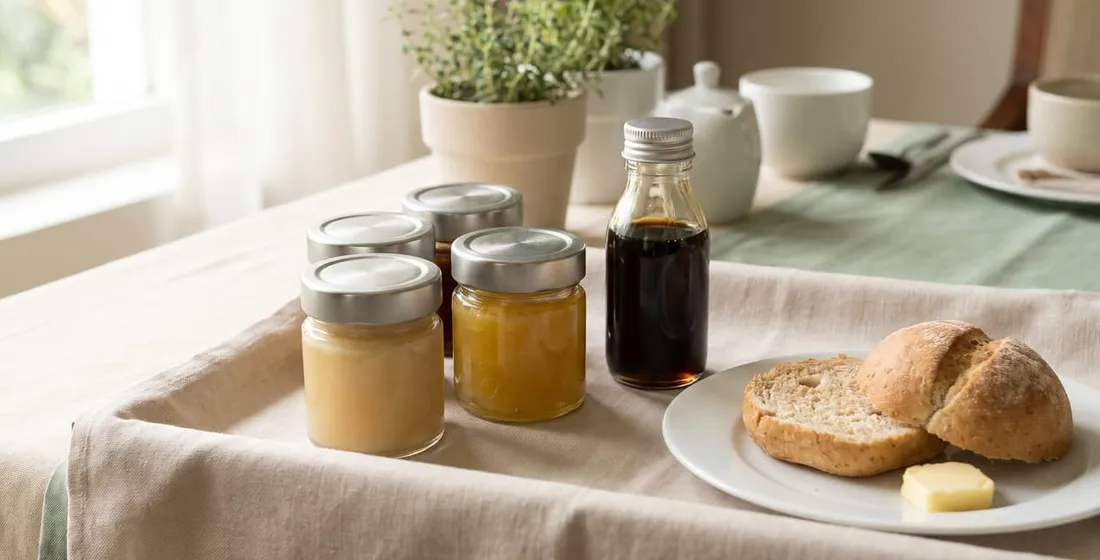
A breakfast tray with a row of small plain glass jars of pale coconut jam and golden pineapple jam beside a small glass bottle of dark treacle, every jar and bottle blank and unlabelled.
Buyer’s snapshot
- Sri Lanka’s 2026 labelling regulations exempt packs of 25 g or 30 ml and under from the full label, provided the dispenser they come from is labelled at the point of sale (Government of Sri Lanka, Gazette 2494/47, regulation 5(3), 2026). A 50 ml in-room jar is above that line and carries the full label.
- The label, not the jar fill, is usually the slowest step in a hotel condiment range.
- Plan the factory clock separately from the approval clocks: sample dispatch runs 1 to 2 weeks and purchase order to dispatch 2 to 3 weeks for an existing recipe.
- Silk Foods Ceylon (SFC) welcomes small runs, quote on request.
A hotel group that wants its own breakfast jam, treacle and spread on the in-room tray tends to think the hard part is the recipe. It is not. The recipe can come off a shelf. What takes weeks is deciding what a 50 ml jar has to say, in how many languages, in what size of type, and who signs it off before a printer cuts a plate.
Silk Foods Ceylon (SFC) makes private-label condiments at its Matale facility under a hotel group’s brand. This guide is for a group’s food and beverage, procurement and brand teams planning a branded breakfast range of two or three condiments. It does not repeat the hotel approval sequence in who signs off a hotel signature line, the portfolio rollout in rolling one blend across a hotel group, or the general commissioning checklist in the HORECA private-label buyer’s guide. It looks at the three decisions specific to a jar-and-bottle breakfast range: portion size, the label, and the weeks from brief to first delivery.
What counts as a breakfast condiment range?
A breakfast range is two or three condiments that share one label system and one filling schedule. A realistic first range for a Sri Lankan hotel tray is a coconut jam, a fruit-flavoured variant of that jam, and a treacle in a small bottle. SFC’s portfolio already carries natural coconut jam in original and pineapple, and treacles filled into glass on the liquid line, so none of the three needs a new recipe.
That is the point of starting from the portfolio. A recipe that already exists skips the R&D step, and the group’s brand goes on a product the Matale team already makes. Where a group wants a flavour that is not in the portfolio, the R&D team takes the brief to an approved formulation in 3 to 4 weeks at most, and that time is added in front of everything below.
Sri Lanka had 1,717,028 tourist arrivals by 4 October 2026, with the winter season still ahead and the Sri Lanka Tourism Development Authority’s revised full-year scenarios running from 2,377,370 to 2,603,311 arrivals (Daily FT, citing SLTDA, 2026). A group that wants a branded range on trays for that season has to start well before the guests arrive, because the label clock is not one the factory controls.
Why does the jar size decide how much label you need?
The jar size decides which label rules apply to it. The 2026 regulations exempt prepackaged food that weighs no more than 25 g, or measures no more than 30 ml, from the main declarations on the pack, but only if the dispenser it is customarily sold from is available at the point of sale and is itself labelled to the regulation (Government of Sri Lanka, Gazette 2494/47, regulation 5(3), 2026).
For a breakfast tray that matters in two ways. A true single-serve portion at or under the line can ride on a labelled carton or tray. But SFC’s smallest stock glass jar is 50 ml, which is above 30 ml, so a 50 ml in-room jar gets no exemption. It carries the full set of declarations on its own label, in a space about the size of a thumbnail.
Neither size is wrong. A 50 ml jar can be taken home, which suits a group that wants its brand to leave with the guest. A smaller portion suits less waste. Decide it in the brief, because it fixes the label area before any artwork is drawn.
| Choice | At or under 25 g / 30 ml | 50 ml jar |
|---|---|---|
| Label on the pack | Exempt if the dispenser is labelled at the point of sale | Full declarations on the pack |
| Where the full label lives | On the carton or tray the portions come from | On every jar |
| Guest takes it home | Unlikely, it is consumed at the table | Yes, the jar is a keepsake |
| Brand space | Small, and the carton carries the identity | Small, and every jar carries the identity |
Confirm the jar and closure on the quote; the private-label jam guide covers jar tiers.
What does the label have to carry on a 50 ml jar?
A jar label has to carry nine things in a very small space. On the main panel it needs the common name of the product in bold, in all three languages or in any two on the main panel and the third on another panel, and the net contents in SI units (Government of Sri Lanka, Gazette 2494/47, regulation 5(1), 2026). Elsewhere on the pack it needs:
- a complete ingredient list, in descending order of weight;
- the name and address of the manufacturer, and of the packer if different;
- the batch number or a decipherable code;
- the date of manufacture;
- the date of expiry, in any two of Sinhala, Tamil and English;
- nutrition labelling in letters of at least 1 mm;
- storage instructions in at least two of the three languages, unless the Chief Food Authority allows an exception for a small surface.
The regulations also size the type. The letters of the common name must be at least one third the size of the letters of the trade or brand name, whichever is larger, with a minimum height of 3 mm (Government of Sri Lanka, Gazette 2494/47, regulation 6(a), 2026). This is where hotel branding and the label collide. A hotel’s logo is designed to be large. On a 50 ml jar, a large logo forces a larger common name, which pushes the ingredients and the languages out of the space.
The Codex general standard adds the principle behind the batch rule: each container is marked, in code or in clear, to identify the producing factory and the lot (Codex Alimentarius, CXS 1-1985, section 4.6). The batch code is applied at filling, so the hotel’s artwork has to leave a clean area for it.
A treacle in a small glass bottle has a small convenience. For bottled food the regulations allow the date of expiry, batch number and date of manufacture to be stamped on the bottle neck, in letters of at least 1.5 mm (Government of Sri Lanka, Gazette 2494/47, regulation 5(2)(c), 2026). That frees space on the bottle’s main label, though the bottle size and neck stamp are confirmed per quote and not assumed.
One label system for three condiments
A range works best when the three condiments share one label grid. The hotel’s brand sits in the same place on every jar, the common name in three languages has the same band, and only the flavour name, ingredient list and nutrition panel change. One grid is approved once. Each new condiment then becomes a content change inside an approved layout, not a new artwork.
| Element | Fixed across the range | Changes per condiment |
|---|---|---|
| Hotel brand mark and position | Yes | No |
| Common name band, in three languages | Position and size | The words |
| Ingredient list | Format and type size | Content |
| Nutrition panel | Format | Values per product |
| Manufacturer and packer address | Yes | No |
| Batch and expiry area | Yes, kept clear | Printed at filling |
| Storage instruction | Wording, two languages | Only if the product differs |
If a group later adds a fourth condiment, the grid is already approved and the change is one new content block, not a restarted approval chain.
The weeks from brief to first delivery
The factory clock for a portfolio recipe under a hotel’s brand is short. Sample dispatch for an existing recipe takes 1 to 2 weeks. Once the label is approved and a purchase order is placed, dispatch takes 2 to 3 weeks. Together that is 3 to 5 weeks of factory time. If the group wants a flavour that is not in the portfolio, add 3 to 4 weeks at most for R&D in front.
The factory clock is not the whole timeline. Three other clocks run beside it, and none belong to SFC.
| Clock | Whose it is | What SFC can say |
|---|---|---|
| Sample dispatch, existing recipe | SFC | 1 to 2 weeks |
| Purchase order to dispatch | SFC | 2 to 3 weeks |
| R&D, if a new flavour is needed | SFC | 3 to 4 weeks at most |
| Label artwork and the hotel’s own sign-off | The group | Set by the group’s approval chain |
| Printing the labels | The printer | Confirm with the printer’s quote |
| SLSI clearance | SLSI | SLSI publishes no processing time, so confirm the current window with SLSI before committing to a date |
The practical consequence is that the first date a group can promise to a property is set by the slowest of the buyer-side clocks, not the jar fill. A group that starts the label and the SLSI submission in the same week as the sample request gets its first delivery sooner than one that waits for samples before briefing the printer.
A scenario to plan for: one range, six properties
Picture a group with six properties that wants three breakfast condiments under one brand. The brand team drafts a label with the hotel’s logo across the top third of a 50 ml jar. At the artwork review, the common name in three languages no longer fits at 3 mm, because it must be at least one third the height of the logo letters.
There are two fixes. Shrink the logo, or move to a larger jar. Each costs a round of approval. A group that checks the type rule on the first draft loses nothing. A group that finds it at the printer’s proof loses the week the printer needed, and an SLSI submission filed on the first artwork may need refiling on the changed one.
A second trap is the property cut. Properties often want a different line on the label, such as the property name. A property name on the label is a different SKU for the printer and a new artwork for the approvals. The better arrangement is one range label with the group’s brand, and the property carried on the carton or the tray, where the property name does not need its own label approval.
What to lock before briefing a breakfast range
A breakfast range brief fits on one page when these are decided first:
- The condiments: which portfolio recipes, and whether any need R&D.
- The pack: jar or bottle, size, closure, and whether a portion at or under 25 g or 30 ml is wanted.
- The label grid: brand position, three-language common name band, and the clear area for the batch and expiry print.
- The languages: which two or three appear, and where.
- The first delivery: one property first or all six, and who receives it.
- The sample plan: a sample of each condiment approved in person at Matale or by courier.
- The approval path: who in the group signs the label, and in what order.
SFC does not suit a group that wants the label designed before the pack size is chosen, or one that wants to cover every property with its own label on the first run. SFC will say so at the brief.
Frequently asked questions
Does a 50 ml hotel jam jar need a full label under the 2026 regulations?
Yes. The exemption covers prepackaged food of 25 g or 30 ml and under, provided the dispenser it is sold from is labelled at the point of sale (Government of Sri Lanka, Gazette 2494/47, regulation 5(3), 2026). A 50 ml jar exceeds both limits, so it carries the full declarations itself.
How big must the product name be next to a hotel logo?
The common name letters must be at least one third the size of the letters of the trade or brand name, whichever is larger, and never under 3 mm in height (Government of Sri Lanka, Gazette 2494/47, regulation 6(a), 2026). A large hotel logo therefore forces a larger product name on the same label.
How long does a branded condiment range take from brief to first delivery?
For portfolio recipes the factory clock is 3 to 5 weeks: 1 to 2 weeks for samples and 2 to 3 weeks from purchase order to dispatch. A new flavour adds up to 4 weeks of R&D. Label approval, printing and SLSI clearance run on the buyer’s side and are confirmed separately.
Does Silk Foods Ceylon make private-label breakfast condiments for hotel groups?
Yes. Silk Foods Ceylon offers private labelling of its portfolio recipes, including natural coconut jam and treacles in glass, under a hotel group’s brand. Small runs are welcome, quote on request. The jar, closure and label grid are agreed in the brief, and the quote confirms them.
How Silk Foods Ceylon can help
For hotel and restaurant groups planning an in-room breakfast range, Silk Foods Ceylon (SFC) offers Private Labelling of its portfolio recipes at the Matale facility, with R&D available at 3 to 4 weeks at most for a flavour outside the portfolio. Small runs are welcome and quoted on request, and a range of two or three condiments can be planned as one production block. An existing recipe typically reaches sample dispatch in 1 to 2 weeks and dispatch in 2 to 3 weeks from purchase order. The facility is BRCGS- and FSSC 22000 V6-audited, with SLSI clearance and Sri Lanka Food Act compliance support for every retail SKU.
To brief an in-room programme, email b2b@esilkroute.com.lk or call +94 77 157 7294.
Sources
- Government of Sri Lanka (2026), Extraordinary Gazette No. 2494/47 of 26 June 2026, Food (Labelling and Advertising) Regulations 2026, regulations 5 and 6, on declarations, languages, type size, the 25 g and 30 ml exemption and bottle-neck dating. eohfs.health.gov.lk (retrieved 4 November 2026).
- Daily FT (2026), “Tourism crosses 1.7 m arrivals, but remains behind 2025 pace”, citing Sri Lanka Tourism Development Authority data to 4 October 2026. ft.lk (retrieved 4 November 2026).
- Codex Alimentarius (revised 2024), CXS 1-1985, General Standard for the Labelling of Prepackaged Foods, section 4.6 on lot identification. cibum.gr copy (retrieved 4 November 2026).
Written by the Silk Foods Ceylon Team. Silk Foods Ceylon (Pvt) Ltd. is a BRCGS- and FSSC 22000 V6-audited contract manufacturer in Matale, Sri Lanka, offering contract manufacturing, private labelling, co-packing, and in-house R&D for local Sri Lankan brand owners, FMCG companies, hotel and restaurant groups, and distributors. To brief a project: b2b@esilkroute.com.lk or +94 77 157 7294.