Seasoning Sachets and Portion Packs for Sri Lankan Hotel Kitchens
HORECA snapshot
- Sri Lanka recorded 2.36 million tourist arrivals in 2025, up 15.1 percent year on year, per Daily FT reporting SLTDA data in January 2026. Kitchen volume across a multi-property group moved with it.
- A four-lane sachet line runs about 280 packs per minute. At a 3 g fill that is roughly 50 kg per hour, well under the 100 to 200 kg per hour the Silk Foods Ceylon spice line reaches on pouches.
- Below roughly 12 g per pack, a sachet programme is bound by pack count, not by tonnage. That single fact reorders how a hotel group should size its order.
- Co-packing is booked as a production block, typically one day, rather than a per-property minimum. Where the seasoning is supplied by the facility the documented minimum is 50 kg per SKU.
Sri Lanka took 2.36 million tourist arrivals in 2025, a 15.1 percent increase on 2024 and the highest annual figure on record, according to Daily FT reporting Sri Lanka Tourism Development Authority data in January 2026. Earnings passed 3.2 billion US dollars. For a hotel group that arrives in the kitchen as covers, and covers arrive as seasoning consumption nobody has measured since the last budget cycle.
Most Sri Lankan food-service kitchens still buy seasoning in 5 kg and 25 kg packs and decant. A sous chef opens a sack, tips it into a plastic container on the bench, and the lot code stays behind in the store room. Cheap on the invoice line, expensive nearly everywhere else. What follows is the alternative worked through: fill throughput, case counts, the real minimum order, and the arithmetic against carrying on with the sack.
What a portion-pack programme actually replaces
A portion-pack programme replaces the decanting step. Instead of a 25 kg sack feeding an unlabelled kitchen container, the same powder arrives pre-weighed in sealed packs sized to a recipe or a service period, opened at the bench and discarded. Batch identity travels with the product to the point of use.
Codex Alimentarius treats that as prepackaged food rather than bulk. CXS 1-1985 defines prepackaged as packaged in advance ready for offer to the consumer or for catering purposes, and defines foods for catering purposes as those used in restaurants, canteens, schools and hospitals. A sack in a store room is a non-retail container. A 10 g sachet handed to a line cook is a prepackaged food, and it carries obligations the sack does not.
The retail-facing side of the same capability is covered in co-packing for supermarket and hotel gift-shop channels.
Why does bulk decanting cost more than the sack price suggests?
Bulk decanting looks cheaper because the only visible number is price per kilogram. Its real costs sit in three places that never reach the purchasing spreadsheet: product lost at the bench, labour spent weighing and refilling, and traceability that ends the moment powder leaves a labelled pack. The United Nations Environment Programme put food services at 28 percent of global food waste in its Food Waste Index Report 2024, some 290 million tonnes in 2022.
Take the waste line alone. A group running 40 sacks of 25 kg a month at a 2 percent loss to spillage, caking and over-scooping discards 240 kg a year of product already paid for. That is a planning illustration. The useful version comes off the group’s own scale weights, and most kitchens have never run it.
The traceability line is harder to price and easier to defend. Once a sack is decanted into an unlabelled container, lot identity is gone. A group that cannot say which properties received a given lot cannot recall that lot, and an auditor reading the food-safety plan will ask exactly that.
| Line item | 25 kg sack, decanted | Portion pack, co-packed | Direction in LKR |
| Packaging cost per kilogram | Lowest available | Adds laminate and fill cost | Higher |
| Product lost at the bench | Spillage, caking, over-scooping on every open | One sealed pack per use | Lower |
| Kitchen labour | Weigh, decant, refill, clean the container | Open and discard | Lower |
| Lot traceability to point of use | Ends at the store room | Code printed on every pack | Avoided cost |
| Moisture pickup in an open container | High in a Sri Lankan kitchen | Sealed until the moment of use | Lower |
| Portion consistency between properties | Set by whoever holds the scoop | Set by the fill weight | Lower rework |
Line rate and the full format ladder sit in the spice and herb co-packing capability one-pager.
Sachet throughput is counted in packs, not kilograms
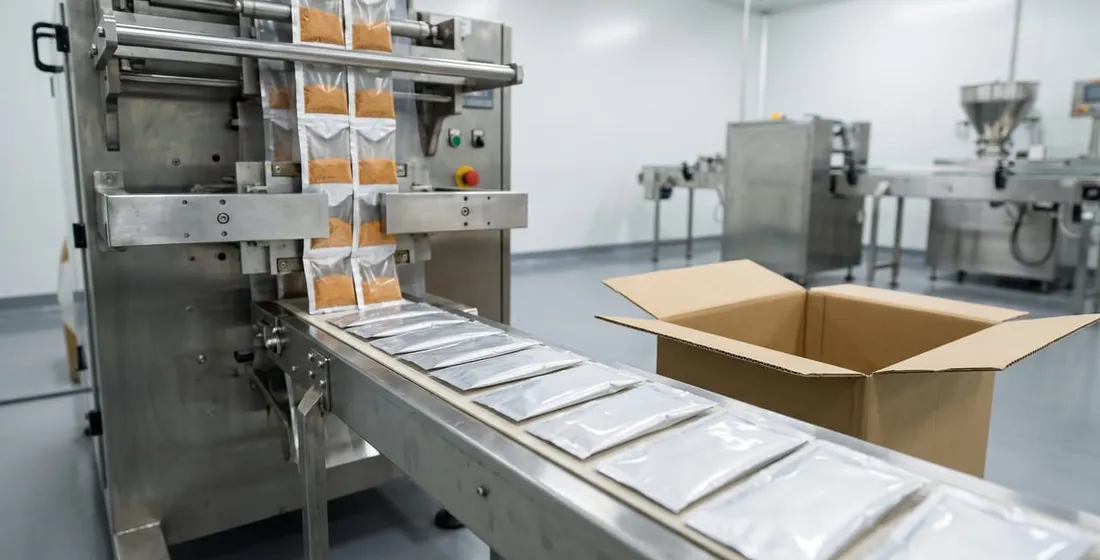
Sachet throughput is set by lanes and cycles, not by tonnage. Matrix Packaging Machinery specifies its INVpack multilane flat sachet platform at 280 packs per minute across four lanes and 700 across ten, with sachet width falling from 100 mm at four lanes to 40 mm at ten. Those two numbers, packs per minute and face width, decide most of what follows.
The planning consequence appears in the arithmetic. At 280 packs per minute a 3 g sachet yields about 50 kg per hour, a 5 g sachet about 84, a 10 g pack about 168. The Silk Foods Ceylon (SFC) spice and herb line at Matale is rated at 100 to 200 kg per hour on pouches, so at roughly a 12 g fill the constraint flips: below it the line is bound by packs it can form and seal, above it by powder it can move.
| Fill weight | Output at 280 packs per minute | Planning case count | Typical kitchen use |
| 3 g sachet | About 50 kg per hour | 1,000 sachets per case, 3 kg net | Table seasoning, room-service tray |
| 5 g sachet | About 84 kg per hour | 1,000 sachets per case, 5 kg net | One-pan dosing for a small batch |
| 10 g portion pack | About 168 kg per hour | 500 packs per case, 5 kg net | Line-cook mise en place |
| 30 g portion pack | At or near the line rate ceiling | 250 packs per case, 7.5 kg net | Banquet and outside catering |
| 1 kg kraft pouch | Line rate, 100 to 200 kg per hour | 10 pouches per case, 10 kg net | High-turnover staples |
Case counts above are planning figures, confirmed against the carton a group already handles. The practical reading: do not portion everything. High-turnover, low-sensitivity seasonings are cheaper left in a 1 kg pouch. Portion packs earn their cost where the dose matters, where the product is expensive, or where consistency between properties is the point.
The same fill economics on a shelf rather than a bench are worked through in 50 g and 100 g spice pouches for the e-commerce tier, and groups running a parallel retail line off the same seasoning should read private-label curry powder for the supermarket shelf.
What a five-property group actually orders
Take five properties and six seasonings in common use: roasted and unroasted curry powder, chilli, black pepper, garlic powder and a mixed herb blend. Three move enough volume to stay in 1 kg pouches. Three are dosing-sensitive and go to 10 g portion packs.
The minimum is not per property. Co-packing at Matale is booked as a production block, typically a single day, because the block is what gets scheduled. Where SFC supplies the seasoning rather than packing buyer-supplied goods, the engagement becomes private labelling and the documented minimum applies: 50 kg per SKU, with volume tiers at 500 kg, 1,000 kg and 2,500 kg.
| Item | Figure | What it means for the group |
| Portion-pack SKUs | 3 of 6 | The dosing-sensitive ones, at 10 g |
| Minimum per portion-pack SKU | 50 kg where the facility supplies the seasoning | 5,000 sachets per SKU at a 10 g fill |
| First order, three SKUs | 150 kg, about 15,000 sachets | 30 cases at 500 packs per case |
| Split across five properties | About 60 kg and 10 cases each | Roughly a quarter of annual use for a mid-size kitchen |
| Fill time at 280 packs per minute | About 54 minutes of running time | Changeovers, not the fill, occupy the day |
| Lead time from goods arriving | 1 to 2 weeks | Artwork sign-off and coding format, not capacity |
The line that surprises procurement is fill time. Fifteen thousand sachets is under an hour of machine running. Three changeovers, each carrying a line clean and a first-article check, are what fill the block. A fourth SKU costs changeover time rather than fill time, which is why one consolidated block beats five property-by-property orders on cost per kilogram.
The wider hospitality picture sits in the HORECA private-label buyer’s guide.
Does a 3 g seasoning sachet need a full label?
Under Sri Lankan law a small pack gets relief. The Food (Labelling and Advertising) Regulations 2022 set an exemption threshold at packs of 25 g or below, which places most seasoning sachets under it. Above the threshold the full rules apply: common name in bold in all three languages at no less than one third of the brand-name letter height and a minimum of 3 mm, other declarations at no less than 1.5 mm, an expiry date in at least two of Sinhala, Tamil and English, and a readable lot code.
Timing matters this year. The United States Department of Agriculture Foreign Agricultural Service reported in February 2025 that implementation of the 2022 regulations had moved to 1 July 2025, and a further gazette that June moved it to 1 January 2026. The regime is now in force, so a programme specified in 2026 is specified against the current rules.
The clause worth knowing sits in the international standard. Codex CXS 1-1985 lets small units below 10 square centimetres of largest surface area drop several mandatory particulars, then carves out one category by name: with the exception of spices and herbs. Seasoning is the single food group Codex refuses to let off the small-unit hook. A group packing for its own Sri Lankan kitchens follows the local threshold. A group whose brand later sells that sachet to a guest, or ships it to an export buyer aligned to Codex, gets a different answer on the same physical pack.
The packaging desk at Matale meets the geometry problem before the legal one. A ten-lane configuration runs a 40 mm sachet face. Fitting a tri-lingual common name at 3 mm, other declarations at 1.5 mm and a legible lot code onto 40 millimetres is arithmetic, not design. Groups wanting a fully declared pack end up at four or six lanes and a wider face, which halves the packs per minute.
Where a sachet crosses into something a guest buys, the SLSI packaged-food submission, step by step, sets out the route, and the upstream powder spec is covered in specifying coriander, cumin and fennel for a curry powder.
Frequently asked questions
What is the minimum order for seasoning sachets at Silk Foods Ceylon?
Co-packing buyer-supplied seasoning is booked as a production block, typically one day, rather than against a tonnage minimum. Where the facility supplies the seasoning the engagement is private labelling, with a documented minimum of 50 kg per SKU and volume tiers at 500 kg, 1,000 kg and 2,500 kg.
How many seasoning sachets can a co-packing line fill per hour?
A four-lane multilane sachet platform runs about 280 packs per minute, per Matrix Packaging Machinery specifications, rising to 700 per minute at ten lanes. At a 10 g fill that is roughly 168 kg per hour. Below about a 12 g fill the constraint is pack count rather than tonnage.
Do back-of-house seasoning sachets need a Sri Lankan food label?
Packs of 25 g or below sit under the exemption threshold in the Food (Labelling and Advertising) Regulations 2022, in force since 1 January 2026. Codex CXS 1-1985 takes the stricter position and excludes spices and herbs from its small-unit exemption, which matters if the pack is ever sold or exported.
Is a portion pack actually cheaper than decanting a 25 kg sack?
Not on packaging cost per kilogram, which rises. It is cheaper on bench waste, kitchen labour and rework, and it restores lot traceability to the point of use. The United Nations Environment Programme attributed 28 percent of global food waste to food services in its 2024 index, some 290 million tonnes.
Can Silk Foods Ceylon co-pack portion packs for a multi-property hotel group?
Yes. Six SKUs across five properties consolidate into a single production block at the Matale facility, which is cheaper per kilogram than property-by-property orders because changeovers rather than fill time occupy the day. Lead time is one to two weeks from finished goods arriving at the facility.
How Silk Foods Ceylon can help
For hotel and restaurant groups standardising back-of-house seasoning across properties, Silk Foods Ceylon (SFC) runs a dedicated co-packing capability at the 10,000 sq ft cellular-manufacturing facility in Matale. The buyer supplies finished goods, and the SFC team handles filling, sealing, coding and labelling under the Sri Lanka Food Act framework, with SLSI submission support where a pack crosses into retail. Formats run from sachet and portion-pack sizes through 50 g to 1 kg kraft pouches and 25 kg and 50 kg sacks, on a spice and herb line rated at 100 to 200 kg per hour. The site is BRCGS- and FSSC 22000 V6-audited, the certificate stack a hospitality procurement team asks for when it audits the chain behind its own kitchens.
To brief a portion-pack or co-packing programme, email brands@esilkroute.com.lk or call +94 76 441 0389 / +94 76 918 5744.
Sources
FAO and WHO Codex Alimentarius Commission, General Standard for the Labelling of Prepackaged Foods, CXS 1-1985, adopted 1985 and amended through 2010. fao.org. Retrieved 18 August 2026.
USDA Foreign Agricultural Service, Sri Lanka Extends Implementation of the Food Labeling and Advertising Regulations-2022 by Additional Six Months, GAIN report CE2025-0003, 26 February 2025. apps.fas.usda.gov. Retrieved 18 August 2026.
Daily FT, Tourism arrivals grow by 15% to 2.36 m record high in 2025, 6 January 2026, reporting Sri Lanka Tourism Development Authority data. ft.lk. Retrieved 18 August 2026.
Matrix Packaging Machinery, INVpack VFFS Multilane Flat Sachets MVA9 machine specification, 2026. matrixpm.com. Retrieved 18 August 2026.
United Nations Environment Programme, Food Waste Index Report 2024, published March 2024. unep.org. Retrieved 18 August 2026.