Costing a fried and seasoned snack production run in Sri Lanka
By the Silk Foods Ceylon Editorial Team
Buyer’s snapshot
- Sri Lanka’s Food and Beverage exports reached USD 583.89 million in 2025, up 24.23 percent year on year, largely on a 40.4 percent rise in processed food exports (Sri Lanka Export Development Board, January 2026).
- Industrial power at 400/230V above 42 kVA now costs LKR 39.00 per kWh at peak and LKR 16.50 per kWh off peak, effective 11 May 2026 (Public Utilities Commission of Sri Lanka, 2026). A fryer booked on the wrong shift pays 2.4 times the off-peak rate for the same output.
- That revision raised I2 and I3 industrial tariffs by 18 percent while holding the smaller I1 category flat, so moving from a pilot line to a demand-metered one changes the cost base twice: once on the unit rate, once on the demand charge.
- Frying and seasoning are one process choice. Extrusion is a different one, and it needs a co-manufacturer with an extruder. Silk Foods Ceylon (SFC) runs battering, breading and frying plus a 100 to 200 kg per hour spice line at its BRCGS- and FSSC 22000 V6-audited Matale facility, and does not operate an extrusion line.
A Sri Lankan snack brand with distribution already in place tends to arrive at a contract manufacturer with a single number in mind: the price per pack. It is the wrong number to start with, not because it does not matter, but because it is the output of four decisions that have not been made yet. Which process the snack is made by, how the seasoning goes on, what the pack has to protect against, and how many units the first run commits to.
Sri Lanka’s Food and Beverage exports reached USD 583.89 million in 2025, a 24.23 percent rise driven largely by a 40.4 percent increase in processed food exports, according to the Sri Lanka Export Development Board. More local brands are costing snack runs than at any point in recent years. This piece walks the costing in the order the decisions actually get made, using real Sri Lankan cost inputs rather than a generic per-kilo figure.
Fried or extruded: the process decision comes first
Fried and extruded snacks look similar on a shelf and cost very differently to make. A fried snack starts from a formed or sliced piece, which is battered or breaded if the recipe calls for it, then cooked in oil and seasoned after the fryer. An extruded snack starts from a dry meal that is cooked, expanded and shaped in a single pass through an extruder, then dried and seasoned. The extruder is a capital machine with its own die tooling; the fryer is not.
The practical consequence for a brand is that these are rarely the same supplier. A co-manufacturer equipped for battering, breading and frying is not automatically equipped to extrude, and asking for an extruded format from a fried-snack line produces either a polite no or an expensive subcontract. Establishing which process the target product needs, before the RFQ goes out, saves a costing round.
| Factor | Fried and seasoned route | Extruded route |
| Starting material | Formed, sliced or coated pieces | Dry meal or grits blend |
| Key machine | Battering, breading and frying line | Extruder with product-specific die tooling |
| Tooling cost on a new shape | Low; shape comes from forming or slicing | High; a new die is a capital item per shape |
| Oil as a cost line | Significant, and it degrades with use | Minimal; oil is applied at seasoning only |
| Seasoning point | After the fryer, onto a warm surface | After drying, usually onto a warm surface |
| Realistic first-run scale | Thousands of units per SKU | Higher, to justify die and changeover time |
What throughput per shift actually tells a buyer
Throughput per shift is the figure most quoted and least useful in isolation, because a line rarely runs a full shift on one SKU. A realistic shift contains changeover, a start-up period where the first output is off-spec, the production window itself, and clean-down. On a fried line the clean-down is not optional, since oil carryover between a garlic and curry leaf seasoning and a plain salted variant is the fastest way to lose a flavour specification.
The number a brand should ask for is saleable units per shift for its own SKU at its own pack size, not machine capacity. Those two figures can differ by a third once changeover and start-up losses are counted. Where a run is small enough that changeover eats a meaningful share of the shift, consolidating several SKUs into one production block is usually cheaper per unit than booking them separately.
That consolidation logic is the same one that governs co-packing blocks, and a brand moving its first production out of a small kitchen environment will recognise the pattern from the first-run move into contract manufacturing.
The fryer sets the oil spec, and the oil spec sets a limit
Oil is the input a fried-snack costing most often underestimates, because it is consumed twice: absorbed into the product, and degraded in the fryer. Frying oil oxidises with heat and time, and the standard quality marker is peroxide value. The Codex Alimentarius standard for named vegetable oils sets a maximum peroxide value of 10 milliequivalents of active oxygen per kilogram for refined oils, which is the ceiling a manufacturer manages the fryer against.
In costing terms that ceiling becomes an oil turnover rate: a defined volume of fresh oil added per production hour to hold the peroxide value below the limit. A brand that asks only for the oil cost per kilogram of product, without asking how the turnover rate was assumed, is comparing quotes built on different assumptions. Two suppliers can quote the same oil price and deliver very different product stability.
This is also where a product’s shelf-life claim starts. Oxidation that begins in the fryer continues in the pack, so the fryer discipline and the pack specification are one problem, not two.
Where a shelf-life figure has to be defended rather than estimated, it is set by testing, not by assumption; the method is covered in accelerated stability testing for Sri Lankan conditions.
Seasoning application and the tolerance nobody writes down
Seasoning is where a snack brand’s product either survives scale-up or quietly changes. A kitchen batch is seasoned by eye onto a small quantity. A production run applies seasoning at a set rate onto a moving, warm product, and the variable that matters is the pickup rate: the percentage of seasoning by weight that actually adheres.
The recurring failure is not a bad seasoning blend. It is an unwritten tolerance. A brand signs off a first production sample, then raises a complaint three runs later on a batch that met every written parameter, because the seasoning pickup drifted within a range nobody had agreed. Measuring the pickup on the approved sample and writing that figure with a tolerance band into the specification costs nothing at sign-off and settles the argument before it happens.
Blend consistency sits upstream of that. A seasoning applied at a controlled rate is only as repeatable as the powder going into the applicator, which means a defined mesh size and a blend produced to the same specification each time rather than mixed per run.
The grinding and sieving discipline behind a repeatable seasoning powder is the same one used for retail spice SKUs, described in the private-label curry powder specification.
Pillow packs, nitrogen flush and what to put in the pack spec
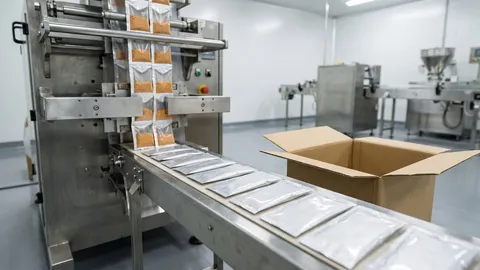
A pillow pack is produced on a form fill machine: film is formed into a tube, filled, and sealed top and bottom. It is the default retail format for snacks because it is fast and the film carries the artwork. What the format does not decide by itself is what is inside the pack besides the product.
Nitrogen flushing replaces most of the air in the pack with nitrogen before sealing, which cuts the oxygen available to continue the oxidation that started in the fryer, and adds a gas cushion that reduces breakage in transit. It is a separate capability from the form fill machine itself, requiring a gas supply and a flushing head, so it must be specified and confirmed rather than assumed. A brand that needs it should ask for a residual oxygen target in the pack specification, expressed as a percentage, and ask how it is verified.
Where flushing is not available, the practical alternatives are a shorter stated shelf life, a higher-barrier film, or a smaller pack that turns over faster. All three are legitimate. What is not legitimate is a shelf-life claim carried over from a flushed product onto an unflushed one.
Building the LKR unit cost, including the tariff clock
A snack unit cost is built from raw material, oil, seasoning, film and closure, direct labour, energy, quality and compliance overhead, and the amortised cost of any tooling or artwork. Most brands cost the first four with reasonable accuracy and treat energy as a rounding error. On a fried line, which runs sustained heat, that is the assumption most likely to be wrong.
The Public Utilities Commission of Sri Lanka’s tariff decision effective 11 May 2026 makes the point sharply. For an industrial consumer supplied at 400/230V with contract demand above 42 kVA, energy costs LKR 39.00 per kWh during the peak window of 18:30 to 22:30, LKR 19.00 during the day window, and LKR 16.50 off peak between 22:30 and 05:30. The same production, scheduled into the off-peak window rather than the evening peak, costs 2.4 times less in energy for an identical output.
The same decision raised I2 and I3 industrial tariffs by 18 percent while holding the I1 category flat, and set the demand charge at LKR 1,650 per kVA with a fixed charge of LKR 6,000 per month at that supply level. Demand charge is billed on peak demand drawn, not on units consumed, which means a short burst of simultaneous fryer and packing draw can set a monthly charge that a longer, flatter production schedule would avoid.
| Cost line | What drives it | What to ask the co-manufacturer |
| Raw material | Recipe and yield after cooking losses | Yield assumption used in the quote |
| Oil | Absorption plus fryer turnover rate | Turnover rate assumed to hold peroxide value |
| Seasoning | Blend cost and pickup percentage | Pickup rate and its tolerance band |
| Film and closure | Pack size, barrier grade, flush or no flush | Whether a residual oxygen target is met |
| Energy | Shift window and contract demand | Which tariff window the run is scheduled into |
| Compliance | Label, testing and clearance work | What sits inside the engagement and what does not |
Costing a run directly against a manufacturer rather than through an intermediary also removes a margin layer that is rarely visible on a quote, an effect examined in the true cost of the broker layer in Sri Lankan FMCG.
MOQ per run, and why it is set by changeover
A first-run minimum is not an arbitrary gate. It is the volume at which a production block absorbs its own changeover and clean-down. For frozen fried formats such as patties and nuggets, a first run typically sits at 5,000 to 10,000 units per SKU. For powder and blend SKUs the equivalent floor is 50 kg per SKU, with volume tiers opening at 500 kg, 1,000 kg and 2,500 kg.
Lead time is the other half of the commitment. On an existing recipe, dispatch typically runs 2 to 3 weeks from purchase order. Where formulation work is needed first, that extends to 6 to 10 weeks, since the recipe iterations sit ahead of the production booking. A brand planning a shelf date backwards from a promotion needs both figures, plus the clearance window covered below.
What the pack has to carry before it reaches a shelf
Sri Lanka’s Food (Labeling and Advertising) Regulations 2022 came into force on 1 January 2026, after the Ministry of Health extended the implementation date from 1 July 2025 in an extraordinary gazette dated 30 June 2025. They are now the operative requirement for any packaged snack sold locally, and on the point that costs the most artwork area they are stricter than the 2005 regulations they replaced: where the older rules accepted a label printed in any two of the three languages used in Sri Lanka, the 2022 regulations require the common name in bold type in all three, English, Sinhala and Tamil. The label must also carry the ingredient list, the manufacturer or packer details, batch code, and manufacture and expiry dates.
For a snack brand this is a design constraint, not just a compliance one. A pillow pack has limited printable area, and a three-language common name plus a nutrition panel consumes more of it than a first artwork round usually allows for. Discovering that after the film is printed is an expensive way to learn it.
Artwork and print lead time is a scheduling dependency in its own right, set out in the artwork and print lead-time guide, and the mandatory clearance route for a packaged food SKU is walked through in the SLSI submission guide. Budget 4 to 8 weeks for SLSI clearance on a stable formulation, and hold a 6 to 10 week buffer between manufacturer sign-off and the retail shelf date.
Frequently asked questions
What is the minimum order quantity for a fried snack run in Sri Lanka?
For frozen fried formats such as patties and nuggets, a first run typically sits at 5,000 to 10,000 units per SKU, the volume at which a production block absorbs its own changeover and clean-down. Powder and seasoning blend SKUs start at 50 kg per SKU, with volume tiers opening at 500 kg, 1,000 kg and 2,500 kg.
How much does electricity add to the unit cost of a fried snack?
It depends far more on the shift window than on the volume. Under the Public Utilities Commission of Sri Lanka tariff effective 11 May 2026, an industrial consumer at 400/230V above 42 kVA pays LKR 39.00 per kWh at peak against LKR 16.50 off peak, a 2.4 times difference for identical output, plus a demand charge of LKR 1,650 per kVA billed on peak demand drawn.
Is nitrogen flushing necessary for a fried snack pack?
It is not mandatory, but it materially slows the oxidation that begins in the fryer and cushions the product against breakage in transit. It is a capability separate from the form fill packing machine, so it should be confirmed rather than assumed. Without it, the honest alternatives are a shorter stated shelf life, a higher-barrier film, or a smaller pack size.
Can Silk Foods Ceylon contract manufacture a fried and seasoned snack SKU?
Silk Foods Ceylon (SFC) operates battering, breading and frying equipment alongside a 100 to 200 kg per hour grinding and sieving line for seasoning blends, and form fill, band sealing and vacuum sealing for final packing, all inside a BRCGS- and FSSC 22000 V6-audited facility. Extruded formats need a co-manufacturer with an extrusion line, which SFC does not operate.
How Silk Foods Ceylon can help
For local FMCG brands moving a snack SKU from a small kitchen operation into professional contract manufacturing, Silk Foods Ceylon (SFC) runs a 10,000 sq ft cellular-manufacturing facility at Silk AgTech Park in Nalanda, Matale, on a BRCGS- and FSSC 22000 V6-audited certification stack, with USDA Organic and EU Organic available per SKU and SLSI submission support inside the standard engagement. The relevant equipment for a fried and seasoned snack brief covers battering, breading and frying, a grinding and sieving line running 100 to 200 kg per hour for seasoning blends, and form fill, band sealing and vacuum sealing on the packing side, with kraft pouches available at 50 g, 100 g, 250 g, 500 g and 1 kg.
The in-house R&D team works alongside production planning, so recipe iterations and the production booking can be scoped together rather than in sequence. Sample dispatch on an existing recipe runs 1 to 2 weeks, and 2 to 4 weeks per iteration where new formulation work is involved. Extrusion is outside the facility’s process scope, and a brief that genuinely requires an extruded format is better placed with a co-manufacturer that operates an extruder.
To brief a project, email b2b@esilkroute.com.lk or call +94 76 441 0389 / +94 76 918 5744.
Sources
Sri Lanka Export Development Board, Sri Lanka’s Export Performance Exceeded US$ 17.2 Billion in 2025, published 26 January 2026, reporting Food and Beverage sector exports at USD 583.89 million, up 24.23 percent, largely on a 40.4 percent increase in processed food exports. srilankabusiness.com (retrieved 1 September 2026).
Public Utilities Commission of Sri Lanka, Decision on Electricity Tariffs, May 2026, effective 11 May 2026, for the industrial energy charges of LKR 39.00 per kWh at peak, LKR 19.00 day and LKR 16.50 off peak at 400/230V above 42 kVA, the demand charge of LKR 1,650 per kVA, the fixed charge of LKR 6,000 per month, and the 18 percent revision applied to the I2 and I3 categories while I1 was held flat. pucsl.gov.lk (retrieved 1 September 2026).
United States Department of Agriculture, Foreign Agricultural Service, Sri Lanka Extends Implementation of the Food Labeling and Advertising Regulations-2022 by Additional Six Months, on the extraordinary gazette of 30 June 2025 that moved the implementation date from 1 July 2025 to 1 January 2026, and on the 2022 requirement that common names appear in bold type in all three languages used in Sri Lanka, against the two-language rule under the 2005 regulations. fas.usda.gov (retrieved 1 September 2026).
Codex Alimentarius Commission, Standards for Fats and Oils from Vegetable Sources, on the maximum peroxide value of 10 milliequivalents of active oxygen per kilogram for refined oils. Food and Agriculture Organization of the United Nations. fao.org (retrieved 1 September 2026).
Sri Lanka Standards Institution, on the SLSI certification scheme operating under the Food Act No. 26 of 1980 framework for packaged food sold in Sri Lanka. slsi.lk (retrieved 1 September 2026).