Co-Packing 500 g and 1 kg Sacks for Sri Lanka's Wholesale Trade
Buyer’s snapshot
- Wholesale and retail trade led Sri Lanka’s services expansion in October 2025, with the sector PMI at 66.0 against 58.7 a month earlier (EconomyNext, 2025).
- The 500 g and 1 kg sack is the one format where the packer’s give-away and the trader’s stack height are both cost lines.
- Bulk goods that are repacked must carry the manufacture date and the repackaging date (Ministry of Health Food Control Administration Unit).
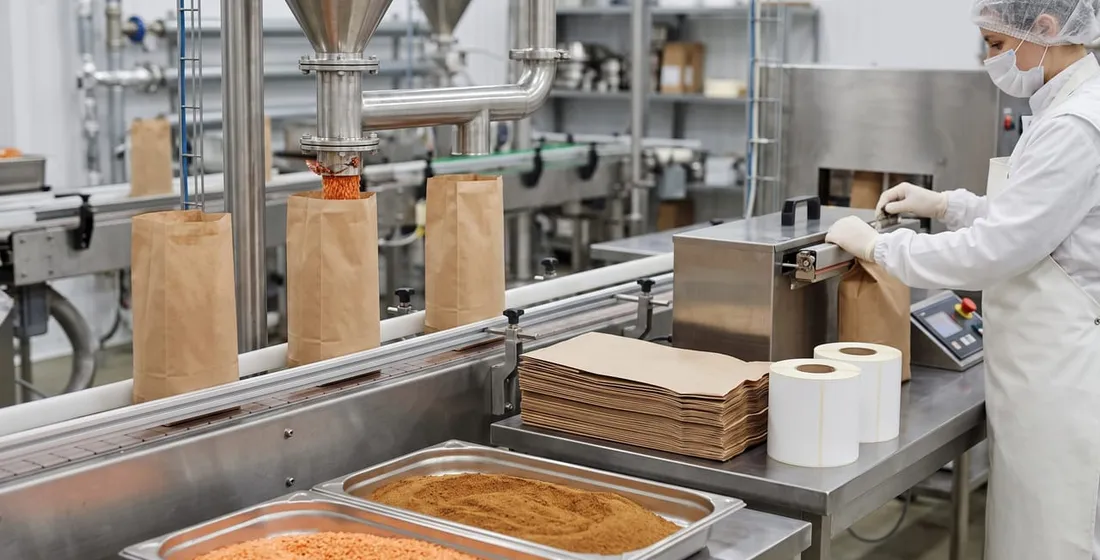
- Silk Foods Ceylon (SFC) co-packs buyer-supplied finished goods into 50 g to 1 kg kraft formats on a BRCGS- and FSSC 22000 V6-audited line.
Wholesale and retail trade led Sri Lanka’s services expansion in October 2025. The sector PMI read 66.0 against 58.7 the month before, and consumer-sector real growth accelerated from 5% in 2024 to 7% in 2025, on EconomyNext’s reporting of the survey. For a distributor moving imported pulses, rice flour, or ground spice through the wholesale trade, that growth arrives in one specific pack format.
It is the 500 g and 1 kg sack. And it is a different engineering problem from the retail pouch, in ways that do not show up on a packaging spec sheet until the first claim comes back.
Why a wholesale sack is not a scaled-up retail pouch
A wholesale sack is built for stacking and storage, not for shelf presentation. It sits in a godown with no climate control, carries the load of five or six sacks above it, and may not reach a household for eight to twelve weeks. Seal integrity and moisture barrier decide whether it survives that. Print quality does not.
The buyer behaves differently too. A supermarket shopper reads the front panel. A wholesale trader picks the sack up, squeezes it, checks the seam, and forms a view on weight by hand before reading anything. A soft seam or a sack that feels light against its neighbours gets discounted at the point of onward sale, and the packer never hears about it.
That gap matters commercially. Retail rejects come back through a procurement desk with a reference number. Wholesale rejects are absorbed as a price adjustment two layers down the chain, so the packer’s first signal is usually a distributor who quietly reorders less.
The distribution-side considerations for smaller kraft formats are covered separately in the note on co-packing kraft pouches for distribution.
Should the SKU run at 500 g or 1 kg?
The choice between 500 g and 1 kg is a turnover decision before it is a pricing decision. A 1 kg sack holds twice the product against the same seal, the same coding step, and roughly the same handling cost per unit, which makes it the cheaper sack to fill. It is also the slower sack to move, and slower movement in a humid godown is the risk the format is supposed to manage.
| Decision factor | 500 g sack | 1 kg sack |
| Packing cost per kilo of product | Higher: two seals, two codes, two labels per kilo | Lower: one of each per kilo |
| Effect of a 5 g overfill | 1.0% of the declared weight | 0.5% of the declared weight |
| Outer case at a 20 kg handling weight | 40 sacks | 20 sacks |
| Godown dwell time before opening | Shorter; suits fast-moving staples | Longer; exposure to humidity and stack load runs longer |
| Where it wins | Trial SKUs, higher-value powders, price-point pack for small traders | Established staples with proven offtake |
| Where it struggles | Packing cost dilutes margin on low-value commodities | Slow movers reach the consumer with less shelf life left |
A practical rule holds for most first launches into the wholesale trade: run the 500 g format first on anything without a sales history, then add the 1 kg once the offtake rate is known. The extra packing cost on the smaller sack buys information, and the information is worth more than the margin it costs in the first two production blocks.
What the sack is made of decides how long the product holds
Sack construction is the single largest lever on wholesale shelf life, and it is usually chosen last. A kraft sack with no barrier layer will pass a factory seal test and still fail in a godown, because the failure mode is slow moisture pickup across weeks, not a burst seam on day one. Ground spice, rice flour, and desiccated products are the formats where that shows first.
| Construction | Moisture barrier | Stack strength | Wholesale fit |
| Single-ply kraft paper | None | Low | Short-dwell, low-hygroscopic goods only |
| Kraft with loose LDPE inner liner | Good | Low to moderate | Common and inexpensive; the liner has to be sealed separately |
| Kraft and polyethylene laminate | Good | Moderate | Single seal step, cleaner line, higher material cost |
| Woven polypropylene with LDPE inner | Good | High | Best for tall stacks and rough handling; less print-friendly |
| Foil laminate pouch | Very good | Low | Overspecified for most wholesale goods; reserve for oxygen-sensitive powders |
For hygroscopic goods the barrier decision runs alongside the fill environment and the storage brief given to the trade, a set of trade-offs also examined in the note on co-packing imported dried fruit into retail pouches.
What has to appear on a repacked wholesale sack?
Labelling for packaged food in Sri Lanka runs off the Food Act No. 26 of 1980 and the regulations made under it, with the Food (Labelling and Advertising) Regulations 2022 replacing the earlier 2005 framework. Net contents are declared in SI units, grams and kilograms for solids, on the reporting of the regulations by the United States Department of Agriculture’s Foreign Agricultural Service. Enforcement sits with the Ministry of Health Food Control Administration Unit.
One requirement catches repackers more than any other. The Food Control Administration Unit states that bulk-imported food which is repackaged must show both the date of manufacture and the date of repackaging. Two dates, not one, on a sack whose contents the packer did not make.
Buyer's checklist: before artwork goes to print 1. Product name, and the true nature of the food, on the principal display panel. 2. Net contents in SI units, grams or kilograms, on the same panel as the name. 3. Date of manufacture of the goods as supplied. 4. Date of repackaging, as a separate declaration. 5. Name and address of the packer, in addition to the importer. 6. Country of origin of the contents. 7. Batch or lot code, traceable back to the incoming consignment. 8. Storage instruction appropriate to a non-climate-controlled godown. |
The two-date rule is the one that lands on the hardware, not the artwork. A distributor who arrives with a printed sack design carrying a single date box has to either add a second coder head at the sealer or reprint the sack stock. Adding a coder head is a day of line work. Reprinting 40,000 pre-printed sacks is six weeks and a written-off inventory line. The order in which those two decisions are taken is worth more than the artwork budget.
Where the wholesale SKU is also destined for organised retail, the clearance pathway is a parallel workstream with its own calendar, set out in the step-by-step guide to an SLSI packaged-food submission.
The fill-weight maths most repackers run backwards
Overfill is invisible on a P&L and expensive in aggregate. Set the target fill 5 g over on a 500 g sack and the give-away is 1.0% of the contents. Across a 20,000-sack production block that is 100 kg of product handed over at no charge. Run the same 5 g overfill on a 1 kg sack and the block gives away the same 100 kg against twice the revenue, which is why the smaller format punishes a loose target setting harder.
Underfill is the more serious exposure, because it is a compliance question rather than a margin question. Codex Alimentarius CXS 1-1985, the general standard for the labelling of prepackaged foods, requires the net-content declaration to appear in the same field of vision as the product name and contemplates enforcement through an average system of quantity control.
Sri Lanka’s legal metrology sits with the Department of Measurement Units, Standards and Services under the Measurement Units, Standards and Services Act No. 35 of 1995, whose Legal Metrology division is mandated to monitor pre-packed commodities. The department does not publish an accessible tolerable-deficiency table for prepackaged food. Absent that, the safe operating position is to treat the declared weight as a floor on every individual sack rather than as an average across a batch, and to confirm the applicable tolerance with the department before a first commercial run rather than after an inspection.
That is a deliberately conservative reading, and it costs a little product. It also removes the failure mode where a batch passes on its mean and fails on a single sack pulled off a trader’s stack.
The same target-setting discipline applies at the other end of the size range, where the arithmetic is harsher still, as covered in the note on co-packing 50 g and 100 g spice pouches.
How a consolidated co-packing block runs
Co-packing at Silk Foods Ceylon sits at the back end of the production chain. The buyer supplies finished goods, and the SFC team packs, seals, labels, and codes them into Sri Lankan retail-ready and wholesale-ready formats. Kraft pouch options run from 50 g to 1 kg, with 25 kg and 50 kg brown sacks and LDPE clear gusseted inner bags available for the bulk end of the same run.
Service snapshot: Co-Packing at Silk Foods Ceylon Service: the buyer supplies finished goods; the Matale facility packs, seals, labels, and codes. Formats: kraft pouches and sacks at 50 g, 100 g, 250 g, 500 g and 1 kg; bulk sacks at 25 kg and 50 kg. Line: band sealer, vacuum sealer, and form-fill packing machine, with grinding and sieving available where the goods need a size-reduction step at 100 to 200 kg per hour. Lead time: typically 1 to 2 weeks for a co-packing run once finished goods arrive at the facility. Cert coverage: BRCGS- and FSSC 22000 V6-audited, with SLSI clearance and Sri Lanka Food Act compliance on retail SKUs. |
Consolidation is where the economics improve for a distributor. Several imported SKUs run through one packing line in a single production block, which spreads the changeover and sanitation cost across the whole set rather than loading it onto whichever SKU happened to be booked alone. A distributor with four imported staples and two formats each is running eight pack configurations, and those eight are cheaper together than in sequence.
The audit chain on the packer’s side is what an organised-retail procurement desk asks about first, and it is the part a distributor cannot retrofit later. That reasoning is set out in the notes on contract manufacturing certifications in Sri Lanka and on switching co-packers without breaking the audit chain. For distributors already running an export-facing line, the 250 g kraft pouch format for the ethnic grocery channel covers the adjacent decision.
Frequently asked questions
What does the co-packing service at Silk Foods Ceylon include for 500 g and 1 kg sacks?
The buyer supplies finished goods. The Matale facility packs, seals, labels, and codes them into kraft formats from 50 g to 1 kg, with bulk sacks at 25 kg and 50 kg on the same run. Lead time is typically 1 to 2 weeks once goods arrive. The line is BRCGS- and FSSC 22000 V6-audited.
Does a repacked wholesale sack need both a manufacture date and a repackaging date?
Yes. The Ministry of Health Food Control Administration Unit states that bulk-imported food which is repackaged must show the date of manufacture and the date of repackaging. Plan the coding hardware around two date fields before artwork is printed, because adding a coder head costs a day and reprinting sack stock costs weeks.
Should a new wholesale SKU launch at 500 g or 1 kg?
Run 500 g first on anything without a sales history, then add 1 kg once offtake is known. The 1 kg sack is cheaper to fill, at one seal and one code per kilo against two, but it dwells longer in a godown with no climate control, which is where moisture pickup and stack load do their damage.
How much product does a 5 g overfill give away across a production block?
A 5 g overfill is 1.0% of a 500 g sack and 0.5% of a 1 kg sack. Across a 20,000-sack block either setting gives away 100 kg of product. Codex Alimentarius CXS 1-1985 contemplates an average system of quantity control, but confirm the applicable tolerance with the Department of Measurement Units, Standards and Services first.
How Silk Foods Ceylon can help
For distributors converting imported bulk into Sri Lankan wholesale-ready and retail-ready SKUs, Silk Foods Ceylon operates a dedicated co-packing capability at the Matale facility. The buyer supplies finished goods; the SFC team handles packing, sealing, labelling, coding, and SLSI submission support under the Sri Lanka Food Act labelling framework. Packaging spans 50 g to 1 kg kraft pouches and sacks, 25 kg and 50 kg bulk sacks, glass jars from 50 ml to 1 L, and 60-count capsule bottles, with a typical 1 to 2 week lead time once finished goods arrive. The BRCGS and FSSC 22000 V6 cert stack on the repacker side is what an organised-retail procurement desk asks about before it asks about price.
To brief a co-packing or consolidation plan, email brands@esilkroute.com.lk or call +94 76 441 0389 / +94 76 918 5744.
Sources
EconomyNext, “Sri Lanka services expand in October, led by wholesale, retail trade: PMI” (2025). https://economynext.com/sri-lanka-services-expand-in-october-led-by-wholesale-retail-trade-pmi-248746/
Central Bank of Sri Lanka, “Inflation in April 2026 (CCPI)” (2026). https://www.cbsl.gov.lk/en/news/inflation-in-april-2026-ccpi
Ministry of Health, Food Control Administration Unit, food labelling and import guidance (accessed 2026). https://eohfs.health.gov.lk/food/index.php?option=com_content&view=article&id=2&Itemid=136&lang=en
Food Act No. 26 of 1980 (Sri Lanka), consolidated text. https://www.srilankalaw.lk/YearWisePdf/1980/FOOD%20ACT,%20NO.%2026%20OF%201980.pdf
United States Department of Agriculture, Foreign Agricultural Service, GAIN report on Sri Lanka’s Food (Labelling and Advertising) Regulations 2022 (2023). https://apps.fas.usda.gov/newgainapi/api/Report/DownloadReportByFileName?fileName=Sri+Lanka+Enacts+New+Legislation+for+Food+Labeling+and+Advertising_Colombo_Sri+Lanka_CE2023-0011.pdf
Department of Measurement Units, Standards and Services, Legal Metrology division, under Act No. 35 of 1995 (accessed 2026). https://www.measurementsdept.gov.lk/
Codex Alimentarius, CXS 1-1985, General Standard for the Labelling of Prepackaged Foods (revised 2024). https://www.fao.org/input/download/standards/32/CXS_001e.pdf
Sri Lanka Standards Institution, standards and certification schemes (accessed 2026). https://slsi.lk/
All sources retrieved 9 August 2026.
Written by the Silk Foods Ceylon Team. Silk Foods Ceylon (Pvt) Ltd. is a BRCGS- and FSSC 22000 V6-audited contract manufacturer in Matale, Sri Lanka, offering contract manufacturing, private labelling, co-packing, and in-house R&D for local Sri Lankan brand owners, FMCG companies, hotel and restaurant groups, and distributors. To brief a project: brands@esilkroute.com.lk, +94 76 441 0389, or +94 76 918 5744.