What the Matale Food Factory Runs: A One-Page Capability Sheet
By the Silk Foods Ceylon Team
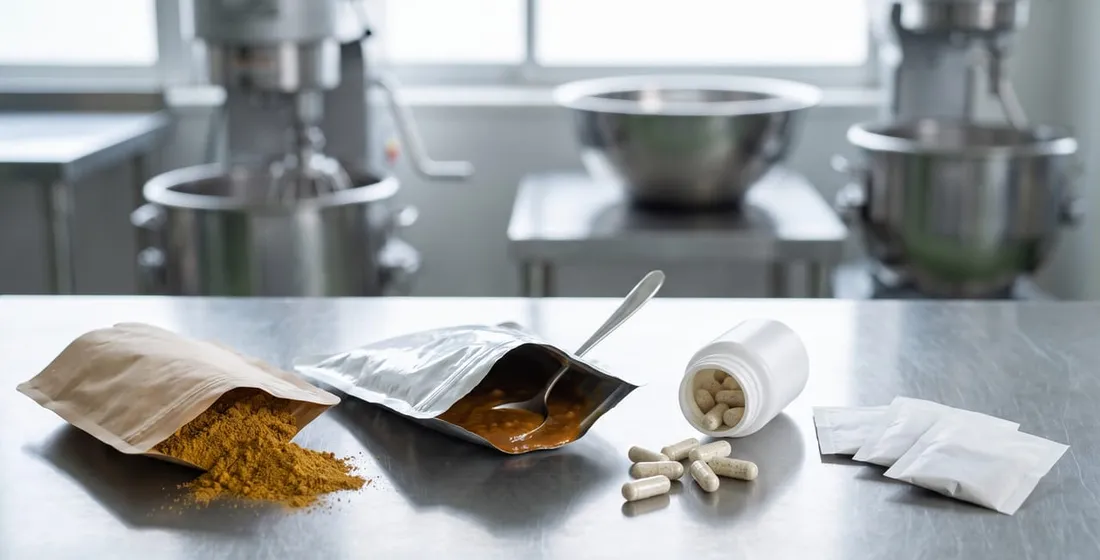
Four plain, unbranded product formats on a brushed stainless steel table: ground golden spice powder spilling from a kraft pouch, an open retort pouch of brown curry sauce, a bottle of herbal capsules and a row of small white powder sachets.
Buyer’s snapshot
- Sri Lanka exported US$449.91 million of spices in 2025, across 40,302.14 tonnes, according to the Sri Lanka Export Development Board.
- The Matale facility of Silk Foods Ceylon (SFC) runs four blocks in one hall: grinding and sieving, cooking and retort, capsule filling, and pouch and sachet sealing.
- Documented rates: 100 to 200 kg an hour on the spice line, 200,000 capsules a day, 3,000 jars a day on semi-liquids.
- The process-block table and the fit table below are the two to forward to your team. Figures not yet documented are marked as such.
Sri Lanka shipped 40,302.14 tonnes of spices in 2025 (Sri Lanka Export Development Board, 2026). Between that tonnage and the pack a shopper picks up sit grinding, mixing, heat treatment, filling and sealing. The question a brand owner asks first is simple. Which parts of that journey can one factory do under one audit?
This page is the one-sheet answer for the Silk Foods Ceylon (SFC) facility at Silk AgTech Park, Hapugasyaya, Matale. It lists the process blocks, the rate or format each one runs, the packs that come out the other end, and where a block’s numbers are not yet published. Nothing here is a quotation. It is a map to decide which conversation to start.
What process blocks does the Matale facility run?
The facility runs six documented process blocks in a layout of about 10,000 square feet: grinding and sieving, cooking and preparation, retort, liquid filling and capping, spray drying, and capsule production, with packing and sealing at the back end. Capsule output is 200,000 a day; the spice line runs 100 to 200 kg an hour.
| Block | What it does | Documented figure | What comes out |
|---|---|---|---|
| Grinding and sieving | Crushing, pulverising, sieving to a set mesh, grading and destoning | 100 to 200 kg an hour | Spice and herb powders; bulk sacks and kraft pouches |
| Cooking and preparation | Washing, dicing, mixing tank, steam-jacketed kettle | 1,500-jar first run on spreads | Jams, sauces, curry bases, pre-processed fruit |
| Retort | Heat treatment of sealed packs, with cleaning-in-place for the vessels | Daily output not yet published | Shelf-stable curry pouches, glass-bottled plant milks |
| Liquid filling and capping | Duplex filter, homogeniser, filler, glass-bottle capper | 3,000 jars a day (semi-liquid); 2,500 bottles of 200 ml a day (beverage) | Glass jars and bottles from 50 ml to 1 L |
| Spray drying | Prep tank, colloid mill, spray drier | 50 kg single-day batch | Plant milk and fruit powders |
| Capsule production | Powder to filled capsule, bottled in 60-count units | 200,000 capsules a day; 180-bottle first run | White or black capsule bottles |
| Packing and sealing | Band sealer, vacuum sealer, form-fill machine | Sachet run size scoped per SKU | Pouches, sachets, sealed retail packs |
Behind those blocks sit the utilities: reefer storage for frozen and chilled goods, a boiler for steam, a backup generator and an air compressor. They are part of what an auditor walks through.
How does the dry side of the hall work?
Dry processing at the facility means crushing, pulverising and sieving spices and herbs to a specified mesh at 100 to 200 kg an hour, then bagging into 50 g to 1 kg kraft pouches or 25 kg and 50 kg sacks, or feeding the powder to the capsule machine. The first-run floor is 50 kg per SKU on bulk powder.
The detail of formats and line rate for spices sits in the spice and herb co-packing one-pager.
The same ground powder can leave the hall three ways. It can go into a kraft pouch as a retail spice, into a bulk sack for another packer, or into a capsule as an herbal supplement. The capsule route has its own rules: Sri Lanka’s Department of Ayurveda, through the Ayurveda Medicine and Production Regulatory Council, publishes a standard procedure for regulating Ayurveda products, and any SKU that carries a traditional claim needs to be looked at against it before the label is drawn. Capsule economics, including the 180-bottle first run, are in the post on capsule contract manufacturing.
What happens on the wet side: mixing, filling and retort?
Wet processing starts in a mixing tank or steam-jacketed kettle, moves through a filter and filler into glass or pouch, and for shelf-stable products ends in the retort, which holds sealed packs at roughly 115 to 121 °C. Semi-liquid filling runs 3,000 jars a day; the retort’s daily output is not yet published.
A retort cycle has three stages: come-up, a holding stage where lethality is delivered, and a cooling stage, and the pouch or jar is exposed to roughly 115 to 121 °C during the hold (Jimenez and co-authors, Food Science and Nutrition, 2024). What decides the schedule is the pack, not the machine. The Canadian Food Inspection Agency notes that for flexible pouches the maximum thickness strongly affects the cold-spot temperature, because thicker packages heat more slowly, and that studies should run at the maximum specified thickness (CFIA, retrieved October 2026).
That is why this page does not print a retort output figure. A curry pouch at one thickness and a glass bottle of plant milk will not share a cycle, and a single “units a day” number would mislead. The working rules, with the cycle-time reasoning, are in the note on the 300 g curry pouch retort.
For powdered drinks, the wet side has a branch. Liquids can be spray dried in a 50 kg single-day batch, then sealed into sachets. Sachet runs are scoped per SKU against the packing block, and the formats are set out in the post on sachet and stick-pack co-packing.
One hall, three SKUs: how does a brief route through it?
A single brand owner with a curry powder, a ready-to-heat curry pouch and a herbal capsule can run all three through one facility under one audit, with one set of supplier and traceability records. That is the practical meaning of a multi-block hall: fewer audits, fewer handovers and a shorter list of people to call.
Take a worked example, not a client. A local food brand has three products at different stages. The curry powder is a locked recipe and needs only pouching. The curry pouch has a good kitchen recipe that has never seen a retort. The capsule is a new idea with no formulation. In a broker chain, that is three suppliers, three audit files and three different lead times. At one facility it is one purchase order sequence, with the locked recipe moving first.
The usual planning mistake on a brief like this is to treat the pouch and the capsule as if they ran on the same clock. They do not. The locked powder can be in a pouch within the standard 2 to 3 weeks from purchase order to dispatch. The retort recipe needs trials against pouch thickness first. The capsule, with no formulation, begins in R&D / NPD (Co-Development on the SFC brochure), which takes 3 to 4 weeks at most from signed brief to approved formulation. Putting them in the right order saves a re-plan. The scheduling logic is set out in scheduling a production run on a shared line.
Which service fits which brief?
Four services run across the blocks. Contract Manufacturing makes a buyer’s locked recipe at scale. Private Labelling relabels an SFC product. Co-Packing packs goods the buyer supplies. R&D / NPD builds a recipe from a brief. The right one depends on who owns the recipe and who owns the raw material.
| Your starting point | Service | Blocks used | Reference number |
|---|---|---|---|
| Locked recipe, you want it made at scale | Contract Manufacturing | Cooking, filling, retort or packing | 1,500 jars or 1,250 bottles first run |
| An SFC product under your brand | Private Labelling | The block that makes the chosen SKU | 180 bottles (capsules); 50 kg per SKU (powders) |
| Finished goods you supply, need packing and labelling | Co-Packing | Packing and sealing; liquid filling for bulk liquid | Typically a one-day production block |
| An idea or a kitchen recipe, no formulation | R&D / NPD (Co-Development) | Pilot work, then the production block | 3 to 4 weeks at most to approved formulation |
Retail and hotel-group buyers will also ask what stands behind the hall. The facility is BRCGS- and FSSC 22000 V6-audited, and every retail SKU carries Sri Lanka Standards Institution (SLSI) clearance and Sri Lanka Food Act compliance. SLSI publishes no processing-time promise, so confirm the current window with SLSI directly before fixing a shelf date. The reasons for a multi-line layout rather than a single line are in why a cellular factory sits in Matale.
Where does this sheet stop, and who is it not for?
This sheet stops at documented numbers. Retort daily output, sachet minimums and bulk-liquid co-packing minimums are not yet published, so they are scoped per brief. The facility is a poor fit for sub-minimum hobby batches, for brands with no label or SLSI plan, and for resellers with no manufacturer relationship.
Where SFC walks away
- Runs below the first-run reference for the format, such as fewer than 180 capsule bottles.
- Briefs where the recipe, the pack and the claim are all undecided and no retail conversation exists. A few more rounds of kitchen testing will cost less than a booked slot.
- Products the facility does not make: MCT oil and softgel encapsulation are not offered.
A blank on this sheet is a prompt to ask, not a reason to guess.
Frequently asked questions
Does Silk Foods Ceylon offer contract manufacturing for more than one product format?
Yes. The Matale facility runs spice and herb grinding at 100 to 200 kg an hour, semi-liquid filling at 3,000 jars a day, retort, spray drying and capsule production at 200,000 capsules a day. A brand owner can run several formats under one audit and one purchase order sequence.
What is the minimum order for a first run at the facility?
It depends on the format. Reference first runs are 1,500 jars for spreads in 300 g glass, 1,250 bottles for beverages in 200 ml, 180 bottles for capsules, 50 kg per SKU for powders and 5,000 to 10,000 units for patties or nuggets. Sachet and retort minimums are scoped per brief.
How long from brief to a first commercial batch?
On a locked recipe, 2 to 3 weeks from purchase order to dispatch, after sample approval. Where no formulation exists, R&D / NPD takes 3 to 4 weeks at most from signed brief to approved formulation, then the production window follows. SLSI timing sits outside both and should be confirmed directly.
Why is there no retort output figure on this page?
Retort output depends on the pack. The Canadian Food Inspection Agency notes that pouch thickness strongly affects cold-spot heating, and thicker packs heat more slowly (CFIA, 2026). A curry pouch and a glass bottle run different cycles, so a single daily figure would mislead; it is scoped against the pack.
How Silk Foods Ceylon can help
For a local brand owner or distributor with more than one format to place, Silk Foods Ceylon offers Contract Manufacturing across the grinding, cooking, retort, capsule and packing blocks at its Matale facility, with first runs from 180 capsule bottles, 1,250 bottles or 1,500 jars. R&D / NPD runs 3 to 4 weeks at most from signed brief to approved formulation. The facility is BRCGS- and FSSC 22000 V6-audited, with SLSI clearance and Sri Lanka Food Act compliance on every retail SKU.
To brief a project, email b2b@esilkroute.com.lk or call +94 77 157 7294.
Sources
- Sri Lanka Export Development Board, Spices, Essential Oils and Oleoresins in Sri Lanka, on 2025 export revenue of US$449.91 million and volume of 40,302.14 MT. srilankabusiness.com (retrieved 28 October 2026).
- Canadian Food Inspection Agency, Heat-penetration studies, on worst-case temperature response, maximum pouch thickness, load pattern and come-up time. inspection.canada.ca (retrieved 28 October 2026).
- Jimenez, P.S., Bangar, S.P., Suffern, M. and Whiteside, W.S. (2024), “Understanding retort processing: A review”, Food Science and Nutrition 12(3), on the three-stage cycle and the 115 to 121 °C range. pmc.ncbi.nlm.nih.gov (retrieved 28 October 2026).
- Department of Ayurveda, Sri Lanka, Ayurveda Medicine and Production Regulatory Council, on the standard procedure for regulating Ayurveda products. ayurveda.gov.lk (retrieved 28 October 2026).
- Silk Foods Ceylon, internal capacity and lead-time reference: spice line 100 to 200 kg an hour, 200,000 capsules a day, 3,000 jars a day, first-run minimums by format, 2 to 3 weeks from purchase order to dispatch, R&D at 3 to 4 weeks at most (October 2026).
Written by the Silk Foods Ceylon Team. Silk Foods Ceylon (Pvt) Ltd. is a BRCGS- and FSSC 22000 V6-audited contract manufacturer in Matale, Sri Lanka, offering contract manufacturing, private labelling, co-packing, and in-house R&D for local Sri Lankan brand owners, FMCG companies, hotel and restaurant groups, and distributors. To brief a project: b2b@esilkroute.com.lk or +94 77 157 7294.