Scheduling a Production Run on a Shared Line, From PO to Delivery
By the Silk Foods Ceylon Team
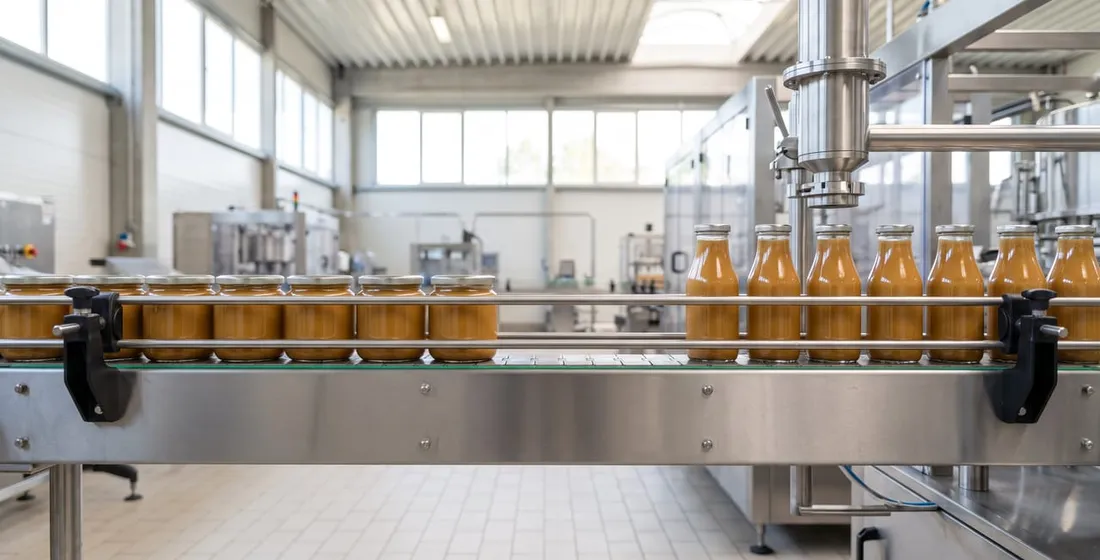
A stainless steel filling line with two separate groups of plain unlabelled glass jars on the conveyor, one squat group and one tall group, with a clear gap of empty belt between them.
Buyer’s snapshot
- On a locked recipe, Silk Foods Ceylon (SFC) runs 2 to 3 weeks from purchase order to dispatch. The run itself is a fraction of that: a 1,500-jar first run takes about half a day on a line that fills 3,000 jars a day.
- A slot on a shared line is a place in a sequence, not just a date. Codex hygiene guidance expects products with different allergen profiles to be separated in space or in time, with cleaning between them.
- The slot only holds if printed packaging and inputs are in hand. A late input moves the run to the next open slot, and the next open slot is not always next week.
- The input-gate table and the back-planning example are the two parts to take into a launch meeting.
Founders usually ask one question about production: how long from the day I order to the day it arrives? The honest answer is a range, 2 to 3 weeks on a locked recipe, and nearly all of it is not machine time. It is the time a run needs to be placed in a sequence, supplied with everything it needs, released after testing and dispatched.
This post explains how that placement works on a shared line at the SFC facility in Matale, and why booking the slot early protects a launch date more than any promise about speed. It is the post-order companion to the 12-week brief-to-shelf calendar, which treats the purchase order as one gate. Here the order is the starting point.
A note on method. The week numbers, jar counts and delays in the worked example are planning figures that show how the arithmetic runs. They are not a quote, and they are not a commitment for any date. The lead times and line rate come from SFC’s own reference figures, and the standards and regulations cited are real.
What do the 2 to 3 weeks between purchase order and dispatch contain?
The 2 to 3 weeks contain six stages, and only one of them is the run. The others are confirming the slot, receiving inputs, sequencing, release testing and dispatch. A brand owner controls two of them directly: whether the inputs arrive, and whether the order is placed with enough notice.
| Stage | What happens | What the brand owner must have done |
|---|---|---|
| Slot confirmation | The run is placed on the line plan against the order | Purchase order placed with the pack and volume locked |
| Inputs in hand | Printed packaging and any bought-in ingredients are received and checked | Packaging delivered to the plant, matching the signed-off artwork |
| Sequencing | The run is ordered against other products on the line | Allergen declaration and any strong colour or flavour stated in the brief |
| Run day | Fill, seal, label and code | Approvals for the first article on the day |
| QC release | Testing against the specification; certificate of analysis issued | Nothing, unless a test fails |
| Dispatch | Pallet or cartons leave the plant with documents | Receiving point and delivery contact confirmed |
The recipe is not on this list. On a locked recipe the formulation is finished, which is exactly why this window is 2 to 3 weeks and not the 3 to 4 weeks R&D takes first. The quote-ready pack lists the five inputs that make a quote firm. Those same inputs are what make a slot firm.
How is a run sequenced on a shared line?
A run is sequenced by what it contains and what it leaves behind. The Codex Alimentarius general principles of food hygiene ask food businesses to prevent cross-contact between allergen-containing foods and other foods by separating them in space or in time, with effective cleaning between foods of different allergen profile, and to protect foods through line-changeover practice or product sequencing (Codex Alimentarius, CXC 1-1969, revised 2020).
On a line shared by several brands, that principle turns into a plain scheduling rule. Two runs that look interchangeable on a calendar are not interchangeable on the floor. A plain jam and a nut-based spread can both fill the same jar, but the order they run in decides how much cleaning sits between them.
For a brand owner this has two practical results. First, the allergen declaration and any strong colour or flavour belong in the brief, because the planner uses them to place the run. Second, a slot is worth more the earlier it is booked, because an early booking can be fitted into a sensible sequence and a late one has to be fitted around it. The stick-pack changeover post puts a cost on that cleaning time for a powder line.
Why does the slot hold only when the inputs are in hand?
A slot is a promise of line time, and line time is only useful if everything the run needs is already at the plant. The input that most often decides this is printed packaging. Local suppliers quote lead times and minimums per order, tied to pouch or reel size, the number of colours and the supplier’s own production schedule at the time, not from a fixed menu (Varna Packaging, 2026).
That is why placing a purchase order earlier does not bring delivery forward. The order can be signed in week 1, but if the labels reach the plant in week 4, the run cannot start before then. The artwork and print lead-time post explains why this step so often sets the date.
The label itself is a second gate. Food made in Sri Lanka since 1 July 2026 must carry the particulars set out in the Food (Labelling and Advertising) Regulations 2026, Gazette Extraordinary No. 2494/47. A label corrected after printing means a reprint, and a reprint means the slot is lost. The labelling regulations explainer lists the particulars to check before artwork is signed off.
| Input | Who supplies it | If it arrives late |
|---|---|---|
| Printed pouches, labels or cartons | Brand owner, from its own printer | Run moves to the next open slot on the line plan |
| Glass jars and closures (if brand-supplied) | Brand owner | Run moves; a short delivery can also force a smaller run |
| Bought-in ingredients (if brand-supplied) | Brand owner | Run moves; incoming checks must still happen first |
| Signed-off label copy | Brand owner | No printing, so no packaging, so no run |
| Purchase order | Brand owner | Slot is not confirmed until it exists |
What does a launch look like when it is planned backwards?
A launch date that must not move is planned from the shelf date backwards, and the purchase order date is the last thing to set, not the first. The arithmetic is short: take the date stock must be on the shelf, subtract the days the stock needs to travel and be received, subtract the 2 to 3 weeks of purchase-order-to-dispatch, and add a buffer for the inputs.
Here is an illustrative scenario, not a named client. A founder briefs a chilli-lime sauce in a 300 g glass jar, with a retail listing that starts in week 14 and cannot be moved. The first run is 1,500 jars, which is half a day on a line that fills 3,000 jars a day.
Working back: stock must reach the retailer’s receiving point in week 13, which allows a week for delivery and checking. Dispatch therefore has to happen by the end of week 12. At the longer end of the window, 3 weeks from purchase order to dispatch, the order has to be placed by the start of week 9. And because the order is only as good as the packaging behind it, the printed labels must be at the plant by then too, which pushes artwork sign-off back to about week 6, as in the 12-week calendar.
Now one input slips. The labels arrive in week 10, a week after the slot was planned. The recipe is fine, the jars are fine, and the run still moves. On a shared line the next open slot depends on what else is booked, and in a busy season that can be more than a week. A launch that had 1 week of buffer now has none.
What does the run day itself involve?
The run day is short and detailed. At 3,000 jars a day, a 1,500-jar run is about half a day of filling, but the day also includes setup, first-article approval and cleaning. The brand owner or a named delegate approves the first article, because an error caught on the first jar is cheaper than one caught on the fiftieth carton.
On a shared line the rest of the day belongs to the sequence, not automatically to your run. Whether another product runs in the other half depends on the line plan, which is another reason the brief should state the allergen profile and strong flavours up front.
Service snapshot: Contract Manufacturing at Silk Foods Ceylon
- Purchase order to dispatch: 2 to 3 weeks on a locked recipe, once packaging is confirmed
- Line rate used in this post: 3,000 jars a day, so a 1,500-jar first run is about half a day
- First-run minimums: 1,500 jars (300 g spreads), 1,250 bottles (200 ml beverages), 180 bottles (capsules)
- Certification: BRCGS- and FSSC 22000 V6-audited, with SLSI submission support and Sri Lanka Food Act label review inside the engagement
What to send with the purchase order
A purchase order that carries these seven items can be slotted the day it arrives. One that is missing any of them sits in a queue until it is complete.
Buyer’s checklist: attach to the purchase order
- Final pack format, fill weight and run quantity, matching the quote
- Confirmed delivery date for printed packaging, from the printer in writing
- Allergen declaration and any strong colour or flavour
- Signed-off label copy that matches the artwork
- The date the stock must be on the shelf, and the receiving point
- A named person who can approve the first article on the run day
- Who receives the certificate of analysis and dispatch documents
Frequently asked questions
How long from purchase order to delivery for a contract manufacturing run in Sri Lanka?
On a locked recipe, Silk Foods Ceylon runs 2 to 3 weeks from purchase order to dispatch, provided printed packaging is already confirmed. Add transport and receiving time. A new recipe adds R&D first, which SFC caps at 3 to 4 weeks from signed brief to approved formulation.
Why does a production slot on a shared line move when packaging arrives late?
Because the line plan sequences several products around each other, and a run without its packaging cannot start. The run is placed in the next open slot, which depends on what else is booked. Codex hygiene guidance also expects sequencing and cleaning between products of different allergen profile.
Does placing the purchase order earlier shorten the delivery time?
No. The 2 to 3 week window only holds once printed packaging and other inputs are at the plant. An order signed early with packaging due in week 4 still cannot run before week 4. Place the order when the inputs are confirmed, and book the slot as early as the quote allows.
Can Silk Foods Ceylon plan a first run backwards from a retail listing date?
Yes. Contract Manufacturing at SFC starts from the shelf date and works back through delivery, the 2 to 3 week window and the packaging deadline. The first-run minimums are 1,500 jars for 300 g spreads, 1,250 bottles for 200 ml beverages and 180 bottles for capsules.
How Silk Foods Ceylon can help
For a founder or brand manager with a fixed launch date, Silk Foods Ceylon runs Contract Manufacturing at its cellular-manufacturing facility at Silk AgTech Park in Hapugasyaya, Matale. On a locked recipe the run goes from purchase order to dispatch in 2 to 3 weeks, with a 1,500-jar first run taking about half a day of line time, and the team works the date back from the shelf with the brand owner before the order is placed. If the recipe is not yet locked, in-house R&D / NPD runs 3 to 4 weeks at most from signed brief to approved formulation. The facility is BRCGS- and FSSC 22000 V6-audited, with SLSI clearance and Sri Lanka Food Act compliance on every retail SKU.
To plan a first run, email b2b@esilkroute.com.lk or call +94 77 157 7294.
Sources
- Codex Alimentarius Commission, General Principles of Food Hygiene, CXC 1-1969, revised 2020, on allergen management, separation in space or time, cleaning between products and product sequencing. fao.org (retrieved 26 October 2026).
- Varna Packaging, “How to Choose a Flexible Packaging Supplier in Sri Lanka,” 2026, on minimums and lead times that depend on pouch or reel size, number of colours and the production schedule at the time. varnapackaging.com (retrieved 26 October 2026).
- Government of Sri Lanka, Food (Labelling and Advertising) Regulations 2026, Gazette Extraordinary No. 2494/47, in operation from 1 July 2026. eohfs.health.gov.lk (retrieved 26 October 2026).
- Silk Foods Ceylon, internal lead-time and capacity reference: 2 to 3 weeks from purchase order to dispatch on a locked recipe, 3,000 jars a day on the jar line, first-run minimums (October 2026).
Written by the Silk Foods Ceylon Team. Silk Foods Ceylon (Pvt) Ltd. is a BRCGS- and FSSC 22000 V6-audited contract manufacturer in Matale, Sri Lanka, offering contract manufacturing, private labelling, co-packing, and in-house R&D for local Sri Lankan brand owners, FMCG companies, hotel and restaurant groups, and distributors. To brief a project: b2b@esilkroute.com.lk or +94 77 157 7294.