Shelf-Stable Curry Pouch R&D in Sri Lanka: A Retort Scenario
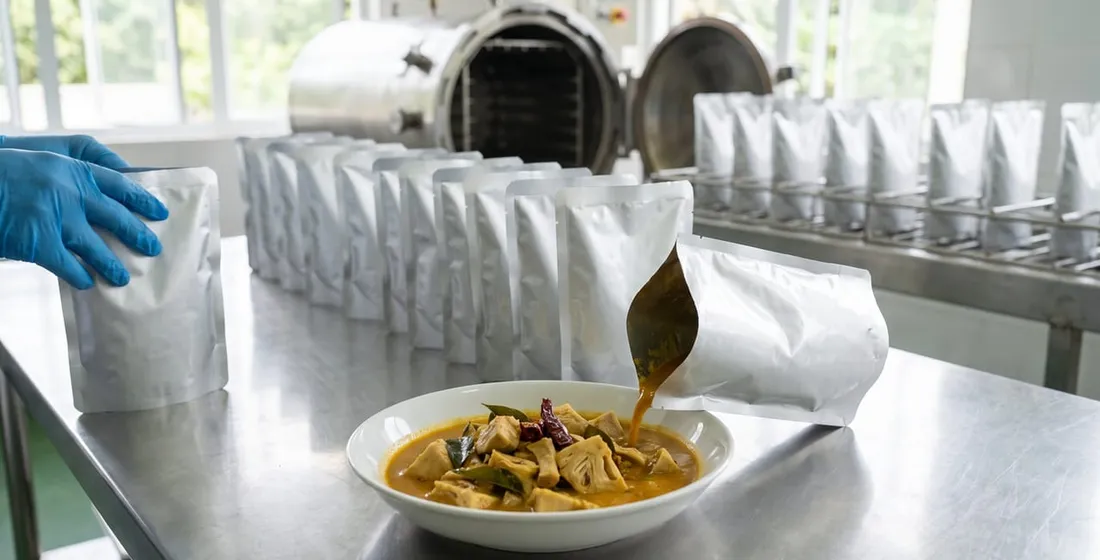
A row of blank silver foil retort pouches on a stainless steel table beside a bowl of young jackfruit curry in coconut gravy, with an open retort vessel behind and a gloved hand holding a pouch.
Buyer’s snapshot
- Under the US FDA rule for low-acid foods in sealed containers (21 CFR 113.83), maximum fill-in or drained weight is a critical factor of the retort schedule as well as a label number.
- That means the solids-to-gravy ratio of a curry pouch has to be fixed before heat testing starts, or the testing has to be repeated.
- In this scenario, a 300 g jackfruit curry pouch reaches a released first run of 1,500 pouches at Silk Foods Ceylon (SFC) in 16 weeks from brief.
- The format table and the week-by-week plan are the two sections to take into a planning meeting.
A Persona B (local FMCG mid-tier brand) that already sells chilled ready meals wants an ambient version. The brief is one line: a heat-and-eat polos (young jackfruit) curry in coconut gravy, 300 g, 12 months on an ambient shelf, sold at modern-trade supermarkets and through the online grocery channel. The brand has a kitchen recipe customers like. It has no retort schedule, no pouch spec and no shelf-life data. What follows is how that brief would run through R&D and NPD (Co-Development on the SFC brochure) at the Matale facility, and where the 16 weeks go.
A note on method. This is a scenario, not a client file. The recipe, the targets and the week numbers are planning figures that reflect how retort briefs are scoped. The regulations and standards cited are real.
Why is a curry pouch a validation project before it is a recipe?
Because a coconut curry with vegetable pieces is a low-acid food, and low-acid foods sold ambient need a validated thermal process. The accepted floor is a “botulinum cook” of F0 3 minutes, a 12-log reduction of Clostridium botulinum spores, as a 2024 review in Food Science and Nutrition (Jimenez et al.) restates.
The rule that sets how that process is fixed is 21 CFR 113.83. It says scheduled processes for low-acid foods “shall be established by qualified persons having expert knowledge of thermal processing”. It also lists the critical factors the schedule depends on: headspace, consistency, maximum fill-in or drained weight, and water activity among them.
For the brand owner, the consequence is practical. Every change to the recipe after heat testing (a thicker gravy, bigger jackfruit pieces, more solids per pouch) can move the cold spot and invalidate the schedule. The R&D team’s first job is therefore to freeze the things that affect heat, then test. Taste refinements that do not change those factors can continue later.
Which format targets get fixed first?
Five of them, and they get fixed before the first heat penetration trial. The table sets out the scenario’s targets and why each one matters to the retort schedule.
| Format factor | Scenario target | Why it is fixed early |
|---|---|---|
| Net weight | 300 g | Sets pouch size and fill volume |
| Solids share (drained weight) | 165 g minimum jackfruit and vegetable pieces, 55% of net | A critical factor under 21 CFR 113.83; more solids slow heat penetration |
| Filled pouch thickness | 20 mm maximum, laid flat | Heat travels to the centre of the pouch; thickness sets time |
| Gravy consistency | Fixed viscosity range at fill temperature | Coconut gravy thickens under heat; a thicker gravy heats more slowly |
| Pouch structure | Four-layer foil laminate, not microwavable | Foil gives the oxygen and light barrier a 12-month ambient claim needs |
The pouch structure is a commercial decision disguised as a technical one. A foil laminate carries a 12-month ambient claim comfortably, but it cannot go in a microwave, so the pack copy says “boil in pouch or empty and heat”. A clear high-barrier pouch is microwavable, but it usually supports a shorter claim. In this scenario the brand chose shelf life over microwave convenience, because the online grocery channel holds stock longer than a supermarket does.
Drained weight needs one more note. Under the Codex General Standard for the Labelling of Prepackaged Foods (CXS 1-1985, section 4.3.3), a drained-weight declaration applies to foods in a “liquid medium”, which Codex defines as water, sugar or salt solutions, certain juices, or vinegar. A coconut curry gravy is not on that list. So the label may carry net weight only, but the plant still controls solids per pouch, because the retort schedule depends on it.
Spec snapshot: scenario polos curry pouch
- Product: young jackfruit curry in coconut gravy, heat-and-eat, ambient
- Pack: 300 g net, four-layer foil retort pouch, 20 mm maximum filled thickness
- Solids: 165 g minimum per pouch, checked on every fill shift
- Process target: F0 of 6 minutes at the slowest-heating point, twice the botulinum floor
- Shelf-life claim: 12 months ambient, supported by accelerated data and real-time checkpoints
- First run: 1,500 pouches, about 450 kg of finished product
How does the retort validation actually run?
In three steps, in this order: heat distribution, heat penetration, then incubation. None of them can start until the format table above is signed off.
- Heat distribution: temperature probes spread across a loaded retort confirm that every position in the vessel reaches process temperature. This maps the retort, not the product.
- Heat penetration: probes placed at the centre of filled pouches record how fast the slowest-heating point warms. The scenario runs three trial loads at worst case: maximum fill, maximum solids, maximum thickness, and the lowest fill temperature the line allows. The process authority then calculates the time at temperature that delivers F0 6 at that point.
- Incubation: pouches from the validation batch are held warm and inspected for swelling or leaks. The FDA’s Bacteriological Analytical Manual (Chapter 21A) describes holding sealed containers at 35°C and examining them over 14 days. Any swollen pouch sends the schedule back to step two.
Why F0 6 and not 3? The floor of 3 covers C. botulinum. Some spoilage organisms are more heat-resistant than that, and a pouch that is safe but spoiled is still a recall. The process authority sets the margin. The brand owner’s job is to accept that a longer process costs some texture, which is why the jackfruit piece size was fixed early.
The R&D team at the Matale facility sees one pattern in most retort briefs: the kitchen recipe was designed to be eaten the same day. Coconut gravy that looks right in a pot splits under a long process, and jackfruit that is tender after 20 minutes on a stove turns soft after a full retort cycle. In this scenario the second bench round cut the pre-cook on the jackfruit by half and moved part of the coconut milk to a later stage in the cook, so the finished pouch came out of the retort with the texture the kitchen version had on the plate. The wider version of that problem is covered in reformulating a kitchen recipe for retort and batch consistency, and the pH fork that decides whether a jackfruit product needs a full retort at all is set out in jackfruit in brine: retort or freezer.
Where does the 12-month shelf-life claim come from?
From two data sets running in parallel, starting with the validation batch. Safety is settled by the retort schedule and incubation. Shelf life on a retorted pouch is mostly about quality: colour, oil separation in the gravy, texture of the pieces, and any flavour picked up from the pack.
The scenario uses an accelerated stability study at elevated temperature to support a first 12-month claim at launch, with real-time samples held at ambient and opened at 1, 3, 6, 9 and 12 months. If a real-time checkpoint disagrees with the accelerated prediction, the real-time result wins and the claim is shortened. The method is set out in accelerated stability testing for shelf life, and the tasting side of each checkpoint follows the approach in sensory panel screening before commit.
The 16 weeks, stage by stage
Week zero is the brief and the kitchen sample. Week 16 is the release of the first 1,500 pouches after their incubation check.
| Weeks | Stage | Output |
|---|---|---|
| 0 | Brief, kitchen sample tasted, low-acid route confirmed | Signed brief |
| 1 to 4 | Two bench rounds, two weeks each, adjusting for retort | Recipe with fixed solids and gravy consistency |
| 5 | Sensory panel on bench pouches | Go or rework |
| 6 to 7 | Pouch spec and fill trials; format table signed off | Frozen critical factors |
| 8 to 9 | Heat distribution and three heat penetration loads | Draft scheduled process |
| 10 | Process authority signs the schedule; validation batch made | Validation pouches |
| 10 to 12 | Incubation of validation pouches; accelerated study starts | Pass or reprocess |
| 8 to 13 | Label artwork, proofs and print | Printed pouches on site |
| 14 | First commercial run | 1,500 pouches |
| 14 to 16 | Incubation hold on production samples, then release | Retail-ready stock |
Two things in this plan are easy to underestimate. The first is that label work overlaps with validation, not after it, because printed retort pouches carry a print lead time of their own; the gate is described in artwork and print lead time. The second is the hold at the end. A retorted pouch is not released on the day it is made, so the first delivery date is the run date plus the incubation window.
The label itself answers to the Food (Labelling and Advertising) Regulations 2026, in operation from 1 July 2026 for food manufactured from that date. The common name goes in bold in Sinhala, Tamil and English, with the other mandatory particulars covered in the 2026 labelling regulations.
What does the first run cost in volume terms?
The first-run minimum in this scenario is 1,500 pouches, which is about 450 kg of finished curry at 300 g each. That matches the first-run minimum Silk Foods Ceylon uses for other shelf-stable semi-solid formats such as jars and cans. The run is planned as one production day across several retort loads, with the incubation hold added before dispatch.
The costs that sit outside the per-pouch price are the ones to budget separately: bench rounds, the heat penetration trials, the process authority’s time, the validation batch, and the accelerated study. A brand that changes the recipe after week 7 pays for the trials twice. That is the single most expensive decision in the plan, and it costs nothing to avoid.
Where SFC walks away
Silk Foods Ceylon does not book a retort run for a brand owner who wants to keep adjusting solids or gravy thickness after the heat penetration trials. A schedule validated on one recipe does not cover a different one.
Frequently asked questions
What F0 value does a shelf-stable curry pouch need?
The minimum botulinum cook for low-acid foods is an F0 of 3 minutes, a 12-log reduction of Clostridium botulinum spores, as restated by Jimenez et al. in Food Science and Nutrition in 2024. Process authorities often set a higher target, such as the F0 6 used in this scenario, to cover spoilage organisms.
Does a curry pouch have to declare drained weight?
Not under Codex CXS 1-1985 section 4.3.3, which requires drained weight for foods in a liquid medium defined as water, sugar or salt solutions, certain juices or vinegar. Curry gravy is outside that list. The plant still controls solids per pouch, because 21 CFR 113.83 treats drained weight as a critical factor.
How long does it take to go from a brief to a retail-ready curry pouch?
In this Silk Foods Ceylon scenario, 16 weeks from brief to released stock: four weeks of bench rounds, three weeks fixing format factors, three weeks of heat testing and schedule sign-off, a first run in week 14, and an incubation hold before release. A recipe change after week 7 adds the heat trials again.
Can Silk Foods Ceylon develop a retort curry pouch for a local brand?
Yes. SFC’s in-house R&D team runs bench rounds, format trials and retort validation with a qualified process authority at the Matale facility, then manufactures the first run of about 1,500 pouches. The facility is BRCGS- and FSSC 22000 V6-audited, with Sri Lanka Food Act labelling compliance on every retail SKU.
How Silk Foods Ceylon can help
For a ready-meal brand owner moving a chilled or kitchen recipe to an ambient pouch, Silk Foods Ceylon runs R&D / NPD at its cellular-manufacturing facility at Silk AgTech Park in Hapugasyaya, Matale, with a retort, a jacketed kettle and a vacuum sealer on the same site. The in-house team fixes the format factors, runs the heat testing with a qualified process authority, and hands a signed schedule to Contract Manufacturing for a first run of about 1,500 pouches, typically 14 to 16 weeks from brief to released stock. The facility is BRCGS- and FSSC 22000 V6-audited, with Sri Lanka Food Act labelling compliance on every retail SKU.
To brief a retort project, email b2b@esilkroute.com.lk or call +94 76 441 0389 / +94 76 918 5744.
Sources
- US Code of Federal Regulations, 21 CFR 113.83, Establishing scheduled processes, on qualified persons and critical factors including maximum fill-in or drained weight. law.cornell.edu (retrieved 27 September 2026).
- Jimenez, P.S., Bangar, S.P., Suffern, M. and Whiteside, W.S. (2024), “Understanding retort processing: A review”, Food Science and Nutrition 12(3), on the F0 3 minute botulinum cook and faster heat transfer in thin pouches. pmc.ncbi.nlm.nih.gov (retrieved 27 September 2026).
- Codex Alimentarius, General Standard for the Labelling of Prepackaged Foods, CXS 1-1985, section 4.3.3 on drained weight and the definition of liquid medium. fao.org (retrieved 27 September 2026).
- US FDA, Bacteriological Analytical Manual, Chapter 21A, Examination of Canned Foods, on incubation of sealed containers at 35°C over 14 days. fda.gov (retrieved 27 September 2026).
- Government of Sri Lanka, Food (Labelling and Advertising) Regulations 2026, Gazette Extraordinary No. 2494/47, in operation from 1 July 2026. eohfs.health.gov.lk (retrieved 27 September 2026).
- Further reading: Industrial Technology Institute, Sri Lanka, list of transferable food technologies, including curries in retort pouches (FTS/VBP/10). iti.lk (retrieved 27 September 2026).
Written by the Silk Foods Ceylon Team. Silk Foods Ceylon (Pvt) Ltd. is a BRCGS- and FSSC 22000 V6-audited contract manufacturer in Matale, Sri Lanka, offering contract manufacturing, private labelling, co-packing, and in-house R&D for local Sri Lankan brand owners, FMCG companies, hotel and restaurant groups, and distributors. To brief a project: b2b@esilkroute.com.lk, +94 76 441 0389, or +94 76 918 5744.