Kombucha SKU R&D in Sri Lanka: Flavour and Line Economics
Buyer’s snapshot
- Sri Lanka moved the sugar colour-code bands for liquid foods on 23 June 2026. Red now starts at 8 grams of sugar per 100 ml, down from 11. Amber runs from 2.5 to 8 grams, and green sits below 2.5 grams (Extraordinary Gazette under Section 32 of the Food Act No. 26 of 1980, reported by Lanka News Web and Xinhua, 2026).
- For a kombucha, the flavour decision and the label decision are the same decision. Fruit added after the first fermentation moves residual sugar, and 2.5 grams per 100 ml is the line that decides whether the bottle carries green or amber.
- Silk Foods Ceylon (SFC) fills 200 ml glass bottles in Matale at up to 2,500 bottles a day, with a first-run MOQ of 1,250 bottles per SKU, on a BRCGS- and FSSC 22000 V6-audited site.
- The tables below cover the colour bands, the line maths for a multi-flavour launch, and where R&D and NPD hand over to contract manufacturing.
On 23 June 2026 the Minister of Health and Mass Media gazetted an amendment to Sri Lanka’s colour-code labelling rules for sugar in liquid foods. The red band, which had begun at 11 grams of sugar per 100 ml, now begins at 8. Amber runs from 2.5 to 8 grams, and green sits below 2.5 (Lanka News Web, 2026).
For most soft drinks that is a reformulation problem with a known answer. For a kombucha it is a research problem, because residual sugar in a fermented tea is not a recipe line a formulator sets. It is an outcome of when the ferment stops and what goes in afterwards. Which is also, exactly, where the flavour comes from.
What actually changes when a kombucha flavour pivots?
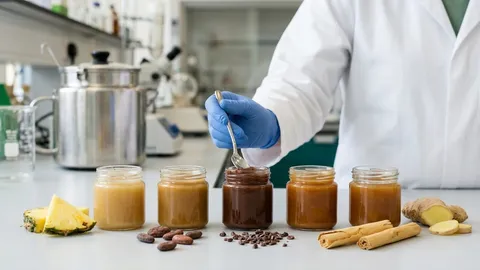
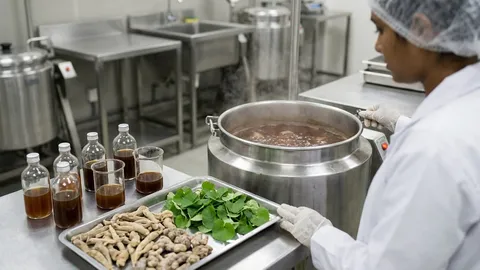
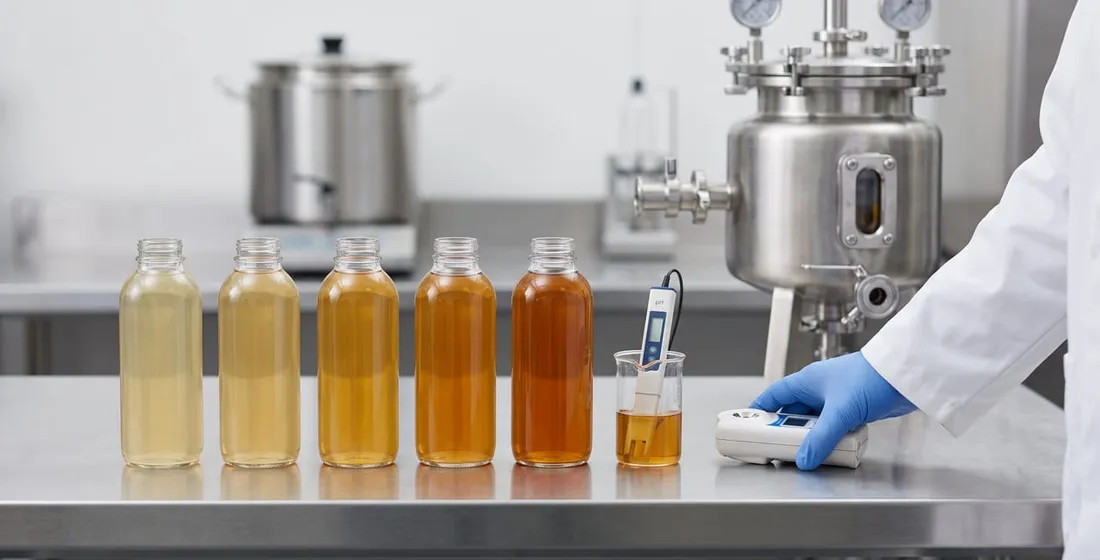
A kombucha flavour pivot changes the second stage, not the base. The first fermentation converts sugar in sweetened tea into organic acids over roughly one to two weeks, taking commercial kombucha to a pH of about 2.9 to 3.8. Flavour is added after that, at a second fermentation or as a post-ferment dose. That split is why a six-flavour range can share one base ferment and still need six separate filling blocks.
The base is a shared asset. A brand running a Ceylon tea base does not rebuild it when a flavour changes, and the fermentation schedule does not move either. What moves is everything downstream: the dosing step, the filling block, the label artwork, and the declared sugar. A pivot from mint to passionfruit is a two-day change on the filling floor and a six-week change on the calendar.
The flavour carrier is the complication. Fruit juice, purée, herb infusion and spice extract all arrive with sugar of their own, and some of that sugar is fermentable. That makes a flavour pivot simultaneously a sugar question and an alcohol question, because a live kombucha keeps working in the bottle.
The alcohol side of that question, and the live-culture against flash-pasteurised decision that settles it, is covered separately in the glass-line contract manufacturing brief for vegan kombucha. This post takes the sugar side.
The sugar line that decides your label colour
Sri Lanka’s Food (Colour Coding for Sugar Levels - Liquid) Regulations 2022 were gazetted on 14 February 2023 and came into force on 1 January 2026, after a series of extensions (USDA Foreign Agricultural Service GAIN reporting, 2023 to 2025). The 23 June 2026 amendment then reset the bands. A liquid food above 8 grams of sugar per 100 ml carries a red logo, 2.5 to 8 grams carries amber, and below 2.5 grams carries green.
The bands are declared per 100 ml, not per bottle, which matters for a small format.
| Colour code | Sugar per 100 ml, 2016 rules | Sugar per 100 ml, current rules | Sugar in a 200 ml bottle at the band ceiling |
| Green | Below 2 g | Below 2.5 g | Under 5.0 g |
| Amber | 2 g to 11 g | 2.5 g to 8 g | Up to 16.0 g |
| Red | Above 11 g | Above 8 g | Above 16.0 g |
The practical R&D line is not the red one. Very few kombuchas approach 8 grams per 100 ml. The line that decides a bottle’s face is 2.5. A well-attenuated unflavoured kombucha can finish under it. Add fruit juice at eight to twelve percent by volume at the second stage and the same liquid lands in amber, on the same base, from the same tank, on the same day.
The June 2026 amendment carried two provisions that read as administrative and are not. It introduced an alternative logo for glass bottles with limited printing space, which is precisely the 200 ml wrap-label problem a kombucha SKU has. It also defined business-to-business food products as items not sold directly to consumers but intended for further processing or resale, which draws a line between a bulk supply and a retail bottle.
Sugar carries a second cost beside the logo. Sri Lanka has taxed sweetened beverages on sugar content per 100 ml since 2017, at 50 cents per gram initially, later reduced to 30 cents per gram (Development Asia, Asian Development Bank, 2023). A flavour pivot that adds two grams per 100 ml moves the tax line and the label colour at once.
Neither of those is a reason to avoid flavour. They are a reason to fix the target sugar band before the artwork goes to print and before the SLSI submission is filed.
How many flavours can one beverage line carry?
Silk Foods Ceylon fills up to 2,500 200 ml glass bottles a day on the beverage line at the Matale facility, at a first-run MOQ of 1,250 bottles per SKU. Each flavour is a separate filling block with its own changeover and clean-in-place cycle. The constraint on a multi-flavour launch is therefore changeovers per day, not bottles per day.
| Flavours in the launch | Bottles at first-run MOQ | Filling blocks | Line days at 2,500 bottles a day | What sets the schedule |
| 1 | 1,250 | 1 | Under 1 | Fill volume |
| 3 | 3,750 | 3 | About 2 | Changeovers |
| 6 | 7,500 | 6 | 3 to 4 | Changeovers and clean-in-place |
Read the last column, not the third. At one flavour the line fills for half a day and the day-rate is the whole cost story. At six flavours the line spends more time being cleaned and reset than filling, and the cost per bottle stops falling with volume. That is the point where a brand owner is paying for range rather than for scale.
The same arithmetic governs any variant programme, which is why a flavour-variant range in a dry format and a glass-bottle beverage line land in different places on the same question. Dry variants share a packing line cheaply. Wet variants each carry a wash.
There is a second cost that catches brand owners late. Label stock has its own minimum order. A flavour pivot after the artwork is approved is paid twice, once in formulation time and once in a print run that no longer matches the bottle.
Where do the R&D iterations actually go?
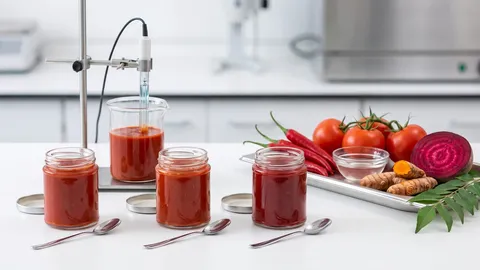
R&D and NPD (Co-Development on the SFC brochure) typically runs two to four sample iterations before a recipe locks, at two to four weeks per iteration. For a kombucha the iterations rarely go on taste alone. They go on residual sugar at fill, titratable acidity, carbonation, and whether the flavour holds once the bottle leaves a cold chain.
The R&D team at the Matale facility sees the same gap in beverage briefs. A brief will specify the flavour in careful detail, passionfruit with lime, ginger, hibiscus, and say nothing at all about the target residual sugar or the target acidity. The flavour is the part the brand owner has tasted. The sugar is the part the label will have to declare. When the target band arrives late, the iteration count usually goes from two to four, and a six-week window becomes ten.
Service snapshot: R&D and NPD at Silk Foods Ceylon Service: in-house formulation from a buyer's brief (Co-Development on the SFC brochure) Typical iterations: 2 to 4 before the recipe locks, at 2 to 4 weeks per sample iteration Beverage first run: 1,250 x 200 ml glass bottles per SKU, line capacity up to 2,500 bottles a day Lead time: 2 to 3 weeks from PO to dispatch on a locked recipe, 6 to 10 weeks when formulation work comes first Cert coverage: BRCGS- and FSSC 22000 V6-audited, with SLSI clearance and Sri Lanka Food Act 1980 compliance on every retail SKU R&D location: Matale, with an adjoining plantation supplying herbs for pilot batches |
A brief that arrives with a target band attached usually clears in two iterations. The wider R&D iteration budget for a Sri Lankan food product sets out what each round costs in time, and the flavour-variant work on a coconut jam range shows the same pattern in a jar format: the first variant is formulation, the rest are adjustments to a locked base.
What a flavour pivot costs before the SKU reaches a shelf
A late flavour pivot moves four things at once: the R&D window, the label artwork, the declared colour code, and the SLSI submission. SLSI clearance on a packaged food with a stable formulation typically runs four to eight weeks, so a pivot filed after submission resets the longest item on the calendar rather than the shortest.
| R&D and NPD (Co-Development) | Contract Manufacturing | |
| What the brand brings | A flavour direction and a target sugar band | A locked recipe and a signed specification |
| Best fit | No stable formulation yet, or a pivot mid-programme | A formulation already proven at batch scale |
| First-run volume | Sample batches, not a commercial MOQ | 1,250 x 200 ml bottles per SKU |
| Typical window | 2 to 4 iterations at 2 to 4 weeks each | 2 to 3 weeks from PO to dispatch |
| Cert anchor | Same BRCGS- and FSSC 22000 V6-audited site | Same site, plus SLSI clearance on the retail SKU |
The order is the whole argument. Pivot the flavour before the artwork and before the submission, and the cost is a four-week iteration. Pivot afterwards and the cost is a resubmission, a reprint, and a shelf date that has moved a quarter.
For a local brand watching an export step later, the category is moving in the right direction: Sri Lankan food and beverage export earnings reached USD 583.89 million in 2025, 24.23% above the previous year, with processed food up 40.4% (Sri Lanka Export Development Board, 2026). A kombucha built to a declared sugar band on an audited site is a SKU that can make that step without reformulating.
Frequently asked questions
Can Silk Foods Ceylon develop a new kombucha flavour for a Sri Lankan brand?
Yes. R&D and NPD at the Matale facility takes a flavour brief and runs two to four sample iterations, typically two to four weeks each, before the recipe locks. Bringing a target sugar band and a target acidity with the brief usually cuts the iteration count in half.
What sugar level makes a kombucha carry a red label in Sri Lanka?
Above 8 grams of sugar per 100 ml, following the 23 June 2026 amendment that lowered the red band from 11 grams (Lanka News Web, 2026). Amber covers 2.5 to 8 grams and green sits below 2.5 grams. Most kombucha decisions happen at the 2.5 gram line, not the 8 gram line.
What is the minimum order for a kombucha SKU at Silk Foods Ceylon?
The first-run MOQ on the glass beverage line is 1,250 200 ml bottles per SKU, on a line that fills up to 2,500 bottles a day. A three-flavour launch is therefore 3,750 bottles across three separate filling blocks, each with its own changeover and clean-in-place cycle.
How long does a kombucha flavour pivot add to a launch timeline?
A pivot before artwork and SLSI submission costs one R&D iteration, roughly two to four weeks. A pivot after submission costs a resubmission on a four to eight week SLSI clearance, plus new label artwork, which in practice moves a shelf date by a quarter.
Does adding fruit at the second fermentation change the sugar declaration?
Usually yes. Fruit juice or puree dosed at the second stage adds sugar of its own, and at eight to twelve percent by volume it can move a bottle from the green band, below 2.5 grams per 100 ml, into amber. The declaration follows the finished liquid, not the base.
How Silk Foods Ceylon can help
For local FMCG brands building a beverage range, Silk Foods Ceylon runs an in-house R&D and NPD team alongside a glass-bottle beverage line at the Matale facility, so a formulation brief and a production slot sit under one roof. Sample iterations typically run two to four rounds at two to four weeks each, and the first commercial run starts at 1,250 200 ml bottles per SKU on a line filling up to 2,500 bottles a day. The site is BRCGS- and FSSC 22000 V6-audited, with SLSI clearance and Sri Lanka Food Act 1980 compliance handled inside a standard contract manufacturing engagement. Briefs that arrive with a target sugar band and a target acidity move fastest.
To brief a project, email b2b@esilkroute.com.lk or call +94 76 441 0389 or +94 76 918 5744.
Sources
- Lanka News Web, “Sri Lanka updates colour-coded sugar labelling rules for beverages” (2026). Extraordinary Gazette of 23 June 2026 under Section 32 of the Food Act, No. 26 of 1980. https://lankanewsweb.net/archives/228641/sri-lanka-updates-colour-coded-sugar-labelling-rules-for-beverages/ (retrieved 2026-08-02)
- Xinhua, “Sri Lanka amends sugar color-code label rules for liquid foods” (4 July 2026). https://english.news.cn/20260704/f6d260006f714d4b8233a2b95385fc6e/c.html (retrieved 2026-08-02)
- USDA Foreign Agricultural Service, GAIN reporting on the Food (Colour Coding for Sugar Levels - Liquid) Regulations 2022, gazetted 14 February 2023 and extended to 1 January 2026 (2023 to 2025). https://www.fas.usda.gov/data/sri-lanka-sri-lanka-enacts-new-legislation-color-code-sugar-levels-liquid-food (retrieved 2026-08-02)
- Development Asia (Asian Development Bank), “Improving Public Health in Sri Lanka Through Enhanced Sugary Drinks Taxation” (22 December 2023), drawing on the Institute of Policy Studies of Sri Lanka. https://development.asia/insight/improving-public-health-sri-lanka-through-enhanced-sugary-drinks-taxation (retrieved 2026-08-02)
- Sri Lanka Export Development Board, “Sri Lanka’s Export Performance Exceeded US$ 17.2 Billion in 2025” (26 January 2026). https://www.srilankabusiness.com/news/sri-lankas-export-performance-exceeded-us-17.2-billion-in-2025.html (retrieved 2026-08-02)
- World Health Organization, “Taxation for Sugar Sweetened Beverages in Sri Lanka” technical report. https://cdn.who.int/media/docs/default-source/searo/obesity/technical-report-taxation-for-sugar-sweetened-beverages-in-sri-lanka.pdf (retrieved 2026-08-02)
- Sri Lanka Customs, National Imports Tariff Guide 2025, Chapter 22 (non-alcoholic beverages defined at an alcoholic strength by volume not exceeding 0.5%). https://www.customs.gov.lk/wp-content/uploads/2022/06/Ch-22.pdf (retrieved 2026-08-02)
Written by the Silk Foods Ceylon Team. Silk Foods Ceylon (Pvt) Ltd. is a BRCGS- and FSSC 22000 V6-audited contract manufacturer in Matale, Sri Lanka, offering contract manufacturing, private labelling, co-packing, and in-house R&D for local Sri Lankan brand owners, FMCG companies, hotel and restaurant groups, and distributors. To brief a project: b2b@esilkroute.com.lk, +94 76 441 0389, or +94 76 918 5744.