Specifying black pepper grades for a Sri Lankan private-label spice line
Buyer's snapshot Codex Alimentarius sets a minimum piperine content of 3.5% on a dry basis for ground black pepper, with caps on moisture (12%), total ash (6%), and acid-insoluble ash (1.2%) (Codex Alimentarius, 2017). The words "black pepper" specify none of these. Sri Lanka grows pepper across roughly 32,800 hectares and supplies about 2% of world demand, prized for the high piperine that gives Ceylon pepper its pungency (Sri Lanka Export Development Board). A private-label spec should fix grade class, whole or ground, bulk density or mesh, piperine floor, moisture, and cleanliness limits before the first run, not after it. Silk Foods Ceylon runs a 100 to 200 kg per hour spice line in Matale, grinds to a specified mesh, and takes a 50 kg first-run MOQ per SKU. See the grade table below. |
A purchase order that reads “black pepper, 500 kg” is not a specification. It is a category. Two suppliers can both deliver clean, legal black pepper against that line and send you two visibly different products: different berry size, different bulk density, different pungency, a different grind. For a brand owner launching a private-label pepper SKU, the grade is where shelf consistency, landed cost, and customer trust actually live. Silk Foods Ceylon (SFC), a contract manufacturer in Matale, writes that grade into the spec before the first batch runs.
”Black pepper” is a category, not a purchase order
A grade is the set of measurable parameters that turn “black pepper” into a repeatable product: how heavy the berries are for their volume, how many are immature, how clean the lot is, and, once ground, how pungent and how fine. Silk Foods Ceylon (SFC) sits at Silk AgTech Park in Hapugasyaya, Matale, and offers private labelling, contract manufacturing, and the co-processing layer (washing, sorting, grading, drying, and grinding, in the SFC brochure’s language) that a spice SKU passes through. The facility is BRCGS- and FSSC 22000 V6-audited, with SLSI clearance on every retail SKU. A grade spec is the document that makes each of those steps reproducible.
The point is not academic. A brand that orders “black pepper” and lets the price decide the grade will get a different product every quarter, because the cheapest lot available in Matale in March is not the cheapest lot in September. Fixing the grade fixes the shelf. The same discipline applies to a blended SKU, which is why the curry powder blend a brand takes to a supermarket shelf starts from named, graded inputs rather than a generic spice bill.
What grades exist for whole black pepper?
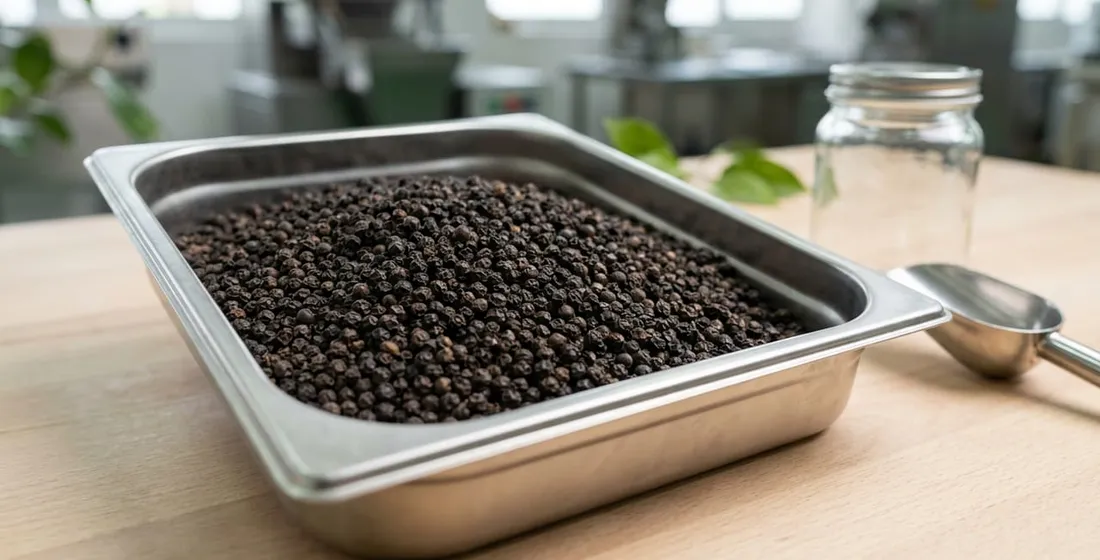
Whole black pepper is graded on weight-for-volume and cleanliness. Codex Alimentarius (CXS 326-2017) splits whole black pepper into Class I, Class II, and Class III, set mainly by bulk density and by limits on light berries, pinheads, and foreign matter. Bulk density is the headline number: a minimum of 550 grams per litre for Class I, 500 for Class II, and 400 for Class III. Heavier berries mean more mature fruit, more piperine, and more product per jar.
Two trade terms sit alongside the class system. “Garbled” pepper has been cleaned and sorted after harvest; “ungarbled” pepper is closer to as-harvested, with more stalk, dust, and light berries still in the lot. “Fair Average Quality”, or FAQ, is a named middle grade. Sri Lanka’s own standard, SLS 105, grades local pepper on the same logic of cleanliness and maturity, with FAQ as a named grade (Sri Lanka Standards Institution). For a retail SKU, garbled Class I is the sensible default; ungarbled lots belong in a processing stream, not a finished jar.
| Parameter (whole black pepper) | Class I | Class II | Class III |
| Bulk density, g/L (min) | 550 | 500 | 400 |
| Light berries, % (max) | 2.0 | 5.0 | 10.0 |
| Pinheads, % (max) | 1.0 | 2.0 | 4.0 |
| Extraneous vegetable matter, % (max) | 1.0 | 2.0 | 2.0 |
| Foreign matter, % (max) | 0.1 | 0.5 | 0.5 |
| Moisture, % (max) | 12.0 | 12.0 | 13.0 |
| Piperine, % dry basis (min) | 3.5 | 3.0 | 2.0 |
Read the table as a single decision. A higher class is not a luxury; it is a promise about weight, pungency, and how little rubbish rides along in the lot. A brand paying for Class I and receiving Class II is losing piperine and gaining light berries, and neither shows up on an invoice that just says “black pepper” (Codex Alimentarius, 2017).
How do you specify ground black pepper?
Ground black pepper is graded on chemistry and particle size rather than berry weight. Codex CXS 326-2017 sets, for ground black pepper, a minimum piperine of 3.5% on a dry basis, moisture at 12% maximum, total ash at 6% maximum, acid-insoluble ash at 1.2% maximum, and a volatile oil floor of 1.0 millilitre per 100 grams. Those are the numbers that separate a pungent, aromatic powder from a dull, over-extended one.
Particle size is the one parameter Codex leaves to the buyer. Mesh (the fineness of the grind) is a commercial choice, not a regulatory one; a table-grade powder commonly runs in the 40 to 60 mesh range, while a coarser crack suits a grinder-top SKU. Silk Foods Ceylon grinds to a specified mesh on its milling and sieving line, so the spec sheet, not the mill’s default setting, decides the grind. Specifying an active compound by a floor is the same move a brand makes for curcuminoid content in a turmeric capsule, and the same grade-first thinking that sits behind coconut oil grades for a retail SKU.
Why Sri Lankan pepper is worth specifying by origin
Piperine is the alkaloid that gives black pepper its bite, and it is the reason origin belongs in the spec. The Sri Lanka Export Development Board describes Ceylon pepper as quite rich in piperine, the compound that lends it a distinct pungency, grown across roughly 32,800 hectares and sold mainly into India, Germany, and the United States. Codex puts the floor for ground pepper at 3.5% piperine; Ceylon pepper is valued because good lots sit comfortably above that floor. Matale sits in the island’s pepper-growing belt, which for a Matale-based line means a short sourcing radius and same-week access to fresh lots when a grade needs re-sampling. For export bulk supply of Ceylon pepper rather than a private-label jar, see the Ceylon spices supplier page of our export sister company, E-Silk Route Ventures.
The origin claim is only worth making if the grade backs it up. A brand that prints “Ceylon black pepper” on a jar and fills it with an under-graded lot is spending its best asset on a weak product. In practice, the SFC R&D team finds that most first briefs arrive with the origin named and the grade blank. A founder will ask for “good Sri Lankan pepper” and leave bulk density, mesh, and piperine unstated, then wonder why the second batch tastes different from the first. The grade conversation, held before the first run, is what makes the origin claim true on every jar rather than the first one.
The certifications and labelling a private-label pepper SKU needs
A packaged pepper SKU faces the same local floor as any retail food: SLSI clearance for shelf eligibility and Sri Lanka Food Act 1980 compliance for the label. The label carries the product name, the ingredient declaration, net weight, manufacturer details, and the manufacture and expiry dates in the prescribed format; a blended pepper SKU adds an allergen line where the blend calls for it. Above that local floor, the SFC facility is BRCGS- and FSSC 22000 V6-audited, the combination the higher tier of local private-label programmes, and any later export step, asks for on the manufacturer. The full picture of the certification stack a local manufacturer carries sits alongside SLSI and the Food Act, and the SLSI submission itself runs step by step on its own timeline.
Grade also carries a fraud guard, and this is where the acid-insoluble ash limit earns its place on the spec sheet. Ground pepper is one of the most adulterated spices in the region: analytical research on Sri Lankan black pepper has detected powder cut with papaya seed and with green and red chilli, tested at adulteration levels from 5% upward (published on ScienceDirect, 2018). A low acid-insoluble ash result is one of the clearest signals that a powder is clean pepper and not padded with ground seed or grit, which is exactly why Codex caps it at 1.2% for the ground grade. A spec that names the acid-insoluble ash limit is a spec that can be tested against a cheat.
MOQ, packaging, and lead time for a private-label pepper line
Silk Foods Ceylon runs the spice line at 100 to 200 kg per hour and takes a 50 kg first-run MOQ per SKU on a private-label spice or herb powder, with volume tiers at 500, 1,000, and 2,500 kg. Whole pepper passes through the co-processing layer (washing, sorting, grading, drying) before grinding to the specified mesh, so a brand can start from cleaned whole berries and finish at a jarred, labelled powder on one site. Packaging runs from a 40 gram glass spice jar for retail up to kraft pouches at 50 grams through 1 kg for food-service and refill formats.
Buyer's checklist: what a black pepper grade spec should fix
|
Lead time follows the spec. Once the grade is locked, a sample dispatches in one to two weeks and a purchase order runs two to three weeks from order to dispatch on the existing spec; a new blend or a first-time grade sign-off adds the R&D window ahead of the production slot. The economics reward a locked spec: a brand that re-argues the grade every quarter pays for it in inconsistency, while a brand that fixes bulk density, mesh, and piperine once buys the same jar on every run.
Frequently asked questions
What grade of black pepper should a private-label brand specify?
For a retail jar, specify garbled Class I whole pepper (Codex CXS 326-2017): a 550 grams per litre minimum bulk density, light berries at 2% maximum, and piperine at 3.5% minimum on a dry basis. Lower classes suit processing or blending, not a finished single-origin SKU.
What is the difference between a whole and a ground black pepper spec?
Whole pepper is graded on bulk density, berry size, and cleanliness. Ground pepper is graded on chemistry and mesh: piperine at 3.5% minimum, moisture at 12% maximum, total ash at 6% maximum, and acid-insoluble ash at 1.2% maximum (Codex Alimentarius, 2017), plus a chosen particle size.
Why is Sri Lankan black pepper considered high quality?
The Sri Lanka Export Development Board describes Ceylon pepper as quite rich in piperine, the alkaloid behind its pungency, grown across roughly 32,800 hectares. Good lots sit comfortably above the Codex 3.5% piperine floor, which is why origin is worth naming in the spec when the grade backs it up.
What is the MOQ for a private-label black pepper SKU at Silk Foods Ceylon?
The first-run MOQ is 50 kg per SKU on the private-label spice line, with volume tiers at 500, 1,000, and 2,500 kg. The Matale line runs at 100 to 200 kg per hour, grinds to a specified mesh, and includes SLSI submission support in a standard private-label engagement.
How Silk Foods Ceylon can help
For founders and brand owners launching a private-label pepper SKU, Silk Foods Ceylon (SFC) runs a spice line at the Matale facility at 100 to 200 kg per hour, grinds to a specified mesh, and takes a 50 kg first-run MOQ per SKU, with volume tiers at 500, 1,000, and 2,500 kg. Whole berries pass through washing, sorting, grading, and drying before grinding, so a brand can hand over a grade spec and receive a jarred, labelled powder from one site. The facility is BRCGS- and FSSC 22000 V6-audited, with SLSI submission support built into a standard private-label engagement.
To brief a private-label pepper or spice SKU, email brands@esilkroute.com.lk or call +94 77 157 7294.
Sources
- Codex Alimentarius (FAO/WHO) (2017), “Standard for Black, White and Green Peppers (CXS 326-2017)”, https://www.fao.org/fao-who-codexalimentarius/codex-texts/list-standards/en/ (retrieved 2026-07-05).
- Sri Lanka Export Development Board, “Pepper cultivation in Sri Lanka”, https://www.srilankabusiness.com/spices/about/pepper-cultivation-sri-lanka.html (retrieved 2026-07-05).
- Sri Lanka Standards Institution, “SLS 105: Specification for pepper”, https://www.slsi.lk/ (retrieved 2026-07-05).
- ScienceDirect (2018), “Detection of adulteration in Sri Lankan black pepper (whole and powder)”, https://www.sciencedirect.com/science/article/abs/pii/S2210803318300046 (retrieved 2026-07-05).
- Further reading: UNIDO / STDF (2023), “Value Chain Analysis on Pepper, Clove and Nutmeg in Sri Lanka”, https://downloads.unido.org/ot/33/88/33884613/2023%20VC%20Analysis%20On%20Pepper,%20Clove%20and%20Nutmeg%20in%20Sri%20Lanka%20Report%20UNIDO_STDF%20WEB.pdf (retrieved 2026-07-05).
Written by the Silk Foods Ceylon Team. Silk Foods Ceylon (Pvt) Ltd. is a BRCGS- and FSSC 22000 V6-audited contract manufacturer in Matale, Sri Lanka, offering contract manufacturing, private labelling, co-packing, and in-house R&D for local Sri Lankan brand owners, FMCG companies, hotel and restaurant groups, and distributors. To brief a project: brands@esilkroute.com.lk or +94 77 157 7294.