BRCGS and FSSC 22000 V6: What They Unlock for Sri Lankan Brands

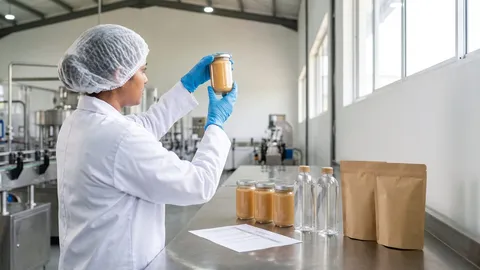
A quality-control technician reviews test results in a food-safety laboratory adjoining a bottling line, the kind of clean, audited environment BRCGS and FSSC 22000 V6 certification cover.
Buyer's snapshot Sri Lanka's processed-food export earnings rose 33.11% year on year to USD 189.44 million in January-July 2026, per Export Development Board data reported by BusinessNews.lk (2026). For a brand fielding its first overseas order, the manufacturer's certification stack often decides whether a buyer's supplier questionnaire gets past page one. Silk Foods Ceylon (SFC) runs a BRCGS- and FSSC 22000 V6-audited facility in Matale, with SLSI clearance and Sri Lanka Food Act compliance built into every retail SKU. The comparison table below sets out what each certification gates, and for whom. This post is written for Persona B brand owners weighing an export step. A brand selling only on the local shelf can skip to the FAQ. |
Sri Lanka’s processed-food export earnings grew 33.11% year on year to USD 189.44 million in the first seven months of 2026, per Export Development Board figures reported by BusinessNews.lk (2026). For a local FMCG brand that has built a stable business on Sri Lankan shelves and is now fielding interest from an overseas buyer, distributor, or diaspora retailer, the recipe is rarely the obstacle. The obstacle is usually a line item on the buyer’s supplier questionnaire: which food-safety certification does the manufacturer carry, and is the version current.
The certification floor and the certification ceiling
A Sri Lankan FMCG brand selling only through local channels needs SLSI clearance and Sri Lanka Food Act 1980 compliance. Neither is negotiable once a product reaches a packaged retail shelf. That is the floor. BRCGS and FSSC 22000 V6 sit above it, for a different reason. They are what an overseas buyer or retail-listing agent checks before a Sri Lankan product gets a shelf slot abroad.
The distinction trips up a lot of first-time exporters. SLSI answers the question “is this legal to sell in Sri Lanka.” BRCGS and FSSC 22000 V6 answer a different question. Does this factory run a food-safety system a UK, EU, or US retailer’s own auditors would sign off on, without visiting it themselves? A brand can pass the first test for years and still fail the second, simply because nobody has asked it yet.
What does BRCGS unlock for a Sri Lankan manufacturer?
BRCGS (Brand Reputation Compliance Global Standards, formerly BRC Global Standards) is the retail-driven food-safety standard with the deepest roots in UK and EU grocery. As of 2026, BRCGS-certified sites number in the tens of thousands across more than 130 countries. The standard is accepted by many of the largest retail groups in the UK and EU (BRCGS, 2026). For a Sri Lankan manufacturer, a current BRCGS certificate is close to a prerequisite for a first conversation with a UK or EU retail buyer. It is not a nice-to-have on a supplier deck.
For a local brand that has not yet exported, BRCGS is still worth tracking. The premium tier of Sri Lanka’s largest supermarket chains increasingly asks whether the manufacturer behind a private-label SKU carries a current BRCGS or FSSC 22000 audit. That holds even for a shelf that never leaves the country. The audit becomes a domestic procurement signal before it becomes an export requirement. The full stack, and how each layer compounds, is broken down in the certification stack for a Sri Lankan FMCG launch.
What does FSSC 22000 V6 unlock, and why does the version number matter?
FSSC 22000 (Food Safety System Certification 22000) is built on ISO 22000, with sector-specific prerequisite programmes layered on top. It is GFSI-recognised, so major global retail and foodservice buyers treat it as an accepted baseline rather than a standard they separately vet. Version 6 became mandatory from 1 April 2024. The GFSI Steering Committee voted to recognise it against the 2020 benchmarking requirements on 23 August 2024 (GFSI, 2024). Certificates issued before that date do not carry current GFSI recognition. That is why the version number on a manufacturer’s certificate is not a formality.
Sri Lanka’s own standards infrastructure caught up quickly. The Sri Lanka Standards Institution (SLSI) was itself accredited by the Sri Lanka Accreditation Board to certify against FSSC 22000 V6.0 on 20 August 2025 (SLSI, 2025). That means a Sri Lankan manufacturer no longer needs to route an FSSC 22000 V6 audit through a purely foreign certification body, and it sits alongside the SLSI submission process, step by step, which most brands are already running in parallel. For a brand budgeting the audit into its manufacturing cost, that shortens the certification cycle’s logistics. The audit itself still runs to the same global standard.
BRCGS and FSSC 22000 V6 compared: what each gates
The two certifications overlap in what they cover but differ in who asks for which one first.
| Dimension | BRCGS | FSSC 22000 V6 |
| Retail geography where it opens doors fastest | UK and EU grocery multiples | Global; GFSI-recognised at nearly every retail import gate |
| What it signals | Retailer-driven food-safety and product-integrity system | ISO-based food-safety management system with GFSI benchmarking |
| Local relevance today | Premium private-label tier at Sri Lanka’s largest supermarket chains, ahead of any export step | Same, plus a shorter local audit path since SLSI’s own FSSC 22000 V6 accreditation in 2025 |
| Typical first-ask buyer | A UK or EU retail buyer or importer | A GFSI-member retailer or foodservice group in any market |
| What it does not replace | SLSI clearance or Sri Lanka Food Act compliance for the local shelf | Same |
Read the table as a sequencing question rather than a choice between the two. Most manufacturers that carry one current certification are already most of the way to the other, since the underlying food-safety systems overlap heavily. The cert order that matters in practice: BRCGS leads, FSSC 22000 V6 follows. USDA Organic and EU Organic sit on the SKUs that need them. SLSI clearance and Sri Lanka Food Act compliance stay the non-negotiable local base underneath all of it.
Certification snapshot: Silk Foods Ceylon, Matale BRCGS-audited FSSC 22000 V6 (covers the processing scope across capsules, plant-based formats, retort lines, and spray-dried powders) USDA Organic and EU Organic available per SKU SLSI clearance on every retail SKU Sri Lanka Food Act 1980 compliance built into the engagement Department of Ayurveda registration on relevant capsule and kashaya SKUs |
One local wellness brand at Silk Foods Ceylon spent eighteen months selling exclusively through Sri Lankan channels before an overseas distributor asked for its manufacturer’s certification file. The brand’s own SLSI paperwork was current. But the distributor’s supplier questionnaire had a line item neither the brand nor its original co-packer had ever been asked to fill in. Moving the SKU’s manufacturing to a BRCGS- and FSSC 22000 V6-audited line closed that gap. The recipe itself had never been the problem, the same lesson that runs through the kitchen-to-contract-manufacturing transition for brands scaling past their first commercial run.
Does a brand selling only in Sri Lanka need BRCGS or FSSC 22000 V6?
Strictly, no. SLSI clearance and Sri Lanka Food Act compliance are what the local shelf requires. Neither BRCGS nor FSSC 22000 V6 changes that floor. What has changed is who else is asking. The premium private-label programmes at Sri Lanka’s largest supermarket chains increasingly request a current FSSC 22000 or BRCGS audit on the manufacturer. That holds even when the SKU itself never crosses a border. For a brand that expects an export inquiry within the next year or two, the practical answer shifts. It moves from “not required” to “worth having before the buyer asks,” and the budgeting question is answered in more detail in what SLSI certification costs a first-time brand.
Buyer's checklist: before you brief a manufacturer on export-grade certification 1. The specific market a buyer is asking about (UK, EU, US, or a regional distributor) 2. Whether the inquiry names BRCGS, FSSC 22000, or leaves the standard unspecified 3. The SKU's current SLSI and Sri Lanka Food Act status 4. Whether the recipe needs any reformulation for the target market's labelling rules 5. A realistic timeline: a manufacturer switch or a fresh audit cycle rarely closes in under two to three months 6. Whether the buyer needs USDA Organic or EU Organic on the specific SKU, which is certified per product rather than per facility 7. Whether the target market also expects a halal declaration, which is a separate registration from SLSI and BRCGS/FSSC 22000, covered in [halal certification in Sri Lanka: what it adds beside SLSI clearance](/blog/halal-certification-sri-lanka-beside-slsi/) |
Frequently asked questions
Is BRCGS needed for the Sri Lankan market?
Not for the local shelf. SLSI clearance and Sri Lanka Food Act 1980 compliance are the local requirements. BRCGS becomes relevant once a UK or EU buyer is involved, or when a premium private-label programme at a major Sri Lankan supermarket chain asks for it specifically.
What is FSSC 22000 V6, and how is it different from earlier versions?
FSSC 22000 Version 6 became mandatory on 1 April 2024 and gained GFSI recognition on 23 August 2024 (GFSI, 2024). Certificates issued before that recognition date are not considered GFSI-recognised, so a current V6 certificate matters more than the FSSC 22000 name alone.
Does Silk Foods Ceylon offer contract manufacturing for an export-curious brand?
Yes. Silk Foods Ceylon’s Matale facility runs contract manufacturing on a BRCGS- and FSSC 22000 V6-audited line. SLSI submission support is built into a standard engagement, so a brand can move a recipe to an export-ready manufacturer without starting the certification conversation from zero.
Can a Sri Lankan manufacturer get FSSC 22000 V6 audited locally now?
Largely, yes. The Sri Lanka Standards Institution (SLSI) was accredited by the Sri Lanka Accreditation Board to certify against FSSC 22000 V6.0 on 20 August 2025 (SLSI, 2025). That shortens the logistics of the audit cycle for a Sri Lankan facility, compared with routing it entirely through a foreign certification body.
How long does it take to move a SKU to a BRCGS- and FSSC 22000 V6-audited manufacturer?
Budget more than a single quarter. Between the manufacturer transition, a first commercial batch, and SLSI paperwork carried across, most brands should plan on two to three months minimum. Longer if the recipe itself needs adjustment for the new line.
How Silk Foods Ceylon can help
For local FMCG brands weighing an export step, Silk Foods Ceylon (SFC) operates a cellular-manufacturing facility in Matale. The line flexibility runs 50+ ready-to-go SKUs on a single BRCGS- and FSSC 22000 V6-audited cert stack. A brand does not need to restart the certification conversation for every new product. Capacity ranges across formats: 3,000 jars a day on semi-liquids, 2,500 x 200 ml bottles a day on beverages, and 200,000 capsules a day. SLSI submission support and Sri Lanka Food Act compliance sit inside the standard contract manufacturing engagement, alongside USDA Organic and EU Organic certification on the SKUs that need it.
To brief a project, email b2b@esilkroute.com.lk or call +94 76 441 0389 / +94 76 918 5744.
Sources
- GFSI, “FSSC 22000 v6 Gains GFSI Recognition” (2024), https://mygfsi.com/press_releases/fssc-22000-v6-gains-gfsi-recognition/ (retrieved 2026-09-23).
- FSSC, “FSSC 22000 Version 6 Achieves GFSI Recognition” (2024), https://www.fssc.com/insights/fssc-22000-version-6-achieves-gfsi-recognition/ (retrieved 2026-09-23).
- BRCGS, “BRCGS Food Safety Global Standard” (2026), https://www.brcgs.com/our-standards/food-safety (retrieved 2026-09-23).
- Sri Lanka Standards Institution (SLSI), official announcement on FSSC 22000 V6.0 accreditation by the Sri Lanka Accreditation Board (20 August 2025), https://x.com/SLSIOfficial/status/1958037758561112463 (retrieved 2026-09-23).
- BusinessNews.lk, “Exports Pass US$10 Billion as Electronics, Services and Food Sales Grow” (31 August 2026), citing Sri Lanka Export Development Board data, https://businessnews.lk/2026/08/31/exports-pass-us10-billion-as-electronics-services-and-food-sales-grow/ (retrieved 2026-09-23).
- Further reading: Sri Lanka Export Development Board, https://www.srilankabusiness.com/food-and-beverages/about/export-performance.html (retrieved 2026-09-23).
- Further reading: FSSC, accreditation bodies list, https://www.fssc.com/accreditation-bodies/ (retrieved 2026-09-23).
Written by the Silk Foods Ceylon Team. Silk Foods Ceylon (Pvt) Ltd. is a BRCGS- and FSSC 22000 V6-audited contract manufacturer in Matale, Sri Lanka, offering contract manufacturing, private labelling, co-packing, and in-house R&D for local Sri Lankan brand owners, FMCG companies, hotel and restaurant groups, and distributors. To brief a project: b2b@esilkroute.com.lk, +94 76 441 0389, or +94 76 918 5744.