What Each Food Certification Signals to a Buyer, and How to Check It
By the Silk Foods Ceylon Editorial Team
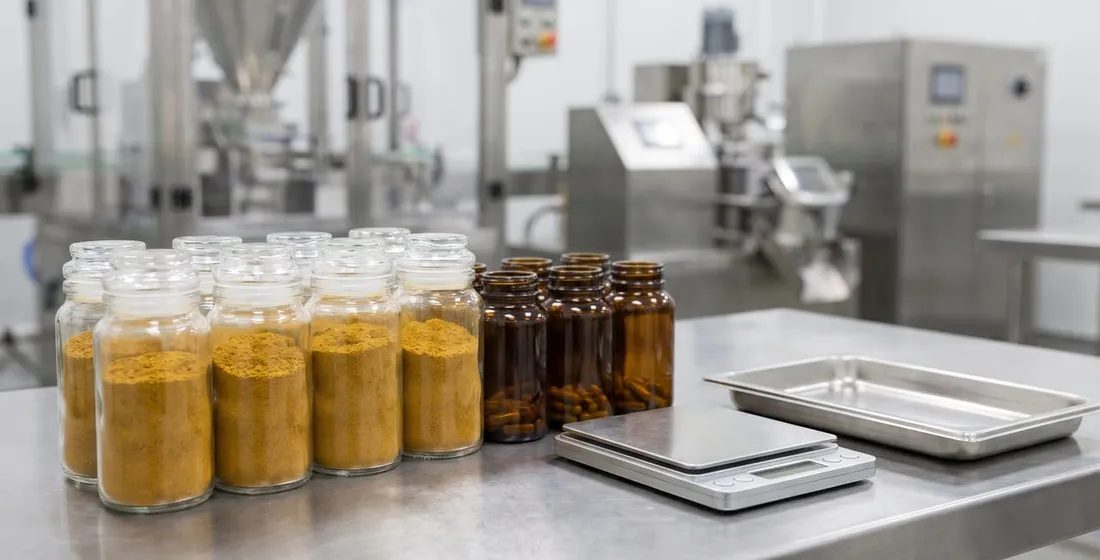
A row of plain, unlabelled glass jars of golden spice powder and amber capsule bottles on a stainless steel inspection bench, beside a small digital scale, with food-processing equipment blurred behind.
Buyer’s snapshot
- The public BRCGS Directory lists only currently certificated sites, and certificate data is entered by the certification body, not by the company (BRCGS, 2025).
- A certificate answers three questions only: which site, which scope, which dates. Brands that skip those three checks buy a logo, not an assurance.
- Silk Foods Ceylon (SFC) holds a BRCGS- and FSSC 22000 V6-audited stack at its Matale facility and expects buyers to verify it, not take it on trust.
- The comparison table below gives, for seven credentials, what each signals, what it does not prove and where to check it.
A supplier’s capability deck usually carries a row of certification logos. A logo is a claim. The certificate behind it is a document with a named site, a stated scope and an expiry date, and the register behind that document is the only place the claim becomes a fact. Most local brand owners have never been told which register to open.
This guide is written for the buyer who has to sign off a manufacturer: a brand owner choosing a contract manufacturer, or a procurement desk reading a supplier questionnaire. It covers BRCGS, FSSC 22000 V6, USDA Organic, EU Organic, SLSI, the Sri Lanka Food Act 1980 and Department of Ayurveda registration. For each one, it says what the credential signals, what it leaves open and how to check it. Where no public lookup could be found, it says so.
What can a certificate prove, and what does it leave open?
A food-safety or organic certificate proves that a named site, for a stated scope, passed a third-party audit on a stated date and is still in good standing. It does not prove that every product made at the site is covered, that every batch is identical or that the supplier fits your volume. Three fields decide its value: site, scope and validity.
Site means the exact address. A group can hold a certificate for one plant while a different plant makes your product. Scope means the product categories and processes the audit covered: a certificate for dry blending does not cover a retort line. Validity means the current dates and status, which a printed copy cannot show. The BRCGS Directory description is explicit on this point: certificate data comes from the certification body that ran the audit, and updates are typically made within 24 hours of the certification decision (BRCGS, 2025).
That is why a PDF handed over by a supplier is a starting point. Ask for it, then check the register, then compare the two. The sections below name the register for each credential.
Seven credentials compared: signal, limit and where to check
The order follows the SFC listing convention: international food-safety standards first, organic next, then the local floor. In practice a Sri Lankan retail shelf asks for the local floor first. A buyer should read the table as seven different questions, not one ladder.
| Credential | What it signals | What it does not prove | Where to check |
|---|---|---|---|
| BRCGS | A retailer-driven food-safety and product-integrity audit of a named site | That your product is in scope, or that a given batch is consistent | BRCGS Directory (current certificates); BRCGS Verify (adds expired, suspended and revoked status) |
| FSSC 22000 V6 | An ISO 22000-based food-safety management system, built on the GFSI-recognised scheme | The same limits; also that the certificate is to version 6 unless it says so | FSSC register of certified organizations, and the certification body’s own listing |
| USDA Organic | A handling or production operation certified to the US National Organic Program for stated scopes | That every SKU in the plant is organic; the scope is per operation and product | USDA Organic Integrity Database |
| EU Organic | An operator controlled by a recognised control body under Regulation (EU) 2018/848 | That a particular shipment is organic without its own electronic certificate | The operator certificate from the control body; import certificates in TRACES |
| SLSI (SLS mark) | A product-certification permit issued after assessment and audit by the Sri Lanka Standards Institution | That the mark is compulsory for your product (it is for listed categories only) | No public permit lookup found; ask SLSI to confirm the permit |
| Sri Lanka Food Act 1980 | The statutory floor for labelling and food-safety conduct | Nothing: it is law, not a certificate, so there is nothing to display | The label itself, and premises registration |
| Department of Ayurveda registration | Approval to carry traditional or Ayurvedic claims, via Form A (manufactory) and Form B (product) | That the formulation or claim is suitable for another product | The Department of Ayurveda’s registration process |
Two rows in that table are different in kind. The Food Act is a legal duty on every packaged food, so a supplier who “has” it has told you nothing. And SLSI certification is a voluntary scheme except where the Consumer Affairs Authority has made the mark mandatory for a listed product, which SLSI publishes as a compulsory product list (SLSI, 2026). Both are covered further below.
How do you verify BRCGS and FSSC 22000 V6?
Open the issuer’s register and match three things against the certificate you were given: the site address, the scope wording and the dates. The BRCGS Directory shows current certificates only; BRCGS Verify also shows expired, suspended and revoked results. FSSC publishes a register of certified organizations, and its certification-body pages break scope down by category.
The two standards overlap heavily, but the scope fields differ. FSSC 22000 V6 was published on 1 April 2023 with revised scope categories, so a certificate should name its version and its category (FSSC, 2023; Eurofins, 2023). A certificate that says “FSSC 22000” with no version is a question to ask, not an answer.
Picture a procurement desk with a supplier file open. The supplier’s PDF shows a current BRCGS certificate and a plant address in Matale. The Directory shows the same site, but the scope lists dry powders and capsules only, and the brand wants a jar-filled sauce. Nothing is false. The certificate simply does not reach the product. That mismatch between a real certificate and the wrong scope is the most common gap a supplier questionnaire exposes, and it takes five minutes to find.
For the buyer deciding whether either standard matters for a local shelf at all, BRCGS and FSSC 22000 V6: what they unlock for Sri Lankan brands sets out the sequencing.
Why organic certificates need a scope check as well as a name check
Organic certification is per operation and per product category, so a site can be certified organic for some SKUs and not others. The USDA Organic Integrity Database lists each operation’s scopes (crops, wild crops, livestock, handling) and its status, and operations showing as surrendered, suspended or revoked are not certified (CCOF, 2025).
The EU route is different. Imports need certificates issued by control authorities or bodies recognised by the European Commission under Article 46 of Regulation (EU) 2018/848, and the import certificate is issued electronically in TRACES (European Commission, 2024). In practice the buyer asks for the operator certificate and the control body’s name, then confirms the shipment’s electronic certificate when the goods move.
The common mistake is treating “organic” as a property of the factory. It is a property of a specific ingredient chain and a specific product list. SFC’s own position is plain: USDA Organic and EU Organic apply on relevant SKUs, not across the whole facility, and a buyer should ask for the SKU list.
What do the three Sri Lankan credentials actually tell you?
SLSI, the Food Act and Department of Ayurveda registration each answer a different local question: is this product certified to a Sri Lankan standard, is this label lawful, and may this product carry a traditional claim. None of them is verified the way a GFSI certificate is, and a buyer should know where the documents are rather than where a database is.
SLSI: voluntary scheme, with a compulsory list
SLSI describes its product certification schemes as voluntary, run under the Sri Lanka Standards Act No. 6 of 1984. Permits follow assessment, audit and a Permit Committee decision, then ongoing surveillance. The mark is mandatory only for the products on the list the Consumer Affairs Authority has made compulsory (SLSI, 2026). No searchable permit directory turned up in research for this post, so the practical check is to ask the supplier for the permit and ask SLSI to confirm it. The step-by-step process is in the SLSI packaged-food submission guide, and the records SLSI-minded buyers should expect from a maker are in the quality records a food maker keeps before launch.
The Sri Lanka Food Act: test the label, not the supplier
The Act has no certificate, so the test is the artwork. Read the label against the current regulations: product name, ingredient order, allergens, manufacturer details and date format. Then check the premises. The 2026 labelling regulations guide and the premises registration guide for brand owners cover both.
Department of Ayurveda registration: claim language decides it
Any product carrying an Ayurvedic or traditional claim goes through the Department of Ayurveda, with Form A covering the manufactory and Form B each product, and the Drug Formulatory Committee signing off the claim (Department of Ayurveda, 2026). A registered capsule does not make a different kashaya registered. See the kashaya registration track and private-label Ayurvedic capsules for how the two tracks run.
Buyer’s checklist: verify a manufacturer’s certificates in one sitting
- Ask for each certificate as a file, with the full site address and scope wording.
- Open the issuing register and compare site, scope and dates line by line.
- Confirm the version (FSSC 22000 V6) and the certification body’s name.
- For organic, ask for the SKU list and the control or certifying body’s name.
- For SLSI, ask for the permit and the product it covers; confirm with SLSI where no public list exists.
- For any Ayurvedic claim, ask for the Form B product registration, not a company-level statement.
- Ask what is not covered. A supplier who answers fast and plainly is a good sign.
Which certificate does your shelf actually ask for?
A local shelf needs the local floor: SLSI where the product is on the compulsory list or a retail buyer asks for the mark, and Food Act compliance on every label. BRCGS and FSSC 22000 V6 are not legally required for that shelf, but they increasingly decide premium private-label tiers and any export step. Organic and Ayurveda registration follow the claim you print.
A brand should therefore work backwards from the claim and the channel, not forwards from a supplier’s logo row. If the SKU is plain, sold locally and not on the compulsory list, SLSI and a lawful label are the work. If the SKU says “organic” or carries a traditional claim, the scope check moves to the front. For the longer view of how the stack fits together across a launch, contract manufacturing certifications in Sri Lanka maps each layer to the door it opens, and halal certification beside SLSI clearance covers a separate registration some buyers also ask for.
Where SFC walks away
Silk Foods Ceylon declines briefs that claim a certification the product’s scope does not carry, such as an organic label on a non-organic ingredient chain, or an Ayurvedic claim with no registration plan. A first run starts at 1,500 jars, 1,250 bottles or 180 capsule bottles for brands that have settled their claim language first.
Frequently asked questions
How do I check whether a supplier’s BRCGS certificate is real?
Search the BRCGS Directory for the site address and compare scope and dates with the supplier’s copy. The public Directory shows current certificates only; BRCGS Verify also shows expired, suspended and revoked status, and certificate data is entered by the certification body within about 24 hours of a decision (BRCGS, 2025).
Is SLSI certification compulsory for every packaged food?
No. SLSI describes its product certification as voluntary, but the Consumer Affairs Authority has made the SLS mark mandatory for a published list of products (SLSI, 2026). Check your product against that compulsory list, then confirm what your retail buyer asks for in its own supplier requirements.
Does a USDA Organic certificate cover every product a factory makes?
No. USDA organic certification is per operation and per scope, and the Organic Integrity Database lists each operation’s scopes and status (CCOF, 2025). A buyer should ask which SKUs are covered and check that the status is current, since surrendered, suspended or revoked operations are not certified.
Does Silk Foods Ceylon offer contract manufacturing with certificates a buyer can verify?
Yes. Silk Foods Ceylon offers Contract Manufacturing at its BRCGS- and FSSC 22000 V6-audited Matale facility, with SLSI submission support inside a standard engagement. Buyers are invited to request the certificate files and check scope and dates against the issuing registers before signing a brief.
How long does R&D take if a recipe needs registration alongside it?
R&D / NPD (Co-Development on the SFC brochure) takes 3 to 4 weeks at most from signed brief to approved formulation. Department of Ayurveda registration, where a traditional claim applies, is filed alongside and runs on its own clock, so confirm the current window with the Department at filing.
How Silk Foods Ceylon can help
For a brand owner reading supplier certificates, Silk Foods Ceylon (SFC) offers Contract Manufacturing at its Matale facility, with first runs from 180 capsule bottles, 1,250 bottles or 1,500 jars. The facility is BRCGS- and FSSC 22000 V6-audited, with USDA Organic and EU Organic on relevant SKUs, plus SLSI clearance support and Sri Lanka Food Act compliance built into the engagement. Where a product carries a traditional claim, Department of Ayurveda registration runs alongside R&D, which takes 3 to 4 weeks at most. Request the certificate files and check them against the registers first.
To brief a project, email b2b@esilkroute.com.lk or call +94 77 157 7294.
Sources
- BRCGS (2025), “About the BRCGS Directory” and “BRCGS Verify FAQs”, on current-only listings, Verify status coverage and certification-body data entry. brcgs.com (retrieved 29 October 2026).
- Foundation FSSC (2023), “FSSC 22000 Scheme Version 6”, on the register of certified organizations and scope categories. fssc.com (retrieved 29 October 2026).
- Eurofins (2023), “FSSC 22000”, on version 6 scope-category changes. eurofins.com (retrieved 29 October 2026).
- CCOF (2025), “OID Advanced Search Instruction”, on Organic Integrity Database scopes and status, citing USDA AMS. ccof.org (retrieved 29 October 2026).
- European Commission (2024), “The organic control system” and the TRACES guide for third-country organic operator certificates, on Regulation (EU) 2018/848 Article 46 recognition and electronic certificates. agriculture.ec.europa.eu (retrieved 29 October 2026).
- Sri Lanka Standards Institution (2026), “SLS Mark Product Certification” and the SLS Mark Compulsory Product List, issue 12. slsi.lk (retrieved 29 October 2026).
- Department of Ayurveda, Ministry of Health (2026), “Regulation of Local Ayurveda Drugs/Products Registration”. ayurveda.gov.lk (retrieved 29 October 2026).
Written by the Silk Foods Ceylon Team. Silk Foods Ceylon (Pvt) Ltd. is a BRCGS- and FSSC 22000 V6-audited contract manufacturer in Matale, Sri Lanka, offering contract manufacturing, private labelling, co-packing, and in-house R&D for local Sri Lankan brand owners, FMCG companies, hotel and restaurant groups, and distributors. To brief a project: b2b@esilkroute.com.lk or +94 77 157 7294.