
Cardamom grading for a Sri Lankan private-label spice brand
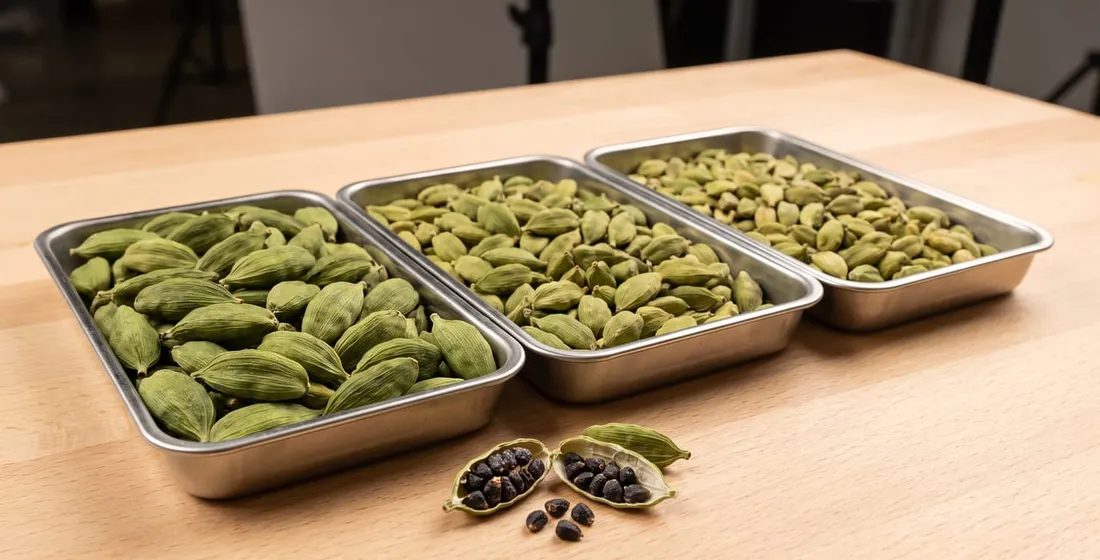
Three stainless-steel trays of graded green cardamom pods arranged side by side for size comparison, extra-bold, bold, and supreme grades, with a few pods split open to reveal the black seeds inside.
Buyer’s snapshot
- Green cardamom grades (Bold, Supreme, AGEB) are international trade terms for pod screen size and bulk density, not a quality label a jar can claim on its own.
- Codex Alimentarius’s CXS 357-2024 standard (2024) sets a separate chemistry floor: a volatile-oil minimum of 3.5 ml per 100 g dry basis for whole capsules, alongside caps on moisture, ash, and acid-insoluble ash.
- A private-label spec should fix size grade, colour, volatile-oil floor, and moisture before the first run.
- Silk Foods Ceylon (SFC) runs a 100 to 200 kg per hour spice line in Matale and grades cardamom by mm screen and weight before it reaches a jar.
A jar labelled “cardamom” tells a shopper almost nothing about what is inside it. Grade determines pod size, colour, and the volatile-oil content that carries cardamom’s aroma, and two suppliers can both sell legal, clean cardamom against the same purchase order while sending noticeably different products. For a Sri Lankan brand owner building a private-label spice line, bold, supreme, and AGEB are not marketing flourishes. They are size grades, and locking one into the spec is what keeps a jar consistent from the first run to the fiftieth. Silk Foods Ceylon (SFC), a contract manufacturer at Silk AgTech Park in Hapugasyaya, Matale, writes that grade into the spec before a private-label cardamom SKU goes into production.
Bold, supreme, and AGEB describe pod size, not marketing tier
Bold, Supreme, and AGEB are size grades used across the international green-cardamom trade, not proprietary labels a packer invents. AGEB (Alleppey Green Extra Bold) covers pods of 7 mm diameter and above. Bold covers roughly 6.0 to 6.9 mm. Supreme, also called Superior in some trade listings, covers roughly 5.0 to 5.9 mm. The grade fixes pod size and bulk density; it says nothing about flavour intensity on its own, which is a separate, chemistry-based measurement.
The naming is where private-label briefs go wrong more often than the size does. “Supreme” on one packer’s price list and “Superior” on another’s often describe the same 5 to 6 mm bracket, because the terms originated as regional trade shorthand (the “Alleppey Green” series, named for the Kerala port) rather than as a single fixed international standard. A brand that specifies “Supreme grade” without a screen size in millimetres is trusting the seller’s own definition of the word.
What screen sizes and colours separate the cardamom grades?
Screen size in millimetres, not the grade name, is the number that repeats reliably from lot to lot and supplier to supplier. The table below sets out the size brackets in common trade use, the colour a buyer should expect at each bracket, and where each grade typically lands on a Sri Lankan retail or gifting shelf.
| Grade | Screen size (mm) | Colour | Volatile oil (Codex floor) | Typical use / channel fit | Relative cost |
| AGEB (Alleppey Green Extra Bold) | 7.0 and above | Deep, uniform green | 3.5% dry basis minimum; well-filled AGEB lots commonly test above the floor | Premium single-origin jars, hotel gift-shop and diaspora gifting SKUs | Highest |
| Bold (AGB) | 6.0 to 6.9 | Mature green | 3.5% dry basis minimum | Mainstream supermarket retail jars and pouches | Mid to high |
| Supreme / Superior (AGS) | 5.0 to 5.9 | Green, slightly lighter shade | 3.5% dry basis minimum | Blended masala mixes, chai-spice blends, food-service | Mid |
| Shipment grades (AGS-1, AGS-2) | Below 5.0 | Mixed green, more variation | 3.5% dry basis minimum | Bulk, extraction, industrial reprocessing; not retail-facing | Lowest |
Read the table as one decision rather than four separate ones. Codex’s volatile-oil floor applies to all whole-capsule cardamom regardless of size grade, but larger, well-filled pods carry more mature seed mass and commonly test above that floor with room to spare. A brand paying AGEB pricing and receiving Bold-size pods is losing both visual size and, often, some of that aroma margin, and none of it shows up on an invoice that just reads “cardamom.” The same size-first discipline applies to a blended SKU, which is why the curry powder blend a brand takes to a supermarket shelf starts from named, graded inputs rather than a generic spice bill.
How does Codex grade cardamom on chemistry, not just size?
Codex Alimentarius adopted CXS 357-2024, the standard for small cardamom, in 2024, and it grades on chemistry rather than pod diameter. For whole unopened capsules, the standard sets a volatile-oil minimum of 3.5 ml per 100 g on a dry basis (2.5 ml per 100 g for opened capsules), a total ash ceiling of 9.5%, an acid-insoluble ash ceiling of 2.5%, and a moisture ceiling of 13% (Codex Alimentarius, 2024). None of these figures depend on whether the pod measures 5 mm or 8 mm.
This is the parameter set a private-label brand should ask a supplier to test against, alongside the size grade. Volatile oil is the number that tracks most closely with the aroma a buyer actually smells when the jar opens; acid-insoluble ash is the number that flags dust, grit, or poor post-harvest handling riding along in the lot. A brand that specifies “AGEB grade” and stops there has fixed the size but left the chemistry to chance. The same size-and-chemistry discipline runs across the spice range: it is the same grading logic behind specifying black pepper grades for a private-label spice line, and behind the premium sizing tiers set out for nutmeg, mace, and vanilla on a private-label spice line.
Where Ceylon cardamom sits in the size-grade language
Sri Lanka grows green cardamom, Elettaria cardamomum, mainly across the Kandy, Matale, Kegalle, Nuwara Eliya, Ratnapura, and part of Galle districts, with a concentration in the Knuckles hill zone that spans Kandy and Matale (Sri Lanka Export Development Board). By 2009, national cardamom cultivation covered roughly 2,794 hectares, with about 2,635 hectares of that sitting in the Matale and Kandy districts alone, a large share of it in the Kalupahana area of the Knuckles Conservation Forest (Hector Kobbekaduwa Agrarian Research and Training Institute). Matale sits inside that growing belt, which for a Matale-based line means a short sourcing radius when a lot needs re-grading.
Sri Lanka’s own export trade runs a parallel naming system: LG (Lanka Green) and LLG (Lanka Light Green) are the grades the EDB lists for Ceylon cardamom, alongside the Bold, Supreme, and AGEB terms that dominate the wider international trade (Sri Lanka Export Development Board). In 2019, Daily FT reported that the EDB’s “Ceylon Spice” master brand, covering cinnamon, pepper, clove, nutmeg, mace, and cardamom, was built to help the sector reach an export target of USD 880 million by 2022 (Daily FT, 2019). For a private-label brief, the takeaway is practical rather than promotional: whichever name a supplier uses, LG, LLG, Supreme, or AGEB, the screen size in millimetres and the Codex chemistry floor are what should end up written into the purchase order.
How does the same grade fit both a supermarket shelf and a hotel gift box?
One local spice brand at Silk Foods Ceylon briefed a single “premium cardamom” SKU meant to run on both a supermarket jar and a hotel gift-shop line. The R&D team’s first question was which channel the word “premium” was actually serving: a supermarket shopper rarely opens the jar before buying, so Bold-grade pods at a lower per-kilogram cost held the shelf price competitive without a visible size complaint. The gift-shop line, sold to a guest who often does open the box before deciding, moved to AGEB for the larger, more uniform pod that reads as premium on sight. Same origin, same certification file, two different size specs for two different moments of inspection.
The consequence for a brand owner planning a private-label range is that “premium” is a channel decision, not a fixed grade. A jar destined for a shelf where price sensitivity dominates can specify Bold or Supreme and hold margin. A box destined for a guest who will open it before paying justifies the AGEB premium, because the pod itself is doing part of the selling.
What certifications and labelling does a private-label cardamom SKU need?
A packaged cardamom SKU faces the same local floor as any retail spice: SLSI clearance for shelf eligibility and Sri Lanka Food Act 1980 compliance for the label itself. The label needs the product name, ingredient declaration where the SKU is a blend, net weight, manufacturer details, and manufacture and expiry dates in the prescribed format. Above that local floor, the SFC facility is BRCGS- and FSSC 22000 V6-audited, the combination the higher tier of local private-label programmes, and any later export step, increasingly asks for on the manufacturer. The full picture of the certification stack a local manufacturer carries sits alongside SLSI and the Food Act, and the SLSI submission itself runs step by step on its own timeline of roughly four to eight weeks.
Grade also functions as a fraud guard for cardamom, one of the higher-value spices by weight. A lot with unusually low moisture and a suspiciously high bulk density for its stated size can signal added weight from foreign matter rather than genuine pod maturity, which is exactly why Codex caps acid-insoluble ash and moisture rather than trusting size alone. A spec that names both the screen size and the chemistry ceilings is a spec that can be tested against a cheap substitution.
MOQ, packaging, and lead time for a private-label cardamom line
Silk Foods Ceylon runs its spice line at 100 to 200 kg per hour and takes a 50 kg first-run MOQ per SKU on a private-label spice or herb, with volume tiers at 500, 1,000, and 2,500 kg. Whole cardamom passes through cleaning, size-grading, and moisture-check steps before packing, so a brand can hand over a size and chemistry spec and receive a jarred, labelled SKU from one site. Packaging runs from a 40 g glass spice jar for retail up to kraft pouches at 50 g through 1 kg for food-service and refill formats.
For a local FMCG founder weighing the choice, contract manufacturing at the Matale facility is the operational equivalent of moving from hand-sorting a home-kitchen batch to a line that grades by screen size and tests moisture before a single jar is filled. R&D and NPD (Co-Development on the SFC brochure) comes first only when the grade or blend ratio is not yet locked; once the spec is signed off, the same line runs the private-label production. Lead time follows the spec: once the grade is fixed, a sample dispatches in one to two weeks, and a purchase order runs two to three weeks from order to dispatch on an existing spec. A first-time grade sign-off or a new blend adds an R&D window ahead of the production slot.
Frequently asked questions
What grade of cardamom should a private-label brand specify?
For a retail jar sold on visible pod size, specify AGEB (7 mm and above) or Bold (6.0 to 6.9 mm), with the Codex CXS 357-2024 volatile-oil floor of 3.5% dry basis and a moisture ceiling of 13% named alongside the size. For a blended masala or chai mix where pod size will not be seen, Supreme (5.0 to 5.9 mm) usually holds the same chemistry floor at a lower cost.
What does AGEB mean in cardamom grading?
AGEB stands for Alleppey Green Extra Bold, an international trade term for green cardamom pods of 7 mm diameter and above with a bulk density around 435 g per litre. The name comes from the Kerala trading port of Alleppey, though the grade itself is used across the global cardamom trade, including by Sri Lankan private-label packers.
Is Ceylon cardamom graded the same way as Indian cardamom?
Sri Lanka’s own export system uses LG (Lanka Green) and LLG (Lanka Light Green) as its named grades (Sri Lanka Export Development Board), while the wider international trade, including many Sri Lankan private-label packers, also uses the Bold, Supreme, and AGEB screen-size language. Specifying the millimetre size and the Codex chemistry floor avoids confusion between the two naming systems.
Does Silk Foods Ceylon offer private labelling or contract manufacturing for cardamom-based spice SKUs?
Yes. Silk Foods Ceylon runs a 100 to 200 kg per hour spice line at its Matale facility with a 50 kg first-run MOQ per SKU, grading cardamom by screen size before packing into glass jars or kraft pouches. The engagement includes SLSI submission support for a new private-label spice SKU.
How long does it take to get a sample of a graded cardamom spec from Silk Foods Ceylon?
Once the size and chemistry spec is fixed, a sample typically dispatches in one to two weeks, with a full purchase order running two to three weeks from order to dispatch. A first-time grade or blend sign-off adds an R&D window of several weeks ahead of the first commercial run.
How Silk Foods Ceylon can help
For founders launching a first commercial cardamom or spice SKU, Silk Foods Ceylon (SFC) operates a cellular-manufacturing facility in Matale that handles the steps between a graded raw material and a retail-ready jar. The spice line runs at 100 to 200 kg per hour, with a 50 kg first-run MOQ per SKU and volume tiers at 500, 1,000, and 2,500 kg. Lead times typically run two to three weeks once a grade is locked; if a new blend or grade sign-off is needed first, plan a several-week R&D window ahead of the production slot. The Matale facility is BRCGS- and FSSC 22000 V6-audited, with SLSI submission support built into a standard private-label engagement.
To brief a private-label cardamom or spice SKU, email b2b@esilkroute.com.lk or call +94 76 441 0389 or +94 76 918 5744.
Sources
- Codex Alimentarius (FAO/WHO) (2024), “Standard for Small Cardamom (CXS 357-2024)”, https://www.fao.org/fao-who-codexalimentarius/sh-proxy/de/?lnk=1&url=https://workspace.fao.org/sites/codex/Standards/CXS+357-2024/CXS_357e.pdf (retrieved 2026-07-18).
- Sri Lanka Export Development Board, “Cardamom from Sri Lanka - Ceylon Cardamom”, https://www.srilankabusiness.com/spices/about/cardamom-cultivation-sri-lanka.html (retrieved 2026-07-18).
- Hector Kobbekaduwa Agrarian Research and Training Institute (HARTI), “Cardamom Cultivation in Knuckles Conservation Forest: Environmental and Socio-Economic Perspective”, http://harti.gov.lk/images/download/reasearch_report/new/research_report_196_f.pdf (retrieved 2026-07-18).
- Daily FT (2019), “Sri Lanka unveils ‘Ceylon Spice’ master brand”, https://www.ft.lk/front-page/Sri-Lanka-unveils-Ceylon-Spice-master-brand/44-686499 (retrieved 2026-07-18).
- Sri Lanka Standards Institution (SLSI), https://www.slsi.lk/ (retrieved 2026-07-18).
- Further reading: Sri Lanka Export Development Board, “Export Potential of Ceylon Spices and Essential Oils”, https://www.srilankabusiness.com/spices/export-potential-of-ceylon-spices.html (retrieved 2026-07-18).
Written by the Silk Foods Ceylon Team. Silk Foods Ceylon (Pvt) Ltd. is a BRCGS- and FSSC 22000 V6-audited contract manufacturer in Matale, Sri Lanka, offering contract manufacturing, private labelling, co-packing, and in-house R&D for local Sri Lankan brand owners, FMCG companies, hotel and restaurant groups, and distributors. To brief a project: b2b@esilkroute.com.lk, +94 76 441 0389, or +94 76 918 5744.