Five questions before your first plant-based run in Sri Lanka
By the Silk Foods Ceylon Editorial Team
Buyer’s snapshot
- Sri Lanka has no SLS standard for meat analogues. The nearest domestic reference is SLS 898:2017 for defatted textured soya protein, which covers an ingredient rather than a finished patty or nugget.
- Regulation 10(5) of the Food (Labelling and Advertising) Regulations 2026 requires a food of vegetable or plant origin that contains any ingredient of animal origin to name that ingredient in bold type at a minimum font size of 1.5 mm, with a statement that it is of animal origin.
- The colour coding regulations for solid and semi-solid foods, Gazette 2119/3, carry no exemption for frozen or chilled processed protein. A patty above 17.5 g fat or 1.25 g salt per 100 g takes a red mark.
- First-run MOQ at Silk Foods Ceylon (SFC) is 5,000 to 10,000 units per SKU on the patty and nugget line, which runs up to 15,000 patties or 30,000 nuggets a day.
- Four of the five questions below are regulatory and can be answered before a single sample is made. The fifth is a scheduling question, and it is the one most first briefs get wrong.
Most plant-based briefs that reach a Sri Lankan contract manufacturer arrive with a flavour profile and a target price, and almost nothing else. The recipe usually works. It has been cooked at home, tasted well at a pop-up, and convinced a retail buyer to ask for a listing. What it has not done is survive a regulatory read, a 5,000-unit batch, or a freezer.
The five questions below are the ones that decide whether a first plant-based production run goes to plan. Four are regulatory, and every one of them can be answered on paper before any money reaches a production line. The fifth is about the calendar, and it is where most of the time gets lost.
The five questions, what governs each, and when it has to be settled
| Question | What governs the answer | Settle it by |
|---|---|---|
| What is the protein base? | SLS 898:2017 for defatted textured soya protein; no SLS standard for finished meat analogues | Before the first R&D brief |
| Does anything in it come from an animal? | Regulation 10(5), Food (Labelling and Advertising) Regulations 2026 | Before artwork, and before the ingredient list is fixed |
| Will the pack carry a red mark? | Gazette 2119/3, colour coding for solid and semi-solid foods | Before the formulation is locked, not after |
| Which binder is permitted? | Food (Additives - General) Regulations 2019, Gazette 2131/2, reading across to Codex | During R&D, confirmed at submission |
| What do the units and the calendar look like? | Line capacity, MOQ, cold chain and the SLSI submission window | Before a shelf date is promised to a buyer |
Question 1. What is the protein base, and is there a standard behind it?
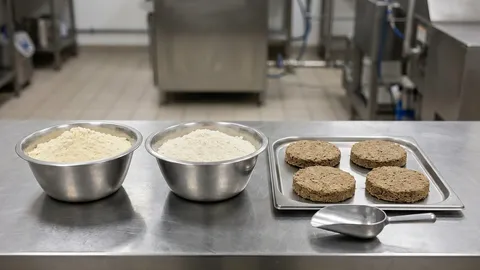
Sri Lanka’s published standards catalogue lists SLS 898:2017 for defatted textured soya protein. It does not list a standard for meat analogues, plant-based patties or vegetarian meat substitutes. The practical effect is that the ingredient can be specified against a domestic standard, while the finished SKU cannot, so its specification has to be written by the brand and the manufacturer.
That absence is not a problem in itself. It does change who carries the risk. Where a written standard exists, a brand, a laboratory and a retail buyer can all point at the same document when a batch is disputed. Where it does not, the only reference is the specification the two parties agreed, which means that document has to be far more complete than most first briefs assume.
The base itself drives everything downstream: water binding, cook loss, texture after freezing, and the fat and salt load that Question 3 turns into a label decision. Soy and pea behave differently on all four, as the pea and soy protein comparison for a Sri Lankan patty spec sets out. A whole-food base behaves differently again, which is the argument for jackfruit as a plant-meat feedstock.
Pick the base first. A brief that says “plant protein” and leaves the choice to the R&D stage is really asking for two development cycles instead of one.
Question 2. Does anything in the formulation come from an animal?
The Food (Labelling and Advertising) Regulations 2026 were gazetted on 26 June 2026 as Gazette Extraordinary 2494/47 and came into operation on 1 July 2026. Regulation 10(5) is the provision every plant-based brand owner in Sri Lanka needs to read, because it is written specifically for food of vegetable or plant origin.
The regulation requires that where a food of vegetable or plant origin contains any ingredient of animal origin, the name of that ingredient is declared on the label, in bold type, at a minimum font size of 1.5 mm, together with a statement that it is of animal origin. Dairy products are exempted unless they contain animal-origin ingredients other than dairy, and the proviso exempts dairy ingredients, bee honey, bee wax, added micronutrients, food additives and processing aids.
Read that against a typical plant-based brief and the exposure becomes obvious. A binder or a stock base carried over from a kitchen recipe, a flavour built on a dairy or egg derivative, a glaze, a release agent: any of these can turn a product marketed as plant-based into one carrying a mandatory 1.5 mm bold animal-origin declaration on the front of a pack designed to say the opposite. The formulation decision and the artwork decision are the same decision here, and the time to make it is before either is locked.
Buyer’s checklist: the animal-origin audit before artwork
- List every ingoing ingredient, including carriers, anti-caking agents and release agents, not just the recipe headline
- Trace each compound ingredient to its own sub-ingredients, since flavours and seasoning blends are where animal derivatives usually sit
- Ask each supplier for a written statement of animal-origin content rather than assuming a vegetarian specification
- Check the glaze, the coating and the frying medium separately from the core formulation
- Confirm whether any exempted category applies before relying on the exemption, since the proviso is narrow
One more provision in the same regulations bears on plant-based artwork. Regulation 9(2) requires that where a characterising ingredient is named, pictured or emphasised on a label, its proportion is declared in the ingredient list as a percentage of the ingoing ingredients. A pack that leads with a named protein has to be ready to print that percentage. The full set of changes is covered in the walkthrough of the 2026 labelling regulations.
Question 3. Will the pack have to carry a red mark?
The colour coding regulations for solid and semi-solid foods were gazetted on 17 April 2019 as Gazette Extraordinary 2119/3 and came into operation on 1 June 2019. Schedule I sets three thresholds per 100 g: sugar above 22 g, salt above 1.25 g, and fat above 17.5 g each take a red mark, with defined amber bands below them.
The scope question matters more than the numbers. The regulations apply to any solid or semi-solid food, and the exemption list covers primary agricultural products, separately sold spices and condiments, special dietary and medical foods, bulk goods weighed for a purchaser, bulk packs whose retail packs comply, infant formulae, export-only products, foods that become liquid on preparation, and food made before the regulations took effect. Frozen and chilled processed protein appears nowhere on that list, so a plant-based patty, nugget or sausage sits inside scope like any other packaged solid food.
That is where a lot of plant-based formulations run into trouble, because fat and salt are load-bearing in this category. Fat carries the mouthfeel that makes a meat analogue credible, and salt carries the flavour that a low-fat version loses. A formulation tuned purely on a tasting panel will often land above 17.5 g fat or 1.25 g salt per 100 g without anyone having checked. The mark is then mandatory, and the only way to remove it is to reformulate and start the sample cycle again.
Reformulating against the thresholds during R&D costs an iteration. Discovering the mark after artwork is signed off costs an iteration plus a print run plus a shelf date. How the sugar, salt and fat colour code works in practice covers the bands and the logo requirement in full.
The nutrient declaration behind those numbers is also on a clock. Under the 2026 labelling regulations, a nutrient declaration is already mandatory for foods carrying a nutrition or health claim, foods for infants, young children and pregnant mothers, and special dietary and medical foods. For all other packaged food products it becomes mandatory one year after the regulations were published in the Gazette, which puts that date at the end of June 2027.
Question 4. Which binder is permitted, and on what authority?
The Food (Additives - General) Regulations 2019 were gazetted on 8 July 2019 as Gazette Extraordinary 2131/2 and came into operation on 1 January 2020. Regulation 2(b) permits classes of additives used for technological functions specified in Schedule II and covered by the lists and limits published in the Codex Alimentarius General Standard for Food Additives, unless regulated by a product standard made under the Food Act.
For a plant-based formulator, that wording is the whole answer and also the whole difficulty. The binder that holds a patty together through forming, freezing, cooking and service is usually a cellulose derivative. No such substance is named in the regulations, by name or by INS number, because the instrument is a framework rather than a substance list. Permission therefore has to be traced through the Codex standard and matched to a functional class that Schedule II actually names, and the classes it names are not a perfect map of the functions a binder performs.
The honest position is that this is an interpretation, not a printed permission, and it belongs in a written question to the regulator at submission rather than in an assumption built into a launch plan. A manufacturer that tells a brand owner the binder is simply approved has skipped a step. A brand that carries a home-kitchen binder straight into a commercial specification has skipped the same one.
The wider point is the same one that governs preservatives and colours in every other local category: where a substance is not named in a Sri Lankan schedule, the route to permission runs through Codex by reference, and a local product standard overrides it where one exists.
Question 5. What do the units, the cold chain and the calendar actually look like?
A plant-based SKU is a frozen or chilled product, which means the run is only half the commitment. The other half is the chain that holds the product between the factory freezer and the retail cabinet, and that chain is usually the part a first-time brief has not costed at all.
Service snapshot: contract manufacturing for plant-based SKUs at Silk Foods Ceylon
- Facility: a 10,000 sq ft cellular-manufacturing site in Matale running more than 50 ready-to-go SKUs across formats
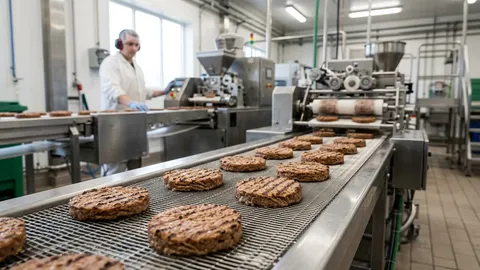
- Line: patty forming, battering, breading and frying equipment, with capacity up to 15,000 patties or 30,000 nuggets a day
- First-run MOQ: 5,000 to 10,000 units per SKU on the patty and nugget line
- Sample to first purchase order: typically 2 to 3 weeks on a locked recipe, and 6 to 10 weeks where R&D and NPD come first
- Certification: production on a BRCGS and FSSC 22000 V6 audited line, with SLSI submission support and Sri Lanka Food Act labelling review inside the standard engagement
The R&D team at the Matale facility sees the same failure on kitchen-developed plant-based briefs, and it is rarely flavour. It is cook loss. A patty that holds its shape in a domestic pan at 120 g releases water and fat differently at 5,000 units through a forming machine and a continuous fryer, and a formulation that loses an extra few percent in the fryer changes the finished weight, the fat per 100 g, and therefore the answer to Question 3. A brand that budgeted two sample rounds usually needs four. That single misjudgement is the most common reason a six-week launch becomes a twelve-week one.
Format decides the chain. A frozen SKU is more forgiving in distribution and less forgiving in R&D, because freeze-thaw behaviour has to be designed in rather than discovered, a point worked through in the frozen seitan SKU formulation and cold chain. A chilled SKU shortens the shelf life and hands more of the risk to the retailer, which is the decision set out in holding a chilled or frozen SKU on a modern trade shelf.
On the calendar, work backwards rather than forwards. A locked recipe reaches a first purchase order in about two to three weeks. A brief that still needs development takes 6 to 10 weeks before that point, and the SLSI submission sits after production, not alongside it. A brand that has promised a buyer a shelf date without a locked formulation has already committed to a date it cannot control. The unit economics of that first run are set out in the 5,000 to 10,000 unit first patty run.
Frequently asked questions
Is there an SLS standard for plant-based meat in Sri Lanka?
No. Sri Lanka’s published standards catalogue lists SLS 898:2017 for defatted textured soya protein, which is an ingredient standard. No SLS standard is listed for meat analogues, plant-based patties or vegetarian meat substitutes, so the finished SKU is specified between the brand and the manufacturer instead.
Does a plant-based product in Sri Lanka have to declare animal ingredients?
Yes. Regulation 10(5) of the Food (Labelling and Advertising) Regulations 2026, Gazette 2494/47, requires a food of vegetable or plant origin containing any ingredient of animal origin to name it in bold type at a minimum font size of 1.5 mm, with a statement that it is of animal origin. Narrow exemptions apply.
Do the sugar, salt and fat colour coding rules apply to frozen plant-based patties?
Yes. The colour coding regulations for solid and semi-solid foods, Gazette 2119/3 of 17 April 2019, apply to any solid or semi-solid food, and frozen or chilled processed protein is not on the exemption list. Above 17.5 g fat or 1.25 g salt per 100 g, the red mark is mandatory.
Are cellulose binders permitted in Sri Lanka for plant-based products?
The Food (Additives - General) Regulations 2019, Gazette 2131/2, name no such substance directly. Regulation 2(b) permits additive classes specified in Schedule II and covered by the Codex General Standard for Food Additives, unless a local product standard applies. Treat the position as a question to confirm at submission.
What is the minimum order for a plant-based patty run at Silk Foods Ceylon?
First-run MOQ is 5,000 to 10,000 units per SKU on the patty and nugget line at the Matale facility, which runs up to 15,000 patties or 30,000 nuggets a day. Production is on a BRCGS and FSSC 22000 V6 audited line, with SLSI submission support inside the standard engagement.
How Silk Foods Ceylon can help
For local FMCG brands taking a plant-based SKU out of a kitchen and onto a retail shelf, Silk Foods Ceylon runs R&D and NPD alongside production planning at a 10,000 sq ft cellular-manufacturing facility in Matale, so formulation work and the regulatory read advance together rather than one after the other. First-run MOQ is 5,000 to 10,000 units per SKU on a line that runs up to 15,000 patties or 30,000 nuggets a day. Sample to first purchase order is typically 2 to 3 weeks on a locked recipe and 6 to 10 weeks where development comes first. Production runs on a BRCGS and FSSC 22000 V6 audited line, and SLSI submission support and Sri Lanka Food Act labelling review sit inside the standard engagement.
To brief a project, email b2b@esilkroute.com.lk or call +94 76 441 0389 or +94 76 918 5744.
Sources
- Government of Sri Lanka, Ministry of Health. Food (Labelling and Advertising) Regulations 2026, Gazette Extraordinary No. 2494/47 of 26 June 2026. eohfs.health.gov.lk. Retrieved 21 September 2026.
- Government of Sri Lanka, Ministry of Health. Regulations on colour coding of solid and semi-solid foods, Gazette Extraordinary No. 2119/3 of 17 April 2019. eohfs.health.gov.lk. Retrieved 21 September 2026.
- Government of Sri Lanka, Ministry of Health. Food (Additives - General) Regulations 2019, Gazette Extraordinary No. 2131/2 of 8 July 2019. eohfs.health.gov.lk. Retrieved 21 September 2026.
- Sri Lanka Standards Institution. Alphabetical index to the SLS standards catalogue. slsi.lk. Retrieved 21 September 2026.
- Sri Lanka Standards Institution. Scope of testing, microbiology laboratory (lists SLS 898:2017, textured soya protein, defatted). slsi.lk. Retrieved 21 September 2026.
Written by the Silk Foods Ceylon Editorial Team. Silk Foods Ceylon (Pvt) Ltd. is a BRCGS and FSSC 22000 V6 audited contract manufacturer in Matale, Sri Lanka, offering contract manufacturing, private labelling, co-packing and in-house R&D for local Sri Lankan brand owners, FMCG companies, hotel and restaurant groups, and distributors. To brief a project: b2b@esilkroute.com.lk, +94 76 441 0389, or +94 76 918 5744.