Allergen Changeovers on a Shared Filler: Line Time and Records
By the Silk Foods Ceylon Editorial Team
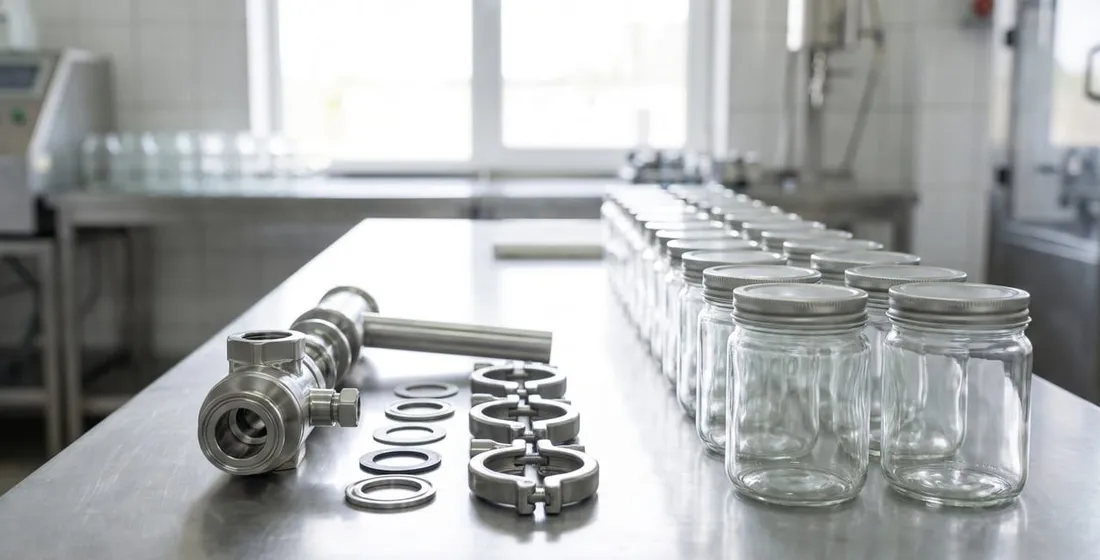
Disassembled stainless steel filler valve and tri-clamp fittings on a steel worktop beside a row of empty unlabelled glass jars.
Buyer’s snapshot
- When two clients’ products run on one filler on the same day, the changeover between them is a block of line time that nobody can sell and somebody must pay for.
- The Codex code of practice on allergen management asks makers to separate products of different allergen profile by time where they share equipment, to clean between them, and to keep cleaning records with any test results.
- A clean is proved on two levels: validation shows the method works for a given allergen and product, and verification shows it was done properly on the day.
- Ordering a week’s runs by allergen profile cuts the number of allergen-grade changeovers. In the worked example below, one planned order needs 5 hours of changeover where an unplanned order needs 7.
- Silk Foods Ceylon (SFC) sequences runs against the other products on the line, and welcomes small runs, quote on request.
A buyer who books a co-packing slot usually pictures one product on one line. The real floor is busier. The jar filler that runs your sauce on Monday may run another brand’s nut spread on Tuesday, and the work between the two is where the quote, the schedule and the allergen declaration all meet.
This note explains what an allergen changeover on a shared filler consists of, how it eats line time, which records prove the clean, and how to batch a week so that you pay for fewer of them. It builds on two earlier SFC notes, how a run is scheduled on a shared line and what a changeover costs on a sachet line, and goes further into the allergen side.
What is an allergen changeover, and why is it more than a wash?
An allergen changeover is the controlled stop between two products on shared equipment when the first product holds an allergen that the second does not declare. The aim is that nothing from the first run can end up in the second, because a label that is correct for the second product would then be wrong.
The Codex Alimentarius Code of Practice on Food Allergen Management for Food Business Operators (CXC 80-2020) is the international reference. It notes that factories commonly handle several allergens on the same equipment, that dedicated lines are ideal but not always feasible, and that production sequencing, meaning separation by time, is an option especially for smaller businesses (Codex Alimentarius, 2020, section 4.1.2.1). It also lists scheduling that leaves an allergen behind, and cleaning that is inadequate at changeover, among the ways unintended allergen presence arises.
That is why a changeover is more than a wash. It has three parts: the clean itself, the proof that the clean worked, and the release of the next run only after that proof is on file.
| Part of the changeover | What happens | Who feels it |
|---|---|---|
| Strip and clean | Product-contact parts are taken apart where feasible and cleaned to a written method | Line time, labour and cleaning materials |
| Proof | The line is inspected, and swabs or other tests are taken where the method calls for them | Release time while results are read |
| Restart | First packs after restart are checked, and early output may be scrapped while the fill settles | Product loss and a later first good pack |
Which two numbers decide what a changeover costs?
Two numbers decide it: how long the line is stopped, and how many stops the week contains. The cost of a changeover is a fixed block, paid whether the next run is 200 jars or 20,000, which is why short runs carry the heaviest share per jar. The sachet note linked above sets out that per-pack logic in detail.
The allergen layer adds a second fixed block on top of an ordinary product change. A change between two plain, allergen-free products needs a clean for flavour, colour and hygiene. A change from a nut or milk product to a product that does not declare it needs the allergen-grade clean, with its proof. SFC does not publish its own changeover times, and they differ by product and equipment, so the figures below are assumed round numbers for the arithmetic only.
For the worked example, assume an ordinary changeover takes 1 hour and an allergen-grade changeover takes 2 hours, including proof and release. These are assumptions to show the method, not SFC data.
How does the order of a week’s runs change the bill?
The order changes the number of allergen-grade changeovers, because only some transitions need one. Codex suggests running products without allergens at the start of a schedule and running products with the same allergen profile one after another before moving to a different profile (Codex Alimentarius, 2020, section 5.2.1.1). It also suggests adding allergenic ingredients as late as possible in a process, so that less equipment meets them.
Take a week with five runs on one filler: two plain products (A and C), two containing tree nuts (B and E) and one containing milk (D). A transition needs the allergen-grade clean when the product just finished holds an allergen that the next product does not declare.
| Order | Transitions | Allergen-grade (2 h) | Ordinary (1 h) | Total changeover time |
|---|---|---|---|---|
| Unplanned: B, D, E, A, C | nut to milk, milk to nut, nut to plain, plain to plain | 3 | 1 | 7 hours |
| Batched: A, C, B, E, D | plain to plain, plain to nut, nut to nut, nut to milk | 1 | 3 | 5 hours |
The batched week saves 2 hours, which on an 8-hour day is a quarter of a shift returned to production. The saving comes entirely from order. Nothing about the cleaning method was weakened, and the single allergen-grade clean that remains still gets its full proof.
Batching has a price of its own. Moving your run to the plain end of the week may push it later, and a client whose product is the nut product may find it sits mid-week. A buyer who can accept a flexible day inside the week gives the planner room to batch, and a buyer who needs a fixed day takes the changeover the order produces.
Which records prove an allergen clean?
The records are a written cleaning method, a validation file, and a verification record for each changeover. Codex says cleaning procedures should name the equipment to be cleaned, the tools and materials, the sequence of steps, any disassembly, the monitoring and the action to take if residue is not removed. It also says manufacturers should keep cleaning records, including test results, and review them (Codex Alimentarius, 2020, section 6.2.1).
The same text separates the two levels of proof. Validation shows a cleaning process is adequate to reduce or eliminate allergens, and it should be specific to the allergen, the process and the product matrix. Verification confirms that the clean was carried out and worked, through visual observation and, where feasible and appropriate, an analytical testing programme (Codex Alimentarius, 2020, sections 6.2.1 and 6.5).
| Record | Question it answers | When it is made |
|---|---|---|
| Cleaning method | What exactly is done, with which tools, in what order? | Written once, reviewed on any change |
| Validation file | Does this method remove this allergen from this product on this equipment? | Before the method is relied on, and again when equipment, recipe or method changes |
| Changeover record | Was the method followed, by whom, and was the line visibly clean? | Every changeover |
| Test result | Did a swab or rinse sample show residue? | Per the verification plan |
| Release sign-off | Who allowed the next run to start? | Every changeover |
A buyer does not need to see every changeover record, but is entitled to ask whether the validation behind the method exists and which allergens it covers. The quality records a food maker keeps before launch sit beside these.
How do swab checks fit, and what can they not show?
Swabs are a verification tool, and each type answers a narrower question than it first appears to. Codex says manufacturers should inspect equipment after each cleaning for visible cleanliness, and periodically test surfaces for residue, using an allergen-specific test kit where one exists for the allergen and food in question. It adds that a test should suit the allergen and the matrix, and that the user should know its limit of detection and its specificity (Codex Alimentarius, 2020, section 6.5).
An ATP swab is quick and shows general cleanliness, but it is not a direct marker of allergen removal. A 3M Food Safety microbiologist notes that the ATP present varies with the food type, and recommends pairing ATP with a protein test, ideally an allergen-specific rapid test (Lopez-Velasco, 2018). A protein swab detects protein without naming it, and its sensitivity may differ from that of an allergen-specific test.
For the buyer this has one practical meaning. A line that is visibly clean and passed an ATP swab has shown it is clean in the ordinary sense. Whether it shows the allergen is gone depends on the validation and on which test was used, so ask what the verification actually measures.
Codex also describes a push-through technique for lines where water is a problem: the next product, or an inert material such as sugar or salt, is run through to carry residue out, and where testing is feasible that first material is evaluated to show the allergen has gone (Codex Alimentarius, 2020, section 6.2.1). A buyer whose product is the first one through after an allergen should expect that first material to be treated with care.
What does a changeover look like on the floor?
On a typical Thursday afternoon at a food plant, a changeover looks like this. A nut spread has just come off the filler. The next job is a plain fruit preserve for a different brand. The filler is stripped, the valve and fittings go to the wash bay, the hopper is hand-scraped rather than blasted, since Codex warns that high-pressure hoses and compressed air can spread residue instead of removing it (Codex Alimentarius, 2020, section 6.1.1). Fresh cleaning solution is mixed rather than reused from the nut clean, which Codex also advises. The quality lead inspects, swabs, and signs. Only then does the first jar of preserve fill.
What should a buyer ask before booking a shared slot?
A buyer should ask five things, and put the answers in the brief or the quote.
- What shares the line? SFC’s private-label documentation pack carries an allergen statement that records which named groups are present in the product and what shares the line. See the documentation pack note.
- Is the changeover shown as its own line in the quote? A separate line lets you see what an allergen-grade change adds, and what batching would save.
- How flexible is the day? Flexibility inside the week lets the planner batch.
- Where does your product sit in the sequence? Plain products usually come early, and an allergen product is better placed late in a block of the same profile.
- What goes on the label? Sri Lanka’s 2026 labelling regulations name seven groups that may not be dropped from an ingredient list and do not prescribe a “may contain” format. Whether to print a cross-contact statement is a decision for maker and brand owner, resting on the cleaning and changeover records. The label-check note and the labelling regulations summary cover that decision.
State your allergen profile up front, including the allergens inside compound ingredients such as seasonings and flavourings, because the planner uses it to place your run.
When is a shared line the wrong choice?
A shared line is the wrong choice when the product cannot tolerate any shared-equipment risk the maker is willing to document, or when the volume is large enough to justify equipment of its own. Codex notes that dedicated lines are the ideal where feasible. A brand whose product is marketed around the absence of an allergen should say so at the first conversation, so the maker can say plainly whether the plan can support the claim.
Frequently asked questions
How much line time does an allergen changeover on a shared filler take?
It varies with the product, the equipment and the allergen, so no single figure applies. A useful way to plan is to count allergen-grade changes separately from ordinary ones. In a worked example using assumed times of 2 hours and 1 hour, batching a five-run week cut changeover time from 7 hours to 5 (Codex Alimentarius, 2020).
What records should a co-packer keep for an allergen clean?
Codex says manufacturers should keep cleaning records, including test results, and review them. In practice that means a written cleaning method, validation data showing the method removes the allergen in that product, a record for each changeover, any swab or rinse results, and a release sign-off. Cleaning validation is specific to the allergen, process and product (Codex Alimentarius, 2020).
Does an ATP swab prove an allergen has been removed?
No. ATP shows general cleanliness, and the amount present varies with the food type, so it is not a direct marker of allergen removal. A 3M Food Safety microbiologist recommends pairing it with a protein test, and preferring an allergen-specific rapid test where one is available (Lopez-Velasco, 2018).
Can Silk Foods Ceylon run my product on a shared line?
Yes. Co-packing at the Matale facility runs on a shared line, with each run placed in the schedule against the other products booked, and small runs are welcome, quote on request. Tell the team your allergen profile and any flexibility on the day when you brief, and the planner can sequence the run to limit changeovers (SFC, 2026).
How Silk Foods Ceylon can help
For brand owners and distributors booking a first co-packing run, Silk Foods Ceylon (SFC) operates a cellular-manufacturing facility in Matale where each run is sequenced against the other products on the line, with the allergen profile in the brief driving the placement. Small runs are welcome, quote on request. Lead times typically run 2 to 3 weeks from purchase order to dispatch once inputs are in hand. The Matale facility is BRCGS- and FSSC 22000 V6-audited, with SLSI submission support and Sri Lanka Food Act labelling support built into a standard engagement.
To brief a project, email brands@esilkroute.com.lk or call +94 77 157 7294.
Sources
- Codex Alimentarius Commission, Code of Practice on Food Allergen Management for Food Business Operators, CXC 80-2020, adopted 2020, read in full for this note: sections 4.1.2.1, 5.2.1.1, 6.1.1, 6.2.1 and 6.5. fao.org (retrieved 11 November 2026).
- Lopez-Velasco, G. (3M Food Safety), “Method Acting: Comparing Different Analytical Methods for Allergen Testing and Verification”, FoodSafetyTech, 31 December 2018, on ATP and protein swabs against allergen-specific tests. foodsafetytech.com (retrieved 11 November 2026).
- Government of Sri Lanka, Food (Labelling and Advertising) Regulations 2026, Gazette Extraordinary No. 2494/47 of 26 June 2026, on the seven named groups, as read in the SFC label-check note of 10 November 2026. eohfs.health.gov.lk
- Silk Foods Ceylon (2026), internal capability data for the Matale facility: 2 to 3 weeks from purchase order to dispatch on a locked recipe; small runs welcome, quote on request. The changeover times in the worked example are assumed round figures for illustration, not SFC data.
Written by the Silk Foods Ceylon Team. Silk Foods Ceylon (Pvt) Ltd. is a BRCGS- and FSSC 22000 V6-audited contract manufacturer in Matale, Sri Lanka, offering contract manufacturing, private labelling, co-packing, and in-house R&D for local Sri Lankan brand owners, FMCG companies, hotel and restaurant groups, and distributors. To brief a project: brands@esilkroute.com.lk or +94 77 157 7294.