Hotel Amenity Private Label in Sri Lanka: A Four-Property Case Study
By the Silk Foods Ceylon Editorial Team
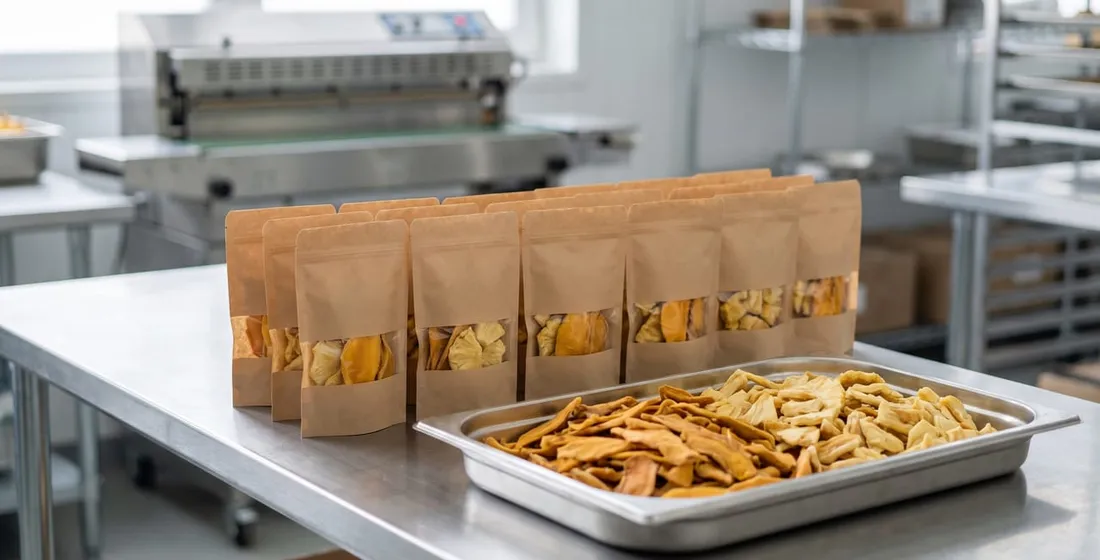
Small plain kraft window pouches filled with dried mango and pineapple pieces on a stainless steel packing table, with a tray of loose dried fruit in front and a band sealer behind.
HORECA snapshot
- Sri Lanka’s 170 classified tourist hotels held 18,308 rooms at the end of 2025, about 108 rooms per property (Sri Lanka Tourism Development Authority, 2026).
- In this genericised case, a four-property group with 430 rooms replaced a bought-in turndown treat with a 25 g branded pouch of dried mango and pineapple.
- Silk Foods Ceylon (SFC) ran it as Private Labelling from an existing portfolio SKU: 12 weeks from brief to first delivery, 14 weeks to all four properties.
- The consumption table and the week-by-week timeline are the two sections to take into a procurement meeting.
The brief arrived from a group food and beverage director with one sentence of intent: a turndown amenity that tasted of Sri Lanka, carried the group’s name, and cost less per night than the imported chocolate it was replacing. The group ran four properties: a 160-room city hotel, two beach resorts of 120 and 95 rooms, and a 55-room hill-country property. Nobody had yet counted how many pouches that meant.
A note on method. This is a genericised composite built from the pattern of HORECA amenity briefs at the Matale facility. The group is not one client, and the volumes and LKR figures are planning assumptions that show how these projects run, not a quote or a copy of one file. The regulations, room statistics and arrival figures are real.
Why did the group choose a portfolio SKU instead of a new recipe?
Because a portfolio SKU removes the longest and least predictable step. A private-label amenity built on a product the factory already makes, dries and packs skips formulation from zero. The remaining work is fitting the cut, the moisture target and the pouch to the room, which is weeks of adjustment, not a development programme.
The group’s first instinct was a bespoke spiced cookie. The R&D team at the Matale facility talked it through with them on the first call: a new baked recipe needs shelf-life work, a new line slot and a full R&D cycle of up to four weeks before anything reaches a room. Dehydrated mango and pineapple were already in the SFC portfolio, already on the drying and packing line, and already a product guests associate with the island.
That changed the service. The project ran as Private Labelling, with the SFC product under the group’s brand, rather than Contract Manufacturing of a group recipe. The difference between the two routes is set out in the HORECA private-label buyer’s guide. For a first amenity, the portfolio route is usually the faster one to defend internally, because the group can taste the finished product in week one.
Spec snapshot: the turndown pouch
- Product: dehydrated mango tidbits and pineapple tidbits, mixed, unsweetened
- Net weight: 25 g per pouch, one pouch per occupied room per night
- Pouch: foil-lined kraft with a small window, heat sealed, tear notch
- Outer: printed carton of 50 pouches for the housekeeping store
- First production run: 25,000 pouches, about three months of consumption
How many pouches does a four-property group actually use?
About 8,380 a month at 65% occupancy, or roughly 100,000 a year. The arithmetic is one pouch per occupied room per night, which is how the group’s rooms division defined turndown. The count per property matters more than the total, because each property’s stock has to be sized and delivered separately.
| Property | Rooms | Occupied room-nights a month (65%) | Pouches a month |
|---|---|---|---|
| City hotel | 160 | 3,120 | 3,120 |
| Beach resort one | 120 | 2,340 | 2,340 |
| Beach resort two | 95 | 1,850 | 1,850 |
| Hill-country property | 55 | 1,070 | 1,070 |
| Group total | 430 | 8,380 | 8,380 |
The 65% figure was the group’s own planning number, not a national average. It matters that it was theirs. Demand at the national level is moving: arrivals reached 1,642,215 for 2026 by the third week of September, with India the largest market at 418,019 (Sri Lanka Tourism Development Authority data reported by Newswire, September 2026). A group should size the first run on its own forward bookings, then check it against those national figures.
The same count sets the cost case. At an illustrative landed cost of LKR 110 a pouch, the programme costs LKR 110 per occupied room-night, and about LKR 922,000 a month across the group. The table below shows how that moves with price and occupancy, so a financial controller can replace the assumptions with real ones.
| Monthly group cost (LKR) | 55% occupancy | 65% occupancy | 75% occupancy |
|---|---|---|---|
| LKR 90 a pouch | 638,550 | 754,200 | 870,750 |
| LKR 110 a pouch | 780,450 | 921,800 | 1,064,250 |
| LKR 130 a pouch | 922,350 | 1,089,400 | 1,257,750 |
The same sizing logic, applied to a tea sachet, is worked through in rolling one tea blend across a hotel group. The difference with dried fruit is shelf behaviour. A tea sachet tolerates a damp store room far better than a chewy fruit piece does, and that is where this project spent its only real R&D time.
The 12 weeks, stage by stage
Week zero is the day the group sent a room count, an occupancy assumption and a target in-room date. Week 12 is the first carton arriving at the city hotel. Most of the calendar was the group’s approvals and the printed packaging, not the factory.
| Weeks | Stage | Who holds it |
|---|---|---|
| 0 | Brief with room count, occupancy and in-room date; portfolio route agreed | Group and SFC |
| 1 to 2 | Samples of two cut sizes dispatched from the existing SKU | SFC |
| 3 to 4 | One R&D adjustment: lower moisture target, foil-lined pouch, smaller window | SFC R&D team |
| 3 to 7 | Internal sign-off: food and beverage, rooms division, brand, procurement, finance | Group |
| 5 to 8 | Artwork for pouch and carton, two proof rounds, label particulars checked | Group brand team and SFC |
| 8 | Purchase order for 25,000 pouches; printed pouches and cartons ordered | Group procurement |
| 9 to 10 | Printed packaging lead time; fruit dried and conditioned to the approved spec | Printer and SFC |
| 11 | Packing run, metal detection, batch release | SFC |
| 12 | First delivery, city hotel | SFC |
| 13 to 14 | Deliveries to the two beach resorts, then the hill-country property | SFC |
The internal sign-off window, weeks three to seven, is the one groups underestimate. Five departments each had a reason to hold the brief, and none of them sat at the factory. The order those approvals usually run in is mapped in who signs off on a hotel signature line. Starting artwork in week five, before the last approval landed, saved roughly two weeks.
The printed pouch was the long pole after the purchase order. Plain kraft is available from stock; a printed, foil-lined pouch with the group’s mark is not. Why proofs and print runs set the calendar more often than production does is covered in artwork and print lead times for private label.
What went wrong in the housekeeping store?
The first samples went soft. In week three, the group left a carton of sample pouches in a beach resort’s housekeeping store for a week, which was a sensible test nobody at the factory had asked for. The store ran warm and humid, and the standard pouch let enough moisture through that the fruit lost its bite.
The R&D team at the Matale facility sees the same gap in most coastal HORECA briefs: the product is specified for a supermarket shelf, then lives in a service corridor. The fix was two changes made inside one adjustment round. The drying target moved lower so the pieces started drier, and the pouch moved to a foil-lined kraft with a smaller window, trading some visibility for a better moisture barrier. The re-test at the same resort store held for the full test period.
The consequence was a rule the group wrote into its own stock policy: no carton older than 90 days on a property, first in, first out, with the batch number on every carton. That is also why the first run was sized at about three months of use, not a year. The drying and moisture side of the product is covered in more depth in dehydrated fruit snack SKUs.
What does a 25 g pouch have to carry on its label?
Less than a retail pack in law, but this group chose to print more. The Food (Labelling and Advertising) Regulations 2026, Gazette Extraordinary No. 2494/47 under the Food Act No. 26 of 1980, set the mandatory particulars in regulation 5, and regulation 5(3) disapplies them for packs of 25 g or less, subject to a labelled dispenser or container being available at the point of sale.
A complimentary turndown pouch is not sold from a dispenser, so the exemption does not map neatly onto it. The group took two decisions. The carton of 50 in the housekeeping store carries the full regulation 5 set. The pouch back carries the common name, ingredients, net weight, batch number, dates and the manufacturer, because guests take the pouches home and the gift shop wanted to sell a four-pouch pack.
| Pack level | What was printed |
|---|---|
| 25 g turndown pouch | Group mark, common name, ingredients, net weight, batch, dates, manufacturer |
| Housekeeping carton of 50 | The full regulation 5 particulars, plus storage instruction |
| Gift-shop four-pouch pack | A retail pack in its own right, labelled to regulations 5 and 6 |
That reading is the group’s, taken with its own advisers. A group briefing a similar amenity should confirm its position with the Ministry of Health’s food control office before the printer is briefed, because a reprint after the purchase order costs the full print lead time again.
What would the group do differently?
Count the rooms before choosing the product. The first two weeks of the project were spent on a cookie that the room count and shelf life would have ruled out on day one. A brief that arrives with room numbers, an occupancy assumption and a target date can be quoted and scheduled in one pass.
The group would also brief the carton at the same time as the pouch. The carton was treated as an afterthought and went to a second proof round on its own. Finally, it would test in the real store room from the start, because the week-three humidity test was the most useful single day in the project. The coconut version of the same in-room problem appears in private-label coconut chips for the hotel minibar.
Frequently asked questions
How long does a private-label hotel amenity take in Sri Lanka?
In this genericised case, 12 weeks from brief to first delivery and 14 weeks to all four properties. The factory steps took about four of those weeks. The rest was internal approvals and printed packaging, so a group that starts artwork early and approves in parallel can shorten it. SLSI and Ministry of Health timelines should be confirmed directly.
How many turndown pouches does a hotel group need?
Multiply rooms by occupancy by nights. A 430-room group at 65% occupancy uses about 8,380 pouches a month at one per occupied room-night. With 170 classified hotels averaging about 108 rooms in 2025 (Sri Lanka Tourism Development Authority), a single average property at 65% needs roughly 2,100 a month.
Does Silk Foods Ceylon offer private labelling for hotel amenities?
Yes. Silk Foods Ceylon runs private labelling of its portfolio SKUs, including dehydrated fruit, coconut chips, tea and spice formats, under a hotel group’s brand. The line is BRCGS- and FSSC 22000 V6-audited, and a portfolio SKU usually needs one adjustment round, not full R&D, before the first run.
Does a 25 g amenity pouch need a full food label?
Regulation 5(3) of the Food (Labelling and Advertising) Regulations 2026 disapplies the main label particulars for packs of 25 g or less, if a labelled dispenser is at the point of sale. A free turndown item fits that awkwardly, so many groups label the outer carton fully and print key particulars on the pouch.
How Silk Foods Ceylon can help
For a hotel group commissioning a first in-room or turndown amenity, Silk Foods Ceylon offers Private Labelling of 50-plus ready-to-go SKUs under the group’s brand, with sample dispatch in 1 to 2 weeks and 2 to 3 weeks from purchase order to dispatch on a settled spec. Where a product needs adjusting, the in-house R&D team works to 3 to 4 weeks maximum from signed brief to approved formulation. The Matale facility is BRCGS- and FSSC 22000 V6-audited, with SLSI clearance and Sri Lanka Food Act compliance on retail SKUs, and first runs can be split across properties with staggered deliveries. To brief a project, send your room count, occupancy assumption and target in-room date to b2b@esilkroute.com.lk or call +94 76 441 0389 or +94 76 918 5744.
Sources
- Sri Lanka Tourism Development Authority (2026), “Year in Review 2025”, 170 classified tourist hotels with 18,308 rooms. sltda.gov.lk (retrieved 30 September 2026).
- Newswire (2026), “September tourist arrivals exceed 100,000 mark”, 24 September 2026, citing SLTDA: 107,093 arrivals in the first three weeks of September, 1,642,215 for 2026 to date, India 418,019. newswire.lk (retrieved 30 September 2026).
- Ministry of Health, Sri Lanka (2026), Food (Labelling and Advertising) Regulations 2026, Gazette Extraordinary No. 2494/47 of 26 June 2026, in operation from 1 July 2026, regulations 5 and 5(3). eohfs.health.gov.lk (retrieved 30 September 2026).
- Food Act No. 26 of 1980 (with amendments), the parent statute under which the 2026 labelling regulations are made.
Written by the Silk Foods Ceylon Team. Silk Foods Ceylon (Pvt) Ltd. is a BRCGS- and FSSC 22000 V6-audited contract manufacturer in Matale, Sri Lanka, offering contract manufacturing, private labelling, co-packing, and in-house R&D for local Sri Lankan brand owners, FMCG companies, hotel and restaurant groups, and distributors. To brief a project: b2b@esilkroute.com.lk, +94 76 441 0389, or +94 76 918 5744.