The Four-Document Listing Pack Modern Trade Wants, per SKU
By the Silk Foods Ceylon Editorial Team
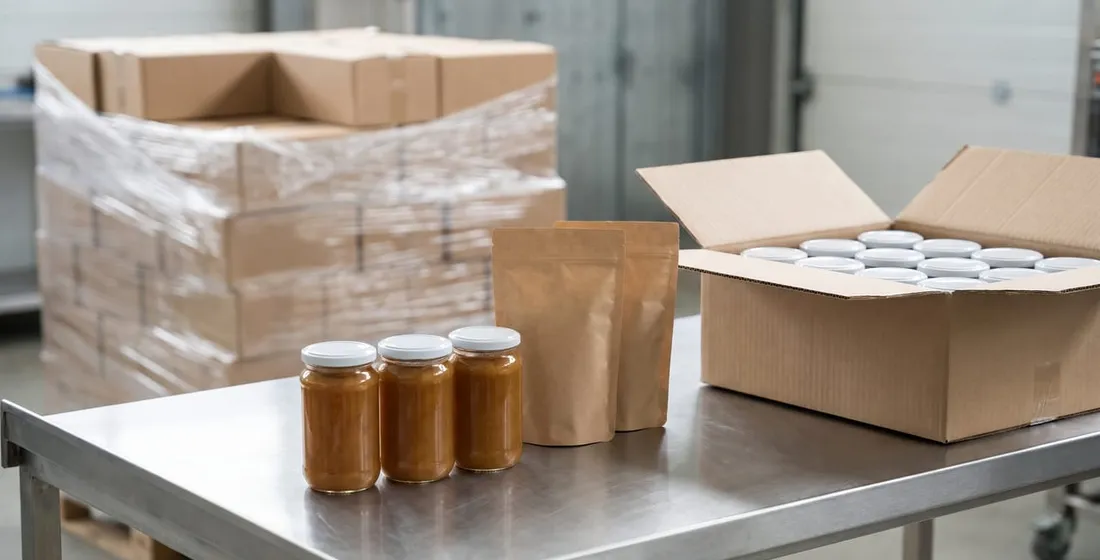
A stainless steel table in a food packing room with three plain unlabelled glass jars of fruit spread, two plain kraft pouches and an open brown carton of identical jars, with a stretch-wrapped pallet of cartons behind.
Buyer’s snapshot
- A listing desk reviewing a new SKU usually wants four things together: a specification sheet, a label compliance file, a case and pallet configuration, and a price file with promotional support. Submission guides list SKU data with GTINs, dimensions, weights and pallet configuration, plus a pricing schedule with promotional allowances (Racklify, 2026).
- Build them in that order. The spec sheet feeds the label file, the label file and barcodes feed the case sheet, and the case sheet sets the unit of the price file.
- The LKR figures in this note are hypothetical arithmetic, not Silk Foods Ceylon (SFC) quotes. In the worked example, a 10 per cent four-week promotion costs the brand LKR 768 on every case sold.
- Each buyer’s own form comes first. This pack is the preparation that makes filling it in a one-day job.
A distributor or brand owner books a meeting with a modern trade listing desk and walks in with a good product and a sample. The desk asks for the paperwork. The answers arrive over three weeks, one email at a time, and each late document pushes the shelf date back.
The fix is dull and it works: build the four documents before the pitch, in the right order, so the first reply to “send us the pack” is the pack.
What do listing desks ask for with a new SKU?
Listing desks ask for four documents per SKU: a specification sheet, a label compliance file, a case and pallet configuration, and a price file with promotional support. Retailer submission guides group product data, logistics data and a pricing schedule together, and buyers judge whether the item will sell, whether the retailer can earn on it, and whether the supplier can deliver (Racklify, 2026).
Retailer forms differ in layout, not in substance. One European grocery group asks for a complete product sheet covering label information, logistics data and certificates, attached to the item record (Colruyt Group, 2026). That is a pattern, not a Sri Lankan rule, so ask the local desk for its own form.
| Document | The buyer’s question | Main contents | Who feeds it |
|---|---|---|---|
| Specification sheet | What exactly is this product? | Name, ingredients, allergens, pack format, net weight, shelf life, storage, certificates | Maker and brand owner |
| Label compliance file | Can this legally go on a shelf? | Label proof, regulation check, SLSI status, batch code position | Brand owner, checked by maker |
| Case configuration | Can we receive, store and scan it? | Units per case, case size and weight, pallet pattern, GTINs | Maker and brand owner |
| Price file | Can we earn on it, and what does the launch cost? | Cost per case, suggested shelf price, promotional allowance, order terms | Brand owner |
What goes in the specification sheet?
The specification sheet answers one question: what exactly is the buyer being asked to stock. It holds the product name as it will appear on the label, the full ingredient list, the allergen statement, the net weight, the pack format, the shelf life with its storage conditions, and the certificates that apply to the maker and the SKU.
Keep it to one page per SKU and make it match the label word for word, because a mismatch suggests nobody has checked either. The sheet should also name the manufacturer, so a buyer reviewing supplier risk can see who actually makes the product and under which food safety audit.
The maker usually holds most of this. For a private-label SKU made at the Matale facility, the specification data, batch record format and certificate of analysis come from the plant, while the brand owner supplies the brand name, pack artwork and claims. The six documents that travel with a run are set out in the private-label documentation pack.
Build the label compliance file next
The label compliance file is the proof that the pack can lawfully sit on a shelf. It holds the final label proof, a line-by-line check against the regulations, the SLSI status for the SKU, and the position of the batch code. It comes second because it depends on the spec sheet: the ingredient list and weight on the label must match the sheet.
The regulations changed this year. Sri Lanka’s Food (Labelling and Advertising) Regulations 2026 were made under section 32 of the Food Act No. 26 of 1980 and came into operation on 1 July 2026 (Gazette Extraordinary No. 2494/47). A USDA attaché report on the draft noted that the rules would not apply to food manufactured before 1 July 2026, so a listing pack for an older stock line may be checked against different rules from a new run.
A batch number, code number or decipherable code marking is required on pre-packaged food (Gazette Extraordinary No. 2494/47, regulation 5(2)(a)(iii)). Put the batch code position in the file, because a buyer receiving the first case will look for it. For the full requirement set, see the 2026 labelling regulations explained, and for the SLSI side, which categories need the SLSI mark for a retail listing. A maker-side check before artwork is final is described in the maker-side label check.
Spec snapshot: what a complete label file holds
- Final label proof, with the product name, ingredients, allergens, net weight and manufacturer details
- Batch code position and format, and the date marking the label will carry
- SLSI status for the SKU, and the Department of Ayurveda registration where an Ayurvedic claim is made
- A dated note of who checked the label against the 2026 regulations
How do you document the case configuration and barcodes?
The case configuration sheet tells a receiving dock how the product arrives. It states the units per case, the case dimensions and gross weight, the cases per pallet layer and per pallet, and the barcode on the unit and on the case.
Barcodes need care. In Sri Lanka, GS1 Lanka is the authority responsible for the GS1 system, and it states that obtaining or using barcodes from any other entity in the country is unlawful (GS1 Lanka, 2026). Consumer units are identified by a GTIN-13, while a grouped case is identified by its own GTIN-14, GTIN-13 or GTIN-12. A case barcode in ITF-14 form cannot be scanned at the checkout and exists for warehouses and distribution centres (GS1 UK, 2026).
The cost of getting this wrong is a refused delivery. One grocery group states that goods without a barcode, or with an unreadable or unlisted one, are systematically refused (Colruyt Group, 2026). GS1 Lanka is also preparing retail and healthcare for 2D barcodes under its Sunrise 2027 initiative (Daily Mirror, 2026), so ask the desk whether it expects anything beyond the linear code on a new listing.
The detail of case counts and pallet patterns is covered in case packs and pallet patterns before a retail PO, and the barcode and clearance sequence in SLSI, barcodes and case packs for a supermarket listing.
Why does the price file need promotional support in it?
The price file shows the retailer what it pays, what it can charge and what the launch costs the supplier. A pricing schedule in a buyer submission typically covers the wholesale price, suggested retail price, volume discounts and the initial promotional allowances (Racklify, 2026). Quote per case, because the buyer orders and receives cases, not units.
Promotional support is where first-time suppliers are caught. An Ontario government guide describes a promotional allowance as a dollars-off-per-case reduction of the regular cost, says the trade there generally expects about 10 per cent for at least four weeks, and notes that retailers often ask for free goods on a new item. It also lists listing fees as a one-time set-up cost, and warns that internal retailer programmes such as warehouse allowance or leaks and swells are paid by the supplier (Ontario Ministry of Agriculture, 2026). That is Canadian practice. Sri Lankan terms vary by buyer, so ask early which of these apply.
The arithmetic below is hypothetical. It uses a case of 12 jars, a cost price of LKR 640 a jar and a suggested shelf price of LKR 790 a jar, before tax. It is not an SFC quote.
| Line | Regular terms | Four-week 10% promotion |
|---|---|---|
| Cost per case (12 jars) | LKR 7,680 | LKR 6,912 |
| Allowance per case | None | LKR 768 |
| Retailer cost per jar | LKR 640 | LKR 576 |
| Retailer margin at LKR 790 shelf price | 19.0% | 27.1% |
| Retailer margin if shelf price falls to LKR 710 | Not applicable | 18.9% |
| Brand cost if 200 cases sell in the window | None | LKR 153,600 |
The table shows two things a buyer will work out in seconds. If the shelf price falls by the full allowance, the retailer’s margin is the same as on regular terms, so the promotion costs the retailer nothing. And the brand pays LKR 768 on every case in the window, whether or not the extra volume arrives. For how the base cost is built, see building a private-label unit cost and shelf price in LKR.
Consider a distributor who built the pack first
The scenario below is hypothetical. It shows the shape of the work, not a real client or an SFC result.
A distributor has an own-label fruit spread in a 300 g glass jar, made by a contract manufacturer, and a meeting booked with a modern trade desk in two weeks. Before the meeting, the distributor assembles the four documents in order. The spec sheet is checked against the final label. The label file records the batch code position. The case sheet gives 12 jars a case, the pallet pattern and the GTINs. The price file carries the table above, with the promotion agreed in advance with the maker.
At the meeting, the desk asks for the pack and receives it that afternoon. A second distributor with the same product, no pack and a pending barcode answers the same request over three weeks. The product is identical; only the open questions differ.
How do you assemble the pack in a week?
The order matters more than the speed. Work through these steps, and stop at any step that does not close.
- Freeze the product. Lock the recipe, the pack and the net weight, because every document depends on them.
- Write the specification sheet from the maker’s data, one page per SKU.
- Finalise the label, check it against the 2026 regulations, and record the SLSI status and the batch code position.
- Confirm the barcodes with GS1 Lanka for the unit and, where the buyer wants it, the case.
- Fill in the case configuration from a real measured carton, not a drawing.
- Build the price file per case, with the promotional allowance and the cost to the brand written out.
- Ask the desk for its own form, and copy across from the pack.
Where SFC walks away
A listing pack cannot fix a product that is not ready. If the recipe is still changing, the label has not been checked, or the brand has no plan for the promotional cost, the documents will only record the gaps. In that case the better path is a locked sample and a costed first run before any meeting with a buyer.
What does this look like at Silk Foods Ceylon?
Silk Foods Ceylon (SFC) supplies the maker-side inputs to a listing pack: specification data, batch records and a certificate of analysis for each SKU it produces. SLSI submission support sits inside a standard engagement, and small runs are welcome and quoted on request. The brand owner or distributor still owns the label claims, the barcodes and the price file.
For distributors repacking imported bulk, repacking bulk into retail units covers the co-packing route. For a brand that has no locked recipe yet, R&D / NPD (Co-Development on the SFC brochure) comes first and takes 3 to 4 weeks at most from signed brief to approved formulation. Once the specification is signed off, a purchase order goes to dispatch in 2 to 3 weeks.
Frequently asked questions
What documents does a modern trade buyer ask for with a new SKU?
Four are common: a product specification sheet, a label compliance file, a case and pallet configuration sheet, and a price file with promotional support. Submission guides list SKU data with GTINs, dimensions, weights and pallet configuration, plus a pricing schedule with promotional allowances (Racklify, 2026). Each buyer’s own form comes first.
Can a retailer refuse a product because of its barcode?
Yes. One European grocery group states that goods with no barcode, or with an unreadable or unlisted one, are systematically refused (Colruyt Group, 2026). In Sri Lanka, GS1 Lanka is the authority that issues barcodes, so confirm the number and print quality before a case ships (GS1 Lanka, 2026).
What is a promotional allowance and how much is normal?
It is a per-case amount taken off the regular cost price for a set period. An Ontario government guide says the trade there generally expects about 10 per cent for at least four weeks, and often asks for free goods on a new product (Ontario Ministry of Agriculture, 2026). Sri Lankan terms vary by buyer.
Can Silk Foods Ceylon help a distributor build a listing pack?
Yes. Silk Foods Ceylon supplies the maker-side inputs: specification data, batch records and certificate of analysis for each SKU it produces, with SLSI submission support inside a standard engagement. Small runs are welcome and quoted on request, and a locked recipe goes from purchase order to dispatch in 2 to 3 weeks (SFC, 2026).
How Silk Foods Ceylon can help
For distributors and importers turning imported bulk into retail-ready SKUs, Silk Foods Ceylon (SFC) runs Co-Packing and Private Labelling at its Matale facility, and supplies the specification data, batch records and certificate of analysis that a listing pack needs. Small runs are welcome and quoted on request. R&D takes 3 to 4 weeks at most from signed brief to approved formulation, and a locked recipe goes from purchase order to dispatch in 2 to 3 weeks. The facility is BRCGS- and FSSC 22000 V6-audited, with SLSI submission support built into a standard engagement.
To brief a project, email b2b@esilkroute.com.lk or call +94 77 157 7294.
Sources
- Racklify (2026), “How To Prepare A Retail Buyer Submission That Wins Shelf Space”. racklify.com (retrieved 28 November 2026).
- Ontario Ministry of Agriculture, Food and Agribusiness (2026), “Pricing your product”, Guide to Food and Beverage Manufacturing in Ontario. ontario.ca (retrieved 28 November 2026).
- Colruyt Group (2026), supplier requirements overview and product sheet guidance. colruytgroup.com (retrieved 28 November 2026).
- GS1 UK (2026), “Barcodes for cases”. gs1uk.org (retrieved 28 November 2026).
- GS1 Lanka (2026), Ceylon Chamber of Commerce GS1 page. chamber.lk (retrieved 28 November 2026).
- Daily Mirror (2026), “GS1 Lanka drives SL’s shift to 2D barcodes”. dailymirror.lk (retrieved 28 November 2026).
- Government of Sri Lanka, Food (Labelling and Advertising) Regulations 2026, Gazette Extraordinary No. 2494/47, 26 June 2026, regulation 5(2)(a)(iii). documents.gov.lk (retrieved 28 November 2026).
- USDA Foreign Agricultural Service, Sri Lanka attaché report on the draft Food Labelling and Advertising Regulations. fas.usda.gov (retrieved 28 November 2026).
- Silk Foods Ceylon (2026), internal capability data for the Matale facility: R&D of 3 to 4 weeks at most from signed brief to approved formulation, and 2 to 3 weeks from purchase order to dispatch on a locked recipe.
Written by the Silk Foods Ceylon Team. Silk Foods Ceylon (Pvt) Ltd. is a BRCGS- and FSSC 22000 V6-audited contract manufacturer in Matale, Sri Lanka, offering contract manufacturing, private labelling, co-packing, and in-house R&D for local Sri Lankan brand owners, FMCG companies, hotel and restaurant groups, and distributors. To brief a project: b2b@esilkroute.com.lk or +94 77 157 7294.