Case Packs and Pallet Patterns: What to Set Before a Retail PO
By the Silk Foods Ceylon Editorial Team
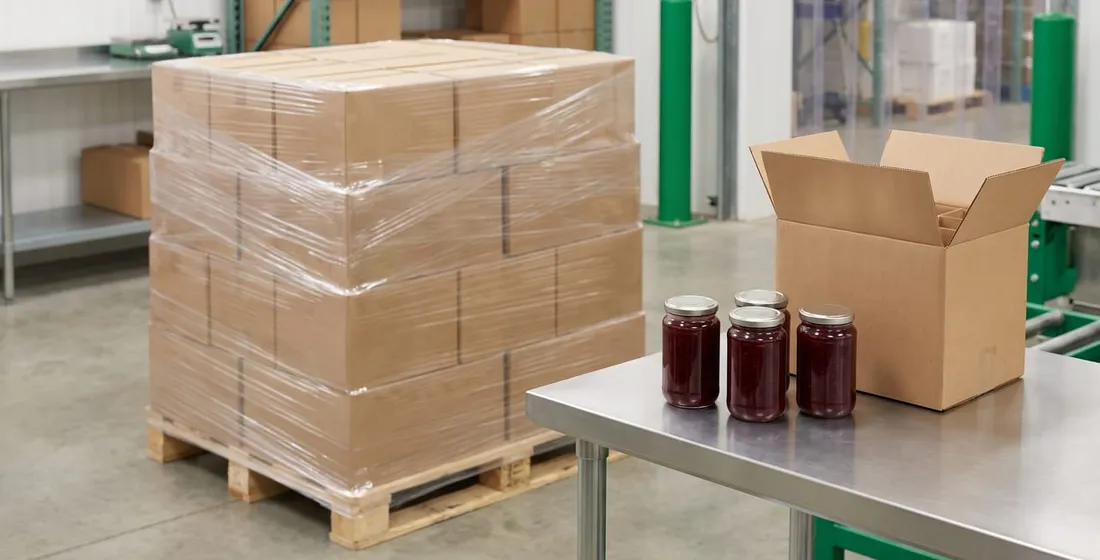
A stretch-wrapped pallet of plain brown shipping cartons in a clean food warehouse, with an open carton and three unlabelled glass jars of fruit spread on a steel table in the foreground.
Buyer’s snapshot
- A retail buyer orders in cases, a warehouse moves pallets, and a shelf stocks single units. Three different numbers have to line up before the first purchase order (PO).
- The pallet label carries one mandatory element, the SSCC serial number, and the case and the jar each need their own GTIN (GS1 UK, 2026).
- A 1,500-jar first run at 12 jars a case is 125 cases, which fills two pallets of 63 cases almost exactly. Sizing the run to the pallet removes a part-pallet from the invoice.
- The table below compares 6, 12 and 24-count cases on handling, breakage and order flexibility.
A distributor who agrees a price per jar has agreed to only part of the real cost. The rest is decided by how the jars are grouped into cases, how the cases are stacked on a pallet and what the retail PO asks for. These choices are cheap to set before a first run and costly to change after cartons are printed.
This guide is written for the distributor or brand owner preparing a first retail PO for a packaged shelf product made under contract. It uses a 300 g glass jar of fruit spread as the worked example, and states plainly where a number is an assumption rather than a measured specification.
Why does case configuration decide handling cost and margin?
The case is the unit a buyer orders, a warehouse picks and a driver delivers. Its count decides how many touches a product takes, how much a breakage costs and how little a store can order. A distributor’s margin is set per case, not per jar, so a poorly chosen count shows up as pick labour and damaged stock.
Three counts cover most packaged goods: 6, 12 and 24. A 6-count case suits heavy or premium items and small stores. A 12-count case is the common middle for retail jars and bottles. A 24-count case lowers cost per unit handled but is hard to split for a small outlet, and a dropped carton loses more product.
| Case count | Best fit | Handling | Breakage exposure | Order flexibility |
|---|---|---|---|---|
| 6 jars | Premium or gift lines, small stores | More cartons to pick per pallet | Lowest per carton | High: small stores can order one case |
| 12 jars | Standard retail jars and bottles | Balanced; one person can lift it | Moderate | Good for most chain and independent orders |
| 24 jars | High-velocity lines, wholesale | Fewest touches per unit | Highest per carton | Low: too large for many small outlets |
The right row is set by who orders. A supermarket chain’s distribution centre usually states its own order multiple, so the case count is a question to put to the buyer, not a design choice made in isolation.
How do inner packs and case labels change the PO?
An inner pack is a shrink-wrapped or tray-packed sub-group inside the case, such as two trays of six. It lets a store open a case and sell or display a half without loose jars. It adds a packing step and a material cost, so it earns its place only where stores split cases.
Labelling follows the same logic. Each level of the pack hierarchy carries its own identity. The consumer jar has a retail barcode, the case needs its own GTIN, and the pallet needs a serial shipping container code (SSCC). GS1 states that the SSCC is the only mandatory element on a logistics label, and that a unit already carrying an SSCC should have the same number read and reused rather than reissued (GS1 UK, 2026; GS1, 2017).
In Sri Lanka, GS1 Lanka is housed at the Ceylon Chamber of Commerce and is described there as the authority for GS1 numbers, with unauthorised use of barcodes called unlawful (Ceylon Chamber of Commerce, 2026). A brand owner should therefore secure its own company prefix before artwork is approved, because both the jar and the case code are built from it. GS1 Lanka has also been promoting 2D barcodes, so a buyer may ask what a printed code can link to (EconomyNext, 2026).
How is a pallet pattern worked out?
Divide the pallet footprint by the case footprint, then check layers against height and weight limits. ISO 6780 lists 1200 x 1000 mm as its preferred unit-load size and 1200 x 800 mm as another recognised size (ISO, 1988). A 1200 x 1000 mm pallet has 1.2 square metres of floor.
The worked example below uses assumed figures: a 12-jar case with a 400 x 300 mm footprint, 150 mm high, weighing about 7 kg with glass. Treat them as illustrative until the real carton is measured.
- Footprint: 3 cases by 3 cases in a straight block gives 9 cases a layer. A rotated pinwheel pattern may add one more, which the pallet-pattern drawing should confirm.
- Height: 7 layers of 150 mm plus a 150 mm pallet is about 1.2 m, a common height ceiling for racked retail distribution.
- Cases per pallet: 9 x 7 = 63 cases, or 756 jars.
- Weight: 63 cases at about 7 kg is about 440 kg, well inside normal pallet limits.
That arithmetic matters most for glass. A tall pallet of jars with no corner boards or stretch-film plan loses cases in transit, and the cost lands on whoever owns the stock at that point. The related question of who holds the stock, and where, is in warehousing, despatch and stock ownership with a co-packer.
How should a first run be sized to the pallet?
Round the run to whole pallets. A first run of 1,500 jars at 12 a case is 125 cases. At 63 cases a pallet, that is 1.98 pallets, so two pallets of 63 cases (1,512 jars) cost almost nothing extra to produce and ship as full units. A run of 1,300 jars leaves a part-pallet that is handled at a premium.
For export-curious brands the same logic extends to containers. Single-layer loading is typically about 10 pallets of 1200 x 1000 mm in a 20 ft container and 20 to 21 in a 40 ft container, against about 11 and 24 for 1200 x 800 mm pallets, though these are planning estimates and a freight forwarder confirms the real count (Denholm Good Logistics, 2026).
The sample-to-pallet step is where first-time distributors most often misjudge volume, which sample order to full-pallet PO: distributor mistakes covers in detail. Minimum volumes per SKU and how they stack across a range are in private-label range minimums for distributors.
Checklist: configuration to agree before the PO
- Ask the buyer for its order multiple and its pallet specification in writing.
- Choose the case count (6, 12 or 24) from who orders, not from the carton supplier’s default.
- Decide on inner packs only if stores split cases.
- Secure a GS1 Lanka company prefix and assign a GTIN to the jar and a separate one to the case.
- Draw the pallet pattern with measured cartons, and set a maximum height.
- Size the first run to whole pallets, and confirm the SSCC label format with the warehouse.
What does the retail channel expect from the pack?
A chain’s distribution centre wants predictable cases, scannable labels and pallets that stack without leaning. A shelf-ready tray lowers in-store labour but raises pack cost. A marketplace fulfilment centre prefers smaller, sturdier outer packs. Each channel changes the right answer, so confirm the channel before locking carton artwork.
Shelf life and storage format interact with all of this, because a chilled or ambient listing changes the permitted stacking and the rotation rule. Chilled or ambient: shelf life and retail fixture format sets that out. For cost per finished unit once the pack is standardised, retail-standardised packaging cost per unit breaks down the lines, and the SLSI mark and retail listing covers the label-side gate a case must still pass.
Where SFC walks away
Silk Foods Ceylon declines to print a case configuration it has not measured against the real carton and pallet. A brief that asks for a pallet count before the carton size is fixed is returned for a measurement step first. A first run starts at 1,500 jars, 1,250 bottles or 180 capsule bottles.
Frequently asked questions
What is an SSCC and does every pallet need one?
An SSCC is a unique serial number that identifies one logistics unit, such as a pallet. GS1 describes it as the only mandatory element on a logistics label, and an existing SSCC should be reused, not reissued (GS1 UK, 2026). Whether a buyer requires it is stated in its supplier terms.
Do the jar and the case need different barcodes?
Yes. The consumer jar carries a retail GTIN and the case carries its own, so a warehouse can scan cases without opening them. In Sri Lanka both are issued under a GS1 Lanka company prefix, and GS1 Lanka is described as the authority for GS1 numbers (Ceylon Chamber of Commerce, 2026).
How many pallets fit in a 20 ft and a 40 ft container?
Typically about 10 pallets of 1200 x 1000 mm in a 20 ft container and 20 to 21 in a 40 ft, with about 11 and 24 for 1200 x 800 mm pallets. These are single-layer planning figures, and a forwarder confirms the real count (Denholm Good Logistics, 2026).
Can Silk Foods Ceylon set the case and pallet configuration for a private-label SKU?
Yes. Silk Foods Ceylon offers Contract Manufacturing and Co-Packing at its Matale facility and agrees the case count, inner pack and pallet pattern with the brand before cartons are printed. A first run starts at 1,500 jars, which converts to about two pallets at 12 jars a case.
How long does it take to go from brief to a first run?
R&D / NPD takes 3 to 4 weeks at most from signed brief to approved formulation. Once a recipe is locked, production lead time typically runs 2 to 4 weeks. Carton and label approval runs alongside, so settle the case configuration early.
How Silk Foods Ceylon can help
For distributors and brand owners preparing a first retail PO, Silk Foods Ceylon (SFC) operates a co-packing and contract manufacturing line at its Matale facility. Capacity runs to 3,000 jars a day on semi-liquids and 2,500 bottles of 200 ml a day on beverages, with first runs from 1,500 jars or 1,250 bottles. The facility is BRCGS- and FSSC 22000 V6-audited, with SLSI submission support and Sri Lanka Food Act labelling compliance built into the engagement. Case count, inner pack and pallet pattern are agreed before artwork is locked.
To brief a co-packing or consolidation plan, email b2b@esilkroute.com.lk or call +94 77 157 7294.
Sources
- GS1 UK (2026), “Logistics labels and SSCCs”, on the SSCC as the only mandatory logistics-label element. gs1uk.org (retrieved 30 October 2026).
- GS1 (2017), “GS1 Logistic Label Guideline, Release 1.2”, on SSCC reuse and label content. ref.gs1.org (retrieved 30 October 2026).
- Ceylon Chamber of Commerce (2026), “GS1 Lanka”, on GS1 numbering authority in Sri Lanka. chamber.lk (retrieved 30 October 2026).
- EconomyNext (2026), “GS1 Lanka drives Sri Lanka’s shift to 2D barcodes”. economynext.com (retrieved 30 October 2026).
- International Organization for Standardization (1988), “ISO 6780: Flat pallets for intercontinental materials handling”, on 1200 x 1000 mm and 1200 x 800 mm unit-load sizes. iteh.ai (retrieved 30 October 2026).
- Denholm Good Logistics (2026), “How many pallets fit in a shipping container?”, on typical 20 ft and 40 ft counts. denholmgoodlogistics.com (retrieved 30 October 2026).
Written by the Silk Foods Ceylon Team. Silk Foods Ceylon (Pvt) Ltd. is a BRCGS- and FSSC 22000 V6-audited contract manufacturer in Matale, Sri Lanka, offering contract manufacturing, private labelling, co-packing, and in-house R&D for local Sri Lankan brand owners, FMCG companies, hotel and restaurant groups, and distributors. To brief a project: b2b@esilkroute.com.lk or +94 77 157 7294.