Repacking Bulk Product into Retail Units for Distributors
By the Silk Foods Ceylon Editorial Team
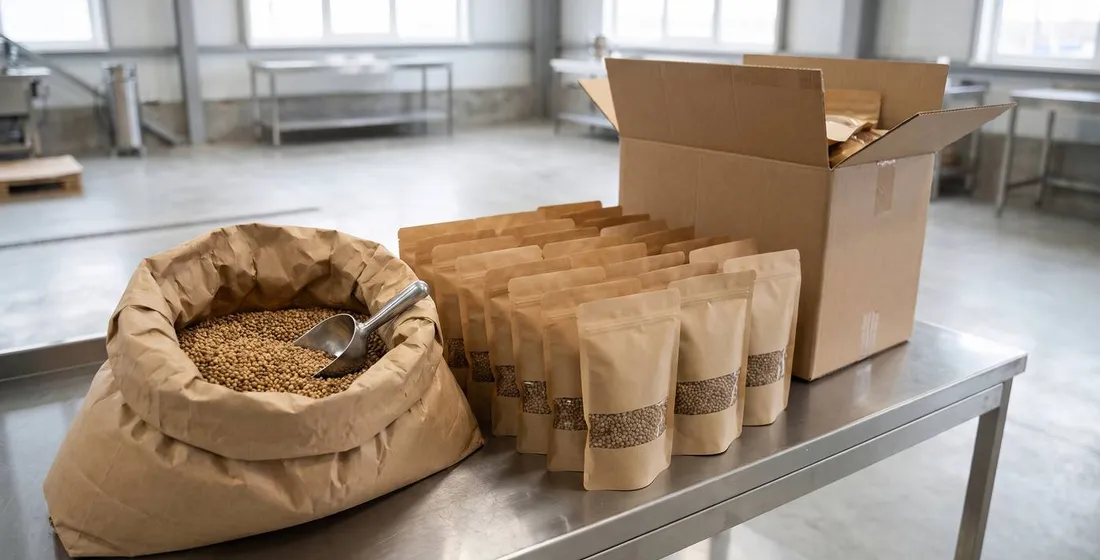
A stainless steel packing table with an open 25 kg bulk sack of whole spice, rows of sealed plain kraft pouches and an unprinted shipping carton holding neat inner packs.
Buyer’s snapshot
- Under the Food (Labelling and Advertising) Regulations 2026, gazetted on 26 June 2026, food imported in bulk and repacked must declare both the date of manufacture and the date of repacking (Government of Sri Lanka, Gazette 2494/47, 2026).
- Repack locally and the packer controls the batch code and the dates. Import finished packs and the importer must add a supplementary label for any coded date.
- Three choices set the cost per unit of a repack: the inner count, the seal and the batch code.
- Silk Foods Ceylon (SFC) co-packs buyer-supplied goods at Matale. Small runs are welcome, quote on request.
A distributor weighing bulk against finished packs usually starts with the unit price on a pallet quote. That number hides three decisions that decide the real cost: how many packs go in each inner pack, how each pack is sealed, and what is printed on it to trace it. Get one wrong and the saving on the bulk price goes into rework.
Silk Foods Ceylon (SFC) co-packs goods that a buyer supplies, filling, sealing and labelling them into retail units at its Matale facility. This guide is for a Sri Lankan distributor or importer deciding whether to import bulk and repack locally, or to import finished packs. It does not repeat the pouch size comparison in co-packing into kraft pouches for distribution, or the changeover argument in how standardised packaging cuts cost per unit. It looks at what sits between the sack and the shelf.
What does repacking bulk into retail units actually change?
Repacking moves the final packing step from the exporter’s factory to a Sri Lankan one, and with it the legal duty to declare dates and batch. The 2026 regulations require imported bulk food that is repacked to carry the date of manufacture and the date of repacking, plus a batch or decipherable code (Government of Sri Lanka, Gazette 2494/47, regulation 5, 2026).
In practice a repacker takes on three jobs the finished-pack importer does not. It controls the fill weight against the declared net contents. It applies a seal that holds through distribution. It assigns a batch code that ties each pack back to the bulk lot it came from.
Done well, that is an advantage. The distributor decides the pack size, the language mix on the label and the inner count, instead of accepting whatever the exporter prints. Done badly, it is a source of held pallets. The next sections take the three decisions in turn.
How does the inner count set the cost per unit?
The inner count is the number of retail packs in each inner pack or tray before cartoning, and it fixes both handling cost and what a retail buyer can order. A 25 kg sack fills 50 packs of 500 g or 100 packs of 250 g, before any allowance for fill giveaway and trim. The arithmetic is simple. The choice behind it is not.
Choose the inner count to match how the next buyer picks. A wholesaler may want 12 packs of 250 g per inner. A modern trade buyer may want a shelf-ready tray that goes straight onto the fixture. An online seller may want packs loose in a carton for individual picking. Each pattern means a different carton, a different pack-out step and a different weight per carton.
Two points catch first-time repack buyers. First, bulk weight rarely divides evenly into packs, so a sack of 25 kg of a dense product and a sack of 25 kg of a light, bulky one give a different count of packs and a different residue. Second, an inner count that does not fill a carton wastes carton volume and raises freight per pack. Fix the count against the carton before the brief goes out.
| Decision | Wholesale channel | Modern trade channel | Online channel |
|---|---|---|---|
| Typical inner | A fixed count of packs in a sleeve or tray | Shelf-ready tray sized to the fixture | Loose in a carton, or a small count |
| What the buyer checks | Carton weight and pack count | Pack presentation and barcode | Pack strength and leak safety |
| Pack-out effort | Low to moderate | Moderate, tray assembly | Low, but pack protection matters |
| Where cost hides | Cartons that do not fill | Tray and print variants | Returns from burst or leaking packs |
Why do sealing and tamper evidence matter for a distributor?
A seal decides whether a pack arrives on the shelf as it left the line. A weak or inconsistent seal produces leaks, stale product and returns that the distributor, not the exporter, pays for. For a repack, the sealing method is part of the specification and belongs in the brief.
Induction sealing is one option for rigid containers such as jars and bottles. A foil liner sits inside the cap, and an electromagnetic field heats the foil so that a polymer layer bonds to the container rim. A broken or missing liner shows that the pack has been opened (Packaging Connections, vendor material). Seal quality depends on heat, pressure and time, so a method is only as good as its settings on the day.
Many dry retail packs, such as kraft pouches, use heat sealing of the pouch mouth instead. Whether a given pack needs a foil induction seal, a heat seal or a vacuum seal depends on the product, its moisture sensitivity and the channel. SFC’s packing area includes a band sealer, a vacuum sealer and a form-fill packing machine. The seal type for your pack, including whether an induction liner is needed, is confirmed per quote and not assumed.
A distributor can test a seal cheaply before committing to a run. Ask for a sample pack from the chosen method. Squeeze it, ship it in a carton and keep it for the shelf-life period you intend to claim. A seal that survives that handling is a better guide than a supplier’s brochure.
What does batch coding have to carry?
Batch coding is the label’s memory. The Codex general standard says each container must be permanently marked, in code or in clear, to identify the producing factory and the lot (Codex Alimentarius, CXS 1-1985, section 4.6). Sri Lanka’s regulations add the local detail: a batch number, code number or decipherable code, together with the dates.
For a repack the code has two jobs. It must let the distributor recall or trace a pack to a single filling run. It must also let the bulk lot be traced back to the exporter’s paperwork. If a retail buyer finds a problem in one pack, a clear code is what limits a recall to one run and not the whole stock.
The dates need care. The regulations say no person may deface, distort or obliterate the original dates, and for a repack the date of packing is declared as well (Government of Sri Lanka, Gazette 2494/47, regulation 4, 2026). For tea, spices, edible oils, salt, cereals and legumes, the date of packing counts as the date of manufacture, provided the packer ensures the product is wholesome and safe at the time of packing (regulation 5, 2026).
Small packs get a gentler rule. Pre-packaged food not exceeding 25 g or 30 ml is exempt from regulation 5’s declarations if the dispenser pack it is sold from is labelled to the regulation at the point of sale. That helps a single-serve sachet, but it does not remove the need to trace the batch.
How does importing finished packs compare?
Importing finished packs shifts the work to the exporter, but not the legal duty to get dates right in Sri Lanka. If an imported pack carries its dates only in code, including a code hidden inside a batch number, a Julian code or a QR code, the importer must affix a supplementary label declaring the corresponding dates in the prescribed format, and keep evidence of how the code is read (Government of Sri Lanka, Gazette 2494/47, regulation 4, 2026).
That supplementary label is a handling step with its own cost. It also needs a document trail from the exporter to show how the code converts to a date. A bulk import repacked locally avoids that step, because the packer prints the dates in the declared format from the start.
| Factor | Import finished packs | Import bulk and repack locally |
|---|---|---|
| Who prints the dates | Exporter, often in code | Local packer, in the declared format |
| Supplementary label | Needed for coded dates, in the other languages | Avoided, local label is printed once |
| Control of pack size and inner count | Exporter’s standard sizes | Distributor’s choice |
| Freight | Shipped as packs, with more air and packaging volume | Shipped as bulk, packaging bought locally |
| Stock risk | A pack size is committed at order | Bulk stays flexible until pack-out |
| Seal and batch control | Exporter’s | Specified in the local brief |
Freight and pack cost comparisons depend on the product, the route and the season, so this guide gives no figures. The related guide on making it locally or importing it sets out how to build that comparison with your own quotes. For an imported dry product, see co-packing imported almonds for one worked example.
A scenario to plan for: one sack, two inner counts
Picture a distributor importing 25 kg sacks of a whole spice and selling to wholesalers and to an online marketplace seller. The distributor plans one pack of 250 g, so each sack gives 100 packs before allowances. For wholesalers the inner is 12 packs. For online orders the same packs go loose in a carton.
On the first run, 100 packs from one sack do not divide into 12-pack inners: eight full inners use 96 packs and four are left over. If each sack is packed out on its own, ten sacks leave 40 loose packs and a stack of odd-count cartons that neither channel wants. If the packs are pooled across sacks, the same ten sacks leave only four.
The lesson is to plan inner count and sack count together, and to say in the brief whether sacks are pooled and what happens to the remainder. A distributor who raises it at briefing avoids a pallet of part-filled cartons. The standardised pack approach in one pack size, one film and one carton count reduces the number of such remainders.
What should a repack brief contain?
A repack brief fits on one page if the three decisions are made first. It also protects the distributor when the first run arrives, because everything checked on the pallet can be checked against it.
- The product, the bulk pack (for example a 25 kg sack with an inner liner) and the lot documents from the exporter.
- The retail pack: material, size, declared net contents and the seal type.
- The inner count and the carton, including what happens to the remainder of a sack.
- The label: languages, mandatory declarations and the dates to be printed.
- The batch code format, and how a pack ties back to the bulk lot.
- The sample plan: a sealed pack, a shipped pack and a retained pack for the shelf-life period.
- Where the stock will be held and who owns it, as covered in warehousing, despatch and stock ownership.
Where SFC walks away: a brief that asks the packer to hide or replace the exporter’s original dates without a proper label. The regulations forbid defacing the original dates, and SFC will not do it.
Frequently asked questions
Do repacked imports need a date of repacking on the label?
Yes. Where food is imported in bulk and repacked, the label must declare the date of manufacture and the date of repacking, along with a batch number or decipherable code (Government of Sri Lanka, Gazette 2494/47, regulation 5, 2026). For tea, spices, oils, salt, cereals and legumes the date of packing counts as the date of manufacture.
Does a finished-pack importer need a supplementary label?
If the imported pack shows its dates only in coded form, yes. The importer must affix a supplementary label giving the corresponding dates in the format the regulations set, and keep documentary evidence of how the code converts (Government of Sri Lanka, Gazette 2494/47, regulation 4, 2026). Packs with plain dates need no conversion label.
What must a batch code show on a retail pack?
It must identify the producing factory and the lot (Codex Alimentarius, CXS 1-1985, section 4.6). Sri Lanka’s rules ask for a batch number, code number or decipherable code on the label. For a repack, the code should also tie the pack to the bulk lot, so one run can be traced and recalled.
Does Silk Foods Ceylon repack buyer-supplied bulk into retail packs for distributors?
Yes. Silk Foods Ceylon offers Co-Packing, where the buyer supplies the goods and SFC packs, seals and labels them at the Matale facility, including kraft pouches and glass formats. Small runs are welcome, quote on request. The seal type and batch-code format are agreed in the brief and confirmed per quote.
How Silk Foods Ceylon can help
For distributors and importers who supply bulk and want retail units back, Silk Foods Ceylon (SFC) offers Co-Packing at its Matale facility: filling, sealing and labelling buyer-supplied goods into the pack and inner count that suit each channel. Small first runs are welcome and quoted on request, and sample packs can be approved in person before a full run. An existing recipe or product typically reaches a first PO in 2 to 4 weeks. The facility is BRCGS- and FSSC 22000 V6-audited, with SLSI clearance and Sri Lanka Food Act compliance support for every retail SKU.
To brief a project, email b2b@esilkroute.com.lk or call +94 77 157 7294.
Sources
- Government of Sri Lanka (2026), Extraordinary Gazette No. 2494/47 of 26 June 2026, Food (Labelling and Advertising) Regulations 2026, regulations 4 and 5, on repacking dates, coded dates on imports and the 25 g exemption. eohfs.health.gov.lk (retrieved 3 November 2026).
- Codex Alimentarius (revised 2024), CXS 1-1985, General Standard for the Labelling of Prepackaged Foods, section 4.6 on lot identification. cibum.gr copy (retrieved 3 November 2026).
- Packaging Connections, “Induction Sealing: Ensuring Tamper Evidence, Freshness, and Leak-Proof Packaging”, vendor material on how induction seals work. packagingconnections.com (retrieved 3 November 2026).
Written by the Silk Foods Ceylon Team. Silk Foods Ceylon (Pvt) Ltd. is a BRCGS- and FSSC 22000 V6-audited contract manufacturer in Matale, Sri Lanka, offering contract manufacturing, private labelling, co-packing, and in-house R&D for local Sri Lankan brand owners, FMCG companies, hotel and restaurant groups, and distributors. To brief a project: b2b@esilkroute.com.lk or +94 77 157 7294.