Own-Label Fruit Spread for Gift Retail: Jars, Batches and Shelf Life
By the Silk Foods Ceylon Team
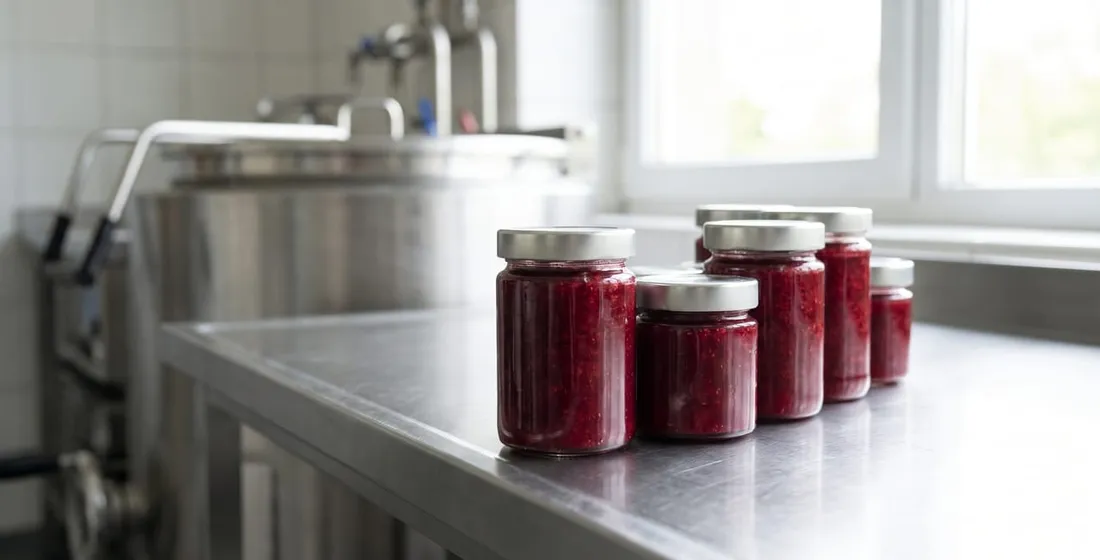
A row of small and medium plain glass jars of deep red fruit spread with metal twist lids, standing on a stainless steel work table beside a jacketed steel cooking kettle in soft daylight.
Buyer’s snapshot
- Sri Lanka recorded 158,557 tourist arrivals in September 2026, down 0.26 per cent on a year earlier, with 1,693,679 for January to September (Trading Economics, October 2026). Plan gift volume on a flat base, not a rising one.
- A gift spread is specified on three numbers: jar size, kettle batch and shelf life at the end of the season.
- On a 100 kg planning batch, one kettle fills about 2,100 jars of 50 ml but only about 475 jars of 220 ml.
- Silk Foods Ceylon (SFC) private-labels spreads on its semi-liquid line from a 1,500-jar first run. The batch table and the back-planning table below are the two to take into a range meeting.
A national retail chain in Sri Lanka ran its seasonal hamper window from 15 November 2021 to 15 January 2022, at prices from Rs. 5,990 to Rs. 130,000 (Daily FT, December 2021). That is nine weeks. A gift spread has to be on the shelf on day one, still saleable on day sixty-three, and ideally saleable again when the next gifting peak arrives in April.
The recipe is the easy part of that brief. Brix, pectin dose, fruit content and the jar costing for a standard retail range are already worked through in the note on private-label jam in Sri Lanka, and this post does not repeat them. It covers what changes when the same spread is sold as a gift: smaller jars, batch sizes that no longer match the order, and a shelf life that is set by the calendar rather than by the product.
A gift spread is sized by the jar, not the recipe
Gift buyers choose by the look and the price of a jar, so the jar tier is the first decision and everything else hangs off it. SFC fills glass jars in 50 ml, 220 ml, 330 ml, 500 ml and 1 L, plus a square 420 ml. Two of those do the gift work: a 50 ml mini for trios and sampler boxes, and a 220 ml jar for the single gift SKU.
| Jar | Typical fill | Role in a gift range | What it forces |
|---|---|---|---|
| 50 ml glass, twist lid | About 45 g | Trio or sampler box, corporate favour | A full label on a very small panel; a gift carton to carry the brand |
| 220 ml glass, twist lid | About 200 g | Single gift SKU, hotel or boutique shelf | Label panel is the binding constraint, not the recipe |
| 330 ml glass, twist lid | About 300 g | Standard retail reference size | Sets the pectin dose and the price the gift tier is compared with |
The labelling rules bite hardest on the mini. The Food (Labelling and Advertising) Regulations 2026 exempt pre-packaged food of 25 g or less, or 30 ml or less, only where the dispenser package it is sold from is available at the point of sale and is itself labelled. A 50 ml jar is above both lines, so it carries a full label. The date of expiry has to appear in two of Sinhala, Tamil and English, in numerals of not less than 1.5 mm. For bottled foods the regulations allow the expiry date, batch number and manufacture date to be stamped on the bottle neck. Whether a jar counts as a bottle under that proviso is a question for the label check before artwork is committed, not an assumption.
Sequencing artwork, glass and first runs across a multi-jar range is covered in launch sequencing for a three-SKU range and artwork and print lead time.
How many jars does one kettle batch fill?
A spread is cooked in a kettle, not in a jar, so the kettle batch is the real unit of production. Industrial jam kettles are sold in sizes such as 70, 150 and 250 litres (equipment supplier listing, 2026). The table below uses a deliberately round planning basis: 100 kg of finished spread per batch and a 5 per cent handling loss between kettle and jar. Both numbers are assumptions for illustration. The quotation replaces them with the batch size SFC actually plans for the flavour.
| Jar | Fill | Jars per 100 kg batch | Batches for 1,500 jars | Reading |
|---|---|---|---|---|
| 50 ml | 45 g | About 2,100 | 0.7 | One batch, 71 per cent loaded |
| 220 ml | 200 g | About 475 | 3.2 | Three full batches plus a 16 per cent part-batch |
| 330 ml | 300 g | About 316 | 4.7 | Four full batches plus a 74 per cent part-batch |
Two consequences follow. First, a flavour is a batch. Changing flavour means cleaning the kettle and re-setting the fill, so a gift trio of three flavours is three batches whatever the jar size. At 50 ml that is about 6,300 minis if each kettle runs full, not the 4,500 that three runs of 1,500 would suggest. The cheapest mini is the one made at a full kettle load, so a trio is better ordered as about 2,100 sets than as 1,500.
Second, the 220 ml jar is cheapest at whole batches. Three batches give about 1,425 jars and four give about 1,900. An order of 1,500 sits just above the three-batch line and pays for a fourth kettle run to fill 75 jars. Rounding to 1,425 or 1,900 moves the cost per jar more than any ingredient.
The ingredient side is small at gift sizes. Using the rates in the jam costing note (processed pulp at LKR 550 per kg, sugar at LKR 240 per kg, pectin at LKR 7,500 per kg, fruit at the 45 per cent floor), the ingredients in a 50 ml mini come to about LKR 19, and in a 220 ml jar to about LKR 86. The gift price is set by glass, closure, label and carton. Ask the quotation to show those four lines per jar for each size separately, since none of them is likely to fall in step with the fill.
Where SFC walks away
A gift retailer wanting 300 jars each of five flavours for a one-off hamper is below any sensible first run on a kettle line. The better route is an existing flavour from the SFC private-label catalogue, relabelled, rather than five new recipes.
The R&D and production planning team sees one correction more than any other on first gift-spread briefs, and it is about order, not fruit. The brief names a flavour, then a gift carton, and only last the jar. But pectin dose is set per container, so a jar fixed late means a second set of trials. A recipe trialled in 330 ml and then moved to 220 ml and 50 ml is three sets inside a window sized for one.
What shelf life does a seasonal gift spread need?
More than the product strictly requires. A sealed, hot-filled jam is not likely to spoil microbiologically in storage, according to the FAO fruit and vegetable processing manual, which recommends evaluating the product after ten weeks at room temperature. Ten weeks is shorter than the season. The gift brief asks for a declared shelf life that covers four things in sequence: the days from filling to the shelf, the season itself, unsold stock carried to the next peak, and the time a recipient keeps the jar before opening it.
Take a spread filled on 1 October. By the close of a 15 January window it is 15 weeks old. If the unsold remainder is held for a mid-April gifting peak, it is about 28 weeks old on 14 April. A seasonal SKU declared at six months would be past its date on the second shelf. The gap is arithmetic, and it is cheapest to close at the specification stage.
The process parameters that carry the shelf life are set by jar size. The FAO manual fills pineapple jam at about 82 °C, keeps pineapple-papaya jam above about 88 °C during filling, inverts the jars for three minutes to sterilise the lid, then cools them upright until slightly above room temperature. A 50 ml jar and a 220 ml jar do not cool at the same rate, so fill temperature, invert time and cooling are trialled per jar and not carried across from the first size. How a declared figure is established, and what an accelerated study can and cannot show, is set out in shelf life and accelerated stability testing.
The date marking itself has a gift-specific wrinkle. Under the 2026 regulations a date of expiry may be shown as month and year only, in which case the product is deemed to expire on the last day of that month. The word before the date can be “Best Before”, “Use by”, “Use before” or “Expiry”. A month-and-year mark on a gift jar is cleaner on a small panel, and the month-end rule means the study has to support the product to the last day of the month printed.
How far back do you plan from a mid-April gift peak?
Further than a gift buyer expects. With this post going out in late October, the November window has largely passed for a new range, and the practical target is the Sinhala and Tamil New Year peak in mid-April. The table works back from a 1 April shelf date, an assumption chosen to leave room for retailer displays. The durations are SFC planning figures: R&D at 3 to 4 weeks at most, 2 to 3 weeks from purchase order to dispatch on a locked recipe, and one extra week of lead time for glass-jar tooling. The one week for distribution and receiving is an assumption.
| Step | Duration | Latest date for a 1 April shelf date |
|---|---|---|
| Distribution and receiving | 1 week (assumed) | Dispatch by 25 March |
| Purchase order to dispatch | 3 weeks, upper end of 2 to 3 | Order placed by 4 March |
| Glass-jar tooling | 1 week extra | Glass ordered by 25 February |
| R&D, signed brief to approved formulation | 4 weeks, the maximum | Brief signed by 28 January |
Artwork runs alongside R&D and must be final before the purchase order, which makes the label check on the mini the item most likely to move the dates. The wider planning method for a festive range is in backward planning for an Avurudu private-label range. For a hotel-property gift shop, where the batch is capped on purpose, see the signature gift line brief.
Frequently asked questions
What jar sizes suit an own-label fruit spread for gift retail?
Two tiers cover most gift ranges: a 50 ml mini for trios and sampler boxes, and a 220 ml jar for the single gift SKU. Silk Foods Ceylon fills glass jars from 50 ml to 1 L. A 50 ml pack is above the 30 ml label exemption in the 2026 regulations, so it carries a full label.
How many jars does one kettle batch of fruit spread fill?
It depends on kettle size and fill weight. On a planning basis of 100 kg of finished spread and a 5 per cent handling loss, a batch fills about 2,100 jars of 50 ml (45 g), about 475 jars of 220 ml (200 g) or about 316 jars of 330 ml (300 g). Industrial jam kettles are sold from 70 to 250 litres.
How long should a seasonal gift spread stay saleable?
Long enough to cover the season, any carry-over stock and the recipient’s holding time. A national retail chain ran its hamper window from 15 November 2021 to 15 January 2022 (Daily FT, 2021). A spread filled on 1 October is 15 weeks old at the end of that window, before any carry-over.
What is the private-label MOQ for a fruit spread at Silk Foods Ceylon?
First-run MOQ is 1,500 jars for spreads in 300 g glass on the semi-liquid line at the Matale facility, which fills 3,000 jars a day. Mini and gift-jar formats are scoped per quotation against the kettle batch. R&D, where the recipe is not locked, takes 3 to 4 weeks at most from signed brief to approved formulation.
How Silk Foods Ceylon can help
For gift retailers, distributors and importers commissioning an own-label fruit spread range, Silk Foods Ceylon runs Private Labelling and Contract Manufacturing at its cellular-manufacturing facility at Silk AgTech Park in Hapugasyaya, Matale. The semi-liquid line fills 3,000 jars a day, with a first-run MOQ of 1,500 jars in 300 g glass; mini and gift-jar formats are quoted against the kettle batch so the order lands on whole batches. On a locked recipe the run goes from purchase order to dispatch in 2 to 3 weeks, and in-house R&D / NPD takes 3 to 4 weeks at most from signed brief to approved formulation. The facility is BRCGS- and FSSC 22000 V6-audited, with SLSI clearance and Sri Lanka Food Act compliance on every retail SKU.
To brief a gift spread range, email b2b@esilkroute.com.lk or call +94 77 157 7294.
Sources
- Trading Economics, “Sri Lanka Tourist Arrivals Extend Fall in September,” 15 October 2026, on 158,557 arrivals in September 2026, the 0.26 per cent year-on-year decline and 1,693,679 arrivals from January to September, reporting Sri Lanka Tourism Development Authority data. tradingeconomics.com (retrieved 27 October 2026).
- Daily FT, “Arpico promotes new, exclusive seasonal hampers range,” 24 December 2021, on the 15 November 2021 to 15 January 2022 hamper window and the Rs. 5,990 to Rs. 130,000 price range. ft.lk (retrieved 27 October 2026).
- Government of Sri Lanka, Food (Labelling and Advertising) Regulations 2026, Gazette Extraordinary No. 2494/47 of 26 June 2026, on the 25 g and 30 ml exemption, two-language date of expiry, 1.5 mm lettering, the bottle-neck proviso, month-and-year date marking and the permitted date wording. eohfs.health.gov.lk (retrieved 27 October 2026).
- Food and Agriculture Organization of the United Nations, Fruit and Vegetable Processing, chapter 8, on hot-fill temperatures, inverting jars, cooling, and evaluation after ten weeks at room temperature. fao.org (retrieved 27 October 2026).
- Making.com, “Jam kettle for preserve and marmalade production,” equipment listing for an industrial jam kettle range in 70, 150 and 250 sizes. making.com (retrieved 27 October 2026).
- Silk Foods Ceylon, internal capacity and lead-time reference: 3,000 jars a day on the semi-liquid line, 1,500-jar first run for 300 g spreads, glass-jar sizes from 50 ml to 1 L, 2 to 3 weeks from purchase order to dispatch on a locked recipe, R&D at 3 to 4 weeks at most (October 2026).
Written by the Silk Foods Ceylon Team. Silk Foods Ceylon (Pvt) Ltd. is a BRCGS- and FSSC 22000 V6-audited contract manufacturer in Matale, Sri Lanka, offering contract manufacturing, private labelling, co-packing, and in-house R&D for local Sri Lankan brand owners, FMCG companies, hotel and restaurant groups, and distributors. To brief a project: b2b@esilkroute.com.lk or +94 77 157 7294.