Who Carries Risk: Contract Manufacturing, Private Label, Co-Packing
By the Silk Foods Ceylon Editorial Team
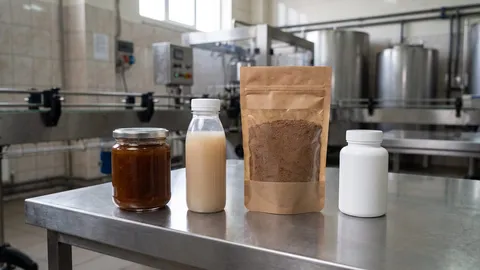
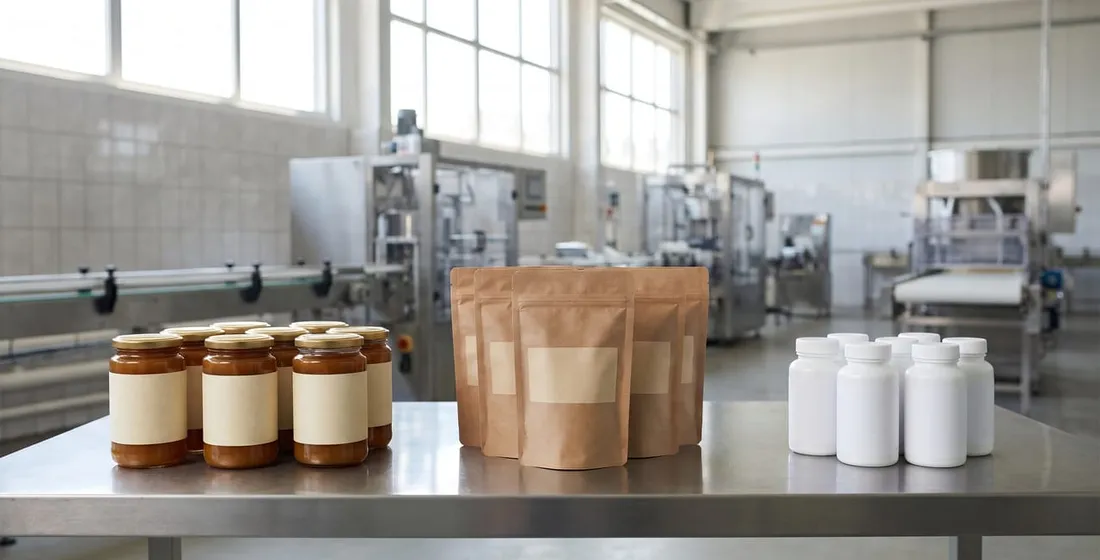
Blank-labelled glass jars, kraft pouches and white capsule bottles stand on a stainless steel packing table inside a clean food factory hall.
Buyer’s snapshot
- Sri Lanka’s manufacturing PMI read 53.0 in September 2026, unchanged from August (Central Bank of Sri Lanka, 15 October 2026), so factory time is being booked and a late change costs a slot.
- An SLSI mark application is specific to a product, a brand and a manufacturing location, and needs a signed contract between brand owner and manufacturer (SLSI application form).
- Contract manufacturing, private labelling and co-packing put the same five risks on different desks. The risk table below shows which.
- Small first runs are welcome at Silk Foods Ceylon and quoted on request. The risk split is agreed before the quote, not after.
Most brand owners compare the three service models on price and speed. The comparison that decides how a project feels at month six is a different one: when something goes wrong, whose problem is it? Leftover packaging, a best-before date that arrives before the stock sells, a label with the wrong allergen line, a batch that fails a test. Each model hands those problems to a different party.
Silk Foods Ceylon (SFC) already sets out which service fits a brief, based on who owns the recipe. This post takes the next step and asks who owns the risk once that choice is made.
Why does ownership of the recipe not settle ownership of the risk?
Recipe ownership tells you what the brand can take to another factory. Risk ownership tells you what the brand pays for when a plan slips. The two overlap but they are not the same list, and the gap between them is where first-time brands get surprised.
Take a brand with its own locked recipe, running through contract manufacturing. It owns the formulation, so it feels in control. It also owns the packaging it ordered, the minimum quantity of raw material the batch consumed, and every unit that does not sell before the date on the pack. A private-label brand owns less of the product but, in practice, often owns just as much of the shelf risk. A co-packing brand owns the goods outright, from the moment they arrive.
That is why the useful question is five questions, asked of each model in turn.
The five risks, and where each model puts them
The table sorts the five risks that come up in nearly every Sri Lankan first-run conversation. It describes the usual starting position at SFC. Every line can be adjusted in the quotation, which is the point of reading it before the quote arrives.
| Risk | Contract manufacturing | Private labelling | Co-packing |
|---|---|---|---|
| Leftover raw material and packaging after the run | Brand, for items bought to its specification | Shared, because the factory already buys catalogue inputs in volume | Brand, for its own goods and packs; factory for its own consumables |
| Unsold stock and the best-before clock | Brand | Brand, once the order is placed | Brand, from arrival at the factory |
| Label content and artwork errors | Brand supplies content; factory checks fit and print | Brand supplies artwork; factory supplies the product facts | Brand, because the brand knows what is inside |
| Failure of a quality test on the batch | Factory, for process faults; brand, for a recipe fault | Factory, since the formulation is the factory’s | Factory, for the packing operation only |
| Permits and audit file | Factory holds the site file; brand holds the brand file | Same split, with the formulation file at the factory | Brand holds the product’s status; factory holds the site file |
Two patterns stand out. Unsold stock is the brand’s risk in all three models, so no service choice removes the commercial exposure. And quality failure leans toward the factory in private labelling and co-packing, because the factory controls the part of the chain that failed. Contract manufacturing is the model where fault has to be diagnosed before it can be assigned.
How do leftovers and the best-before clock get decided?
A first run uses a little of many things. A glass jar order arrives in a pallet quantity, a label roll in a roll quantity, and a spice or herb input in a bag. What the batch does not use stays on a shelf.
In contract manufacturing, anything bought to the brand’s specification, such as a custom closure or a printed carton, is usually the brand’s whether it is used or not. In private labelling the factory already buys catalogue inputs for its own range, so leftovers are easier to absorb and the exposure is smaller. In co-packing the factory buys only its own consumables, and the brand’s goods and packs are the brand’s.
The best-before clock is a separate matter and a harder one. Shelf life starts at production, not at delivery, and a retail buyer will not accept stock that is half spent. A practical approach is to size the first order to the sales plan for the first shelf life window, not to the cheapest per unit price. The cheaper unit is a false saving when the last third of the run is written off. A brand that wants to see how shelf life is set can read what the shelf life file has to contain before a best-before date is printed.
Service snapshot: how SFC splits risk at Matale
|
Who answers for a label error?
The label is where the brand and the factory are most likely to disagree, because both can reasonably believe the other checked it. The brand knows the claims it wants to make and the retail channel it is aiming at. The factory knows what is physically inside the pack, which allergens share the line, and what the print area can hold.
Sri Lanka’s labelling rules sit under the Food Act No. 26 of 1980, and the Act lets the Minister make regulations on the labelling, packaging and advertising of food. A new set of Food (Labelling and Advertising) Regulations took effect on 1 July 2026 under Gazette 2494/47. A brand should read the current text rather than rely on a template from a few years ago.
A workable rule is simple. The brand supplies the claims and the artwork. The factory supplies the product facts, the allergen position and a fit and print check. A maker side check before artwork goes to print catches most errors, and the team explains how in its guide to the maker side label check for private label food. In co-packing the brand carries more of this risk than it expects, because the factory is packing goods it did not make.
A scenario worth walking through before the quote
Picture a brand arriving at a first contract manufacturing run with printed cartons already ordered from a separate printer. The carton dimensions look right on paper. On the line they turn out a few millimetres too tight for the closing flap, and the first thousand cartons cannot be used.
The recipe was sound and the process was sound, so nobody was careless. The carton was bought to a specification that had never met the filling line. The brand pays for the cartons, because it ordered them. The lesson is general: trial any pack bought outside the factory on the line with a sample before a full print order is placed. A few cartons of testing costs a small fraction of a reprint.
Does a quality failure belong to the brand or the factory?
The honest answer depends on the cause, which is why contract manufacturing is the model that needs the clearest paper. If the batch fails because the process drifted, such as temperature, hygiene or weighing, the cause sits with the factory. If it fails because the brand’s recipe does not survive commercial scale, the cause sits with the recipe.
Private labelling avoids most of that argument, because the formulation belongs to the factory and was proven before the brand arrived. Co-packing narrows it, because the factory answers for the packing step only. The factory’s audit stack is what makes the split provable. BRCGS and FSSC 22000 V6 audits, batch records and traceability let both sides see where in the chain a fault began. SFC’s guide to contract manufacturing certifications in Sri Lanka sets out what each one covers.
SLSI adds a structural point. An SLSI mark application is specific to the product, the brand and the manufacturing location, and the application asks for a signed contract between brand owner and manufacturer. So the paper that allocates risk is also paper that a regulator reads. A vague agreement slows the permit as well as the dispute.
Which model should a cautious brand pick?
If the aim is to carry the least risk, private labelling carries the least formulation risk, because the recipe is proven and the factory owns it. It does not remove commercial risk, since unsold stock stays with the brand. A cautious first order is small, quoted on request, and sized to the sales plan.
If the brand needs its own recipe, contract manufacturing is the right model, and the cautious step is a line trial of every external pack before the order is placed. If the goods already exist and need packing, co-packing is fast and simple, but the brand must be sure of what is in the pack, because it carries the label risk.
Brands that want to see what a handover looks like when a project moves between factories can read the guide to switching co-packers and the audit chain handover.
Silk Foods Ceylon walks away from one kind of brief in this area: a brief where nobody will name who owns the stock. That conversation is easier to have before the quote than after the batch. Is it better for a young brand to accept more risk for a lower unit price, or to pay slightly more and shift the exposure to the factory?
Frequently asked questions
Who owns unsold stock in contract manufacturing?
The brand does. Once a batch is made to the brand’s order, the commercial risk of selling it sits with the brand in all three service models. Sizing the first order to the sales plan for one shelf life window is the main way to reduce that exposure.
Is private labelling lower risk than contract manufacturing?
For the formulation, yes. The factory owns and has already validated the recipe, so a recipe fault is the factory’s problem. Commercial risk is unchanged, because the brand still owns the stock it orders and the label it puts on it.
Does Silk Foods Ceylon offer small first runs with a clear risk split?
Yes. Silk Foods Ceylon welcomes small first runs and quotes them on request. The quotation can set out who carries leftover materials, label checks and test failures, so the split is agreed before production is booked.
Why does SLSI need a contract between brand owner and manufacturer?
An SLSI mark application is specific to a product, a brand and a manufacturing location, and the application form asks for a signed contract and an authorisation letter. The paperwork shows the regulator who is responsible for what. Confirm the current requirements with SLSI at submission.
How Silk Foods Ceylon can help
For a Sri Lankan brand owner choosing between the three service models, Silk Foods Ceylon (SFC) runs contract manufacturing, private labelling and co-packing from one cellular-manufacturing facility in Matale. Small runs are welcome and quoted on request, with 2 to 3 weeks from purchase order to dispatch on a locked recipe and in-house R&D, listed as Co-Development on the SFC brochure, of 3 to 4 weeks maximum where the recipe is not ready. The facility is BRCGS- and FSSC 22000 V6-audited, with SLSI clearance and Sri Lanka Food Act labelling support built into a standard engagement.
To brief a project, email b2b@esilkroute.com.lk or call +94 77 157 7294.
Sources
Central Bank of Sri Lanka, Purchasing Managers’ Index for manufacturing and services, September 2026, reporting a manufacturing index of 53.0, unchanged from August 2026. cbsl.gov.lk (retrieved 12 November 2026).
Sri Lanka Standards Institution, SLS Mark product certification application form FM CP 01, showing that an application is specific to a product, brand and manufacturing location and requires a signed contract between brand owner and manufacturer. slsi.lk (retrieved 12 November 2026).
Food Act, No. 26 of 1980, Revised Statutes of Sri Lanka, including the regulation-making power over labelling, packaging and advertising of food. srilankalaw.lk (retrieved 12 November 2026).
Government of Sri Lanka, Extraordinary Gazette 2494/47 of June 2026, Food (Labelling and Advertising) Regulations, in operation from 1 July 2026. documents.gov.lk (retrieved 12 November 2026).