From Cups to Grams: Turning a Kitchen Recipe Into a Production Formula
By the Silk Foods Ceylon Editorial Team
Buyer’s snapshot
- Sri Lanka’s Food (Labelling and Advertising) Regulations 2026 require ingredients to be listed in descending order of ingoing weight (m/m) at the time of manufacture, plus a batch or code number and a date of manufacture (regulation 5(2)(a)). A label can only be right if the formula is written in weight.
- A kitchen recipe becomes three documents before a first run: a mass-based formula, a finished-product specification and a batch record.
- Heating and mixing behave differently in a production vessel. Oklahoma State University extension puts the surface-area-to-volume ratio at nearly half when a 20-quart stockpot becomes a 100-gallon tank.
- Silk Foods Ceylon (SFC) writes the formula and specification inside R&D (3 to 4 weeks at most, signed brief to approved formulation). Small runs welcome, quote on request.
Most home recipes are written for the person who cooks them. """Two cups of grated coconut, a good handful of curry leaves, simmer until it looks right.""" That works because the same pair of hands tastes, adjusts and decides when to stop. A production line has no such person. It has operators on shifts, a scale, a timer and a record, and everything the cook carried in their head has to be written where the next person can read it.
Silk Foods Ceylon (SFC) manufactures packaged food at its Matale facility for Sri Lankan brand owners, and the gap between a working kitchen recipe and a first compliant run is almost always documentation, not flavour. This post covers the three documents that close the gap. For the cost and timeline side of the same transfer, see existing recipe to first PO: sample, costing and sign-off.
What actually changes when a recipe becomes a formula?
The recipe stops being instructions and becomes a specification. Every quantity is a weight, every step has a measurable limit, and anything that depended on judgement is either replaced by a check or removed.
Oklahoma State University extension specialists describe the same shift. Scaled-up batches can differ from the original in taste, texture, aroma or appearance, and it may be possible to bring them closer but not to make them identical (Oklahoma State University Extension, 2017). The sheet also notes that simplified formulations tend to scale more easily, because food is a set of interacting systems that behave differently as they grow.
In practice that means three early decisions. Which ingredients are replaced by a more reliable equivalent, such as a standardised spice grade for a handful of fresh leaves. Which are available all year, since seasonal herbs and fruit can vanish mid-programme. And which can be dropped without the buyer noticing. These calls belong to the R&D team and the brand owner together, and they are recorded, because the brand owner owns the result.
How do cups become grams, and who signs the formula?
By weighing, not by converting. A cup is a measure of volume, and the same cup holds very different weights of desiccated coconut, ground turmeric or chopped onion. The OSU fact sheet flags the common error of treating a cup as eight ounces by weight, and its own example is that two cups of foam packaging peanuts do not weigh a pound (Oklahoma State University Extension, 2017).
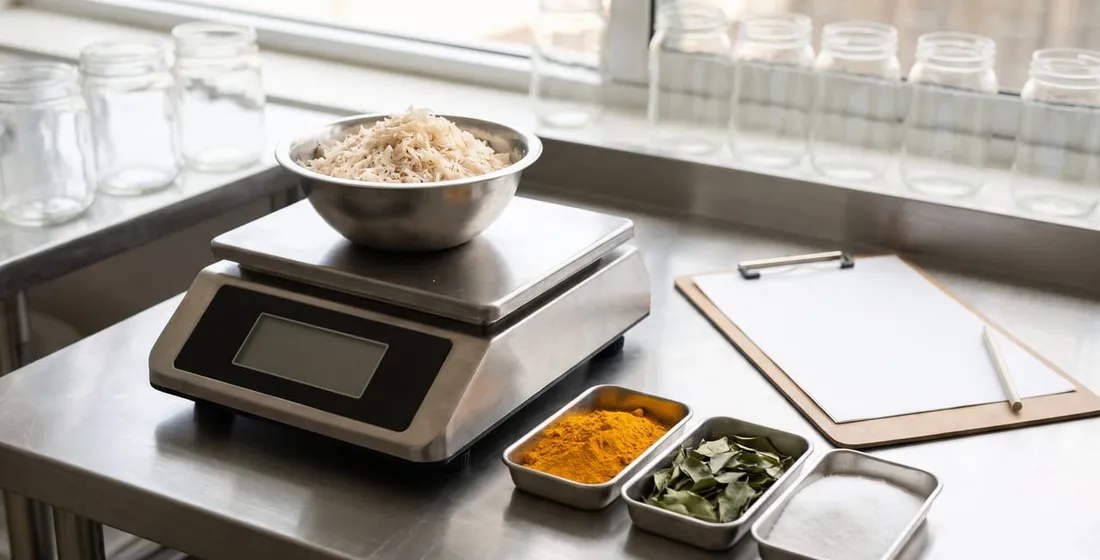
The working method is simple. The kitchen cook makes the recipe once more, with every ingredient weighed on a scale before it goes in. The finished weight is recorded too. Each ingredient then becomes a percentage of the total ingoing weight, and the percentages scale to any batch size.
| Kitchen line | What gets weighed | Formula line (illustrative) |
|---|---|---|
| 2 cups desiccated coconut | Three scoops weighed and averaged | 18.4% desiccated coconut, fine cut, named supplier grade |
| A good handful of curry leaves | One handful weighed five times | 1.2% dried curry leaf, ground to a stated mesh |
| Salt to taste | Tasted dose weighed after the cook agrees | 0.9% fine salt |
| Water, until it looks right | Added in measured steps until the cook approves | 24.0% potable water, plus a stated tolerance |
The figures are planning examples, not a recipe. The point is the right-hand column: a named material, a percentage, and a tolerance.
The percentages matter for the label as well. Regulation 5(2)(a)(i) requires ingredients in descending order of ingoing weight (m/m) at the time of manufacture, and regulation 5(1)(c) requires net contents in SI units, with net drained weight where the food is packed in liquid (Government of Sri Lanka, Gazette 2494/47, 2026). A formula held only in cups cannot prove the order of the list. The label rules themselves are set out in Sri Lanka’s 2026 food labelling regulations.
The formula carries a version number and a signature. The brand owner signs to approve the recipe as a commercial product, and the manufacturer signs to confirm the line can make it. After that, any change to an ingredient, supplier grade or percentage is a new version, not an edit.
Which process settings have to be written down?
Every setting that changes the product if it drifts: times, temperatures, hold periods, particle size and fill. Each one gets a target and a tolerance in place of the phrase """until it looks done""".
This is where kitchen intuition fails most. Heating and mixing both depend on how much vessel surface touches the product relative to its volume. The OSU specialists give the example that the ratio falls by nearly a factor of two moving from a 20-quart stockpot to a 100-gallon hemispherical tank, which changes how a pot heats and mixes, and which makes burn-on at the hot surface a common scale-up problem (Oklahoma State University Extension, 2017). The same sheet lists dispersion of ingredients, mixing time, hold time and cleanup among the common issues.
Take a planning scenario. A sauce or paste that took 20 minutes of gentle stirring in a home pot can scorch at the wall of a jacketed kettle, and the fix is rarely heat alone. It is usually a change of order, with the starch or fat added earlier or later, or a different particle size from the grinder. That is why the process card records the order of addition as carefully as the quantities.
For a first run the process card should state, step by step: the order of addition, the mixing time and speed, the cook or retort target and tolerance, the hold time before filling, the fill weight and headspace, and what the operator must check before the next step. A note on rework belongs here too. OSU points out that a wrongly batched or mislabelled lot can be salvaged if a rework route was planned in advance (Oklahoma State University Extension, 2017).
For retort and glass-jar products specifically, the reformulation work is described in reformulating a kitchen recipe for retort and batch consistency.
What goes into a finished-product specification?
The specification is the written test the finished product has to pass, so that two batches made months apart can be compared against the same standard. It answers one question for the buyer, the manufacturer and an auditor: what does """right""" mean for this product?
A usable first-run specification has five parts:
- Description and ingredients. The product name, the formula version it belongs to, and the allergens present.
- Sensory standard. Colour, aroma, taste and texture described in words an operator can use, ideally with a retained reference sample from the approved trial batch.
- Physical and chemical limits. Measured values with a range, such as moisture, pH, soluble solids or particle size, chosen for the product and agreed with the laboratory.
- Packed-product limits. Net contents, fill tolerance, seal integrity and closure check, with the unit stated in SI as regulation 5(1)(c) requires.
- Storage and date. The storage statement and the date logic that sit behind the label, taken from the shelf-life file described in what a shelf-life file holds before a product can carry a date.
Which measurements go in part 3 depends on the product, and a laboratory or R&D team should set the ranges. Guessing them from a similar product is the common mistake, and it leaves a spec that a good batch can fail or a poor batch can pass.
What does the first batch record hold?
The batch record is the one-batch history that proves the formula and process card were followed. Think of it as the recipe, filled in. It is written on the day, by the people doing the work, and it is kept.
| Record section | What it holds | Why it exists |
|---|---|---|
| Header | Product, formula version, batch number, date of manufacture, batch size | Links the batch to the label, which must carry a batch or code number and a date of manufacture under regulation 5(2)(a) |
| Ingredient and pack log | Each material’s supplier lot, weighed quantity, weigher and checker initials | Lets any ingredient be traced to the batches it went into |
| Process log | Actual times, temperatures, holds and order of addition against the targets | Shows whether the process card was followed or varied |
| In-process checks | Readings taken at each stated check point and the action taken on a miss | Catches drift before filling |
| Yield and reconciliation | Planned against actual output, with losses and rework accounted for | Flags missing material and unplanned waste |
| Release | Specification results, label check against the pack, and the name of the person who released the lot | Shows who decided the product could leave |
Codex defines traceability as the ability to follow the movement of a food through specified stages of production, processing and distribution (Codex Alimentarius Commission, CXG 60-2006). The ingredient and pack log is what makes that definition real for one product. OSU adds the practical point that records must exist to track all ingredients, packaging and finished product through production and distribution, because that is what limits the cost of a recall (Oklahoma State University Extension, 2017).
The batch number printed on the pack is the thread that ties it together. If an inspector or a retail buyer holds a pack, the number should lead to one batch record, which leads to the supplier lots, the checks and the release decision. A number that leads nowhere is a decoration.
The records a maker keeps for a quality-system audit sit around these, and they are covered clause by clause in SLSI quality records: what a food maker keeps before launch.
What should a first-run brief carry?
A brief that arrives with these six items usually moves from sample to a first run without a second round of questions. A brief without them tends to restart at the formula stage.
- The weighed recipe, with every ingredient in grams and the finished weight, from a cook who has made it at least twice.
- The ingredient sources, including brand or grade, so that the first formula names real materials.
- The pack: jar, pouch or bottle, with closure and the net contents the label will state in SI units.
- The claims, such as organic, vegan or any Ayurvedic positioning, since each one adds its own certification or registration step.
- Who signs the formula for the brand owner, and who receives the batch records.
- The reference sample, so the specification’s sensory standard has something physical to match.
Where SFC walks away: a brief that cannot be weighed, for example a recipe held only by a cook who will not write it down, or one that asks the manufacturer to guess the formula from a competitor’s finished pack. SFC works from a formula the brand owner can sign and own. Small first runs are welcome, quoted on request, but they suit a brand that has settled its concept and is ready to commit to a first commercial run.
Frequently asked questions
How do I convert a kitchen recipe to a production formula?
Weigh every ingredient on a scale while the cook makes the recipe, record the finished weight, then express each ingredient as a percentage of total ingoing weight. Percentages scale to any batch size. Cups and spoons are volume measures and do not convert reliably to weight (Oklahoma State University Extension, 2017).
Does the ingredient list on a Sri Lankan label depend on the formula?
Yes. Regulation 5(2)(a)(i) of the 2026 labelling regulations requires ingredients in descending order of ingoing weight (m/m) at the time of manufacture. A formula written in weight is the only reliable way to prove the order, and a change in percentages can change the order printed (Government of Sri Lanka, Gazette 2494/47, 2026).
What is a batch record, and does a first run need one?
A batch record is the written history of one production batch: formula version, supplier lots, weights, process readings, yield and release. A first run needs one because the label must carry a batch or code number under regulation 5(2)(a), and that number should lead to a record a buyer or inspector can read.
Can Silk Foods Ceylon turn my kitchen recipe into a production formula?
Yes. Silk Foods Ceylon (SFC) runs this inside R&D, which takes 3 to 4 weeks at most from signed brief to approved formulation, ending in a signed formula and a finished-product specification. An existing recipe typically reaches a first PO in 2 to 4 weeks. Small runs are welcome, quote on request.
How Silk Foods Ceylon can help
For local brand owners moving from a kitchen to a first production run, Silk Foods Ceylon (SFC) handles the documents this post describes inside one contract manufacturing project at its Matale facility: the weighed formula, the finished-product specification and the batch record for the first lot. Formulation takes 3 to 4 weeks at most from signed brief to approved formulation, and an existing recipe typically reaches a first PO in 2 to 4 weeks. Small first runs are welcome and quoted on request. The facility is BRCGS- and FSSC 22000 V6-audited, with SLSI submission support and Sri Lanka Food Act labelling compliance built into a standard engagement.
To brief a project, email b2b@esilkroute.com.lk or call +94 77 157 7294.
Sources
- Government of Sri Lanka (2026), Extraordinary Gazette No. 2494/47 of 26 June 2026, Food (Labelling and Advertising) Regulations 2026, regulation 5(1)(c) on net contents and regulation 5(2)(a) on ingredient order, batch number and date of manufacture. eohfs.health.gov.lk (retrieved 9 November 2026).
- Oklahoma State University Extension (2017), Scaling Up Your Food Process, Fact Sheet FAPC-141, on formula scale-up, units of measurement, surface-area-to-volume change, rework, and records for recalls. extension.okstate.edu (retrieved 9 November 2026).
- Codex Alimentarius Commission, CXG 60-2006, Principles for Traceability/Product Tracing as a Tool within a Food Inspection and Certification System, definition of traceability. fao.org (retrieved 9 November 2026).