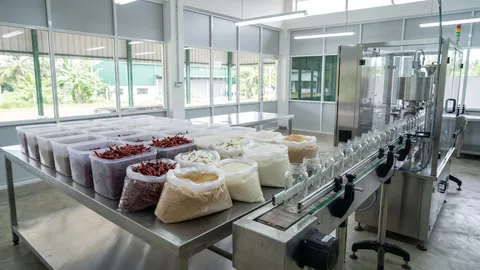
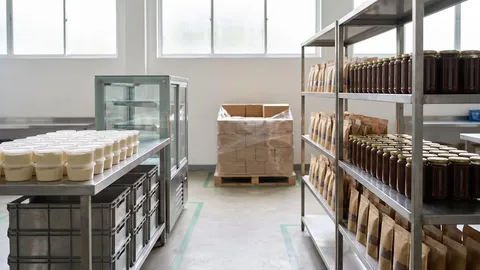
Portion-Controlled Paste Pouches for a Restaurant Chain in Sri Lanka
By the Silk Foods Ceylon Editorial Team
HORECA snapshot
- Sri Lanka recorded 168,625 visitor arrivals in October 2026, a record for the month (SLTDA figures, reported by Newswire, 3 November 2026), so restaurant kitchens portion more paste every week.
- On an illustrative 30 g paste pouch, cost per portion served ran about 14 percent below a scooped tub, but only about 1 percent below where scoops already run true.
- Silk Foods Ceylon (SFC) scopes pouch fill, seal and batch coding as one page, small runs welcome, quote on request.
- The tables below let you rebuild the sums with your own scoop weight.
Sri Lanka logged 168,625 visitor arrivals in October 2026, the busiest October on record and 2.1 percent above October 2025, according to SLTDA figures reported by Newswire on 3 November 2026. For a restaurant chain, that shows up as more covers and more of the same paste leaving the same tubs. The tub is where the money leaks: a cook scoops by eye, the tub is opened on Monday and is still being used on Thursday, and cost per plate drifts from the costed recipe.
A sealed 30 g pouch settles the portion before it reaches the pass. This guide prices that on an illustrative curry-style paste, shows what a 50 kg batch yields, and sets out the fill, seal and batch-code lines to put on one page before any quote. It is written for the procurement or central-kitchen manager of a restaurant chain with a locked paste recipe. For thinner sauces, read single-serve condiment sachets for table service; for dry seasonings, see seasoning sachets and portion packs for hotel kitchens.
What is a 30 g Kitchen Portion, and what does it replace?
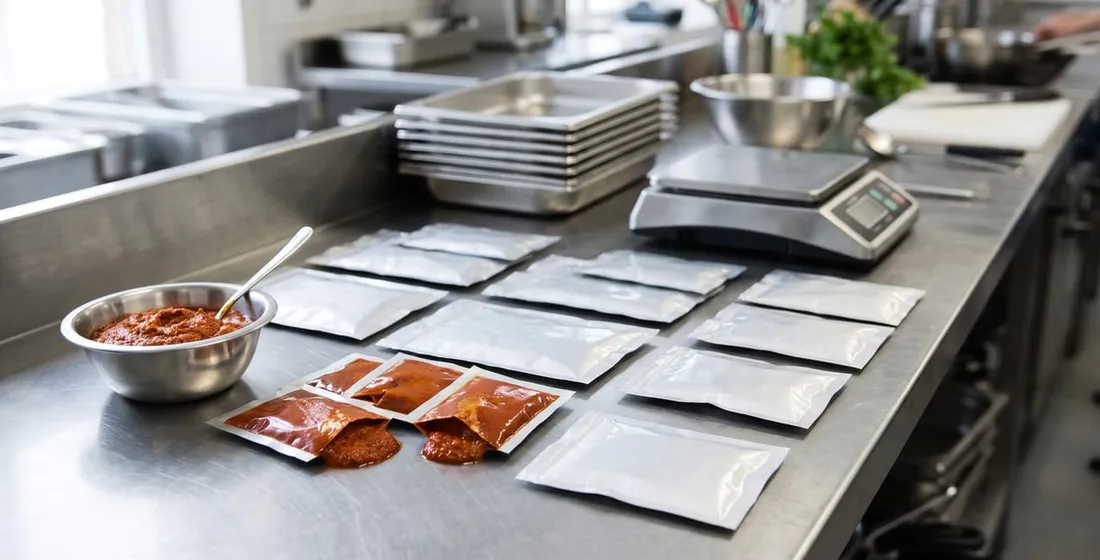
A Kitchen Portion is a sealed pouch filled to one fixed weight, here 30 g of paste, that a cook tears open and empties into one dish. It replaces the bulk tub and the spoon. The weight is decided once, at the filler, instead of on every plate by eye.
The 30 g figure is an example. The chain sets its own weight from its costed recipe, and the pouch should match one dish, not a guess at an average. What the pouch removes is the decanting step: no scoop to drift, no tub lid to leave off, no half-used tub to date and discard. A foodservice supplier blog makes the same point from the supply side, noting that pre-measured sauce containers take the decision out of the rush at service (GoFoodservice, retrieved November 2026).
Who packs the paste decides the service. If the chain’s own central kitchen makes the paste and only needs it sealed into pouches, that is Co-Packing, where the buyer supplies finished goods and SFC packs, seals and labels. If SFC also makes the paste to the chain’s recipe, that is Contract Manufacturing, and where the chain wants an existing SFC paste under its own brand, it is Private Labelling. The private-label curry paste playbook covers that route.
What does one portion cost, scooped or pouched?
On illustrative inputs, paste at LKR 1,800 per kg, a 38 g average scoop and 4 percent lost in opened tubs, one portion costs about LKR 71 from a tub. A 30 g pouch filled to 30.6 g on average, at LKR 6 for pouch and packing, costs about LKR 61. That is a saving of about 14 percent per portion.
The inputs are assumptions, not quotes. Paste cost is set at LKR 1,800 per kg delivered in bulk. The tub case adds the 4 percent that is scraped, spoiled or discarded once a tub has been open for days, so the grams issued per portion are the scoop weight divided by 0.96. The pouch case adds the cost of the pouch and the sealing at LKR 6, and a filler set point of 30.6 g, because the average has to hold at 30 g or above (more on that below).
The saving depends almost entirely on how far the scoop drifts, so the table runs three scoop weights.
| Average scoop from tub | Cost per portion from tub (LKR) | Cost per portion from 30 g pouch (LKR) | Saving per portion (LKR) | Saving |
|---|---|---|---|---|
| 33 g (10 percent over recipe) | 61.9 | 61.1 | 0.8 | 1.3 percent |
| 38 g (27 percent over) | 71.3 | 61.1 | 10.2 | 14.3 percent |
| 42 g (40 percent over) | 78.8 | 61.1 | 17.7 | 22.4 percent |
Consider one outlet on an ordinary Tuesday lunch service, serving 120 portions of the dish. At the 38 g case, the saving is LKR 10.2 on each, about LKR 1,220 a day, or about LKR 36,600 over a 30-day month. Across 20 outlets that is about LKR 732,000 a month. The same outlet, with cooks who already scoop to 33 g, saves under LKR 3,000 a month, and the pouch is then worth buying for consistency and hygiene rather than cost.
So weigh before you brief. Ask each station to weigh 20 scoops on a kitchen scale over one week, and use the real average in the table. If it comes back near 30 g, the money case is thin and you should say so to the manufacturer.
How many pouches does one batch yield?
Yield per batch depends on average fill and line loss, not on batch weight alone. From an illustrative 50 kg paste batch with 3 percent lost to purging and rejected pouches, a 30.6 g average fill gives about 1,585 pouches, while a 33 g average gives about 1,470. Every extra gram of fill removes pouches.
| Average fill (g) | Line loss | Usable paste (kg) | Pouches from 50 kg |
|---|---|---|---|
| 30.6 | 3 percent | 48.5 | 1,585 |
| 30.6 | 6 percent | 47.0 | 1,536 |
| 31.5 | 3 percent | 48.5 | 1,540 |
| 33.0 | 3 percent | 48.5 | 1,470 |
The 50 kg batch is arithmetic for this guide, not an SFC batch size. The point is the spread: between the best and worst rows, the same batch gives 115 fewer pouches, about 7 percent, and the chain pays for the paste either way. A good quote therefore states the expected yield, the filler set point and the loss rule, so that over-fill and line loss are visible lines and not hidden in a unit price.
Which fill, seal and batch-code lines belong on the one page?
A one-page pouch spec fixes five things: nominal fill and tolerance, seal check, batch and date coding, shelf life, and case counts. On a 30 g pouch, the 9 percent tolerance table allows 2.7 g short, and no single pouch may fall below 24.6 g (Austrian federal metrology office, BEV).
The BEV table is a benchmark used here, not a Sri Lankan rule. It sets three tests: the batch average may not fall below the nominal quantity, only about 2.5 percent of packs may be short by more than the tolerable error, and no pack may be short by more than twice that error. Because the average has to hold, the filler sits slightly above 30 g, which is why the cost model uses 30.6 g.
Spec snapshot: 30 g paste pouch, one page
| Line | What to write | Why it matters |
|---|---|---|
| Nominal fill | 30 g, batch average not below 30 g | Fixes the portion the recipe is costed on |
| Tolerance | 2.7 g (9 percent) short at most; no pouch below 24.6 g | Stops a light pouch becoming a thin dish |
| Filler set point | Agreed in writing (illustrative 30.6 g), with a fill record per batch | Over-fill is paid for in paste, as the yield table shows |
| Seal | Seal type and film named; each batch checked by an agreed method; a stated reject rule | One leaker can foul a carton in transit |
| Batch code | Batch number, manufacture date and expiry date printed on each pouch, repeated on inner and carton | Lets a kitchen trace and pull a lot in minutes |
| Shelf life | Stated on the spec, set by the recipe and the validated pack; storage condition for unopened pouches | Sets how many weeks of stock an outlet may hold |
| Inner and carton | Pouches per inner, inners per carton | Sets order size and how long an opened inner waits |
Two cautions on what the page cannot promise. Shelf life comes from testing the actual paste in the actual pouch, so any figure should wait for that result. And 30 g is smaller than the catalogue kraft pouches, which start at 50 g, so a 30 g paste pouch is scoped per quote. The HORECA co-manufacturer checklist explains why procurement teams check batch codes and shelf life on arrival before they check anything else.
How do inner counts save the kitchen?
The inner count decides how many pouches a cook exposes at once. At 40 portions per station per day, an inner of 25 empties in about 0.6 of a day, an inner of 50 in about 1.25 days, and an inner of 100 in about 2.5 days. Match the inner to about one shift so opened stock never waits.
| Pouches per inner | Days to empty at 40 per day | What it means at the station |
|---|---|---|
| 25 | 0.6 | Opened and finished inside one shift |
| 50 | 1.25 | One inner open at a time, finished by next service |
| 100 | 2.5 | Loose pouches sit near the stove for two to three days |
The 40 a day comes from the same illustrative outlet: 120 portions across three stations. Loose pouches kept near heat and steam are the ones that get crushed, torn or used out of order, which is the same decanting loss in another form. A 50-count inner suits this outlet. A smaller outlet with one station might prefer 25.
The outer carton follows from the weekly order. The same outlet uses about 840 pouches a week, which is under two cartons of 500 (ten inners of 50). That keeps delivery drops small enough for a kitchen store and keeps each carton’s batch code easy to track. If you are weighing pouch against sachet formats on order size, the guide to order quantities by format sets out how quotes are framed.
What do the 2026 labelling rules add?
Sri Lanka’s Food (Labelling and Advertising) Regulations 2026 took effect on 1 July 2026 and cover packaged food sold or distributed in the country, according to ChemLinked (August 2026). They do not apply to food made before that date. Have pouch artwork checked against the gazette text before first print.
The regulations were published on 26 June 2026 in Gazette Extraordinary No. 2494/47 and replace the 2005 and 2022 rules, per the same report. This guide could not open the gazette text, so it makes no claim about exact batch-code or date wording. Treat the coding line in the spec table as a working minimum and confirm the wording with the manufacturer’s SLSI submission contact. A kitchen-use pouch is not a retail pack, but a chain that later sells the same paste in a shop will need the full retail label.
Where Silk Foods Ceylon walks away
SFC is not the right fit for a chain that has not weighed its own scoops, since there is no cost case to build on. It is also not the fit for a brief that wants a shelf life printed before the paste has been tested in the pouch, or a chain that wants an unbranded pouch with no batch code. Small runs are welcome, but a paste that is still changing weekly should stay in the central kitchen until the recipe is locked.
Service snapshot: Co-Packing or Contract Manufacturing at Silk Foods Ceylon
- Format: 30 g paste pouch, scoped per quote (catalogue pouches start at 50 g).
- First runs: small runs welcome, quote on request.
- Locked recipe to first run: typically 2 to 4 weeks; if R&D / NPD (Co-Development on the SFC brochure) is needed first, that takes 3 to 4 weeks at most from signed brief to approved formulation.
- Cert coverage: BRCGS- and FSSC 22000 V6-audited, with SLSI submission support in a standard engagement.
Frequently asked questions
How much cheaper is a 30 g paste pouch than a scooped tub?
In the illustrative model, one portion cost about LKR 61 from a pouch against about LKR 71 from a tub, about 14 percent less, when scoops averaged 38 g. Where scoops already run near 33 g, the gap shrinks to about 1 percent. Weigh your own scoops before you commit.
What fill tolerance applies to a 30 g pouch?
On the 9 percent tolerance table used by the Austrian federal metrology office, a 30 g pouch may be 2.7 g short, no single pouch may fall below 24.6 g, and the batch average may not fall below 30 g. The filler is therefore set slightly above nominal.
Does Silk Foods Ceylon fill 30 g paste pouches for restaurant chains?
Silk Foods Ceylon (SFC) scopes a 30 g paste pouch per quote, because its catalogue kraft pouches start at 50 g. Small runs are welcome and quoted on request. Send the paste type, target weight and weekly use per outlet to b2b@esilkroute.com.lk, and the quote will show fill, seal and coding lines.
How many pouches does one batch of paste yield?
From an illustrative 50 kg batch with 3 percent line loss, a 30.6 g average fill gives about 1,585 pouches and a 33 g average about 1,470. Ask for the expected yield, the filler set point and the loss rule in writing, so over-fill is a visible line in the quote.
How Silk Foods Ceylon can help
For restaurant and hotel groups that want portion control built into the pack, Silk Foods Ceylon (SFC) offers Co-Packing for a chain’s own paste and Contract Manufacturing or Private Labelling where SFC makes the paste. Small first runs are welcome and quoted on request. Allow 2 to 4 weeks from a locked recipe and an approved pouch spec to a first run; where the in-house R&D team develops the formulation first, that takes 3 to 4 weeks at most. The Matale facility is BRCGS- and FSSC 22000 V6-audited, with SLSI submission support in a standard engagement.
To brief a project, email b2b@esilkroute.com.lk or call +94 77 157 7294.
Sources
- Newswire.lk, “Sri Lanka records highest-ever October tourist arrivals with over 168,000 visitors”, 3 November 2026, reporting SLTDA figures. Retrieved 2026-11-21. https://www.newswire.lk/6uo4
- ChemLinked, “Sri Lanka enforces new food labelling rules”, 17 August 2026, on the Food (Labelling and Advertising) Regulations 2026. Retrieved 2026-11-21. https://food.chemlinked.com/news/food-news/sri-lanka-enforces-new-food-labelling-rules
- Bundesamt fuer Eich- und Vermessungswesen (BEV), Austria, “Prepackages”, legal metrology guidance on tolerable negative error. Retrieved 2026-11-21. https://bev.gv.at/en/Topics/Metrology-Service/Legal-Metrology/Prepackages.html
- GoFoodservice, “5 Ways Your Restaurant Can Reduce Food Waste”, a foodservice supplier blog on pre-measured sauce containers. Retrieved 2026-11-21. https://www.gofoodservice.com/blog/5-ways-restaurant-can-reduce-food-waste
All LKR figures, scoop weights, batch sizes and loss rates in the worked examples are illustrative assumptions, not quotes and not SFC batch sizes. This guide gives general buying guidance. Confirm labelling wording against the gazette before printing.
Written by the Silk Foods Ceylon Team. Silk Foods Ceylon (Pvt) Ltd. is a BRCGS- and FSSC 22000 V6-audited contract manufacturer in Matale, Sri Lanka, offering contract manufacturing, private labelling, co-packing, and in-house R&D for local Sri Lankan brand owners, FMCG companies, hotel and restaurant groups, and distributors. To brief a project: b2b@esilkroute.com.lk or +94 77 157 7294.