From Liquid to Powder: What a 50 kg Spray-Dry Batch Takes

By the Silk Foods Ceylon Editorial Team
Buyer’s snapshot
- Fifty kilograms of powder at 4 percent moisture holds 48 kg of dry solids. At 10 percent feed solids that is 480 kg of liquid through the dryer, and about 430 kg of it leaves as water vapour.
- Published lab work on orange juice found maltodextrin raised powder yield, yet 65 to 82 percent of the product still deposited on the chamber wall (Phing and Saleena, 2022). Recovery is measured per recipe, never assumed.
- Silk Foods Ceylon (SFC) runs fruit and plant milk through one spray-drying line at Matale: preparation tank, pipe filter, colloid mill and spray drier. The first run is a 50 kg single-day batch.
- The tables below turn a powder target into the litres, the carrier and the days the batch actually needs.
A brief for a powder usually states the end product: 50 kg of mango powder, or an oat milk powder for a hotel buffet. It rarely states the input. The dryer does not make solids, it removes water from them, so every kilogram of powder is the leftover of a much larger volume of liquid that has to be sourced, prepared and filtered before anything dries.
The decision between a powder and a bottle is covered in plant-based beverage formats in Sri Lanka. This post follows one 50 kg batch through the line, so a brand can see what it is actually committing to when it signs for powder.
What does a 50 kg spray-dry batch need at the start?
A 50 kg batch of powder at about 4 percent moisture contains roughly 48 kg of dry solids, so the brief fixes the feed volume before any recipe work begins. The volume depends on how concentrated the liquid is. The arithmetic below uses three assumed feed concentrations; they are planning figures for the maths, not SFC recipe data.
| Total feed solids (fruit or milk solids plus carrier) | Liquid feed needed for 48 kg solids | Water evaporated to reach 50 kg powder |
|---|---|---|
| 10 percent, a typical thin plant milk | 480 kg | about 430 kg |
| 15 percent | 320 kg | about 270 kg |
| 20 percent | 240 kg | about 190 kg |
Two things follow. A thin feed means a long day and a large volume of raw material delivered fresh on the morning; a concentrated feed shortens the dryer time but can thicken past what the pump and atomiser handle. The right concentration is found in the trial, which is why the R&D team sets it before the line books a slot.
The five stations: what does each one do to the liquid?
The Matale spray-drying line is five stations in a row, and a feed that fails at an early one never reaches the dryer. The documented equipment is a preparation tank, a pipe filter, a colloid mill and the spray drier itself, followed by a packing block. Each station exists to protect the next.
The preparation tank is where the batch is made up: fruit pulp or plant base, carrier if the recipe uses one, and water to the target solids. The pipe filter catches seeds, fibre and lumps that would block the atomiser. The colloid mill shears what remains to a fine, even particle size so the nozzle sprays a consistent droplet. The drier then atomises the feed into hot air, and the droplets lose their water in seconds and fall as powder.
Walk into the Matale facility and the cellular-manufacturing layout shows within a minute or two: the capsule line on one side, the spray-drier next to it, the patty-forming machine a few metres on, the colloid mill and retort behind them. The layout exists so equipment moves between configurations rather than sitting in one. For a brand, the consequence is practical: powder, capsule and retort SKUs share one audited site, so a second product does not mean a second manufacturer to qualify.
Service snapshot: Contract Manufacturing at Silk Foods Ceylon
Service: SFC manufactures the buyer’s fruit or plant milk powder at the Matale facility
Line: preparation tank, pipe filter, colloid mill, spray drier, then a packing block
First-run minimum: 50 kg of powder, a single-day batch; tiers at 500, 1,000 and 2,500 kg
Lead time: 2 to 3 weeks for the powder from purchase order, then 1 to 2 weeks for packing once powder and printed laminate are on site; R&D, where the recipe is not yet dryer-ready, is 3 to 4 weeks at most
Cert coverage: BRCGS- and FSSC 22000 V6-audited site, with SLSI submission support and Sri Lanka Food Act labelling review inside the engagement
How does a fruit feed differ from a plant milk feed?
A fruit feed is sugar-dominated and sticky; a plant milk feed is protein-, starch- and fat-dominated and fouls differently. Both are low in total solids when they arrive, and both need help to dry into a free-flowing powder. The difference decides the carrier, the label claim and the packaging.
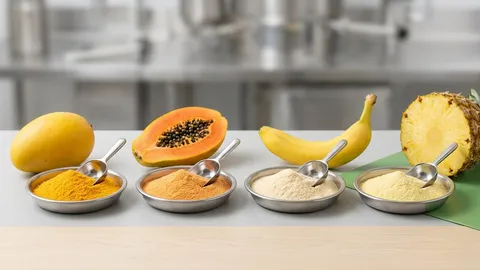
Sugars in fruit stay tacky at dryer temperatures, so the standard fix is a carrier, usually maltodextrin. The Phing and Saleena review of spray-dried fruit powders records the trade-off: carrier lifts yield and flow, and in the orange juice work it still left most of the product on the wall. Plant milks dry more kindly. An oat milk study published in 2025 (Bhokarikar, Gurumoorthi and Athmaselvi) made its feed from 13.17 percent roasted oat flour, tested maltodextrin at 0, 5 and 10 percent, and dried at 160°C inlet and 115°C outlet.
| Question | Fruit powder | Plant milk powder |
|---|---|---|
| Main difficulty on the line | Sugar turns sticky and coats the chamber wall | Starch and protein foul; fat can oxidise |
| Carrier | Usually needed; sets the fruit percentage | Optional; improves flow |
| Moisture and water activity to expect | About 3 to 5 percent moisture | 2.70 to 3.93 percent moisture and water activity 0.33 to 0.60 in the oat study |
| What the label must show | The carrier by name, and a fruit percentage that survives review | The base, any carrier, allergens |
| Read more | Spray-dried fruit powder contract manufacturing | Plant-based milk R&D: spray-dry vs UHT |
The oat powders in that study came out at Carr’s index 16.21 to 20.65 percent, which the authors class as fair flowability. A powder that flows only fairly will bridge in a hopper and underfill a stick pack, so flow is a spec to set, not a hope.
A worked example: 50 kg of mango powder with a 30 percent carrier
Take a mango powder at a 70:30 fruit-to-carrier ratio. The 48 kg of solids split into 33.6 kg of fruit solids and 14.4 kg of maltodextrin. If the fruit puree is strained to 12 percent soluble solids (an assumption for the maths), the fruit side needs 280 kg of puree. Add the 14.4 kg of carrier dissolved in it and the feed is about 294 kg at roughly 16 percent solids.
Three consequences land on the brief. The label can claim at most 70 percent fruit solids, and the ingredient list names the carrier, a point worked through for another beverage in coconut water powder co-packing. The 280 kg of puree has to be ripe, graded and ready on the morning of the run. And the recovered powder will be less than the arithmetic suggests, because some product stays on the wall.
SFC does not quote a recovery percentage in a blog post. It is measured in the trial for each recipe, and the batch is then planned against the packed-ready powder the brand actually needs, with the input volume set to match.
Where does the day go, and what comes after?
A 50 kg batch is a single-day run at Matale, but the dryer is one step in a calendar. The sequence for a first order looks like this.
- R&D, where the recipe is not yet dryer-ready: 3 to 4 weeks at most, signed brief to approved formulation.
- Print of laminate or tins: the long item, set by the artwork plan in artwork and print lead time for private label.
- Powder production: 2 to 3 weeks from purchase order, with the batch itself a single day.
- Packing: 1 to 2 weeks once the powder and printed laminate are on site, into sachets, stick packs, 50 g to 1 kg kraft pouches or 400 ml round tins. Fill tolerance and laminate choice are in sachet and stick-pack co-packing for powdered drinks.
A powder at 3 to 5 percent moisture is stable only while the pack keeps humid air out. Water activity of 0.60 sits at the top of the range in the oat study, and Sri Lankan air is humid for most of the year, so the barrier film belongs in the brief and the shelf-life file, as set out in shelf-life and accelerated stability testing for a Sri Lankan SKU.
Buyer’s checklist: what to bring to a spray-dry brief
- The powder target in kilograms, and the serving size it must make.
- The base: fruit or plant, and the form it arrives in (puree, juice, flour, whole nut).
- The label claim you want, such as a fruit percentage, so the carrier ratio is set to defend it.
- The pack format and barrier film, decided before the trial.
- A date for the print order, since laminate sets the calendar.
Where Silk Foods Ceylon walks away
SFC is not the right line for a brief that wants 100 percent fruit powder with no carrier from a sticky fruit, because the sugars will not dry clean without help. It is not the line for a brand that has not decided the base or the pack. And a first run smaller than 50 kg is below the line’s documented minimum. For a founder still testing flavour in a home kitchen, a few more rounds at home cost less than a dryer day. The step from kitchen to line is set out in home kitchen to contract manufacturing: the first run.
Frequently asked questions
Does Silk Foods Ceylon spray-dry fruit and plant milk for other brands?
Yes. Silk Foods Ceylon runs a spray-drying line at Matale, with a preparation tank, pipe filter, colloid mill and spray drier, for fruit powders and plant milk powders. The first run is a 50 kg single-day batch, with tiers at 500, 1,000 and 2,500 kg. Powder lead time is 2 to 3 weeks from purchase order.
How much liquid does 50 kg of spray-dried powder need?
It depends on feed solids. Fifty kilograms of powder at about 4 percent moisture holds roughly 48 kg of dry solids, so a 10 percent feed needs about 480 kg of liquid and a 20 percent feed about 240 kg. These are planning figures; the real feed concentration is set in the R&D trial for each recipe.
Why does a fruit powder need a carrier like maltodextrin?
Fruit sugars turn sticky at dryer temperatures and coat the chamber wall. The Phing and Saleena 2022 review notes that in orange juice work maltodextrin raised yield, yet 65 to 82 percent of the product still deposited on the wall. A carrier lifts yield and flow but lowers the fruit percentage the label can claim, so the ratio is a trade-off.
How long does R&D take for a new powder at Silk Foods Ceylon?
R&D takes 3 to 4 weeks at most, from signed brief to approved formulation. That window covers the carrier ratio, target moisture and particle size. The 50 kg production batch then follows, with 2 to 3 weeks for the powder and 1 to 2 weeks for packing once printed laminate is on site.
How Silk Foods Ceylon can help
For local FMCG brands and founders weighing a fruit or plant milk powder, Silk Foods Ceylon (SFC) runs the whole chain on one site at Matale: preparation tank, pipe filter, colloid mill and spray drier, then packing into sachets, stick packs, kraft pouches or 400 ml tins. The first run is a 50 kg single-day batch, the powder ships 2 to 3 weeks from purchase order, and in-house R&D takes a recipe that is not yet dryer-ready to approval in 3 to 4 weeks at most. The facility is BRCGS- and FSSC 22000 V6-audited, with SLSI submission support and Sri Lanka Food Act labelling review inside the standard contract manufacturing engagement.
To brief a powder project, email b2b@esilkroute.com.lk or call +94 76 441 0389 / +94 76 918 5744.
Sources
Pui Liew Phing and Lejaniya Abdul Kalam Saleena, Effects of spray-drying parameters on physicochemical properties of powdered fruits, Foods and Raw Materials, 2022, 10(2): 235-251, including the orange juice study reporting yield up to 18 to 35 percent with 65 to 82 percent wall deposit. A laboratory-scale review, not an SFC figure. Retrieved 7 October 2026. https://cyberleninka.ru/article/n/effects-of-spray-drying-parameters-on-physicochemical-properties-of-powdered-fruits
Sanika Bhokarikar, P. Gurumoorthi and Kathirvelpillai Athmanathan Athmaselvi, Impact of drying techniques and maltodextrin as a carrier on the flow properties and reconstitution properties of oat milk powder, Current Research in Nutrition and Food Science, 13(2), 2025: 13.17 percent oat flour feed, 0 to 10 percent maltodextrin, 160°C inlet and 115°C outlet, moisture 2.70 to 3.93 percent, water activity 0.33 to 0.60, Carr’s index 16.21 to 20.65 percent. Retrieved 7 October 2026. https://www.foodandnutritionjournal.org/volume13number2/impact-of-drying-techniques-and-maltodextrin-as-a-carrier-on-the-flow-properties-and-reconstitution-properties-of-oat-milk-powder/
Silk Foods Ceylon, internal capability data for the Matale facility: spray-drying line (preparation tank, pipe filter, colloid mill, spray drier); 50 kg single-day first batch with tiers at 500, 1,000 and 2,500 kg; powder 2 to 3 weeks from purchase order; packing 1 to 2 weeks once powder and laminate are on site; R&D 3 to 4 weeks maximum; packaging list of sachets, stick packs, 50 g to 1 kg kraft pouches and 400 ml round tins. Feed concentrations and the 70:30 mango example in this post are planning arithmetic, not SFC recipe data.
Written by the Silk Foods Ceylon Team. Silk Foods Ceylon (Pvt) Ltd. is a BRCGS- and FSSC 22000 V6-audited contract manufacturer in Matale, Sri Lanka, offering contract manufacturing, private labelling, co-packing, and in-house R&D for local Sri Lankan brand owners, FMCG companies, hotel and restaurant groups, and distributors. To brief a project: b2b@esilkroute.com.lk, +94 76 441 0389, or +94 76 918 5744.