Private-Label Coconut Milk Powder in Sri Lanka: Spray-Dry Specs
Buyer’s snapshot
- Sri Lanka exported US$ 1,233.01 million of coconut and coconut-based products in 2025, and coconut milk powder alone grew 61.47% on the year (Sri Lanka Export Development Board, 2026).
- Codex Alimentarius allows liquid coconut milk to be up to 87.3% moisture, which is the entire commercial argument for the dried format.
- Maltodextrin and sodium caseinate are Codex-permitted carriers, not adulterants, but one of them quietly breaks a vegan claim.
- Silk Foods Ceylon (SFC) spray dries in Matale from a 50 kg single-day batch, with SLSI submission support inside the engagement.
A coconut milk powder SKU looks simple on the shelf. A pouch of off-white powder, a reconstitution line on the back, a price point. The specification behind it is where local private-label projects usually stall.
Most Sri Lankan brand owners arrive with a target retail price and a pouch size, and nothing decided on fat content, carrier ratio, or how the finished pack will be worded. Those three choices set the unit cost, the mouthfeel a chef or a home cook will judge the product on, and whether the SKU clears its first SLSI submission. This post takes them in the order a spec sheet actually needs them.
Why the dried format is taking local shelf space
Coconut and coconut-based products earned Sri Lanka US$ 1,233.01 million in 2025, up 42.66% year on year, and coconut milk powder was one of the faster-moving lines within that at 61.47% growth (Sri Lanka Export Development Board, January 2026). Coconut cream grew 93.16% and coconut oil 78.68% over the same period. EconomyNext reported in January 2026 that coconut-based products now account for 7.2% of the country’s total exports, against a ministry target of US$ 2.5 billion by 2030.
That matters to a local brand owner for an unglamorous reason. The spray-drying capacity built for export buyers is domestic capacity, and it is available for a Sri Lankan retail SKU on the same lines. A powder pouch also removes three problems a liquid coconut milk SKU carries on the local shelf: no chilled logistics, no can seamer, no dented-tin returns from up-country distribution.
What spray drying actually does to coconut milk
Spray drying atomises coconut milk into a hot air stream, so the water leaves as vapour and the solids fall out as free-flowing powder. Published work on coconut milk in Foods (2021) puts the inlet air temperature range at 140 to 170 degrees Celsius, and identifies inlet temperature as the single most influential variable on the moisture outcome of the finished powder.
The reason the format exists is visible in the Codex composition limits. Codex Alimentarius standard CXS 240-2003 allows coconut milk to be up to 87.3% moisture and coconut cream up to 74.6%. Shipping liquid coconut milk to a distributor in Jaffna or Batticaloa means paying freight on mostly water.
| Product (Codex CXS 240-2003) | Total solids % m/m | Fat, minimum % | Moisture, maximum % |
| Light coconut milk | 6.6 to 12.6 | 5.0 | 93.4 |
| Coconut milk | 12.7 to 25.3 | 10.0 | 87.3 |
| Coconut cream | 25.4 to 37.3 | 20.0 | 74.6 |
| Coconut cream concentrate | 37.4 minimum | 29.0 | 62.6 |
The format decision itself, powder against a liquid line, is covered in more depth in the spray-dry powder vs UHT liquid R&D comparison. This post assumes the powder decision is already made.
Fat, carriers, and the vegan claim nobody checks
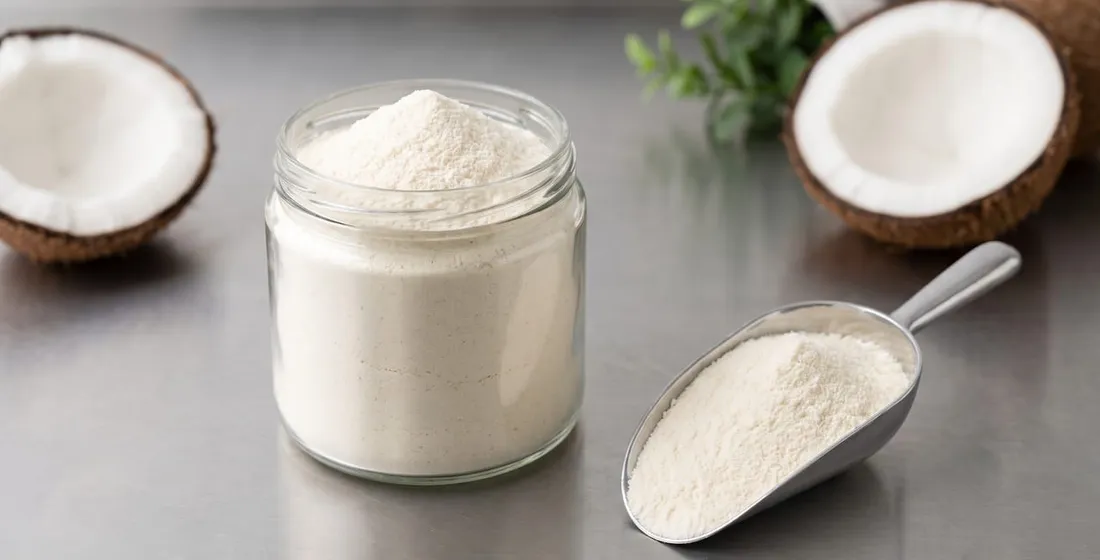
The Coconut Development Authority describes coconut milk powder as carrying 70% to 80% natural coconut fat. That is the band a retail-grade powder should be specified into, and it is the number that decides how the reconstituted product behaves in a curry.
Carriers are the other half of the spec. The Foods (2021) work used maltodextrin and sodium caseinate each in a 0% to 10% w/w range, and Codex CXS 240-2003 lists both as permitted ingredients in aqueous coconut products. So neither is an adulterant, whatever a competing pack’s back panel implies.
They are not interchangeable, though. Maltodextrin is a starch-derived carrier that improves flowability and lowers cost per kilogram, at the price of diluting fat and thinning mouthfeel. Sodium caseinate is a milk protein. It emulsifies better, and it silently disqualifies any vegan or dairy-free claim on the front of the pack while triggering a dairy allergen disclosure under the Sri Lanka Food Act labelling framework.
One local brand owner briefed a coconut milk powder for a hotel gift-shop range and a wellness-positioned retail listing off the same formulation, with sodium caseinate in the carrier because a supplier sample had performed well. The dairy-free line on the artwork had already gone to print. The correction cost a reprint of the pouch film and pushed the launch two production blocks back, which on a seasonal gifting window is the difference between the season and the one after it.
What a first private-label run costs to start
Powder is one of the more forgiving formats to start in, because the minimum is set by batch chemistry rather than by a filling line changeover. Contract manufacturing of spray-dried plant milk powder at the Matale facility starts at a 50 kg single-day batch. Private labelling of bulk powder starts at 50 kg per SKU, with volume tiers at 500 kg, 1,000 kg, and 2,500 kg.
| Stage | Existing formulation | With R&D and NPD |
| Sample dispatch | 1 to 2 weeks | 2 to 4 weeks per iteration |
| Recipe lock | Not required | 2 to 4 iterations typical |
| PO to dispatch | 2 to 3 weeks | 6 to 10 weeks |
Retail formats run across 50 g, 100 g, 250 g, 500 g, and 1 kg kraft pouches in brown, white, or window film, with 25 kg and 50 kg bulk sacks on an LDPE inner bag for foodservice and further-processing buyers. A hotel group running an in-room or gift-shop line and a supermarket listing off one formulation is the common pattern, and the small-MOQ economics of hotel gift-shop private label work the same way for powder as they do for tea.
Where SLSI and the Food Act sit in the timeline
SLSI clearance on a stable-formulation SKU typically runs 4 to 8 weeks, and a 6 to 10 week buffer between QA sign-off and the intended shelf date is the realistic planning assumption. The six-week SLSI submission window documented for a private-label coconut jam is the closest comparable track.
The Sri Lanka Food Act No. 26 of 1980 and its amendments set the label itself: product name in the prescribed language combination, net weight in metric units at the prescribed font sizing, ingredients in descending order by weight, allergen disclosure, country of origin, manufacturer name and address with the SLS number, and expiry format. Codex CXS 240-2003 adds one clause that first-time powder specs routinely miss. Where coconut milk is produced by reconstituting powder with potable water, the finished product must be labelled as reconstituted.
The Matale facility is BRCGS and FSSC 22000 V6 audited, with USDA Organic and EU Organic available per SKU, SLSI clearance on every retail SKU, and Sri Lanka Food Act compliance built into the engagement. The certification backbone behind a local contract manufacturing engagement sets out what each of those unlocks.
Where this SKU does not work
Coconut milk powder is a poor fit for a brand that wants a clean two-ingredient back panel at a mass price point. Once carrier is stripped out, the powder loses flowability and cakes in Sri Lankan ambient humidity, and the cost per reconstituted litre stops competing with a tin. It is also the wrong first SKU for a brand with no distribution agreement in place, because the format’s advantages are logistical and they only pay back across distance. A coconut spread or a coconut oil SKU is a simpler first listing.
Frequently asked questions
What is the private-label MOQ for coconut milk powder at Silk Foods Ceylon?
Contract manufacturing of spray-dried plant milk powder starts at a 50 kg single-day batch at the Matale facility. Private labelling of bulk powder starts at 50 kg per SKU, with volume tiers at 500 kg, 1,000 kg, and 2,500 kg. Retail pouch formats run from 50 g to 1 kg.
How does Silk Foods Ceylon support hotel-group private-label programmes?
Custom branding is applied to existing SFC formulations across 50-plus ready-to-go products, so a multi-SKU hotel programme can run inside a single production block. The Matale facility is BRCGS and FSSC 22000 V6 audited, with SLSI clearance on every retail SKU.
What fat content should a retail coconut milk powder be specified at?
The Coconut Development Authority describes coconut milk powder as containing 70% to 80% natural coconut fat. Specifying inside that band keeps reconstituted performance close to liquid coconut milk. Carrier level, typically maltodextrin at up to 10% w/w, moves fat content down from there.
Does maltodextrin or sodium caseinate have to be declared?
Both are permitted ingredients under Codex CXS 240-2003 and both must appear in the ingredient list. Sodium caseinate is a milk protein, so it also triggers dairy allergen disclosure under the Sri Lanka Food Act and removes any vegan or dairy-free claim from the pack.
How long does SLSI clearance take for a private-label powder SKU?
Clearance on a stable formulation typically runs 4 to 8 weeks. Planning a 6 to 10 week buffer between QA sign-off and the intended shelf date absorbs the normal query cycle without moving a launch date that has already been given to a distributor.
How Silk Foods Ceylon can help
For hotel and restaurant groups running in-room amenity, gift-shop, or minibar SKU programmes, Silk Foods Ceylon (SFC) offers a private-label catalogue of 50+ ready-to-go products across spice blends, coconut SKUs, herbal teas, capsules, jams, and vegan formats. Custom branding is applied to existing SFC formulations; first-run MOQs sit at 1,500 jars or 1,250 bottles per SKU, which keeps a multi-SKU hotel programme on a single production block. The Matale facility is BRCGS- and FSSC 22000 V6-audited, with SLSI clearance on every retail SKU. The adjoining plantation supports brand storytelling for sustainability-positioned hotel groups.
To brief an in-room or gift-shop programme, email b2b@esilkroute.com.lk or call +94 76 441 0389 or +94 76 918 5744.
Sources
- Sri Lanka Export Development Board, “Sri Lanka’s Export Performance Exceeded US$ 17.2 Billion in 2025,” 26 January 2026. https://www.srilankabusiness.com/news/sri-lankas-export-performance-exceeded-us-17.2-billion-in-2025.html (retrieved 6 August 2026)
- EconomyNext, “Sri Lanka’s coconut export revenue crosses USD 1 bn in Jan-Oct last year: Ministry,” 2 January 2026. https://economynext.com/sri-lankas-coconut-export-revenue-crosses-usd-1-bn-in-jan-oct-last-year-ministry-255602/ (retrieved 6 August 2026)
- Coconut Development Authority of Sri Lanka, “Coconut Milk Powder,” product information. https://cda.gov.lk/web/index.php?option=com_cda&view=items&product_id=7&Itemid=238&category_id=1&lang=en (retrieved 6 August 2026)
- FAO/WHO Codex Alimentarius Commission, “Standard for Aqueous Coconut Products: Coconut Milk and Coconut Cream, CXS 240-2003,” adopted 2003. https://www.fao.org/input/download/standards/10401/CXS_240e.pdf (retrieved 6 August 2026)
- Lee Kar Ming, J., Anuar, M. S., How, M. S., et al., “Development of an Artificial Neural Network Utilizing Particle Swarm Optimization for Modeling the Spray Drying of Coconut Milk,” Foods, 2021. https://pmc.ncbi.nlm.nih.gov/articles/PMC8623481/ (retrieved 6 August 2026)
- Sri Lanka Export Development Board, “Coconut and Coconut Based Products: Industry Capability Report.” https://www.srilankabusiness.com/coconut/about/industry-capability.html (retrieved 6 August 2026)
Written by the Silk Foods Ceylon Team. Silk Foods Ceylon (Pvt) Ltd. is a BRCGS- and FSSC 22000 V6-audited contract manufacturer in Matale, Sri Lanka, offering contract manufacturing, private labelling, co-packing, and in-house R&D for local Sri Lankan brand owners, FMCG companies, hotel and restaurant groups, and distributors. To brief a project: b2b@esilkroute.com.lk, +94 76 441 0389, or +94 76 918 5744.