Coconut milk powder private label in Sri Lanka: pouch or tin cost
By the Silk Foods Ceylon Editorial Team
Buyer’s snapshot
- Sri Lanka shipped 13,235 tonnes of coconut milk powder in 2025, up from 11,428 tonnes in 2024, on Sri Lanka Customs figures published by the Coconut Development Authority.
- That growth has come from value-added kernel products rather than raw volume, which is what brings a local retail powder SKU within reach of a brand owner rather than only an exporter.
- The first-run minimum for a spray-dried powder at Silk Foods Ceylon is 50 kg per SKU, a single-day batch, with volume tiers at 500 kg, 1,000 kg and 2,500 kg.
- Fifty kilograms becomes about 200 packs at 250 g and about 1,000 packs at 50 g, so the pack size decides whether a first order is a shelf presence or a sampling exercise.
- The pack-yield ladder, the pouch and tin comparison, and the mandatory label declarations are all set out below.
Coconut milk powder used to be an export line item. A Sri Lankan brand owner looking at the category on a local shelf in 2026 is looking at something the country already makes at scale, in volumes built for buyers in the Gulf and North Asia, on lines that were never pointed at a domestic retail pack.
That is the opening for a private-label SKU, and also where most first orders go wrong. The formulation is the easy part. The fat number, the pack size and the label are what set the economics, and they get taken in the wrong order more often than not. What follows is that decision set, in sequence.
Why coconut milk powder is now a local shelf category, not just an export line
Sri Lanka exported 13,235 tonnes of coconut milk powder in 2025, against 11,428 tonnes in 2024, per Sri Lanka Customs figures published in the Coconut Development Authority’s 2025 export performance table, at a rupee value of Rs 27,789 million. The point for a brand owner is not the total. It is that the processing capacity behind it already sits on the island.
The shift underneath the number is a move toward value-added kernel products. Speaking in February 2026 on the record coconut export year, Coconut Chamber of Commerce and Industry chairperson Jayantha Samarakoon attributed the growth to value-added products rather than volume, with milk, cream, milk powder and water displacing desiccated coconut as the leading kernel exports. Coconut Development Authority figures for 2024 put total nut production at 2,792.03 million nuts, of which 1,378.02 million went to industry rather than household consumption.
For a local brand that means raw material and drying capacity are both domestic, so the constraint on a retail launch is commercial rather than technical. Buyers after export bulk supply of coconut milk powder, rather than a local retail pack, are served by the group’s export desk: see the coconut products supplier page of our export sister company, E-Silk Route Ventures.
Two adjacent coconut categories are worked through separately: coconut oil grades for a private-label retail SKU and private-label coconut spread for hotel gift shops.
Set the fat number before anything else on the specification
Fat content is the first line of a coconut milk powder specification because it sets the raw-material cost, the carrier load and what the pack can honestly claim. The Coconut Development Authority describes Sri Lankan coconut milk powder as carrying 70 to 80 per cent natural coconut fat, produced by filtering the milk, homogenising it, spray drying and packing. Carrier-loaded grades sit lower, and the gap between the two is the single largest cost variable in the specification.
The carrier is what makes the powder dry and flow. Published work on spray-dried coconut milk describes homogenising with 2 per cent sodium caseinate and 8 per cent maltodextrin before drying, at inlet temperatures across a 120 to 200 degree Celsius range, with finished moisture required below 5 per cent (Abdullah and colleagues, Foods, 2020). More carrier means a cheaper kilogram and a thinner reconstituted milk.
The reconstitution claim is where a specification meets the label. The Codex standard for aqueous coconut products sets coconut milk at a minimum 10 per cent fat by mass and coconut cream at a minimum 20 per cent, measured on the liquid product. A pack that tells a shopper to mix a given weight of powder into a given volume of water is making a claim about the liquid that comes out, so the fat number and the stated dilution have to reach those thresholds together. Codex covers product for direct consumption rather than product for further processing, so treat it as a benchmark for the pack claim, not a specification for the powder.
A carrier decision that looks like a costing choice is therefore also a labelling choice. Getting it settled at the sample stage costs nothing. Getting it wrong after artwork is drafted costs the artwork.
The drying-side specification is covered in full in the spray-dry specification guide for private-label coconut milk powder, and the same carrier trade-off in a neighbouring category in coconut water powder co-packing and its spec limits.
How many retail packs does a 50 kg first order actually make?
The first-run minimum for a spray-dried powder at Silk Foods Ceylon is 50 kg per SKU, set by drier start-up and shutdown rather than by run time, with volume tiers opening at 500 kg, 1,000 kg and 2,500 kg. That is a single-day batch, and a smaller retail launch than most brand owners expect, because what reaches a shelf is packs, not kilograms.
| Pack format | Fill weight | Packs from a 50 kg first run | What that is on a shelf |
| Kraft pouch, 50 g | 50 g | 1,000 | A sampling size and an e-commerce trial listing |
| Kraft pouch, 100 g | 100 g | 500 | A single-facing trial listing |
| Kraft pouch, 250 g | 250 g | 200 | Under a month of cover on one facing |
| Round tin, 400 ml | About 150 g to 200 g, depending on bulk density and headspace | About 250 to 330 | A gifting and upper-shelf position |
| Kraft pouch, 500 g | 500 g | 100 | A family format, not a launch quantity |
| Kraft pouch, 1 kg | 1 kg | 50 | A food-service format, order above the minimum |
Read the right-hand column before the left. A 250 g pouch is the size most brand owners name first, and it yields 200 packs from the minimum. Spread across even a handful of stores that is a few weeks of cover, which is not enough to read a sell-through rate or to hold a listing. The same 50 kg in a 50 g pouch yields 1,000 packs, which is a real trial. The powder did not change. The unit count did.
The pattern the planning side sees repeatedly is a brief that arrives specified in packs and priced in kilograms, with no one having multiplied the two together. A brand owner asks for 5,000 pouches at 250 g, which is 1,250 kg, twenty-five times the minimum and a different conversation about tiers and payment terms. Or they ask for the 50 kg minimum in a 500 g pouch and receive 100 units. Both are recoverable at the brief stage and neither is recoverable after artwork has been printed.
The useful sequence is to fix the shelf-facing count first, work back to a fill weight, and only then name a kilogram figure.
The format decision for a liquid alternative, where the same brief can go to powder or to a bottled line, is compared in plant-based milk research and development, spray-dry powder against UHT liquid.
Service snapshot: private labelling a coconut milk powder
|
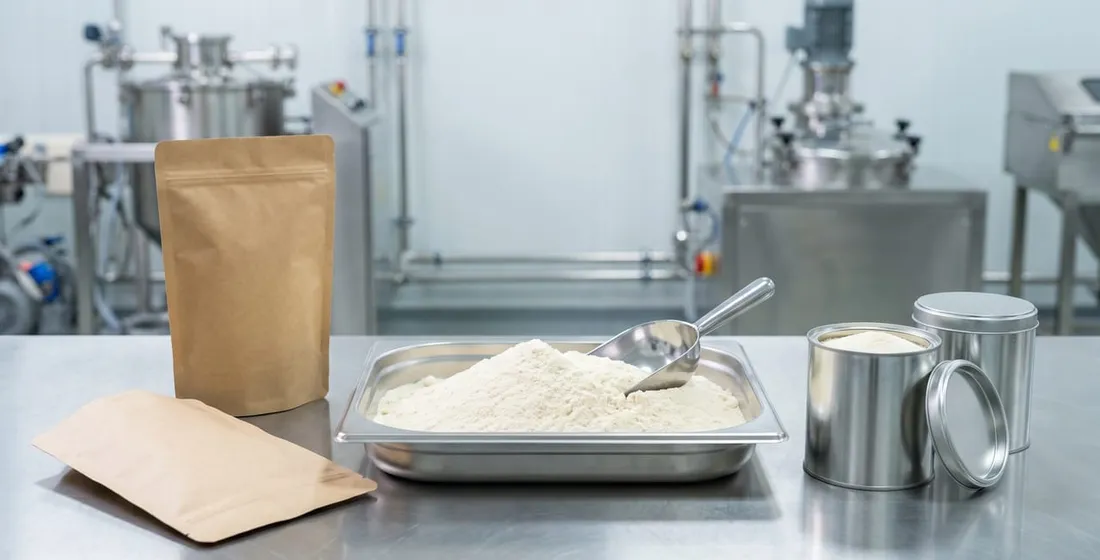
Pouch or tin changes the barrier, the artwork lead and the shelf story
Pack format on a coconut milk powder is a moisture question before it is an aesthetic one. A powder specified below 5 per cent moisture will pick moisture up from a Sri Lankan ambient environment through any weak point in the pack, and caking is the failure mode a retail buyer sends back. Both formats hold the product. They fail differently, cost differently, and carry different artwork lead times.
| Dimension | Kraft pouch | Round tin can |
| Sizes held | 50 g, 100 g, 250 g, 500 g and 1 kg, plain or window | 400 ml |
| Barrier | Set by the laminate structure specified, so it has to be stated on the brief | Rigid metal with a seated lid, strong by construction |
| Reseal after opening | Zipper or clip, specified per SKU | Lid reseals as standard |
| Print route | Printed laminate or an applied label | Applied label or a printed sleeve |
| Artwork lead | Rotogravure laminate runs start near 10,000 units; digital labels start near 250 | Label-led, so a short first run is easier to originate |
| Shipping | Light, stacks flat, low freight cost per unit | Heavier, rigid, higher freight cost per unit |
| Where it fits a first order | Small fills lift the unit count on a 50 kg run | Suits a gifting or upper-shelf position at a lower unit count |
The artwork row is the one that moves a launch date. A printed laminate pouch is cheaper per unit at volume and dearer to originate, because the rotogravure cylinders have to be cut before anything prints. A first order near the 50 kg minimum rarely justifies that, so the working answer is a plain pouch or tin with an applied label, moving to printed laminate once the reorder quantity supports it.
The tin earns its place on positioning rather than cost. It reseals without a component, it survives handling, and it reads as a gift. At 400 ml it also carries a smaller fill weight than a 250 g pouch, lifting the unit count from a fixed 50 kg batch while raising the shelf price per pack. For a gifting or upper-shelf position, that combination usually justifies the freight penalty.
The origination side of that trade-off, including where a print run gates a production slot, is set out in artwork and print lead time as the private-label gate.
What has to appear on the pack before it can be cleared?
The Food (Labelling and Advertising) Regulations 2022, made under the Food Act No. 26 of 1980 and published in Gazette Extraordinary No. 2319/40 of 14 February 2023, set the declarations a packaged food label has to carry in Sri Lanka. They are specific enough that artwork drafted from a competitor pack will usually fail on at least one of them, and specific enough that a 50 g sachet and a 250 g pouch are not governed identically.
- The common name of the food, in bold type, in all three languages, on the main panel.
- The brand or trade name, and the net contents stated in metric units.
- A common name whose letter height is at least one third of the letter height used for the brand name, and never less than 3 mm.
- The full ingredient list in descending order by mass, with any additive named and carried with its INS number.
- The name and address of the manufacturer and of the distributor, and of the importer where the product is imported.
- A batch or code number, a date of manufacture and a date of expiry.
- Nutrition labelling as set out in the schedule to the regulations, printed in letters not smaller than 1.5 mm.
One provision is worth reading twice at the pack-format stage. The regulations exempt prepackaged units of 25 g or less, and 30 ml or less, from part of the declaration set. A 50 g sachet sits above that line and a smaller sampling sachet sits below it, which quietly changes what a trial pack has to carry and how small the printable area can be. That is a format decision with a compliance consequence, and it belongs in the first conversation rather than the fourth.
Sri Lanka Standards Institution (SLSI) clearance runs alongside the labelling work. For a SKU with a stable formulation, SLSI does not publish a processing time, so confirm the current window with SLSI at submission and hold a buffer before the date promised to a retail buyer. Formulation lock, then specification and nutritional data, then artwork, then submission, then the production slot. Reversing any two of those steps is how a brand ends up holding stock and an artwork revision together.
The manufacturer’s certification stack carries into that conversation in a way a brand owner cannot replicate alone. The Matale facility is BRCGS and FSSC 22000 V6 audited, with spray-dried powders inside the audited scope, USDA Organic and EU Organic on relevant SKUs, and SLSI clearance plus Food Act compliance on every retail SKU sold locally. Read it in that order. The international standards are what a category buyer or a later export customer recognises without explanation, while SLSI and Food Act compliance are the local floor every compliant manufacturer already holds.
The submission itself, stage by stage, is broken down in the step-by-step guide to a first packaged-food submission.
Work the rupee maths from the pack outward, not from the kilogram in
There is one public anchor for what a kilogram of Sri Lankan coconut milk powder is worth, and it is an export number. Taking the Coconut Development Authority’s 2025 table at face value, Rs 27,789 million across 13,235 tonnes works out at roughly Rs 2,100 a kilogram on an export basis. That figure is a benchmark for the finished commodity leaving the country, not a conversion quotation, and it should be read as the floor a local retail pack has to sit comfortably above.
The rest of the maths is made of buckets rather than a single rate. Raw material and carrier move with the fat specification. The drying batch carries a fixed start-up and shutdown cost, which is why a 50 kg minimum exists and why the per-kilogram cost falls hard at the 500 kg tier. Packaging is a per-unit cost that rises as fill weight falls, so 1,000 pouches at 50 g absorb far more packaging cost than 100 pouches at 500 g from the same batch. Artwork origination is one-time, and SLSI clearance is annual rather than per-batch.
A first commercial run in this category, taken end to end, generally lands somewhere in the LKR 500,000 to LKR 2 million range depending on fill weight, pack format and whether formulation work runs first. That is a planning band and not a quotation, because the two variables that move it most, the fat specification and the pack count, are exactly the two a brand owner is still deciding at the point they ask.
Frequently asked questions
What is the minimum order quantity for private-label coconut milk powder in Sri Lanka?
At Silk Foods Ceylon the first-run minimum for a spray-dried powder is 50 kg per SKU, a single-day batch on the drier, with volume tiers at 500 kg, 1,000 kg and 2,500 kg. The floor is set by drier start-up and shutdown rather than by run time, which is why it is stated in kilograms.
How much coconut fat should a coconut milk powder specification carry?
The Coconut Development Authority describes Sri Lankan coconut milk powder as carrying 70 to 80 per cent natural coconut fat. Carrier-loaded grades using maltodextrin and sodium caseinate sit lower, giving a cheaper kilogram and a thinner reconstituted milk. The right number depends on the dilution the pack instructs and the claim it makes.
Is a pouch or a tin the better pack for coconut milk powder?
Both work if the barrier is specified. A kraft pouch is lighter to ship and comes in fills from 50 g to 1 kg, but a printed laminate needs a run near 10,000 units to originate. A 400 ml tin reseals without a component and suits a gifting position at a lower unit count.
What has to appear on a coconut milk powder label in Sri Lanka?
Under the Food (Labelling and Advertising) Regulations 2022, Gazette Extraordinary No. 2319/40, the pack carries the common name in bold in all three languages, net contents in metric units, the ingredient list in descending order by mass with INS numbers, manufacturer and distributor details, a batch code, manufacture and expiry dates, and nutrition labelling in letters of at least 1.5 mm.
How long does it take to get a private-label coconut milk powder SKU onto a shelf?
Sampling runs 1 to 2 weeks on a catalogue formulation and R&D from a brief takes 3 to 4 weeks maximum from signed brief to approved formulation. Purchase order to dispatch is 2 to 3 weeks. SLSI clearance runs in parallel on a window SLSI sets, so confirm it at submission and hold a buffer before a promised shelf date.
How Silk Foods Ceylon can help
For a Sri Lankan brand owner adding a coconut milk powder to a retail range, Silk Foods Ceylon (SFC) private-labels the SKU from the spray-dry line at the Matale facility, either on the existing formulation or on a specification developed from a brief. The first-run minimum is 50 kg per SKU as a single-day batch, with volume tiers at 500 kg, 1,000 kg and 2,500 kg, and pack formats held in kraft pouches at 50 g, 100 g, 250 g, 500 g and 1 kg alongside 400 ml round tin cans. Sampling takes 1 to 2 weeks on a catalogue formulation, purchase order to dispatch runs 2 to 3 weeks, and roughly 5 to 7 weeks in total applies when R&D comes first (R&D takes 3 to 4 weeks maximum from signed brief to approved formulation). The facility is BRCGS and FSSC 22000 V6 audited with spray-dried powders inside the audited scope, and SLSI submission support sits inside a standard private-labelling engagement.
To brief a project, email brands@esilkroute.com.lk or call +94 77 157 7294.
Sources
Coconut Development Authority of Sri Lanka, Export Performance of Coconut Products 2023/2024/2025, citing Sri Lanka Customs, coconut milk powder at 13,235 MT and Rs 27,789.39 Mn in 2025 (retrieved 2026-09-02): Coconut Development Authority export performance table
Coconut Development Authority of Sri Lanka, Sri Lanka Coconut Industry 2024 In A Nut Shell, total nut production 2,792.03 million nuts with 1,378.02 million used by industry (retrieved 2026-09-02): Coconut Development Authority industry statistics 2024
Coconut Development Authority of Sri Lanka, Coconut Milk Powder product profile, 70 to 80 per cent natural coconut fat, homogenised and spray dried (retrieved 2026-09-02): Coconut Development Authority coconut milk powder profile
Ministry of Health, Sri Lanka, Food (Labelling and Advertising) Regulations 2022 under the Food Act No. 26 of 1980, Gazette Extraordinary No. 2319/40 of 14 February 2023 (retrieved 2026-09-02): Gazette Extraordinary No. 2319/40
FAO and WHO Codex Alimentarius Commission, CXS 240-2003, Standard for Aqueous Coconut Products, Coconut Milk and Coconut Cream, minimum 10 per cent fat for coconut milk and 20 per cent for coconut cream (retrieved 2026-09-02): Codex Alimentarius CXS 240-2003
Abdullah, Taip, Mustapa Kamal and Abdul Rahman, Nonlinear Process Modelling and Inferential Moisture Control of Spray-Dried Coconut Milk, Foods, 2020, 2 per cent sodium caseinate and 8 per cent maltodextrin, inlet range 120 to 200 degrees Celsius, moisture below 5 per cent (retrieved 2026-09-02): Foods, 2020, spray-dried coconut milk study
The Morning, coverage of Sri Lanka’s record coconut export year quoting Coconut Chamber of Commerce and Industry chairperson Jayantha Samarakoon on value-added growth, 4 February 2026 (retrieved 2026-09-02): The Morning, 4 February 2026
Written by the Silk Foods Ceylon Editorial Team. Silk Foods Ceylon (Pvt) Ltd. is a BRCGS and FSSC 22000 V6 audited contract manufacturer in Matale, Sri Lanka, offering contract manufacturing, private labelling, co-packing and in-house research and development for local Sri Lankan brand owners, FMCG companies, hotel and restaurant groups, and distributors. To brief a project: brands@esilkroute.com.lk or +94 77 157 7294.