Vegan Nugget R&D: Coating Adhesion, Fry Time and a 30,000-a-Day Line
By the Silk Foods Ceylon Editorial Team
Buyer’s snapshot
- At 30,000 nuggets a day on one eight-hour shift, a line pushes about 62 nuggets a minute through the fryer, so roughly 146 to 188 pieces sit in hot oil at any moment (Silk Foods Ceylon line rate; fry dwell range from Crisp Sensation, US Patent 9,326,537, 2016).
- Fry temperature moves moisture loss, colour and oil content together. A 2025 study of chicken nuggets found moisture loss rose from 28.33% to 35% between 160 and 180 degrees C over 180 seconds (Demiray et al., Food Science & Nutrition, 2025).
- Silk Foods Ceylon (SFC) runs R&D / NPD (Co-Development on the SFC brochure) in 3 to 4 weeks maximum, then a first run of 5,000 to 10,000 units per SKU on a BRCGS- and FSSC 22000 V6-audited line.
- For local FMCG brands with a hand-made vegan nugget that has not yet met a continuous line. The bench-versus-line table is in the second section.
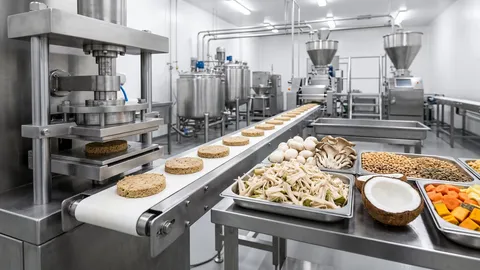
A vegan nugget that holds its crumb on a tray of twelve says almost nothing about how it will behave at 30,000 a day. The tray was crumbed by hand, fried in a pan and eaten within minutes. The line batters by machine, fries on a belt, freezes within minutes of leaving the oil and meets the consumer’s oven or fryer weeks later.
This post covers the three numbers the R&D team settles before a nugget reaches the line: how the coating sticks, how long the nugget fries, and what the daily line rate means for both. It is the formulation-side companion to the frozen vegan nugget contract manufacturing guide, which describes the line itself.
Why does a coating that works by hand shed on a line?
Coating adhesion is a layered system, and each layer has a job. A light flour pre-dust seals surface pores and absorbs surface moisture so the first wet layer can grip. The adhesion batter is the glue between the nugget and the crumb. The crumb gives the crunch and the colour (Innograin, “Batters and Breading: Basic Aspects I”, 2023).
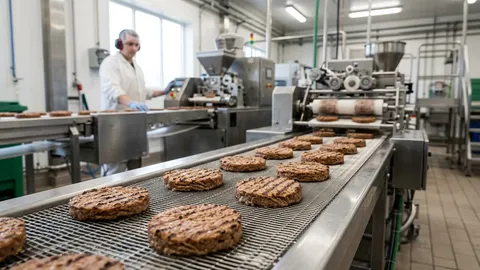
By hand, a founder presses crumb on until it looks right. A machine cannot judge by eye. It applies whatever the batter viscosity and the crumb particle size dictate, every second, for a full shift. Batter viscosity largely decides how much batter a piece picks up. A thin batter forms a poor film. An over-thick one is hard to pump and leaves heavy, uneven coats. Temperature changes viscosity, so the batter tank is controlled, not left to the room.
Formulation matters as much as viscosity. Pre-gelatinised flours and starches are more adhesive than raw ones at the same viscosity (Innograin, 2023). That is a lever the R&D team can pull at bench scale, long before a machine is booked.
What changes between the bench trial and the line?
Most adhesion problems are not flavour problems. They are scale problems that a bench trial can expose cheaply if the bench is run like a small line. The table lists what shifts and what the R&D team therefore tests.
| Variable | Bench (tray of 12) | Line (30,000 a day) | What the R&D team tests |
|---|---|---|---|
| Crumb application | Pressed by hand | Metered by machine | Crumb particle size and bed depth |
| Batter condition | Fresh, small bowl | Recirculated for hours | Viscosity drift over a simulated shift |
| Moisture of the core | Eaten fresh | Formed, then held on a belt | Surface moisture after forming and a hold period |
| Fry | One pan, one batch | Continuous belt, steady oil temperature | Dwell time and temperature, not a single batch |
| After the fryer | Plate | Freezer within minutes | Crumb loss after freezing, thawing and reheating |
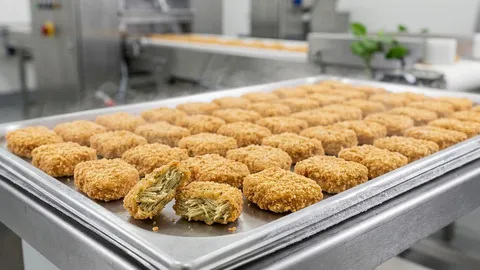
The pattern the R&D team sees most often is a nugget that passes every tasting and then loses crumb after the first freeze. The tasting panel never tested the coating after a freeze. A nugget that sheds on the line is not a production fault. It is a formulation gap that is far cheaper to find in the second sample than in a 10,000-unit run, and it sits behind many of the first-run problems covered in five questions before a first plant-based run.
How is par-fry time set?
A par-fry sets the crust and the colour. It does not finish the cook. The consumer’s oven or fryer does that. The brief for the R&D team is therefore a window, not a single time: long enough to set the coating so it survives freezing, short enough to leave the crumb able to crisp again at home.
The published numbers are a useful frame. In a 2025 study, chicken nuggets were fried at 160, 170 and 180 degrees C for 180 seconds, and the results moved in step with temperature (Demiray et al., Food Science & Nutrition, 2025).
| Frying temperature | Moisture lost in 180 s | Colour change (total, delta E) |
|---|---|---|
| 160 degrees C | 28.33% | 4.78 |
| 170 degrees C | 31.11% | between the two |
| 180 degrees C | 35% | 9.31 |
A patent for coated, microwaveable products describes a preferred oil temperature of 175 to 190 degrees C and a fry of 140 to 180 seconds, with the product moving to a freezer soon after, before its core drops below 50 degrees C (Crisp Sensation, US Patent 9,326,537, 2016). That patent covers poultry-style products. A plant-protein core is judged on bind and bite, not on poultry core temperature. The sequence still carries over: fry, then freeze quickly, so the crust does not dry out or go soft in the gap.
The takeaway is not a recipe. Hotter oil dries the surface faster and darkens it faster, and the right window depends on nugget size, coating and oil. The R&D team finds it by frying a matrix of temperatures and times at bench scale, freezing each sample and then reheating it.
What does 30,000 a day mean inside the fryer?
The line rate sets how many nuggets are in the oil at once, and that number is useful. This is plain arithmetic on the SFC nugget line rate of 30,000 a day. It assumes one eight-hour shift and is an illustration, not a machine specification.
- 30,000 nuggets over 8 hours is 3,750 an hour, or about 62.5 a minute.
- At the 140 to 180 second fry range above, that is roughly 146 to 188 nuggets in the oil at any moment.
- Add 20 seconds of dwell and about 21 more pieces are in the fryer. Small timing changes scale with line rate.
Spec snapshot: why dwell time is a design number
Nuggets in the fryer = nuggets per minute x seconds of dwell / 60.
A nugget fried 20 seconds too long is not a small error on the bench. On the line it changes how many pieces are in the oil, how much crumb the oil collects and how often the oil is rotated.
This is why the fry window is fixed during R&D and not adjusted on the first production day. Oil spec is a compliance decision as well. Sri Lanka bans partially hydrogenated oils, the main industrial source of trans fat (World Health Organization, 2023), so the fry oil, its rotation and its records sit inside the audit. The certification logic is set out in the certification stack for a Sri Lankan FMCG launch.
The same arithmetic shows how first-run volume sits against the line. A first run of 5,000 to 10,000 units is between one sixth and one third of a single day at 30,000. That is deliberate. The first run is sized for a brand that has validated its nugget, not for export-scale volume.
What binds the core through frying and freezing?
A coating cannot hold a core that falls apart. A plant-protein nugget core is a textured protein matrix held together by binders, and the binder has to survive the fryer, the freezer and the reheat. Methylcellulose gels on heating and reverses on cooling, which is why it is common in nuggets.
A 2026 study tested methylcellulose, carrageenan and xanthan gum at 1% and 2% in plant-based nuggets. Methylcellulose reduced cooking loss and moisture loss. Carrageenan improved water holding and texture. Xanthan gum changed several properties, and the authors suggest it works better in combination with other hydrocolloids (Canrea Journal, 2026).
The practical lesson for a brand owner is that binder choice is a trial, not a decision made from a datasheet. The R&D team runs the same core with different binders through the same fry and freeze, then compares crumb retention and bite. The protein base is its own choice, covered in pea protein versus soy protein for plant-based patties, and the frozen-format logic carries over to a frozen seitan SKU.
How long does the R&D take, and what does each round answer?
R&D / NPD at SFC runs 3 to 4 weeks maximum, from signed brief to approved formulation. Within that window the team works through 2 to 4 sample iterations. Each round answers one question, so the brief should say which one matters most to the buyer.
| Round | Question it answers | What the buyer receives |
|---|---|---|
| First | Does the core hold its shape through a par-fry? | Fried and frozen samples with notes on bind |
| Second | Does the coating stay on after freezing and reheating? | Reheated samples against the first round |
| Third (if needed) | Which fry window gives the best crumb and colour? | Samples from two or three fry settings |
| Fourth (if needed) | Does the locked version repeat on a line-style trial? | Final sample and a one-page spec |
The guide to briefing an R&D team lists what to have ready before round one. The brief that moves fastest names the target channel, the pack format and the price band.
Where SFC walks away
A brief with no committed channel, no price band and no plan for the frozen cold chain is better served by more kitchen testing first. R&D time is best spent on a nugget that has a shelf waiting for it.
Frequently asked questions
Does Silk Foods Ceylon offer R&D for a new vegan nugget?
Yes. SFC’s in-house R&D team develops plant-based nuggets from a brief in 3 to 4 weeks maximum, working through 2 to 4 sample iterations before the formulation locks. Production then runs on a 30,000-a-day line with a first-run minimum of 5,000 to 10,000 units per SKU (Silk Foods Ceylon, 2026).
Why does a vegan nugget coating fall off during frying?
Usually the batter viscosity, pre-dust or crumb size was set for hand application, not a machine. Viscosity largely decides batter pickup, and pre-gelatinised starches grip better than raw ones at the same viscosity (Innograin, 2023). The fix is a formulation change tested at bench scale.
What frying temperature suits a coated nugget?
There is no single figure. A 2025 study fried nuggets at 160, 170 and 180 degrees C for 180 seconds and found moisture loss rose from 28.33% to 35% across that range (Demiray et al., Food Science & Nutrition, 2025). The right window depends on size, coating and oil, so it is trialled.
How many nuggets can the SFC line make in a day?
The SFC nugget line is rated at 30,000 nuggets a day at the Matale facility, alongside a patty line rated at 15,000 a day. Both sit under one BRCGS- and FSSC 22000 V6 audit, so a brand launching a second plant-based SKU does not pay for a second audit (Silk Foods Ceylon, 2026).
Can SFC hold the frozen product until dispatch?
Yes. Finished nuggets are frozen soon after frying and held in on-site reefer storage at the Matale facility until dispatch, so the cold chain starts at the line. Dispatch typically follows 2 to 3 weeks after purchase order on a locked recipe (Silk Foods Ceylon, 2026).
How Silk Foods Ceylon can help
For local FMCG brands moving a plant-based nugget from a kitchen recipe to a frozen retail SKU, Silk Foods Ceylon (SFC) runs R&D / NPD (Co-Development on the SFC brochure) in 3 to 4 weeks maximum, then Contract Manufacturing on a nugget line rated at 30,000 a day. First-run MOQs sit at 5,000 to 10,000 units per SKU. The Matale facility is BRCGS- and FSSC 22000 V6-audited, with SLSI submission support inside the standard engagement. The in-house R&D team works alongside production planning, so the fry window and coating are settled before the first batch is scheduled.
To brief a project, email b2b@esilkroute.com.lk or call +94 76 441 0389 or +94 76 918 5744.
Sources
- Innograin (2023), “Batters and Breading: Basic Aspects I”, https://innograin.uva.es/?p=1381 (retrieved 2026-10-11).
- Demiray, I. D., Ergezer, H., Demiray, E. and Sufer, O. (2025), “Deep-Fat Frying of Chicken Nuggets: Impacts on Mass Transfer and Some Quality Indices”, Food Science & Nutrition 13(6), https://openaccess.osmaniye.edu.tr/items/df790deb-79fe-472a-9dcf-49a7a11a0e7e (retrieved 2026-10-11).
- Crisp Sensation Holding SA (2016), “Microwaveable coated food product, and method and apparatus for the manufacture thereof”, US Patent 9,326,537, https://patents.google.com/patent/US9326537B2/en (retrieved 2026-10-11).
- Canrea Journal (2026), “Effect of hydrocolloids type and concentration to the physical properties of plant-based nugget”, 9(1), 91-101, https://agritech.unhas.ac.id/ojs/index.php/canrea/article/view/1132 (retrieved 2026-10-11).
- World Health Organization (2023), “WHO lauds Sri Lanka’s move on trans fat”, https://www.who.int/srilanka/news/detail/25-05-2023-who-lauds-sri-lanka-s-move-on-trans-fat (retrieved 2026-10-11).
Written by the Silk Foods Ceylon Team. Silk Foods Ceylon (Pvt) Ltd. is a BRCGS- and FSSC 22000 V6-audited contract manufacturer in Matale, Sri Lanka, offering contract manufacturing, private labelling, co-packing, and in-house R&D for local Sri Lankan brand owners, FMCG companies, hotel and restaurant groups, and distributors. To brief a project: b2b@esilkroute.com.lk, +94 76 441 0389, or +94 76 918 5744.