If a Minimum Run Feels Too Big, Ask for a Staggered First PO
By the Silk Foods Ceylon Editorial Team
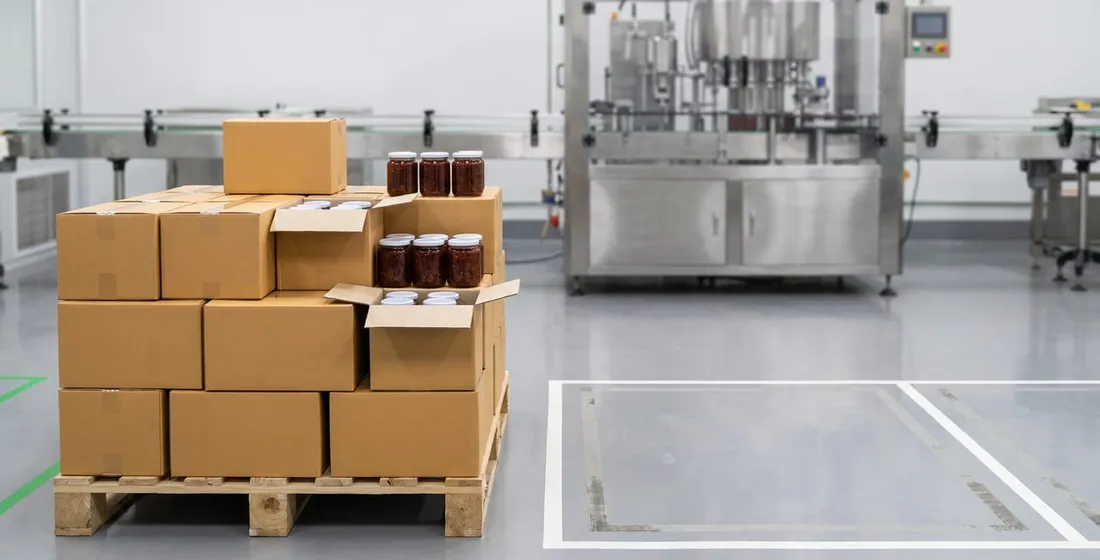
One wooden pallet of sealed cartons, with a few open cartons of plain unlabelled glass jars of dark red chilli sauce, beside an empty marked pallet bay in front of a stainless steel filling line.
Buyer’s snapshot
- Contract packagers report that a pilot run below their normal minimum usually carries a unit premium of 15 to 40 per cent (Assemblies Unlimited, July 2026). A staggered first PO accepts that premium on a small first lot, in return for a second run that is dated before the first one starts.
- A fixed charge is paid on every run, so staggering moves cash rather than removing cost. The LKR figures in this note are hypothetical arithmetic, not Silk Foods Ceylon (SFC) quotes or capacity.
- SFC welcomes small first runs, quoted on request. R&D takes 3 to 4 weeks at most from signed brief to approved formulation, and a locked recipe goes from purchase order to dispatch in 2 to 3 weeks.
- This suits a brand owner with a locked recipe and a plan to reorder. It does not suit one who is still changing the recipe.
A quote arrives for a first production run, and the quantity is larger than your sales plan for the first quarter. The recipe is fixed, the label is nearly done, and the only open question is whether to take the quantity, squeeze the quote, or walk away.
There is another option: write the first purchase order as two dated releases. A small pilot first, then a committed second run in a set week. The maker gets a schedule it can plan around, and you spend the second half of the production cash only after the first half has begun to sell.
Why does a first-run size feel out of reach?
Every production run carries fixed work that takes about the same time whether the run is small or large: line setup, equipment checks, cleaning and changeover, quality checks and teardown. Spread across a small run, those fixed costs inflate the price of every unit (Assemblies Unlimited, July 2026).
Packaging adds a second floor. Assemblies Unlimited gives the example of a 5,000-bottle run against a 50,000-bottle supplier lot, so a brand can clear the maker’s minimum and still be stopped by the packaging supplier’s.
The arithmetic below uses a hypothetical fixed charge of LKR 90,000 per run. It is not an SFC figure. It only shows the shape of the problem.
| Units in the run | Fixed charge per unit (hypothetical LKR 90,000 per run) |
|---|---|
| 1,500 | LKR 60 |
| 3,000 | LKR 30 |
| 5,000 | LKR 18 |
Doubling the run halves the fixed charge per unit, which is why makers quote the larger number first.
What is a staggered first PO?
A staggered first PO is one agreement with two dated releases. The first release is a pilot quantity. The second release has a quantity, a target production week and an adjustment cut-off written into the same document, signed at the same time.
The maker gets something it normally lacks on a first order: a known second run. Eightx notes that co-packers will often trade a smaller first run for a committed reorder cadence, and suggests asking for a step-down on later reorders and for a shared changeover where the maker already runs a similar product (Eightx, June 2026). The brand gets a smaller first cash commitment and a production slot already reserved for the repeat.
Three structures are common, and they differ mainly in who carries the risk.
| One large PO | Staggered PO | Two separate small POs | |
|---|---|---|---|
| Cash committed at signing | All of it | Pilot only, plus a dated commitment | Pilot only |
| Fixed charge per unit | Lowest | Highest (paid twice) | Highest (paid twice) |
| Slot for the second run | Not needed | Reserved | Not reserved, booked when you reorder |
| Planning certainty for the maker | High | Medium to high | Low |
| Risk if sales are slower than planned | The brand holds unsold stock | The brand can still move the second quantity before the cut-off | None beyond the pilot |
| Best for | Proven demand | Locked recipe, expected reorder | Unproven product |
The staggered option sits between the other two: it costs more per unit than one large run, and asks more of the brand than a one-off pilot, because the second release is a commitment.
What does staggering actually cost?
Staggering costs the fixed charge a second time. Assemblies Unlimited makes the point directly: a brand that orders a small run to limit risk and reorders weeks later at the same size pays the setup premium twice, and a single larger run generally costs less per unit than two constrained ones (Assemblies Unlimited, July 2026).
Take the hypothetical figures. One run of 3,000 units carries LKR 90,000 of fixed charge, or LKR 30 a unit. Two releases of 1,500 carry LKR 180,000 between them, or LKR 60 a unit. The price of staggering in this example is LKR 90,000, and what it buys is not spending the second half of the production cash until the first half is selling.
If the product is certain to sell through, take the larger run. If the second 1,500 units would sit in a stockroom for four months, the extra charge is cheaper than the stock.
What can a maker price differently the second time?
Some lines in a first-run quote are one-off, and they fall away once the run is done. Others recur on every run, and they do not. The honest way to ask for a second-run price is to ask for the quote in two parts and to see which lines are expected to drop.
| Quote line | In run one | In run two |
|---|---|---|
| Recipe adjustment and sample iterations | Charged or absorbed | Complete, normally not repeated |
| Label and artwork approval, compliance check | Done once | Reused if the label is unchanged |
| First-run settings (fill weight, sealing, record template) | Set and recorded | Carried forward from run one |
| Packaging bought in a minimum lot | Full lot ordered | Leftover stock may cover run two |
| Setup, cleaning and changeover | Per run | Per run, does not fall away |
| Raw materials | At the price on the day | At the price on the day |
| Line slot | Booked | Booked, or already reserved by the staggered PO |
Two cautions follow. A second run is not half the price of the first, and a maker who implies it is should be asked which lines will drop. And leftover packaging only helps if you own it and it is stored safely. NC State Extension advises that a co-packer contract should state which ingredients and supplies the brand provides and where they are stored between runs (NC State Extension, 2022).
Consider a founder with a locked recipe
The scenario below is hypothetical. It shows the shape of the decision, not a real client or an SFC result.
A founder has a chilli sauce in a 300 g glass jar, with the recipe locked and the label approved. The maker’s first-run quote is for more jars than the founder can sell in a quarter. The founder proposes a first PO for 1,500 jars with a second release of 1,500 in week eight, and asks to move the second quantity between 1,000 and 2,000 until the day the second packaging order is placed.
Five weeks in, 1,100 of the first 1,500 jars have sold, and reorders are slowing. The founder moves the second release to 1,200 jars before the cut-off, and the maker re-plans the slot around it. Without the band, the choice would have been taking 1,500 jars nobody wanted or cancelling. With it, the founder pays one extra fixed charge and avoids 300 jars of unwanted stock.
How do you word the ask?
A first PO that says “we will probably reorder” is a wish. These six points make it a plan.
- Show the sales plan. Give the maker the quantity you expect to sell in the first three months and the date you expect to reorder.
- Lock the recipe and the label first. A staggered PO assumes run two repeats run one. If the formulation or the label changes between releases, the second run is a new first run.
- Ask for the quote in two parts. One-off lines and per-run lines, so you can see what is expected to fall away.
- Set the second release in the same document. Quantity, target production week, an adjustment band and the date after which the quantity is fixed.
- Agree who owns and stores the leftover packaging. The cartons, jars and lids bought for run one that run two will use.
- Agree what happens if the second release slips. Storage of packaging, shelf life of raw materials and any change to the slot.
Each release is also its own production batch. Sri Lanka’s Food (Labelling and Advertising) Regulations 2026 require a batch number, code number or decipherable code marking on pre-packaged food (Gazette Extraordinary No. 2494/47, regulation 5(2)(a)(iii)). Two releases mean two batch codes and two batch records, and the label on run two has to carry the code for run two. See the quality records a food maker keeps before launch.
Buyer’s checklist: before proposing a staggered first PO
- A locked recipe, signed off against a sample
- An approved label, including the batch code position
- A sales plan for the first three months and a reorder date
- The first release quantity and the second release quantity band
- A cut-off date after which the second quantity is fixed
- A written view on who owns and stores the leftover packaging
Where SFC walks away
A staggered PO is not yet the right tool when the recipe is still changing, when there is no plan to reorder, or when the brand wants the second release to commit nothing at all. In that last case it is simply two separate small orders, booked as the line schedule allows. A first PO also cannot promise a second-run price at half the first, and a maker should not be asked to.
What does this look like at Silk Foods Ceylon?
Silk Foods Ceylon (SFC) welcomes small first runs, quoted on request, and the quote depends on the recipe, the pack format and how the run fits the shared line schedule. A brand owner who wants a first PO with a dated second release can put that structure in the brief, and the quote will say what the line schedule allows.
If the recipe is not locked, R&D / NPD (Co-Development on the SFC brochure) comes first and takes 3 to 4 weeks at most from signed brief to approved formulation. Once the specification is signed off, Contract Manufacturing takes a purchase order to dispatch in 2 to 3 weeks. For the steps before the PO, see how a test batch becomes a first commercial run and signing off a sample and costing the first PO. For first-run size by format, see first runs by format, and for slotting a run into the plant, scheduling a production run on a shared line.
Frequently asked questions
What is a staggered first purchase order?
It is one purchase order with two dated releases: a small pilot quantity first, and a second quantity with a target production week and an adjustment cut-off agreed in the same document. The maker gets a known repeat, and the brand defers half the production cash until the pilot is selling (Eightx, June 2026).
Is a staggered PO more expensive than one large run?
Yes, per unit, because the fixed setup and changeover charge is paid on each release. In a hypothetical case with a fixed charge of LKR 90,000, two runs of 1,500 units cost LKR 60 a unit in fixed charge, against LKR 30 for one run of 3,000 (Assemblies Unlimited, July 2026).
Will the second run cost less than the first?
Some lines fall away, such as recipe adjustment, label approval and first-run settings, and leftover packaging may cover part of run two. Setup, changeover and raw materials recur on every run, so the second run is cheaper by those one-off lines, not by half (Assemblies Unlimited, July 2026).
Can Silk Foods Ceylon quote a small first run for contract manufacturing?
Yes. Small runs are welcome and quoted on request, and the quote depends on the recipe, the pack format and the line schedule. R&D takes 3 to 4 weeks at most from signed brief to approved formulation, and a locked recipe goes from purchase order to dispatch in 2 to 3 weeks (SFC, 2026).
How Silk Foods Ceylon can help
For founders and local brands planning a first commercial run, Silk Foods Ceylon (SFC) runs Contract Manufacturing and R&D / NPD at its Matale facility. Small first runs are welcome and quoted on request, and a first PO with a dated second release can be put in the brief. R&D takes 3 to 4 weeks at most from signed brief to approved formulation, and a locked recipe goes from purchase order to dispatch in 2 to 3 weeks. The facility is BRCGS- and FSSC 22000 V6-audited, with SLSI submission support built into a standard engagement.
To brief a project, email b2b@esilkroute.com.lk or call +94 77 157 7294.
Sources
- Assemblies Unlimited, Inc. (2026), “Contract Packaging MOQs: What Is Normal and How to Work Within Them”, 1 July 2026. assemblies.com (retrieved 26 November 2026).
- Eightx (2026), “Co-Manufacturing Cost and MOQs for CPG: How Minimum Runs Trap Your Cash”, 9 June 2026. eightx.co (retrieved 26 November 2026).
- NC State Extension (2022), “Choosing and Using a Copacker”, 31 July 2022. content.ces.ncsu.edu (retrieved 26 November 2026).
- Government of Sri Lanka, Food (Labelling and Advertising) Regulations 2026, Gazette Extraordinary No. 2494/47, regulation 5(2)(a)(iii). documents.gov.lk (retrieved 26 November 2026).
- Silk Foods Ceylon (2026), internal capability data for the Matale facility: R&D of 3 to 4 weeks at most from signed brief to approved formulation, and 2 to 3 weeks from purchase order to dispatch on a locked recipe.
Written by the Silk Foods Ceylon Team. Silk Foods Ceylon (Pvt) Ltd. is a BRCGS- and FSSC 22000 V6-audited contract manufacturer in Matale, Sri Lanka, offering contract manufacturing, private labelling, co-packing, and in-house R&D for local Sri Lankan brand owners, FMCG companies, hotel and restaurant groups, and distributors. To brief a project: b2b@esilkroute.com.lk or +94 77 157 7294.