Vanilla Pod, Paste or Extract: Costing a Sri Lankan Spice SKU
By the Silk Foods Ceylon Editorial Team
Buyer’s snapshot
- Sri Lanka cures only about 1.5 tonnes of vanilla beans a year, and curing turns about six kilograms of green beans into one kilogram (Sri Lanka Export Development Board, trade pages, retrieved 2026).
- The format you pick sets the bean bill: a first run of 1,500 tubes of pods uses about 10.5 kg of beans, while 1,500 bottles of 50 ml extract uses about 7.5 kg.
- Silk Foods Ceylon (SFC) runs private-label spice SKUs from a BRCGS- and FSSC 22000 V6-audited line in Matale, with a 1,500-jar first-run minimum per SKU.
- For a brand owner adding a vanilla SKU to an existing spice range. The comparison table is in the third section.
A spice range with six jars and no vanilla looks unfinished to a retail buyer. A spice range with a vanilla SKU that nobody costed looks fine until the first purchase order, when the bean bill turns out to be larger than the rest of the range put together.
Vanilla is the one SKU in a Sri Lankan spice line where the format decision is a costing decision. Pod, paste and extract use different amounts of the same scarce bean, and the buyer who chooses by shelf appeal alone finds that out late. This post works through the arithmetic for a first run. The mace and nutmeg side of the range is covered in the nutmeg, mace and vanilla specification guide; here the question is only what each vanilla format costs.
How scarce is Sri Lankan vanilla, in numbers?
Sri Lankan farmers produce roughly 1.5 tonnes of hand-cured vanilla beans a year, spread across a few thousand growers, and curing is the bottleneck: about six kilograms of green beans become one kilogram of cured, and a single cured kilogram needs the hand pollination of many flowers (Sri Lanka Export Development Board, 2026). The crop takes three years or more to bear.
That volume matters for a brand because a first run is not small against it. A 7.5 kg bean requirement is half a percent of the national crop. A 10.5 kg requirement is closer to 0.7 percent. Neither will strain the market, but both need a supplier who can name the curing batch and the harvest month, and neither can be bought on a one-week lead time.
Price is the other unknown. One Kandy growers’ partner reports cured beans meeting industry quality standards at about LKR 60,000 per kilogram (Sri Lanka Export Development Board, 2026). That is one company’s figure, not a price series, so the arithmetic below uses it as a planning number and every cost line should be replaced with a written supplier quote before a brief is signed.
What does each vanilla format actually use?
The three formats differ in how much bean goes into each unit and in what else sits in the jar.
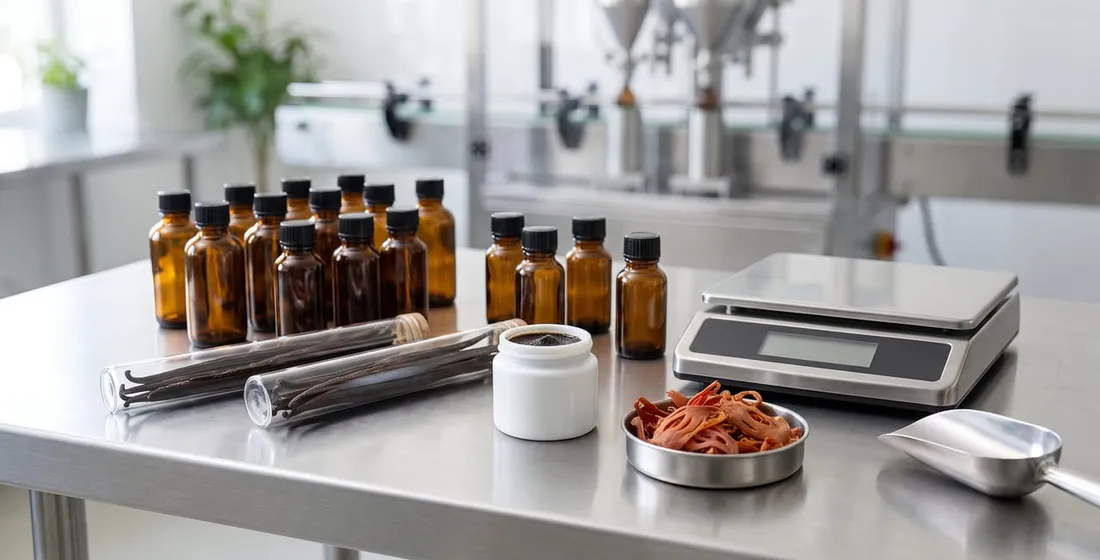
A pod tube holds whole cured beans and nothing else. The bean weight per tube is a spec you set: two or three pods in the 6 to 8 g range is common, and 7 g is used here. At LKR 60,000 per kg, that is LKR 420 of beans per tube.
An extract is regulated in some markets by bean weight per volume. The United States standard for single-strength vanilla extract requires one unit of vanilla constituent per gallon, and a unit is 13.35 oz of beans at 25 percent moisture, in a solution of at least 35 percent ethyl alcohol (US Alcohol and Tobacco Tax and Trade Bureau, summary of 21 CFR 169.175, 2026). That works out to roughly 100 g of beans per litre. At LKR 60,000 per kg, that is LKR 6,000 of beans per litre, or LKR 300 per 50 ml bottle. For a brand that may export later, that US figure is the benchmark it will be measured against, so spec to it from day one and confirm the local labelling position with SLSI.
A paste suspends ground bean and seeds in a sugar or glycerine base. The bean content per jar is whatever the spec says. If a 100 g jar carries 15 g of bean, the bean cost is LKR 900. That figure is an assumption to set in the brief, not an SFC recipe.
Spec snapshot: vanilla SKU, first run of 1,500 units (illustrative planning arithmetic at LKR 60,000 per kg of cured beans)
Pod tube, 7 g of beans: LKR 420 of beans per unit, LKR 630,000 per run, 10.5 kg of beans
Extract, 50 ml at 100 g of beans per litre: LKR 300 per unit, LKR 450,000 per run, 7.5 kg of beans
Paste, 100 g jar at 15 g of beans: LKR 900 per unit, LKR 1,350,000 per run, 22.5 kg of beans
Bean cost only. Glass, closure, label, alcohol or base, labour and margin are extra.
Which format fits which shelf? A comparison
| Format | Beans per unit | Bean cost per unit (illustrative) | Shelf life concern | Best fit |
|---|---|---|---|---|
| Pod tube | 7 g | LKR 420 | Moisture loss if the tube is not sealed | Gift range, hotel amenity, specialty retail |
| Extract, 50 ml | 5 g | LKR 300 | Low, alcohol-stabilised | Everyday baking shelf, export-curious brand |
| Paste, 100 g | 15 g | LKR 900 | Water activity must be controlled | Chef and café channel, small-batch bakers |
The paste row looks expensive because it carries the most bean by design. If the jar holds 6 g instead of 15 g, the cost falls to LKR 360 and the product tastes weaker; the spec, not the format, drives the cost.
For a first SKU in a range, extract is usually the safest. It uses the least bean per unit, it is stable on a shelf, and a 50 ml bottle fits the same shelf slot as the other jars. A pod tube suits a gift programme where the pods themselves are the product. Paste belongs to the chef channel, and that is a different buyer from the one the rest of a spice range reaches.
One operator observation, in team voice: the question the SFC team hears most often on vanilla is not “which format” but “can it be cheaper”. The honest answer is that the bean is the cost, and the levers are bean weight per unit and bean grade. A lower grade of cured bean, split or shorter, suits extraction well, and a presentation-grade pod is wasted in a bottle. Matching grade to format is where a brand can take cost out without making the product worse.
Where does mace fit in the same range?
Mace is the red lacy covering of the nutmeg seed, sold as whole blades or ground. Whole blade is the more visible product on a shelf and is costed by weight per jar, as in the earlier specification guide. Ground mace loses aroma faster, so a first run in a 50 g jar needs a date of milling on the label, not only a best-before date.
Sri Lanka’s reported mace export unit prices in early 2026 ranged widely, from about USD 8 to USD 48 per kg across five sampled transactions (Tridge, Sri Lanka mace trade page, 2026). That spread is mostly grade and form, and it shows why a mace SKU also needs a written quote with a grade named. Treat the range as a warning, not a benchmark.
What does a first run take in time?
Plan the vanilla SKU on the longest lead item, which is bean supply, not the line. A realistic sequence for a brand brief:
- Week 0: signed brief naming format, bean weight per unit, bean grade and target shelf price.
- Weeks 1 to 4: R&D and sampling at SFC, three to four weeks at most from signed brief to approved formulation, typically two to four sample iterations.
- In parallel: written bean quote with curing batch and moisture, because moisture changes the real bean weight per unit.
- After approval: purchase order, then two to three weeks to dispatch on a locked recipe.
- In parallel throughout: SLSI submission support and a label check against the Sri Lanka Food Act, with a buffer for clearance before the shelf date.
The bean quote is the item that slips. A brand that waits for formulation approval before asking for a quote loses weeks it did not need to.
Frequently asked questions
Does Silk Foods Ceylon do private-label manufacturing for a vanilla SKU?
Yes. SFC produces private-label spice and flavouring SKUs on its Matale line, with a first-run minimum of 1,500 units per SKU. The brand sets format, bean weight per unit and bean grade in the brief, and SFC formulates and runs the batch under its BRCGS- and FSSC 22000 V6-audited system (Silk Foods Ceylon, 2026).
How much vanilla does a first run of 1,500 extract bottles need?
At 100 g of beans per litre, a first run of 1,500 bottles of 50 ml (75 litres) needs about 7.5 kg of cured beans. At a planning price of LKR 60,000 per kg that is LKR 450,000 of beans, before glass, alcohol, labels and labour (Sri Lanka Export Development Board, 2026).
Is Sri Lankan vanilla enough to supply a private-label range?
For a single brand, yes, with planning. The national crop is about 1.5 tonnes a year, so a 7.5 to 10.5 kg first run is under one percent of it. The constraint is timing: beans take years to grow and weeks to cure, so a written quote with curing batch should come first (Sri Lanka Export Development Board, 2026).
Which vanilla format is cheapest per unit for a first SKU?
Extract, usually. A 50 ml bottle at single-strength uses about 5 g of beans, against 7 g for a two-pod tube and 15 g for a 100 g paste jar in the illustrative examples above. The spec, not the format name, sets the real cost, so compare at equal bean weight (US Alcohol and Tobacco Tax and Trade Bureau, 2026).
How Silk Foods Ceylon can help
For brand owners adding a vanilla or spice SKU, Silk Foods Ceylon (SFC) offers Private Labelling and R&D / NPD (Co-Development on the SFC brochure) at its Matale facility. First-run minimums start at 1,500 jars per SKU, R&D takes 3 to 4 weeks at most from signed brief to approved formulation, and a locked recipe dispatches in 2 to 3 weeks from purchase order. The line is BRCGS- and FSSC 22000 V6-audited, and SLSI submission support and Sri Lanka Food Act label checks sit inside a standard engagement. SFC does not suit a brand that has not yet chosen a format or a target shelf price.
To brief a project, email b2b@esilkroute.com.lk or call +94 76 441 0389 / +94 76 918 5744.
Sources
Sri Lanka Export Development Board, natural vanilla market and spice pages (1.5 tonnes of hand-cured vanilla a year, curing weight loss, hand pollination, grower numbers, LKR 60,000 per kg cured bean figure from a Kandy growers’ partner). srilankabusiness.com (retrieved 9 October 2026).
US Alcohol and Tobacco Tax and Trade Bureau, summary of 21 CFR 169.175 vanilla extract standard: one unit of vanilla constituent per gallon (13.35 oz of beans at 25 percent moisture), at least 35 percent ethyl alcohol by volume. ttb.gov (retrieved 9 October 2026).
US Code of Federal Regulations, 21 CFR 169.175 and 169.176, vanilla extract and concentrated vanilla extract. law.cornell.edu (retrieved 9 October 2026).
Tridge, Sri Lanka mace (HS 090821) sampled unit prices, January 2026. tridge.com (retrieved 9 October 2026).
Silk Foods Ceylon, internal capability data for the Matale facility: R&D 3 to 4 weeks maximum from signed brief to approved formulation; typically 2 to 4 sample iterations; first-run minimum 1,500 jars per SKU; 2 to 3 weeks from purchase order to dispatch on a locked recipe. The LKR figures and bean weights per unit in this post are illustrative planning examples, not SFC recipe or price data.
Written by the Silk Foods Ceylon Team. Silk Foods Ceylon (Pvt) Ltd. is a BRCGS- and FSSC 22000 V6-audited contract manufacturer in Matale, Sri Lanka, offering contract manufacturing, private labelling, co-packing, and in-house R&D for local Sri Lankan brand owners, FMCG companies, hotel and restaurant groups, and distributors. To brief a project: b2b@esilkroute.com.lk, +94 76 441 0389, or +94 76 918 5744.