Hotel Own-Label Muesli in Sri Lanka: A Cost-per-Cover Case Study
By the Silk Foods Ceylon Editorial Team
HORECA snapshot
- Sri Lanka’s 170 classified tourist hotels held 18,308 rooms at the end of 2025, about 108 rooms per property (Sri Lanka Tourism Development Authority, 2026).
- In this genericised case, a three-property group replaced imported breakfast muesli with an own-label blend at the same 40 g bowl. The assumed saving is LKR 14.40 per breakfast cover.
- Silk Foods Ceylon (SFC) ran it as Private Labelling plus a short R&D adjustment: 8 weeks from brief to first delivery, in 1 kg bags.
- The batch sheet, the allergen split and the reorder point are the three pages to take into a procurement meeting.
The brief came from a group food and beverage controller with a spreadsheet and a complaint. Every breakfast buffet in the group carried the same imported muesli, bought in catering tubs, and the line on the cost report had crept up for three quarters. Nobody wanted to change the bowl. Guests recognised it, and the chefs liked how it held up in a cold milk station. The question was whether the same bowl could cost less.
A note on method. This is a genericised composite built from the pattern of HORECA breakfast briefs at the Matale facility. The group is not one client, and the volumes, the occupancy and the prices are planning assumptions that show how these projects run, not an SFC quote or a copy of one file. The room statistics and the labelling regulations are real.
Why did the group replace an imported cereal with an own-label blend?
Three reasons, in the order the controller listed them: unit cost, supply reliability and control over the recipe. Cost came first because it was on the report. The other two came out of the first call with the R&D team at Silk Foods Ceylon (SFC), and they carried more weight once the numbers were on the table.
Imported muesli arrives on a shipping calendar the hotel does not control. Twice in the previous year a stock-out at the importer had pushed the pastry kitchen into a substitute brand mid-season, with a different oat cut and a different sweetness. Guests noticed. A locally made own-label blend moves the lead time from a shipping window to a production slot, which is a conversation the hotel can have by phone.
Recipe control mattered more than the controller expected. The imported blend carried raisins the chefs picked out for the kids’ station and a cashew count that varied by shipment. An own-label blend fixes the ratios on a batch sheet, so the bowl in the city hotel matches the bowl at the beach resort.
This is a dry blend, not a bake. The group’s pastry team had been toasting its own granola on weekends, and the first thing the SFC team did was talk them out of an oven product for the buffet. A bake needs tray time and cool-down; a blend does not. The difference is set out in the post on granola and muesli contract manufacturing, and it is why the batch sheet below is a blend sheet.
The demand maths behind the bowl
Everything downstream, from the first run to the reorder point, comes from one calculation: how many bowls the buffets pour in a day. The group ran 380 rooms across three properties: a 180-room city hotel, a 120-room beach resort and an 80-room hill-country property. At the national average of about 108 rooms per classified hotel (Sri Lanka Tourism Development Authority, 2026), the group’s properties sit close to the norm.
| Step | Assumption | Result |
|---|---|---|
| Rooms | 380 across three properties | 380 |
| Occupied rooms per night | 70% occupancy | 266 |
| Guests in house | 1.6 guests per occupied room | about 426 |
| Breakfast covers per day | 75% of guests eat in the hotel | about 320 |
| Muesli bowls per day | 45% of covers take cereal | about 144 |
| Muesli per day | 40 g per bowl | 5.8 kg |
| Muesli per month | 30 days | about 173 kg |
The figure to remember is 173 kg a month, or about 40 kg a week. Six 1 kg bags a day sounds small, and that is the point. A hotel group’s muesli volume is a steady trickle, which suits a planned production slot far better than a one-off bulk buy.
What does the saving per cover actually look like?
At the same 40 g bowl, the assumed saving is LKR 32 per bowl and LKR 14.40 per breakfast cover. The controller’s two inputs were the imported price per kilogram and an assumed own-label price per kilogram, which includes the printed bag. The own-label figure here is a planning assumption, not an SFC quote. SFC prices each run on request against the brief.
| Line | Imported blend | Own-label blend (assumed) |
|---|---|---|
| Price per kilogram, delivered | LKR 3,200 | LKR 2,400 |
| Cost per 40 g bowl | LKR 128 | LKR 96 |
| Saving per bowl | None | LKR 32 (25%) |
| Saving per breakfast cover (144 bowls over 320 covers) | None | LKR 14.40 |
| Saving per month (4,320 bowls) | None | about LKR 138,000 |
| Saving per year | None | about LKR 1.66 million |
Two cautions. First, the saving is only real if the bowl stays the same size and the blend keeps the same inclusions. A cheaper blend with fewer cashews would have won the argument on paper and lost it at the buffet. Second, the figures ignore the hotel’s own handling cost, which usually falls slightly, because a 1 kg bag is quicker to open and portion than a 5 kg tub.
For the wider rooms-and-nights method, the earlier hotel amenity case study works the same arithmetic for a turndown pouch.
What goes on the batch sheet?
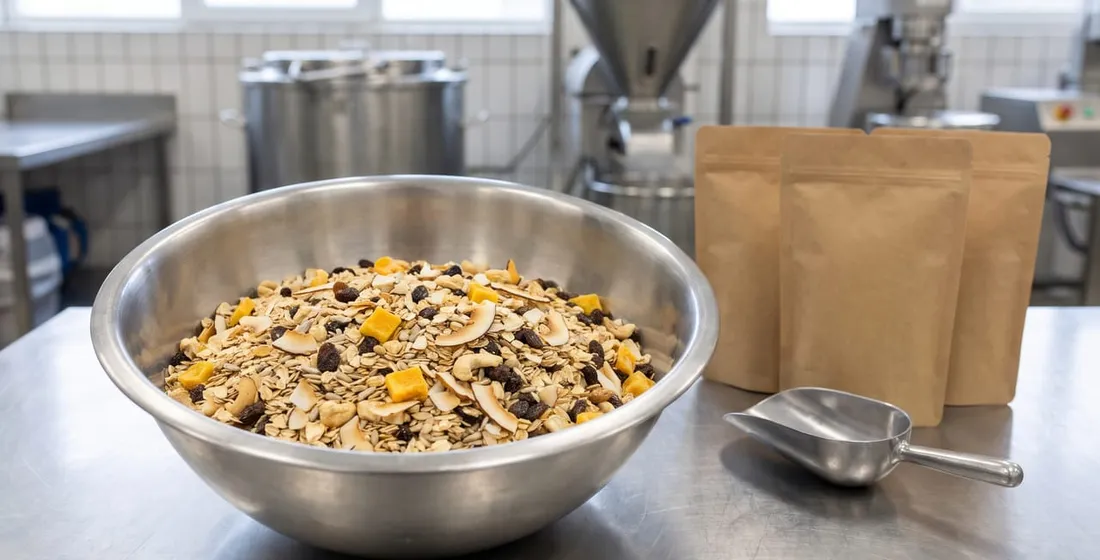
The batch sheet fixes the ingredients, their proportions by weight, the order they go into the blender and the blend time. For a dry muesli it is a single page. It matters because it is the document the hotel signs off, and the document the QA team at the factory weighs against on every batch.
Spec snapshot: the house muesli
- Product: untoasted muesli, dry blend, no added sugar
- Bowl: 40 g, unchanged from the imported product
- Pack: 1 kg laminate bag, 10 bags to a printed outer carton
- Variants: house blend with cashew, and a nut-free blend with pumpkin seed in place of cashew
- Typical shelf life for this format: 6 months
| Ingredient | House blend, % by weight | Nut-free blend, % by weight | Declared as |
|---|---|---|---|
| Rolled oats | 52 | 52 | Cereal containing gluten (oats) |
| Raisins | 14 | 14 | Ingredient list |
| Dried mango pieces | 10 | 10 | Ingredient list, preservative with INS number if used |
| Coconut chips | 8 | 8 | Ingredient list |
| Sunflower seeds | 6 | 6 | Ingredient list |
| Cashew pieces | 10 | 0 | Tree nut |
| Pumpkin seeds | 0 | 10 | Ingredient list |
The percentages are illustrative. The order is the point: oats first, then the dense inclusions, then the light and fragile ones last, so the mango and coconut are not crushed by a long blend. Oats are not grown commercially in Sri Lanka, so they are imported, and the R&D team confirms the cut and the supplier’s specification before the first sample. That is one reason the adjustment round is a matter of weeks, not days.
The group’s pastry chef supplied a sealed pack of the imported blend as the benchmark. R&D matched the oat cut and the raisin-to-mango ratio over three sample rounds, inside the 3 to 4 week maximum. The only change the chef asked for was fewer coconut chips, which went from 12 to 8 percent in the second round.
How does the allergen split work in practice?
The group runs two blends so that one buffet station can be nut-free by design, not by a handwritten card. The factory side of that is a run order and a clean. The hotel side is a label and a scoop.
The Food (Labelling and Advertising) Regulations 2026, in operation from 1 July 2026, list the allergen groups that matter here: cereals containing gluten, which include oats, peanuts and soybeans, milk, and tree nuts and nut products (Government of Sri Lanka, Gazette 2494/47, 2026). Both blends contain oats, so both carry a gluten-cereal declaration. Only the house blend contains tree nuts. Declarations can be made on any panel and in any one or more of the three languages, Sinhala, Tamil and English.
At the plant, the nut-free blend runs first after a full clean and an allergen verification, and the cashew blend runs after it. That order is the cheapest way to protect the nut-free product, and it costs one changeover rather than two. Whether the nut-free pack also needs a precautionary statement is decided with the QA team from the allergen risk assessment, not guessed at the artwork stage.
At the buffet, the two blends sit in separate dispensers with separate scoops, and each dispenser carries the bag’s ingredient panel. Housekeeping of that kind is the group’s responsibility, and the label is what makes it possible.
Where SFC walks away
A single small property pouring a few dozen bowls a day will not earn a custom-printed blend. The better route there is a portfolio SKU under the property’s label, or a good imported product bought well. Own-label starts to pay when several kitchens share one recipe.
Delivery rhythm and the reorder point
The group takes one drop of 300 kg roughly every seven weeks into a central store, then moves stock to the three properties on its own transfers. A single drop means one production slot, one set of paperwork and one quality release per cycle, instead of three small ones.
The first run was 300 kg: 180 kg of the house blend and 120 kg of the nut-free blend, packed into 300 one-kilogram bags in 30 cartons. At 40 kg a week that is about seven and a half weeks of cover, well inside the 6 month typical shelf life, with first-in, first-out rotation in the store.
| Reorder input | Value |
|---|---|
| Weekly use | about 40 kg |
| Purchase order to dispatch on a settled spec | 2 to 3 weeks |
| Transfer and receiving buffer | 1 week |
| Safety stock | 1 week |
| Reorder point | about 200 kg on hand, five weeks of cover |
| Second purchase order, after a 300 kg first delivery | about 2.5 weeks later |
The reorder rule is the whole delivery plan. When the store drops to about 200 kg, the controller raises the next purchase order. The factory has two to three weeks to blend and dispatch, the group has a week to receive and transfer, and one week of stock is left over. The maths is simpler than the importer’s shipping calendar made it look.
Hotels with banqueting kitchens often add a second, larger pack to the same programme. The pattern for that is covered in bulk supply in 5 kg and 10 kg packs.
Eight weeks from brief to first delivery
In this genericised case the programme took 8 weeks from signed brief to first delivery at the central store. The factory steps took about six of them. The rest was approvals and printed packaging running in parallel.
| Weeks | Step | Owner |
|---|---|---|
| 0 | Signed brief, benchmark pack handed to R&D | Group and SFC |
| 1 to 3 | Three sample rounds, formulation approved (3 to 4 weeks maximum) | R&D team, group pastry chef |
| 2 to 4 | Bag artwork, ingredient and allergen panel, carton print | Group, with SFC review |
| 4 | Purchase order on the approved spec | Group |
| 4 to 7 | Blending, filling, QA release, dispatch (2 to 3 weeks) | Matale plant team |
| 8 | Delivery to the central store, first transfers | Group |
The longest item that the group controlled was artwork approval. Where the group’s marketing team had to sign a printed bag, that approval ran into week four. A group that approves in parallel with R&D can shorten the programme by a week or more. Label and SLSI timelines should be confirmed directly with the regulator, as they depend on the product and the day.
The same approach to brief, sample and sign-off applies to other breakfast lines. A hotel group that also wants jams or condiments on the same programme can read the in-room breakfast condiment range, and the HORECA private-label buyer’s guide sets out the route choice between a portfolio SKU and a custom recipe.
Frequently asked questions
How much muesli does a hotel group need for breakfast?
Multiply occupied rooms by guests, breakfast take-up and cereal take-up, then by the bowl weight. A 380-room group at 70% occupancy, 1.6 guests per room and a 40 g bowl uses about 173 kg a month. Classified hotels average about 108 rooms (Sri Lanka Tourism Development Authority, 2026), so scale from there.
Does Silk Foods Ceylon make own-label muesli for hotel groups?
Yes. Silk Foods Ceylon blends and packs muesli under a hotel group’s own label at its BRCGS- and FSSC 22000 V6-audited Matale facility. Small runs are welcome and quoted on request. If a recipe needs adjusting to match an imported benchmark, R&D takes 3 to 4 weeks at most from signed brief to approved formulation.
What allergens must a muesli label declare in Sri Lanka?
Declare cereals containing gluten, which include oats, and tree nuts and nut products where present. The Food (Labelling and Advertising) Regulations 2026 also list peanuts, soybeans and milk (Government of Sri Lanka, Gazette 2494/47, 2026). Declarations may appear on any panel, in one or more of Sinhala, Tamil and English.
When should a hotel reorder own-label muesli?
Reorder at about five weeks of cover. That is two to three weeks from purchase order to dispatch at Silk Foods Ceylon, a week to receive and transfer, and a week of safety stock. For a group using 40 kg a week, the trigger is roughly 200 kg on hand.
How Silk Foods Ceylon can help
For a hotel and restaurant group replacing an imported breakfast line, Silk Foods Ceylon offers Private Labelling from its portfolio and Contract Manufacturing of a group’s own blend at Silk AgTech Park in Hapugasyaya, Matale. R&D takes a signed brief and a benchmark pack to an approved formulation in 3 to 4 weeks at most, and dispatch follows 2 to 3 weeks after the purchase order on a settled spec. Small runs welcome, quote on request. The facility is BRCGS- and FSSC 22000 V6-audited, with SLSI submission support inside the engagement. To brief a breakfast programme, email b2b@esilkroute.com.lk or call +94 77 157 7294.
Sources
Sri Lanka Tourism Development Authority (2026), “Year in Review 2025”: 170 classified tourist hotels with 18,308 rooms at the end of 2025. sltda.gov.lk. Retrieved 16 November 2026.
Government of Sri Lanka (2026), Food (Labelling and Advertising) Regulations 2026, Gazette Extraordinary No. 2494/47 of 26 June 2026, in operation from 1 July 2026: ingredient and allergen declarations, and the three languages. documents.gov.lk. Retrieved 16 November 2026.
Food Act No. 26 of 1980 (with amendments), the parent statute under which the 2026 labelling regulations are made.
Silk Foods Ceylon, internal capability data for the Matale facility: R&D 3 to 4 weeks maximum from signed brief to approved formulation; 2 to 3 weeks from purchase order to dispatch on a settled spec; small runs quoted on request; typical shelf life of 6 months for a 1 kg laminate bag. The group, the occupancy, the prices, the blend percentages and the schedule are illustrative planning assumptions, not SFC recipe, price or schedule data.
Written by the Silk Foods Ceylon Team. Silk Foods Ceylon (Pvt) Ltd. is a BRCGS- and FSSC 22000 V6-audited contract manufacturer in Matale, Sri Lanka, offering contract manufacturing, private labelling, co-packing, and in-house R&D for local Sri Lankan brand owners, FMCG companies, hotel and restaurant groups, and distributors. To brief a project: b2b@esilkroute.com.lk or +94 77 157 7294.