A Distributor's Own-Label Sauce Launch in 16 Weeks: A Case Study
By the Silk Foods Ceylon Team
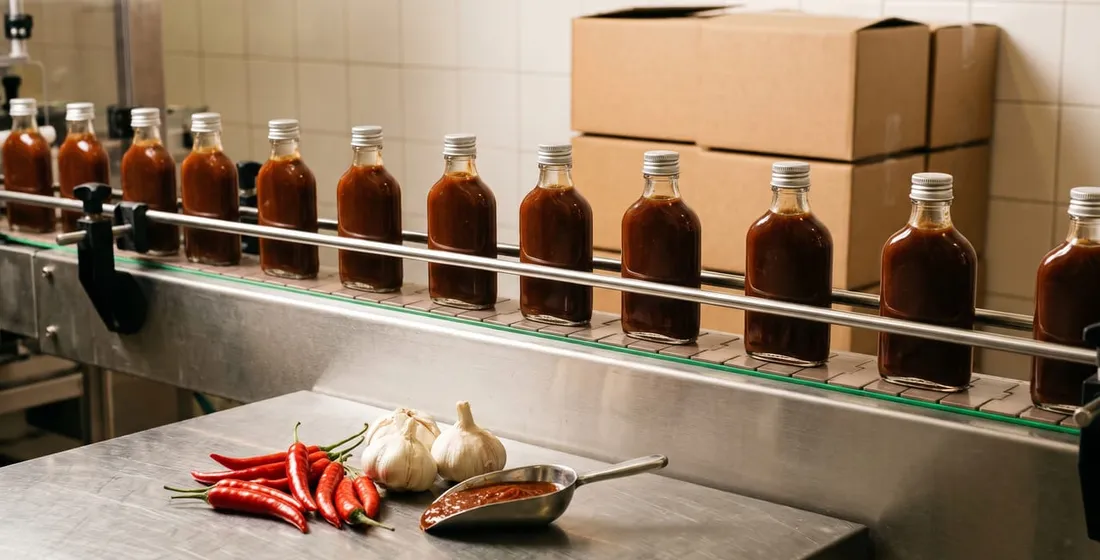
A row of plain, unlabelled 200 ml glass sauce bottles with silver caps on a stainless steel filling line, with fresh red chillies, garlic bulbs and blank brown cartons in the foreground.
Buyer’s snapshot
- Sri Lankan supermarket revenue grew 7 percent in 2023-24 and 10 percent in 2024-25 (Sparkwinn Research, March 2026), so the shelf a distributor’s own label chases is still expanding.
- In this genericised case, one own-label sauce went from brief to first retail delivery in 16 weeks at Silk Foods Ceylon (SFC).
- The first order was sized by weeks of sell-through cover, and the margin beat carrying a brand only above about 90 percent sell-through.
- Take the week table and the margin model into a planning meeting.
A distributor with a few hundred outlets and a sauce that sells every week usually reaches the same question: why keep paying another brand’s margin on a line that already moves? Over twelve quarters, supermarket revenue climbed from about LKR 79.2 billion to more than LKR 110 billion (Sparkwinn Research, 2026), and a 2026 Euromonitor summary says private label offerings expanded rapidly through 2025. The question is fair. The answer turns on three decisions that first own-label briefs tend to make in the wrong order.
Silk Foods Ceylon (SFC) formulates and packs sauces at its Matale facility, and this post follows one genericised case from brief to first shelf delivery. A note on method: it is a composite built from the pattern of distributor own-label briefs, not one client’s file. The week counts follow SFC’s published lead times, the outlet and margin figures are round planning numbers, and the regulations and market data are real. It sits beside the sauce first-run maths and the range-size decision for distributors, which cover the equipment and range questions this case only touches.
Why did a distributor put its own label on one sauce?
A distributor turns to own label when a fast-moving line carries a brand’s margin it could keep. In Sri Lankan supermarkets the pull is real: revenue grew 7 percent in 2023-24 and 10 percent in 2024-25, faster than the 16 listed FMCG companies Sparkwinn tracked (Sparkwinn Research, Daily Mirror, March 2026).
The distributor in this case supplied general trade and two supermarket accounts, and one pourable table sauce, bought from a brand, was its steadiest line. Two things pushed it toward own label. The brand’s price had risen twice in a year, and a supermarket buyer had asked whether the distributor could offer a house-label alternative at a lower shelf price.
That second point set the economics. A speaker quoted by Daily FT in 2023 described one supermarket chain pricing its own-label range 10 percent below comparable brands (Daily FT, 2023). The distributor planned for a shelf price below the brand’s, not level with it, and every later decision followed from that.
The 16 weeks, stage by stage
From signed brief to first outlet delivery took 16 weeks in this case. R&D took 3 weeks, inside the 3 to 4 week maximum SFC states from signed brief to approved formulation, and the first production run followed the 2 to 3 weeks from purchase order to dispatch that applies to a locked recipe (SFC, 2026).
| Weeks | Stage | What had to be true before the next stage |
|---|---|---|
| 1 to 2 | Brief and format decision | The buyer’s shelf specification in hand, bottle or jar chosen |
| 3 to 5 | R&D / NPD (Co-Development on the SFC brochure) | Flavour profile matched, acidity measured, formulation approved in writing |
| 6 to 8 | Pack, artwork and label check | Bottle and cap ordered (glass tooling adds about a week), artwork checked against the 2026 labelling regulations, shelf-life study scoped |
| 9 to 11 | First production run | Purchase order placed, first-article check passed, batch records opened |
| 12 to 13 | QA release and delivery to the distributor | Release signed, listing samples sent to the buyer |
| 14 to 16 | Buyer approval and first outlet deliveries | Supplier approval complete, first delivery to shelf in week 16 |
The Sri Lanka Standards Institution (SLSI) publishes no processing time, and sauces are not among the seven food products for which the SLS mark is compulsory (SLSI, retrieved 7 November 2026). The distributor still held weeks 14 to 16 as a buffer. A supermarket’s supplier-approval step is the buyer’s own process, and it does not follow a manufacturer’s calendar.
Why did the bottle beat the jar?
A pourable table sauce runs the homogenizer and liquid filling line into a 200 ml glass bottle, while a thick sauce or paste runs the semi-liquid jar route after the colloid mill. The distributor chose the bottle because the buyer’s shelf specification and its own delivery rounds favoured it, not because one line was easier for the factory.
| Question | 200 ml glass bottle | 300 g glass jar |
|---|---|---|
| Machine route | Homogenizer, then liquid filling | Colloid mill, then semi-liquid jar fill |
| Suits | Pourable table sauce | Thick sauce, paste or spread |
| Acid and heat | Acid sauces at pH 4.6 or below can be hot-filled and held | The same acid test applies before the heat process is chosen |
| Glass lead | Tooling adds about a week | Tooling adds about a week |
The acidity reading decided the heat process, so the R&D team measured it in week 4 instead of leaving it to the first run. A product that is naturally acid, or acidified to an equilibrium pH of 4.6 or below, suits hot-fill-hold. One above that needs a more severe thermal process under pressure (University of Georgia Extension, 2025). The wider format comparison is in glass jar, retort pouch or bottle for a first retail SKU.
Sizing the first run by cover, not by the line
A first own-label order should be sized by weeks of cover against the printed shelf life, not by what a filling run can produce. In this case the first order covered about 10 weeks of forecast sell-through, using under a fifth of an assumed 12-month printed life. SFC quotes the run on request.
The distributor’s forecast was the input and the run size was the output. Weeks of cover equals units ordered divided by forecast weekly sell-through, and the distributor’s rule was to keep the first order well under a third of the printed life. A bottle that reaches its date unsold is a write-off, and the write-off is the distributor’s.
The team changed its view here. SFC’s first proposal was two flavours in the same bottle. Each flavour carries its own run, its own artwork and its own date clock, so a second flavour would have doubled the stock to sell through before any outlet had proved the first. The distributor cut to one flavour, and the second waited for the first reorder. The same logic runs through three-SKU launch sequencing.
What did the economics look like?
Own label beat carrying a brand only above a sell-through threshold. In the planning model below, shelf price is indexed at 100, and the own-label sauce matched the margin of carrying the brand once about 90 of every 100 bottles sold inside the date. Above that line it was ahead. Below it, the write-off ate the gain.
The model assumes the own label sits 10 percent below the brand’s shelf price, in line with the gap the Daily FT speaker described. Every number is a round planning figure for illustration. None of it is SFC pricing or a quotation, so replace each line with your own.
| Line (shelf price before tax, brand = 100) | Carry the brand | Own label, 10 percent lower shelf price |
|---|---|---|
| Shelf price | 100 | 90 |
| Supermarket margin (25 percent of shelf price) | 25 | 22.5 |
| Distributor’s selling price | 75 | 67.5 |
| Buy-in price, or landed cost per bottle | 63 | 50 |
| Distributor margin, every bottle sold | 12 | 17.5 |
| Distributor margin, 10 percent of bottles written off | 12 | 11.9 |
Break-even sell-through is the landed cost divided by the selling price minus the margin on the brand: 50 divided by 55.5, or 90.1 percent. A distributor who expects to sell fewer than nine bottles in ten inside the date should keep carrying the brand. That is why cover mattered more than any line in the cost stack, and why the first order stayed small enough to sell.
What the label had to carry
Under the Food (Labelling and Advertising) Regulations 2026, the main panel carries the product name and the net contents in SI units, and the manufacturer’s and distributor’s names and addresses can sit on any panel (Gazette Extraordinary No. 2494/47, regulation 5). For a distributor’s own label, the distributor’s address is a legal line, not a design choice.
The peak of the case was a small one. The first artwork gave the shoulder label a clean front and left no panel for the expiry date, batch number and date of manufacture. The regulations let bottled food carry those three on the bottle neck, stamped indelibly in letters of at least 1.5 mm, and the date of expiry must appear in any two of Sinhala, Tamil and English (regulation 5(2)(c)). The neck stamp went into the artwork brief before any label was printed, which turned a likely reprint into one added line.
That is the pattern in most own-label briefs. The recipe is rarely what slips. A date panel, a distributor address or a language rule found after printing is what costs the weeks. The shelf-life file post covers the records behind the date itself.
Where SFC walks away, and what to bring to a brief
Where SFC walks away: a brief that asks for another brand’s recipe or trade dress to be reproduced, and an order sized to what the line can fill rather than to what the outlets can sell. The first puts the distributor in a dispute it did not plan for. The second leaves the stock, and the date risk, entirely on the distributor.
A distributor who has these five items ready usually gets a first sample sooner:
- The buyer’s shelf specification, including pack format and carton pattern.
- A forecast of weekly sell-through, by outlet group, not a single hopeful total.
- The target shelf price, so the landed cost can be tested against it.
- The printed life assumed, and who will own the study that supports it.
- The date, batch and address panels, placed in the artwork before it is sent to print.
For a distributor still carrying a brand with no forecast and no buyer, the better path is a quarter of sell-through data first. The sample-to-pallet post covers the mistakes that follow when the order comes before the data.
Frequently asked questions
How long does it take a distributor to launch an own-label sauce in Sri Lanka?
In this genericised Silk Foods Ceylon case, 16 weeks from brief to first outlet delivery. R&D took 3 weeks, within the 3 to 4 week maximum, and a locked recipe goes from purchase order to dispatch in 2 to 3 weeks. The buyer’s own approval step sits outside that calendar (SFC, 2026).
Is the SLS mark compulsory for a sauce in Sri Lanka?
SLSI lists seven food products for which the SLS mark is compulsory, and sauces are not among them (SLSI, retrieved 7 November 2026). A retail buyer can still ask for it, so check the buyer’s supplier requirements. SLSI publishes no processing time, so confirm the current window directly with SLSI.
What must a distributor’s own-label sauce label carry?
The main panel carries the product name and the net contents in ml or l. Any panel carries the ingredients, the manufacturer’s and distributor’s names and addresses, the batch code, the date of manufacture and nutrition labelling, with the expiry in two of three languages (Gazette Extraordinary No. 2494/47, 2026, regulation 5).
Does Silk Foods Ceylon make own-label sauces for distributors?
Yes. Silk Foods Ceylon (SFC) offers Private Labelling and Contract Manufacturing for pourable sauces in 200 ml glass bottles and thick sauces in 300 g glass jars, with in-house R&D of 3 to 4 weeks at most from signed brief to approved formulation. Small runs are welcome, quote on request.
How Silk Foods Ceylon can help
For a distributor moving a fast-selling sauce to its own label, Silk Foods Ceylon (SFC) runs Private Labelling and Contract Manufacturing at its Matale facility, with pourable sauces in 200 ml glass bottles and thick sauces in 300 g glass jars. In-house R&D takes 3 to 4 weeks at most from signed brief to approved formulation, and a locked recipe goes from purchase order to dispatch in 2 to 3 weeks. Small runs are welcome, quote on request. The facility is BRCGS- and FSSC 22000 V6-audited, with SLSI submission support and Sri Lanka Food Act labelling compliance inside a standard engagement.
To brief a project, email b2b@esilkroute.com.lk or call +94 77 157 7294.
Sources
- Sparkwinn Research, reported by Daily Mirror (20 March 2026), “Consumer goods in modern trade record strong growth momentum over 3 years”, on supermarket revenue rising from about LKR 79.2 billion to over LKR 110 billion across 12 quarters, and growth of 7 percent (2023-24) and 10 percent (2024-25). dailymirror.lk (retrieved 7 November 2026).
- Daily FT (16 February 2023), “Own label brands way forward for supermarkets in economic crisis: Dr. Rohantha Athukorala”, on own-label products priced 10 percent below comparable brands. ft.lk (retrieved 7 November 2026).
- Euromonitor International (2026), “Staple Foods in Sri Lanka”, report summary, on private label offerings expanding rapidly in 2025. euromonitor.com (retrieved 7 November 2026).
- Government of Sri Lanka (2026), Food (Labelling and Advertising) Regulations 2026, Gazette Extraordinary No. 2494/47 of 26 June 2026, regulation 5 on main-panel declarations, manufacturer and distributor details, and the date of expiry, including bottle-neck stamping. eohfs.health.gov.lk (retrieved 7 November 2026).
- Sri Lanka Standards Institution, Information for Local Manufacturers, on the products for which the SLS mark is compulsory. slsi.lk (retrieved 7 November 2026).
- University of Georgia Cooperative Extension (2025), Preserving Acidified Foods Using the Hot-Fill-Hold Process, publication C1328-03, on the pH 4.6 boundary and the pressure process above it. fieldreport.caes.uga.edu (retrieved 7 November 2026).
- Silk Foods Ceylon (2026), Capabilities Flyer, Food and Beverage Contract Manufacturing brochure and product and service catalogue (first-party lead-time data).
Written by the Silk Foods Ceylon Team. Silk Foods Ceylon (Pvt) Ltd. is a BRCGS- and FSSC 22000 V6-audited contract manufacturer in Matale, Sri Lanka, offering contract manufacturing, private labelling, co-packing, and in-house R&D for local Sri Lankan brand owners, FMCG companies, hotel and restaurant groups, and distributors. To brief a project: b2b@esilkroute.com.lk or +94 77 157 7294.