A Recall Drill on Paper for a Co-Packed Food Brand in Sri Lanka
By the Silk Foods Ceylon Editorial Team
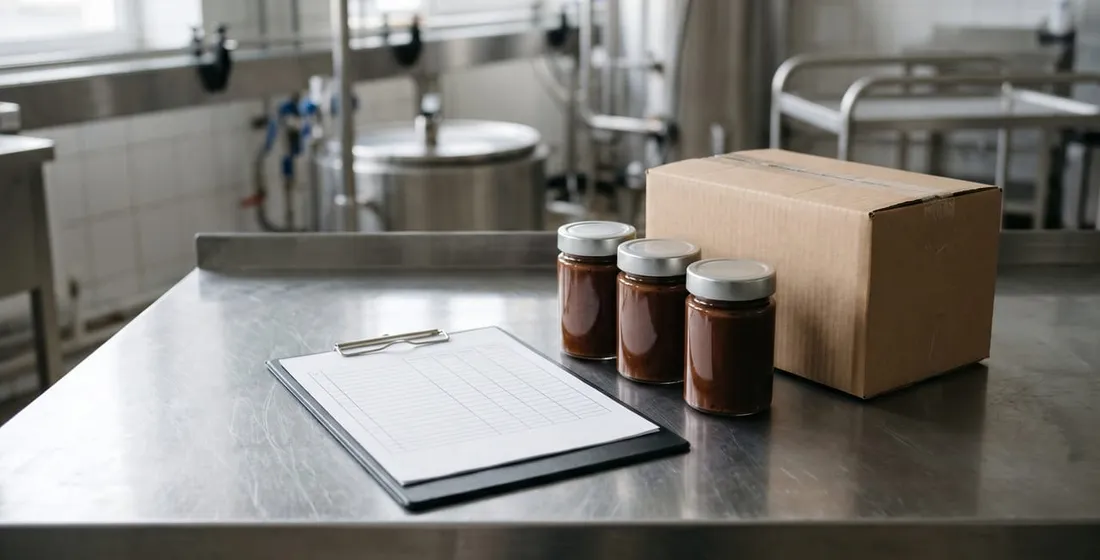
A closed clipboard with a blank printed record sheet, three plain unlabelled glass jars with blank lids, and a sealed brown shipping carton on a clean stainless steel worktop.
Buyer’s snapshot
- Sri Lanka’s Food (Labelling and Advertising) Regulations 2026 require a batch number, code number or decipherable code marking on pre-packaged food, and the Food (Hygiene) Regulations 2011 require a food business to be able to recall “any implicated lot”.
- Neither text sets a time limit, so a brand owner has to set one. A two-hour paper drill is a practical target.
- The drill runs three links: raw lot to finished batch, finished batch to carton, carton to store.
- Silk Foods Ceylon (SFC) welcomes small first runs, quoted on request, and a drill on the first batch is a fair condition to put in the brief.
A co-packed brand owns the label, the stock and the customer. It does not own the plant records. When a retailer calls about a jar, the brand owner has to answer from a combination of the co-packer’s batch file, a supplier’s certificate and a warehouse’s dispatch log, held by three different parties.
The answer is rarely missing. It is slow, because nobody rehearsed the walk from one record to the next. A paper drill fixes that before a real call arrives. It costs a few hours of two people’s time and needs no product to be touched.
Who holds which record in a co-packed brand?
The Food (Labelling and Advertising) Regulations 2026 (Gazette Extraordinary No. 2494/47) came into operation on 1 July 2026. Regulation 5(2)(a)(iii) requires the batch number, code number or a decipherable code marking among the declarations on a pre-packaged food. For bottled food, the date of expiry, batch number and date of manufacture may be stamped on the bottle neck. For metal cans they go on the top or bottom.
The Food (Hygiene) Regulations 2011 (Gazette Extraordinary No. 1742/26), regulation 12(14), go further. A food business must have procedures to deal with hazards to food safety and to enable the complete, rapid recall of any implicated lot of the finished food from the market. “Rapid” is not defined. The Codex hygiene code (CXC 1-1969, section 13.5) adds that recall procedures should be documented and adjusted from the results of periodic field trials. A paper drill is the cheapest field trial available.
| Link in the chain | Question the drill asks | Record that answers it | Usually held by |
|---|---|---|---|
| Raw lot | Which supplier lots went into this batch, and where else did they go? | Batch record with ingredient lot numbers; supplier certificates of analysis | Co-packer, with the supplier |
| Finished batch | What exactly was made, when, on which line, with what rework? | Batch record, line clearance and fill record, retained sample log | Co-packer |
| Carton | Which cartons carry this batch code, and where are they now? | Palletising and despatch record; carton label or case code | Co-packer, then the warehouse |
| Store | Which customers received which cartons, and in what quantity? | Brand owner’s invoices and delivery notes, mapped to batch code | Brand owner or distributor |
The table shows the gap. The first two rows sit with the manufacturer, the last row sits with the brand owner, and the carton row changes hands halfway. A drill is only as fast as its slowest handover.
How should a batch code be built?
A batch code needs to answer one question quickly: which production run is this? Most small brands code by date of manufacture, which works until two runs happen on one day or one run spans midnight.
A sound code carries three things: the date, the line or run identifier, and a sequence for runs on the same day. A code such as 261123-A2 (date, line A, second run) can be read by a person and keyed by a clerk. It needs no software and cannot be mistaken for the expiry date printed beside it.
Decide in advance what counts as one batch. Our note on kitchen recipes and batch records covers the definition. A batch that mixes two lots of the same ingredient is still one batch, but the record must name both lots. A batch that is reworked with product from an earlier batch needs both codes written into the record. Without those two rules the drill will stall at the first link, because the question “which lots were in it” has more than one answer.
What does a two-hour drill look like?
The figures below are illustrative. They show the shape of the exercise for a hypothetical brand with one 300 g jar SKU, not a real customer or an SFC capacity figure.
The trigger is a retailer’s report that one jar from code 261123-A2 has a foreign particle. The clock starts at the call.
| Clock | Step | Output |
|---|---|---|
| 0:00 | Log the call: code, store, date bought, what was found | One-page incident sheet |
| 0:20 | Pull the batch record for 261123-A2 from the co-packer | Ingredient lots, line, operators, rework flag, fill count |
| 0:45 | Check each raw lot against the supplier certificate and find other batches that used it | List of related batches, if any |
| 1:15 | Pull the despatch record and match carton codes to consignments | Carton count by destination |
| 1:45 | Reconcile quantities: produced, held, dispatched, retained, destroyed | One line that adds up |
| 2:00 | Decision pack: scope, hold or recall, who is told | Signed one-pager |
Take the reconciliation line, because it is where most drills fail. Say the batch was 2,400 jars, packed 24 to a carton, so 100 cartons. The drill finds 62 cartons in the brand’s own store, 36 cartons dispatched in three consignments of 20, 10 and 6, and 2 cartons opened for quality checks and the retained sample. 62 plus 36 plus 2 is 100. The line adds up, so the scope is known. Had it come to 98, the drill would have found its first real finding: two cartons nobody can account for.
One short moment from the exercise is worth naming. In a paper drill, the delay is almost never the record that does not exist. It is the record that exists in a form nobody can open, such as a handwritten despatch note held at a transport depot. That is a finding, and it is cheap to fix now.
Where do paper drills usually break?
Five points recur. Each can be tested before any product ships.
- Carton codes missing. The jar carries a batch code, the outer carton does not, so stores cannot be matched to batches. Print the batch code on the case label.
- Shared supplier lots. One lot of an ingredient feeds three batches, and the drill cannot list them without the co-packer’s cross-reference.
- Rework with no trail. A returned or trimmed product is folded into a later batch and the record says nothing.
- Third-party warehouse. Stock moves out on a pick list that records the product, not the batch. Our note on warehousing, despatch and stock ownership covers who holds the stock and the record.
- Brand-side invoices. The invoice names the SKU but not the batch, so the store link is a guess.
None of these needs expensive systems. They need a decision on what is written, by whom, at which step.
What should a brand owner ask a co-packer before the first run?
Use the checklist as an annex to the first-run brief. It sits beside the quality records a food maker keeps before launch and the documentation pack for a private-label SKU.
Buyer’s checklist: before the first co-packed run
- How is one batch defined, and what happens when a run spans a shift or a day?
- Does the batch record name every ingredient lot and every packaging lot?
- Is the batch code printed on the jar, the carton and the pallet label?
- How are rework and returns recorded, and against which code?
- How quickly can the co-packer send a batch file, and in what format?
- Who keeps retained samples, for how long, and who can release them?
- Which records does the brand owner keep, and are invoices mapped to batch codes?
- Will the co-packer take part in a paper drill on the first batch, and who signs the result?
Records should be kept longer than the product’s shelf life, and the Codex hygiene code makes the same point at section 13.4. The shelf-life file is the sister record for the date on the label.
A buyer moving between manufacturers should rerun the drill at the handover. The audit chain handover note explains why records do not travel automatically. For a first small run, the small-batch BRCGS buyer journey sets out the sequence, and the co-packing overview covers the service itself.
Where does the drill not apply?
A drill needs a batch code to start from. A brand still iterating a recipe at kitchen scale, with no stable batch definition and no outer carton label, should settle those first. Running a drill on records that do not exist only proves the point.
A drill also does not replace a recall plan. It tests the traceability a plan depends on. The decision on whether to withdraw product, who tells the regulator and how stores are notified belongs to a written plan, which the brand owner should hold separately.
Frequently asked questions
Does Sri Lankan law require a batch number on packaged food?
Yes. Regulation 5(2)(a)(iii) of the Food (Labelling and Advertising) Regulations 2026 lists the batch number, code number or a decipherable code marking among the declarations on pre-packaged food. Bottle necks and can ends are the permitted stamping positions in the provisos (Government of Sri Lanka, 2026).
How fast must a recall be in Sri Lanka?
The law gives no figure. The Food (Hygiene) Regulations 2011, regulation 12(14), require procedures for the “complete, rapid recall of any implicated lot”, and Codex CXC 1-1969 section 13.5 asks for documented procedures tested by periodic field trials. The two-hour target in this note is a working standard, not a legal one (Government of Sri Lanka, 2011; Codex, 2023).
What records should a co-packed brand keep?
Keep a copy or index of the batch record, supplier certificate references, retained sample log, despatch records and invoices mapped to batch codes. Codex section 13.4 says records should be kept beyond the product’s shelf life or as the competent authority requires (Codex, 2023).
Can Silk Foods Ceylon support a traceability drill on a first run?
A paper drill fits the first-run approval stage and can be written into the brief. Silk Foods Ceylon welcomes small runs, quoted on request, and a locked recipe typically goes from purchase order to dispatch in 2 to 3 weeks. R&D takes 3 to 4 weeks at most from signed brief to approved formulation (SFC, 2026).
How Silk Foods Ceylon can help
For brand owners launching a co-packed or contract-made SKU, Silk Foods Ceylon (SFC) runs a cellular-manufacturing facility in Matale that is BRCGS- and FSSC 22000 V6-audited, with SLSI submission support and Sri Lanka Food Act labelling support built into a standard engagement. Small runs are welcome, quote on request. Lead times typically run 2 to 3 weeks once a recipe is locked, and R&D takes 3 to 4 weeks at most. Writing a batch-code rule and a paper drill into the first-run brief is a reasonable condition to ask of any co-packer.
To brief a project, email brands@esilkroute.com.lk or call +94 77 157 7294.
Sources
- Government of Sri Lanka, Food (Labelling and Advertising) Regulations 2026, Gazette Extraordinary No. 2494/47 of 26 June 2026, read in full for this note: regulation 5(2)(a)(iii) and the provisos on bottles and cans. eohfs.health.gov.lk (retrieved 23 November 2026).
- Government of Sri Lanka, Food (Hygiene) Regulations 2011, Gazette Extraordinary No. 1742/26, regulation 12(14) and (15) on recall and recalled product. eohfs.health.gov.lk (retrieved 23 November 2026).
- FAO and WHO, General Principles of Food Hygiene, Codex Alimentarius Code of Practice CXC 1-1969 (2023 edition), sections 13.4, 13.5 and 14.1 (read in the Spanish-language edition). fao.org (retrieved 23 November 2026).
- Silk Foods Ceylon (2026), internal capability data for the Matale facility: R&D of 3 to 4 weeks at most from signed brief to approved formulation, and 2 to 3 weeks from purchase order to dispatch on a locked recipe.
Written by the Silk Foods Ceylon Team. Silk Foods Ceylon (Pvt) Ltd. is a BRCGS- and FSSC 22000 V6-audited contract manufacturer in Matale, Sri Lanka, offering contract manufacturing, private labelling, co-packing, and in-house R&D for local Sri Lankan brand owners, FMCG companies, hotel and restaurant groups, and distributors. To brief a project: brands@esilkroute.com.lk or +94 77 157 7294.