How a Sri Lankan BRCGS Factory Runs Small-Batch Co-Packing
By the Silk Foods Ceylon Editorial Team
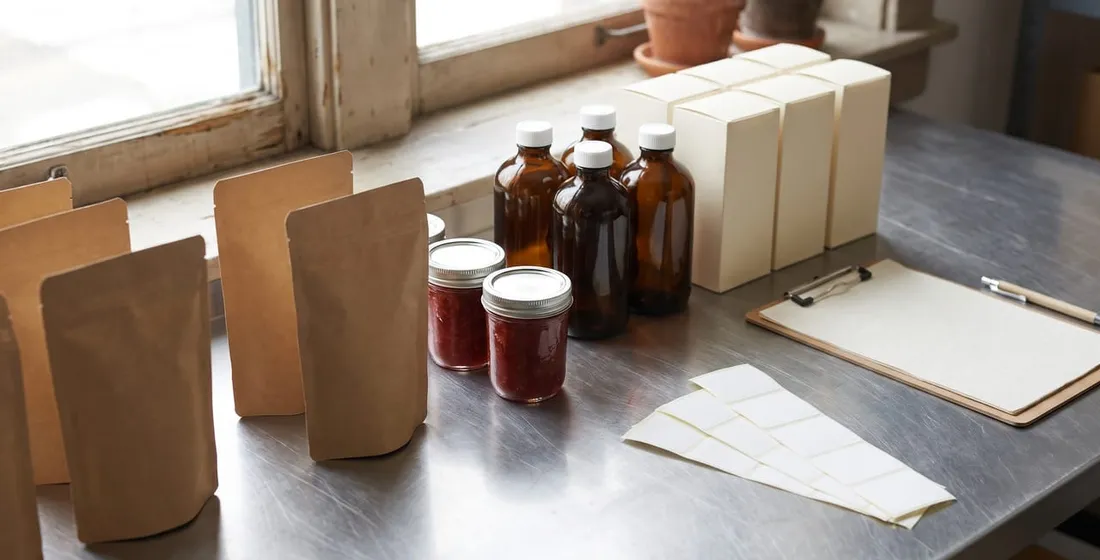
A small mixed batch of plain kraft pouches, glass jars of fruit spread, amber capsule bottles and unprinted tea cartons on a stainless steel packing table, with blank batch-code label strips and an empty clipboard beside them.
Buyer’s snapshot
- A BRCGS audit assesses practical implementation by observing procedures, reviewing documents and interviewing staff (BRCGS, 2026). A small batch inherits that system.
- Silk Foods Ceylon (SFC) states three lead times: 1 to 2 weeks for an existing-recipe sample, 3 to 4 weeks at most for new R&D, and 2 to 3 weeks from purchase order to dispatch.
- Small runs are welcome and quoted on request.
- The buyer-journey table below shows each stage, what you provide and what the factory does.
A first-time brand rarely has a volume problem. It has a sequence problem: who to call, what to bring, which steps cannot be skipped. Small-batch co-packing looks informal from outside. At a certified plant it follows the same documented path as any other run, only shorter.
This guide walks that path at Silk Foods Ceylon (SFC), a BRCGS certified food factory at Silk AgTech Park in Hapugasyaya, Matale. It runs from the first enquiry to a reorder, and says plainly where no firm time is published.
What should a first enquiry and brief contain?
A first enquiry works best when it names the product, the pack format, the sales channel and the date the stock is needed. Silk Foods Ceylon reads each brief for gaps before quoting, because a small run leaves little room to fix a missing detail later. Small runs are welcome and quoted on request.
The formats SFC runs today are spray-dried powders, herbal tea bags, herbal capsules in 60-count bottles, spreads and sauces in glass, and bottled drinks. Single-serve stick packs arrive from December 2026. Say which your product is closest to, and who supplies the recipe, ingredients and packaging. Add the nearest product already on a shelf.
One honest limit applies. A founder still adjusting flavour at kitchen-table scale, with no retail or hotel conversation behind the product, is better served by more bench testing before booking line time.
Contract manufacturing, private label or co-packing: which route fits?
Three routes cover most small brands. Contract manufacturing makes the buyer’s own recipe. Private labelling puts the buyer’s label on a recipe from the Silk Foods Ceylon catalogue. Co-packing packs finished goods the buyer already owns. The route depends on who owns the formulation and where the product physically is when the brief arrives.
A locked recipe never made at line scale is contract manufacturing. A proven catalogue product under your name is private labelling, with no R&D step. Finished goods such as a tea blend or a bulk liquid go to co-packing, which covers packing, sealing and labelling. The guide to choosing between the three routes works through the branches.
How do samples and R&D fit inside 3 to 4 weeks?
For an existing SFC recipe, a sample can be dispatched in 1 to 2 weeks. For a new formulation, the in-house R&D team takes a signed brief to an approved formulation in 3 to 4 weeks at most, over a few sample rounds. The clock starts at the signed brief, not at the first conversation.
Quick, specific feedback on each sample is the largest thing a buyer controls. The R&D clock explainer shows what starts and stops it. Samples can also be approved in person at the site, a day trip from Colombo.
What gets signed off before the first run: spec, label artwork and SLSI?
Three things need a buyer signature before a run is booked: the product specification, the label copy and the pack format. Food made in Sri Lanka must meet the Food (Labelling and Advertising) Regulations 2026, in operation from 1 July 2026 (Ministry of Health, 2026). SLSI timing is separate and should be confirmed directly.
The Gazette lists the label particulars: common name, net contents, an ingredient list in descending order of weight, allergen declarations, manufacturer name and address, batch number, dates of manufacture and expiry, and nutrition labelling (Ministry of Health, 2026). The 2026 labelling regulations guide covers each field. A label corrected after printing means a reprint.
The SLS Mark scheme is voluntary, except for the 46 products the Consumer Affairs Authority has made compulsory (SLSI, 2026). Check your product against that list. SFC does not quote a processing time for SLSI, so ask SLSI for its current window before you fix a shelf date.
The buyer journey at a glance
From first enquiry to reorder, a small-batch run passes eight stages. SFC publishes three fixed times: 1 to 2 weeks for an existing-recipe sample, 3 to 4 weeks at most for new R&D, and 2 to 3 weeks from purchase order to dispatch on an existing recipe. Everything else depends on the buyer’s inputs.
| Stage | What the buyer provides | What SFC does | Typical time (where published) |
|---|---|---|---|
| 1. First enquiry and brief | Product, pack format, channel, target date | Reads the brief, flags gaps | Depends on the brief |
| 2. Route choice | Who owns the recipe; where the product is | Matches the route | Usually the first conversation |
| 3. Samples and R&D | Signed brief; prompt feedback | Dispatches or formulates in-house | Sample 1 to 2 weeks (existing recipe); R&D 3 to 4 weeks at most |
| 4. Spec and label artwork | Final spec, label copy, brand-supplied packaging | Reviews spec and label fields, confirms batch coding | Set by your printer; confirm SLSI timing with SLSI |
| 5. Quote | Quantity, packaging source, target date | Quotes against the line plan | Small runs welcome, quote on request |
| 6. Scheduling | Purchase order; packaging at the plant | Slots the run; approves supplied materials | 2 to 3 weeks to dispatch (existing recipe) |
| 7. Release and dispatch | Delivery point and documents needed | Release checks, batch record, dispatch | Inside the 2 to 3 weeks |
| 8. Reorder | Reorder purchase order; notice of changes | Runs the locked recipe to the same spec | 2 to 3 weeks to dispatch |
Stage 4 is the gate first-time brands underestimate, because artwork and packaging sit with outside suppliers. Stage 6 starts its clock only once packaging has arrived. A brand that plans both gates loses very little time to them.
How does a small run fit on a shared, modular line?
Silk Foods Ceylon runs a cellular-manufacturing layout: the line is modular and moves between configurations instead of staying fixed to one product. A small run is a place in the line plan, next to other brands’ runs. It is quoted on request and holds only when packaging and inputs are at the plant.
Sequencing is where a shared line shows discipline. A plain spread and a nut-based one can fill the same jar, but the order decides how much cleaning sits between them. Say in the brief if your product contains an allergen or a strong colour or flavour. The production-run scheduling guide shows how a slot is placed. Until stick packs arrive from December 2026, single-serve sachets are scoped per quote.
What do BRCGS and FSSC 22000 V6 change for a small batch?
A certificate does not shrink for a small run. Silk Foods Ceylon is BRCGS certified, with FSSC 22000 V6, so a batch of any size follows the same documented controls: a food safety plan, traceability, allergen control, supplier approval and release checks. A small order gets the paperwork a large one would.
FSSC 22000 is built on ISO 22000, sector prerequisite programmes and the scheme’s own requirements, and is recognised by the Global Food Safety Initiative (FSSC, 2026). GMP and HACCP sit underneath both standards. USDA Organic, EU Organic and Vegan (Control Union) are available for qualifying recipes only.
| System element | What it means for a small batch | What to ask to see |
|---|---|---|
| Documented HACCP plan | Hazards are assessed before the run | The hazard analysis for your product type |
| Traceability and batch coding | Each carton’s code links to the run | The batch record |
| Allergen and cleaning validation | Cleaning between runs is validated | The allergen matrix and cleaning records |
| Supplier approval | Buyer-supplied materials are checked first | The approval steps |
| Retained samples | A batch sample is kept after dispatch | How long it is held |
| Release checks | The batch meets the spec before leaving | The criteria and who signs |
Codex Alimentarius defines traceability as the ability to follow a food through specified stages of production, processing and distribution, one step back and one step forward (Codex Alimentarius, 2006). For a small brand, that separates a one-batch recall from a recall of everything.
Scope is a fact to verify. The guide to verifying each certificate shows how to check site, scope and dates. Certification scope for the stick-pack line will be stated once that line is commissioned.
What does a small brand’s first run look like in practice?
Picture a small herbal tea brand with two blends that sell at weekend markets. This is a composite of how first runs usually go, not a named client. The founder owns the blend, so the route is tea cutting and bagging of a buyer-supplied recipe. A sample comes back in the 1 to 2 week window.
The label is the first surprise. The draft lacks a batch field and an expiry date in the required format, so the copy is corrected before the printer is paid. One dried herb comes from the founder’s own supplier, so its documents go through supplier approval before it reaches the line.
The run is slotted behind a product with a different allergen profile, with cleaning in between. Each carton leaves with a batch code matching the record. The payoff shows at the reorder. Nothing about recipe, label or supplier has changed, so no approval repeats, and the order moves inside 2 to 3 weeks.
What happens at dispatch, and how do reorders work?
At dispatch, cartons leave with a batch record the buyer can match to the label code. On a locked recipe, a reorder runs to the same specification and moves from purchase order to dispatch in 2 to 3 weeks. A change to recipe, pack or label restarts the relevant approvals first, so raise changes at the quote stage.
Frequently asked questions
Does Silk Foods Ceylon accept small first-time co-packing runs?
Yes. Silk Foods Ceylon welcomes small runs and quotes them on request, across spray-dried powders, herbal tea bags, herbal capsules in 60-count bottles, spreads and sauces in glass, and bottled drinks. The quote depends on recipe, pack format and the line plan. Stick packs arrive from December 2026.
How long from signed brief to first dispatch?
R&D takes 3 to 4 weeks at most from signed brief to approved formulation. After that, an existing recipe runs 2 to 3 weeks from purchase order to dispatch, once packaging and inputs are at the plant. Label printing and any SLSI step run alongside and can set the date, so confirm both early.
Does BRCGS certification change how a small batch is run?
It means a small batch follows the same documented system as a large one. BRCGS describes its audit as an assessment of practical implementation, through observation, document review and staff interviews (BRCGS, 2026). In practice that covers a food safety plan, batch coding, allergen cleaning, supplier approval and release checks.
How long does SLSI take to clear a product?
Silk Foods Ceylon does not quote a processing time for SLSI. The SLS Mark scheme is voluntary, except for the 46 products the Consumer Affairs Authority has made compulsory (SLSI, 2026). Confirm whether your product is on that list, and ask SLSI for its current window before fixing a shelf date.
How Silk Foods Ceylon can help
For small and first-time brands, Silk Foods Ceylon (SFC) runs co-packing, contract manufacturing and private labelling from a cellular-manufacturing facility at Silk AgTech Park in Hapugasyaya, Matale. Small runs are welcome and quoted on request. R&D takes 3 to 4 weeks at most from signed brief to approved formulation, and an existing recipe runs 2 to 3 weeks from purchase order to dispatch. The facility is BRCGS certified, with FSSC 22000 V6, and label review against the Sri Lanka Food Act regulations sits inside a standard engagement.
To brief a project, email b2b@esilkroute.com.lk or call +94 77 157 7294.
Sources
- BRCGS (2026), “Food Safety Standard: Guide to Certification”, on audit method (observation, document review, staff interviews) and GFSI benchmarking. brcgs.com (retrieved 30 October 2026).
- FSSC (2026), “FSSC 22000”, on the scheme’s ISO 22000, prerequisite-programme and scheme-requirement components and GFSI recognition. fssc.com (retrieved 30 October 2026).
- Ministry of Health, Government of Sri Lanka (2026), “Food (Labelling and Advertising) Regulations 2026”, Gazette Extraordinary No. 2494/47, in operation from 1 July 2026. eohfs.health.gov.lk (retrieved 30 October 2026).
- Sri Lanka Standards Institution (2026), “SLS Mark Product Certification”, on the voluntary scheme and the 46 compulsory products. slsi.lk (retrieved 30 October 2026).
- Codex Alimentarius Commission (2006), “Principles for Traceability/Product Tracing as a Tool within a Food Inspection and Certification System”, CAC/GL 60-2006. fao.org (retrieved 30 October 2026).
Written by the Silk Foods Ceylon Team. Silk Foods Ceylon (Pvt) Ltd. is a BRCGS certified food manufacturer in Matale, Sri Lanka, with FSSC 22000 V6, offering contract manufacturing, private labelling, co-packing, and in-house R&D for local Sri Lankan brand owners, FMCG companies, hotel and restaurant groups, and distributors. To brief a project: b2b@esilkroute.com.lk or +94 77 157 7294.