Five Surprises for New Brand Owners in a First Co-Manufactured Run
By the Silk Foods Ceylon Editorial Team
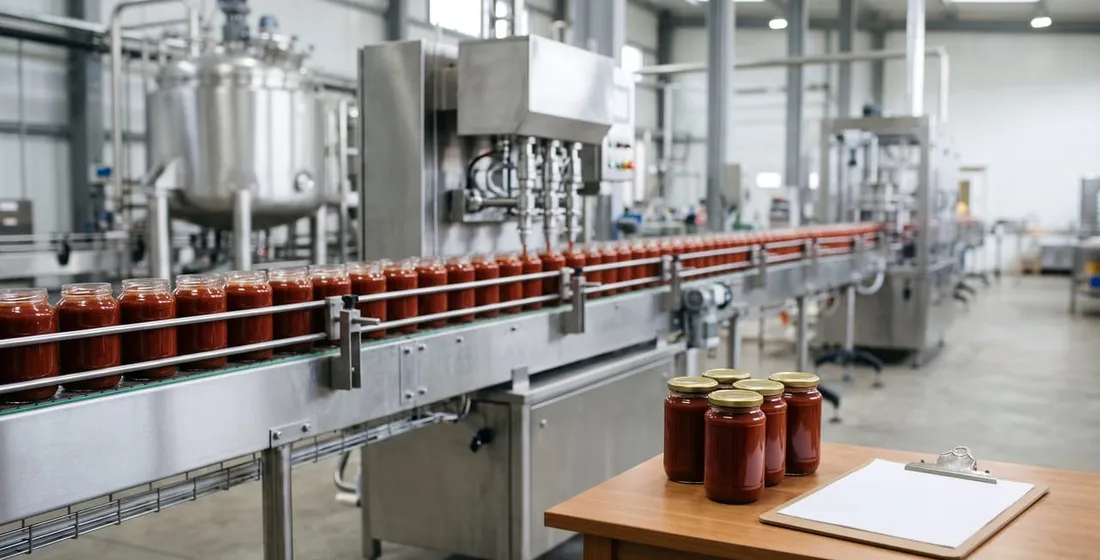
A stainless steel jar filling line with plain unlabelled glass jars of dark red sauce on a conveyor, and a few sample jars beside a blank clipboard on a table in the foreground.
Buyer’s snapshot
- A test batch made in a kitchen is not a preview of the first plant run. Heating rate, agitation, holding time and pumping can change how ingredients behave, and a first plant trial can produce unsaleable product (NC State Extension, 2022).
- Fixed charges are paid on every run, and packaging and ingredient minimums can exceed the run itself (Eightx, June 2026). Both surprise a first-time owner more than the per-unit quote does.
- Silk Foods Ceylon (SFC) welcomes small first runs, quoted on request. R&D takes 3 to 4 weeks at most from signed brief to approved formulation, and a locked recipe goes from purchase order to dispatch in 2 to 3 weeks.
- The LKR figures in this note are hypothetical arithmetic. They are not SFC quotes, and no customer account is quoted here.
A first co-manufactured run is rarely a disaster. It is more often a series of small shocks: a texture that moved, a packaging order that was bigger than the run, a quote with a line nobody had asked about, a request to be standing in the plant on the day. Each one is manageable if it is known before the purchase order is signed, and expensive if it is learned on the production floor.
This note sets out five of those surprises for a brand owner who has a recipe that sells in small quantities and is about to hand it to a manufacturer. It draws on published co-packing guidance and on how the Silk Foods Ceylon (SFC) Matale facility describes its own process. It does not quote customers, because there is no signed-off client account behind it, and it does not invent one.
Why does the product change between a sample and the first plant run?
A kitchen batch and a plant batch are made with different equipment, in different volumes, with different heat and mixing. NC State Extension warns that moving from a home-kitchen test batch to the first plant trial may yield “unsaleable or unusable product”, because heating rate, agitation, holding at high temperature and pumping can change how ingredients work and how the product looks (NC State Extension, 2022). Thorough development before the pilot reduces the risk, but the same guide says unforeseen differences can still occur.
The practical answer is a pilot step between the bench and the full run. Food & Hospitality Asia recommends a pilot production run 6 to 8 weeks before launch, to test the packaging line and the quality-control methods before the first full run (Food & Hospitality Asia, 2025). The sample a founder approved is a reference point, not a guarantee.
Two things follow for a brief. Ask what is changing between the sample and the run, in plain terms: vessel size, how the product is heated and held, how it is pumped and filled. And agree in writing who pays for disposal or rework if the first run does not meet the approved sample, because NC State Extension notes that a contract should say so (NC State Extension, 2022).
Why might a manufacturer ask you to be in the plant?
Many copackers ask the product owner to be present the first time the product is run, so that satisfaction can be confirmed on the spot, and they usually do not ask again for later runs (NC State Extension, 2022). New brand owners often plan for a sample sign-off by email and are surprised that the real approval is a morning on the floor.
It is better treated as a benefit. An owner who tastes the first filled jar, sees the fill level and checks the label position can approve or correct before the whole run is committed. Plan the day: bring the approved sample, a printed label proof and the name of the one person who can say yes. Food & Hospitality Asia also recommends a pre-production approval step ahead of the first full run, and retained samples from it (Food & Hospitality Asia, 2025).
Why is a small first run so expensive per unit?
Every run carries fixed work: line cleaning, equipment set-up, material staging, allergen handling and the changeover to the next product. Eightx describes these as fixed charges paid per run, and shows that the same set-up fee adds a large amount per unit on a run of 1,000 and almost nothing on a run of 50,000 (Eightx, June 2026). The owner sees a high per-unit number and assumes the manufacturer is pricing a new customer harshly. Usually it is the fixed charge, spread over few units.
The table shows the shape of it with a hypothetical fixed charge of LKR 60,000 per run. It is arithmetic, not an SFC price.
| Units in the run | Fixed charge per unit (hypothetical LKR 60,000 per run) |
|---|---|
| 1,000 | LKR 60 |
| 3,000 | LKR 20 |
| 10,000 | LKR 6 |
This is also why the first quote and the second quote differ. Some one-off lines, such as recipe adjustment and label approval, do not recur. Ask for the quote in two parts, one-off lines and per-run lines, so the second run is something you can plan. For a structure that moves the cash without removing the cost, see asking for a staggered first PO.
How can packaging and ingredient minimums be bigger than the run?
The manufacturer’s minimum is not the only floor. Printed film, caps, cartons and some ingredients are bought from suppliers with their own minimums, and Eightx notes these can exceed the co-manufacturer’s run, for example a full roll of printed film or a pallet of caps (Eightx, June 2026). The surplus becomes your inventory, on your balance sheet.
A hypothetical example: a label-and-lid set costs LKR 45 and the supplier’s minimum is 5,000 sets, for a first run of 1,500 jars. The 3,500 sets left over are worth LKR 157,500 sitting on a shelf until a second run uses them. That is only a problem if nobody planned for it, because a second run in a known week turns the surplus into stock you intended to hold.
Timing matters as much as quantity. Food & Hospitality Asia advises locking die-lines at least four weeks before production (Food & Hospitality Asia, 2025). A label that is still being redesigned in the week of the run is the most common reason a booked slot moves. See artwork and print lead time for how long that step runs.
Why does the cash outlast the production lead time?
A quoted production lead time of a few weeks describes the time on the line. Eightx points out that the working-capital cycle on a balance sheet runs well past it once safety stock and channel buffers are added, and that deposits of 30 to 50 per cent at booking are common (Eightx, June 2026). NC State Extension describes a typical 10 per cent down with the remainder on delivery in the United States, so terms vary by manufacturer and are worth asking about directly (NC State Extension, 2022).
For SFC, a locked recipe goes from purchase order to dispatch in 2 to 3 weeks. That figure starts after the recipe is approved, the packaging has arrived and the label is final, which is where most first-time delays sit. Count the cash from the day packaging is ordered, not from the day the run starts.
How do the five surprises compare, and what should the brief say?
| Surprise | What the sample hid | What to put in the brief |
|---|---|---|
| Product changes at scale | Kitchen heating, mixing and pumping differ from plant equipment | A pilot step, and who pays for rework or disposal |
| Owner in the plant | Approval was assumed to be by email | The day, the approver, the approved sample and the label proof |
| Per-unit price on a small run | Fixed charges are paid on every run | A quote split into one-off lines and per-run lines |
| Packaging and ingredient minimums | Supplier floors exceed the run | Who orders, who stores, and which run uses the surplus |
| Cash outlasts the lead time | Production time is not the working-capital cycle | Deposit terms and the date packaging is ordered |
Buyer’s checklist: before the first purchase order
- An approved sample and a written description of what changes at plant scale
- A decision on who attends the first run and who can approve on the day
- A quote split into one-off and per-run lines
- A packaging plan with die-lines locked at least four weeks ahead
- Deposit terms and a cash calendar that starts at the packaging order
- A written position on rework, scrap and the cost of disposal
Where SFC walks away
A first run is not the time to change the recipe, the pack size and the label together. If more than one of them is still open, R&D / NPD comes first. SFC also does not promise a first-run price equal to the second, and a brand owner should be wary of any manufacturer that does.
What does this look like at Silk Foods Ceylon?
Silk Foods Ceylon (SFC) welcomes small first runs, quoted on request, and the quote depends on the recipe, the pack format and how the run fits the shared line schedule. A brand owner who wants the quote split into one-off and per-run lines, a pilot step or a dated second release can put that in the brief.
If the recipe is not locked, R&D / NPD (Co-Development on the SFC brochure) comes first and takes 3 to 4 weeks at most from signed brief to approved formulation. Once the specification is signed off, Contract Manufacturing takes a purchase order to dispatch in 2 to 3 weeks. For the steps before the purchase order, see how a test batch becomes a first commercial run and signing off a sample and costing the first PO. For the move from kitchen equipment to a filling line, see scaling a home recipe to a filling machine, and for questions to ask before signing, ten questions before signing a co-manufacturer. For how a run is slotted into the plant, see scheduling a production run on a shared line.
Frequently asked questions
Will my product taste the same in a first plant run as in my kitchen sample?
Not automatically. Heating rate, agitation, holding time and pumping differ at plant scale and can change texture and appearance, and a first plant trial can yield unusable product. A pilot step and a signed-off sample reduce the risk, and the contract should say who pays for rework (NC State Extension, 2022).
Do I have to be at the plant for the first run?
Many copackers ask the product owner to attend the first time the product is run, to confirm it meets expectations, and usually do not ask again for later runs. Bring the approved sample, the label proof and one person who can approve on the day (NC State Extension, 2022).
Why is my first-run quote higher than I expected?
Set-up, cleaning and changeover are fixed charges paid on every run, so a small run carries more of that cost per unit. In one published model a set-up fee adds USD 4.00 per unit at 1,000 units and USD 0.08 at 50,000 (Eightx, June 2026).
Can Silk Foods Ceylon quote a small first run?
Yes. Small runs are welcome and quoted on request, and the quote depends on the recipe, the pack format and the line schedule. R&D takes 3 to 4 weeks at most from signed brief to approved formulation, and a locked recipe goes from purchase order to dispatch in 2 to 3 weeks (SFC, 2026).
How Silk Foods Ceylon can help
For founders launching a first commercial run, Silk Foods Ceylon (SFC) runs Contract Manufacturing and R&D / NPD at its Matale facility. Small first runs are welcome and quoted on request, and a quote split into one-off and per-run lines can be put in the brief. R&D takes 3 to 4 weeks at most from signed brief to approved formulation, and a locked recipe goes from purchase order to dispatch in 2 to 3 weeks. The facility is BRCGS- and FSSC 22000 V6-audited, with SLSI submission support built into a standard engagement.
To brief a project, email b2b@esilkroute.com.lk or call +94 77 157 7294.
Sources
- NC State Extension (2022), “Choosing and Using a Copacker”, John Rushing, 31 July 2022. content.ces.ncsu.edu (retrieved 27 November 2026).
- Eightx (2026), “Co-Manufacturing Cost and MOQs for CPG: How Minimum Runs Trap Your Cash”, 9 June 2026. eightx.co (retrieved 27 November 2026).
- Food & Hospitality Asia (2025), “Working with Co-Packers: How to Scale Retail Rollouts Without Losing Quality”, 3 June 2025, updated 8 October 2025. foodnhotelasia.com (retrieved 27 November 2026).
- Silk Foods Ceylon (2026), internal capability data for the Matale facility: R&D of 3 to 4 weeks at most from signed brief to approved formulation, and 2 to 3 weeks from purchase order to dispatch on a locked recipe.
Written by the Silk Foods Ceylon Team. Silk Foods Ceylon (Pvt) Ltd. is a BRCGS- and FSSC 22000 V6-audited contract manufacturer in Matale, Sri Lanka, offering contract manufacturing, private labelling, co-packing, and in-house R&D for local Sri Lankan brand owners, FMCG companies, hotel and restaurant groups, and distributors. To brief a project: b2b@esilkroute.com.lk or +94 77 157 7294.