From 20 Jars to 2,000: What Breaks First in a Chutney Scale-Up
By the Silk Foods Ceylon Editorial Team
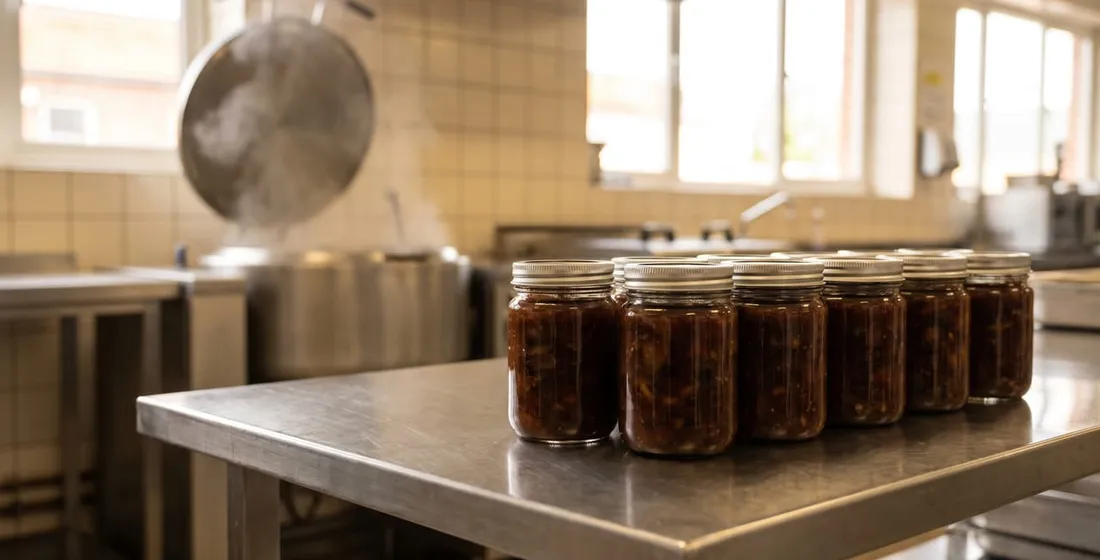
A row of plain unlabelled glass jars with blank metal lids, filled with dark fruit chutney, on a stainless steel table in a food production hall with a steam kettle behind.
Buyer’s snapshot
- Codex treats a food with a natural pH of 4.6 or below as an acid food, and a low-acid food acidified to 4.6 or lower after heat processing as its own class (Codex Alimentarius, CAC/RCP 23-1979). pH 4.6 is the line a chutney recipe is held to on the line.
- Between 20 jars and 2,000, four things move: how the fruit pieces hold in the fill, where the pH lands after cooling, how hot the product is at the filler, and what gets written down.
- The batch sizes in this note are illustrative, not Silk Foods Ceylon (SFC) capacity figures.
- SFC welcomes small first runs, quoted on request. R&D takes 3 to 4 weeks at most from signed brief to approved formulation.
A home chutney that sells out at a Sunday market is usually made in a 20 jar batch. One pot, one cook, one pair of eyes on the thickness. Everything the recipe needs to work is in that cook’s hands, and none of it is written down.
Then a shop asks for 2,000 jars. The recipe has not changed, but the process around it has to. A kettle replaces the pot, a filling machine replaces the ladle, and a record sheet replaces the cook’s memory. This note covers what breaks first, in the order it usually breaks, so a brand owner can ask the right questions before the first commercial run is booked.
What actually changes between 20 jars and 2,000?
Four variables change when a chutney moves from a pot to a line: particle suspension, acidity, fill temperature and documentation. The ingredient list can stay identical while each of these shifts, which is why a recipe that tasted right in the kitchen can still fail its first commercial batch.
| Variable | In the home kitchen | On a filling line | What has to be fixed |
|---|---|---|---|
| Fruit and vegetable pieces | Stirred by hand, filled in minutes | Held in a hopper while jars fill one after another | Piece size, syrup body and a stirring or filling method that keeps pieces spread through the jar |
| Acidity | Vinegar or lime added by taste | Acid added by weight into a much larger mass | A written acid dose, a mixing time and a pH reading after cooling |
| Temperature | Jars filled warm from the pot | Product cools while it waits for the filler | A minimum fill temperature, a cap-on time and a logged reading |
| Records | None, or a notebook | A batch record a buyer or auditor can read | Lot numbers, weights, pH, temperatures and a batch code |
The rest of this note takes the four rows in turn. For the wider move from kitchen to line, see our note on what a kitchen recipe needs before production.
Why do fruit pieces settle or float on a filling line?
Pieces settle or float because their density differs from the liquid around them, and a filling line gives them far more time to separate than a ladle does. A cook fills 20 jars in a few minutes. A filler working through 2,000 jars holds the product in a hopper for much longer, while it thins with heat or thickens as it cools.
The result shows up on the shelf, not in the kitchen. The first jars are fruit-heavy. The last jars are mostly syrup. A retail buyer who opens two jars from one case and finds two different products will not read it as a tolerance. They will read it as inconsistency.
Three things control it. Piece size sets how fast pieces move, so the dicing specification matters as much as the recipe. Syrup body sets how long they stay put, which is why cooking time and sugar or fruit-pulp balance get fixed in R&D rather than judged by eye. And the filling method decides how long product waits before it reaches the jar.
This is also where batch cooking time changes. A home cook reduces a pot until it looks right. In a steam-jacketed kettle, “looks right” has to become a measured end point, such as a soluble solids reading or a weight loss, because a larger mass cools and thickens differently once it leaves the heat.
Why does the pH drift between batches?
The pH drifts because acid in a home recipe is added by taste, and taste does not scale. Fruit lots differ in natural acidity from one delivery to the next. Onion, garlic and ginger, common in chutneys, are low-acid ingredients that pull the pH up. Mixing a larger mass takes longer to reach an even acid level, and the reading that matters is taken after the product has cooled and settled, not while it is hot in the kettle.
The line that matters is pH 4.6. Codex defines an acid food as one with a natural pH of 4.6 or below, and an acidified low-acid food as one treated so that it reaches an equilibrium pH of 4.6 or lower after heat processing (Codex Alimentarius, CAC/RCP 23-1979). The same threshold sits in United States federal rules: 21 CFR 114.80 requires a finished equilibrium pH of 4.6 or lower in acidified foods, with frequent testing and recorded results (US Code of Federal Regulations, retrieved 24 November 2026).
Two cautions apply. Neither text is Sri Lankan law, so they are used here as benchmarks, not as the local rule. And 21 CFR 114 excludes jams, jellies and preserves, and acid foods with small amounts of low-acid ingredients where the pH stays close to that of the main acid component. A sweet fruit preserve may fall outside it. A chutney with a real share of onion or ginger sits closer to the line. Which side a given recipe falls on is a question for R&D and a qualified process authority, not for a rule of thumb.
Buyer’s checklist: before the first commercial chutney run
- A written recipe by weight, including the acid, with the order and time of each addition
- The pH target, the method used to measure it and the point in the process where it is read
- The dicing or piece-size specification for every fruit and vegetable
- The minimum fill temperature and the longest permitted wait between kettle and cap
- The jar, lid and fill weight, confirmed against the label
- A batch code format and a list of what each batch record must contain
Consider a 20 jar batch that works
The scenario below is hypothetical. It shows the shape of the problem, not a real client or an SFC result.
A founder makes a mango and ginger chutney in a home kitchen. It sells well, and the batch of 20 jars always tastes the same, because the founder adds lime juice until it “bites”. A shop asks for 2,000 jars. Scaled up by weight, the same recipe uses a fixed volume of lime juice. That year’s mangoes are sweeter and less acidic than the last year’s. The finished pH comes out higher than any kitchen batch ever was, and nobody knows, because the kitchen never measured it.
The fix keeps the recipe and adds measurement: a pH reading on a cooled sample from every batch, an acid dose that is adjusted against that reading inside a written range, and a record of both. The founder’s judgment stays in the process, with a number beside it that a buyer or auditor can check.
How hot does the product need to be at the filler?
The product needs to be hot enough at the filler that the jar, the headspace and the underside of the lid are treated by the product’s own heat, and that temperature has to be set, measured and written down. A home cook fills warm jars from a pot and screws the lid on. On a line, the product cools while it waits, and a jar filled 10 minutes later is filled at a different temperature from the first.
Two routes exist for a glass-jar chutney. In a hot-fill and hold route, the product goes into the jar at or above a set minimum temperature, the jar is capped, and the heat of the fill does the work. In a retort route, the sealed jar goes through a measured heat cycle. The choice depends on the recipe, the pH and the shelf life the brand wants to claim. SFC runs steam-jacketed kettles, a liquid filling machine, glass capping and a retort, and the route for each recipe is decided during R&D, not assumed in advance.
The temperature figure itself is not something to copy from a blog post. It comes from the recipe’s pH, solids content and pack size, and from advice by a qualified process authority. 21 CFR 114 asks that the process for an acidified food be established by a qualified person with expert knowledge of acidification and processing. Our note on reformulating a kitchen recipe for retort covers the heat-treatment side in more depth.
What records prove the batch held?
The records that prove a batch held are the ones taken during the run, not reconstructed after it: ingredient lot numbers, weights, the pH reading, the fill temperature, the cap time and the batch code. If a jar comes back from a shop six months later, the batch record is the only evidence of what happened on the day.
Sri Lanka’s Food (Labelling and Advertising) Regulations 2026 require a batch number, code number or decipherable code marking on pre-packaged food (Gazette Extraordinary No. 2494/47, regulation 5(2)(a)(iii)). The code is only useful if it leads somewhere. Each code should point to one batch record, and that record should answer a short list of questions:
- Which lots of fruit, vegetables, sugar and acid went in, and in what weights?
- What was the pH after cooling, and who took the reading?
- What was the product temperature at the first fill, the middle and the last?
- How many jars were filled, and how many were rejected?
- Which jars carry this batch code, and where did they go?
Records also decide how fast a problem can be contained. For the regulatory side of keeping them, see our note on quality records a food maker keeps before launch. For the label side, the 2026 labelling regulations note lists what has to appear on the jar.
Where SFC walks away
A run is not yet ready to book when the recipe exists only in the cook’s head, when nobody has measured the pH of a cooled sample, or when the brand wants a long shelf-life claim without a process behind it. In those cases a few more rounds of measured trial batches, or an R&D phase first, is the honest answer.
What does a first run at Silk Foods Ceylon look like?
A first chutney run at SFC starts with the recipe and the pack, then moves through R&D to a locked specification. Silk Foods Ceylon (SFC) welcomes small first runs, quoted on request, and the quote depends on the recipe, the jar format and how the run fits the line schedule.
If the recipe already works on a stove, R&D / NPD (Co-Development on the SFC brochure) adjusts it for the kettle, the filler and the thermal route. That takes 3 to 4 weeks at most from signed brief to approved formulation. Once the specification is locked, Contract Manufacturing takes a purchase order to dispatch in 2 to 3 weeks. Glass formats run from 50 ml to 1 L. The first-PO costing note covers how the sample is signed off, and the private-label chutney and pickle range note covers range planning.
Frequently asked questions
Why does a home chutney recipe change when it moves to a filling machine?
The recipe’s ingredients usually stay the same, but the process around them changes. Pieces spend longer in a hopper, acid is added to a bigger mass, product cools while it waits for the filler, and every step has to be recorded. Those four shifts, not the taste, are where a first commercial run most often goes wrong (Codex, 1979).
What pH should a chutney reach?
Codex and 21 CFR 114 both use an equilibrium pH of 4.6 or lower as the line for acid and acidified foods. 21 CFR 114.80 asks for frequent testing and recorded results. Whether a given chutney is classed as an acid or an acidified food depends on its recipe, so confirm it with a qualified process authority (US CFR, 2026).
Does Sri Lankan law require a batch code on a jar of chutney?
Yes. Regulation 5(2)(a)(iii) of the Food (Labelling and Advertising) Regulations 2026 requires a batch number, code number or decipherable code marking on pre-packaged food. For bottled products, the date of expiry, batch number and date of manufacture may be stamped on the bottle neck (Government of Sri Lanka, 2026).
Can Silk Foods Ceylon scale up a home chutney recipe?
Yes. Silk Foods Ceylon offers R&D / NPD and Contract Manufacturing for glass-jar preserves, chutneys and spreads. R&D takes 3 to 4 weeks at most from signed brief to approved formulation, and a locked recipe goes from purchase order to dispatch in 2 to 3 weeks. Small runs are welcome, quoted on request (SFC, 2026).
How Silk Foods Ceylon can help
For founders moving a home recipe onto a line, Silk Foods Ceylon (SFC) runs R&D / NPD and Contract Manufacturing at its Matale facility, with steam-jacketed kettles, liquid filling, glass capping and a retort on site. R&D takes 3 to 4 weeks at most from signed brief to approved formulation, and a locked recipe goes from purchase order to dispatch in 2 to 3 weeks. The facility is BRCGS- and FSSC 22000 V6-audited, with SLSI submission support built into a standard engagement. Small first runs are welcome and quoted on request.
To brief a project, email b2b@esilkroute.com.lk or call +94 77 157 7294.
Sources
- Codex Alimentarius Commission, Code of Hygienic Practice for Low and Acidified Low Acid Canned Foods, CAC/RCP 23-1979, definitions 2.1 and 2.2 (read in full text). fao.org (retrieved 24 November 2026).
- US Government, Code of Federal Regulations, 21 CFR 114.3 (definitions and exclusions) and 114.80 (pH control and testing), Electronic Code of Federal Regulations. law.cornell.edu, 114.80 and 114.3 (retrieved 24 November 2026).
- Government of Sri Lanka, Food (Labelling and Advertising) Regulations 2026, Gazette Extraordinary No. 2494/47, regulation 5(2)(a)(iii) and the provisos on bottled food. eohfs.health.gov.lk (retrieved 24 November 2026).
- Silk Foods Ceylon (2026), internal capability data for the Matale facility: R&D of 3 to 4 weeks at most from signed brief to approved formulation, and 2 to 3 weeks from purchase order to dispatch on a locked recipe.
Written by the Silk Foods Ceylon Team. Silk Foods Ceylon (Pvt) Ltd. is a BRCGS- and FSSC 22000 V6-audited contract manufacturer in Matale, Sri Lanka, offering contract manufacturing, private labelling, co-packing, and in-house R&D for local Sri Lankan brand owners, FMCG companies, hotel and restaurant groups, and distributors. To brief a project: b2b@esilkroute.com.lk or +94 77 157 7294.