What a Retort Line Can Promise a Brand: A One-Page Capability Read
By the Silk Foods Ceylon Editorial Team
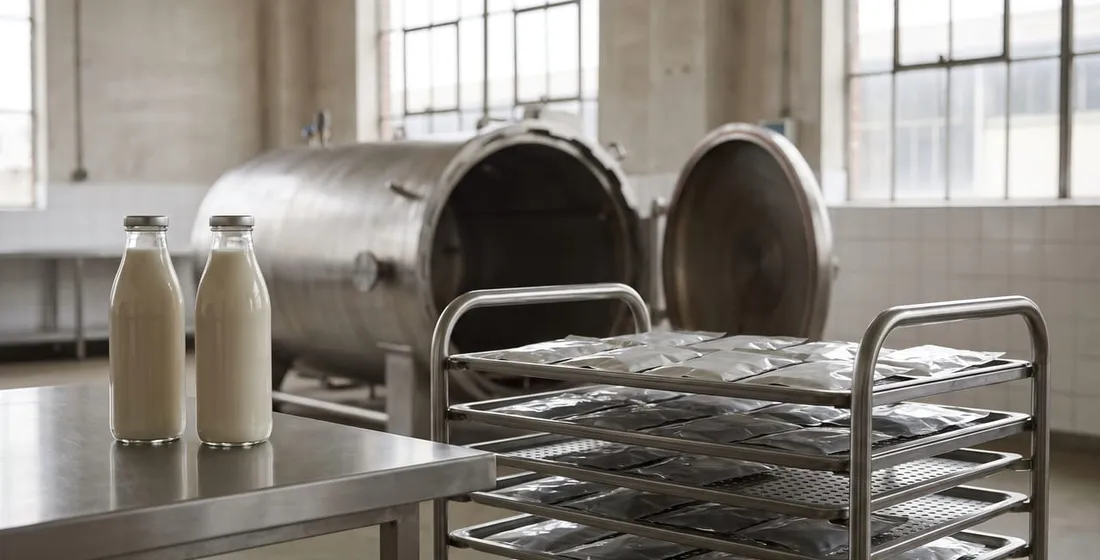
A stainless steel loading trolley of blank silver retort pouches beside two plain unlabelled glass bottles of pale milk, in front of an open retort vessel in a clean food production hall.
Buyer’s snapshot
- A retort line promises one thing: a sealed pack of low-acid food that is commercially sterile and can sit on a shelf at room temperature. Under 21 CFR 113 and 114, low-acid means a finished pH above 4.6 and a water activity above 0.85.
- What a pouch has to survive is a heat cycle of about 115 to 121 °C at 15 to 20 psi, then a cooling stage that can burst a weak pouch (Food Science and Nutrition, 2024).
- Silk Foods Ceylon (SFC) does not publish cycle times or load sizes. They are fixed per product and quoted on request.
- SFC welcomes small first runs. R&D takes 3 to 4 weeks at most from signed brief to approved formulation.
A brand owner asking for a retort run usually wants three answers on one page: what the line can promise, what the pack has to survive, and which of the brand’s products belong on it. The answers exist, but they are scattered across a quote, a process study and a label proof.
This note puts them side by side. It is a capability read for a brand owner deciding whether a product goes to retort at all, not a spec for one pouch. For the cycle arithmetic on one pack, see the 300 g curry pouch spec. This post covers the step before that: whether the product, the pack and the promise fit the process.
What does a retort line actually promise?
A retort line promises commercial sterility of a sealed pack, achieved by a heat process that was set for that product and then recorded for every batch. It does not promise a shelf life by itself, and it does not promise anything about taste, texture or cost.
The US federal rules define the terms precisely. A scheduled process is the process a processor selects as adequate to achieve commercial sterility, and it must be at least equivalent to one established by a competent processing authority (21 CFR 113.3). A hermetically sealed container is one designed to be secure against the entry of microorganisms (21 CFR 113.3). Neither text is Sri Lankan law, so they serve here as the benchmark a serious buyer or export-curious brand will be measured against, not as the local rule.
Commercially sterilised food in a sealed container can be kept at room temperature for up to two years, according to a 2024 review in Food Science and Nutrition citing earlier work. That is a ceiling for the process, not a claim any one product earns. The date printed on a pack comes from that product’s own stability work, which our note on the contents of a shelf-life file sets out.
The one-page capability read
The table is the page a brand owner can take into a briefing. The middle column is what SFC can discuss at the Matale facility, and the right column is how it is stated, so nobody expects a number that does not exist.
| Item | What SFC can discuss | How it is stated |
|---|---|---|
| Process | Batch retort for sealed pouches and glass bottles | Shelf-stable bottled and pouched goods |
| Pack formats | Retort pouch; glass bottle on the Non-Dairy Milk line | Format fixed during R&D |
| Heat process | A scheduled process per product, set with a qualified process authority | Never copied from another product |
| Cycle time and load size | Fixed once the load pattern is validated | Quoted per brief, not published |
| Run size | Small first runs welcome | Quote on request |
| R&D | Signed brief to approved formulation | 3 to 4 weeks at most |
| After formulation is locked | Purchase order to dispatch | 2 to 3 weeks |
| Records | Heat process and batch records kept for each run | Shared with the brand on request |
Two rows deserve a note. The first is cycle time: a number copied from a blog post would be wrong for most products, because it depends on pack thickness, solids and the validated load. The second is lead time: the 2 to 3 weeks applies once the recipe and process are locked, so a new retort product starts with R&D and validation, not with a purchase order.
What does a pouch have to survive?
A retort pouch has to survive three things: heat, pressure and the cooling stage. The same review gives a typical retort range of about 115 to 121 °C at 15 to 20 psi above atmospheric, and it notes that the cooling stage can cause pouches to burst. That last point is why cooling in a batch retort is done under controlled overpressure, and why the film, the seal and the filled thickness are chosen together, not one at a time.
For a brand owner the practical limits are four.
- The laminate has to be rated for the process temperature. A pouch that is fine at 100 °C can fail at 121 °C. The pack is chosen against the heat process, and the heat process is not relaxed to suit the pack.
- The seal has to hold through the whole cycle. A weak seal shows up as leakers after cooling, not before. Seal checks are part of the run, not a one-off at set-up.
- The fill has to stay flat and even. Thicker pouches heat more slowly, so the thickness validated in the study is a ceiling for every fill, not a guide.
- Headspace and air have to be controlled. Trapped air changes how a pouch behaves under pressure, so fill weight and sealing method are fixed in the specification.
A pouch that passes these four is not yet a promise. It is a pack that can be put through the process. The promise comes from the heat-penetration work on the product inside it.
Which products belong on a retort line?
The test is acidity and water activity, not the product category. Low-acid, wet foods need the full heat process to be shelf-stable. Acid foods have other options, and dry foods are not retort products at all.
| Product type | Finished pH and water activity | Usual route | Retort a fit? |
|---|---|---|---|
| Cooked curry, jackfruit, legumes or vegetables in sauce | pH above 4.6, water activity above 0.85 | Scheduled retort process | Yes, the core fit |
| Plant milks (oat, soy, rice) in glass | Low-acid | Hot-fill, cap, then in-container retort | Yes, on the Non-Dairy Milk line |
| Chutney, pickle, fruit spread | pH 4.6 or below once equilibrated | Acid food or acidified food route; hot-fill and hold, or retort | Possible, chosen per recipe |
| Powders, teas, capsules | Low water activity | Dry-line processing | No |
| Fresh or chilled meals | Not shelf-stable | Cold chain | Not a retort promise |
The pH 4.6 line is the hinge. The US rules class a food with a finished equilibrium pH above 4.6 and water activity above 0.85 as low-acid, and acidified foods as low-acid foods to which acid is added so the pH settles at 4.6 or below (21 CFR 114.3). Our note on scaling a chutney shows what that line means on the filling side. The rows for jackfruit and plant milk are covered in the jackfruit-in-brine note and the plant-based beverage format note.
Where SFC walks away
Retort is the wrong promise for a dry product, a chilled product, or a recipe whose pH has never been measured. It is also the wrong first step for a brand that wants a long shelf-life claim before the formulation has been fixed. In those cases the honest answer is another line, or a round of R&D first.
Consider two products and one retort promise
The scenario below is hypothetical and shows the shape of the decision, not a real client.
A brand owner has two products in development: a jackfruit curry and a tamarind chutney. The first brief says “retort pouch for both, 12 months”. The curry is a low-acid wet food, so the retort route is the right one, and it needs a validated process before any claim is printed.
The chutney is different. Suppose its finished pH, measured on a cooled sample, settles well below 4.6. It then belongs to the acid-food side of the table, and a hot-fill and hold route in a glass jar may do the job at lower cost and with a better texture than a retort pouch. The brand owner saves a validation study on one SKU. If the measured pH sits near 4.6, the answer changes, and that is a question for R&D and a qualified process authority, not for a rule of thumb.
The point of the one-pager is the order of the questions: product first, then pack, then process, then promise.
What should the brief to a contract manufacturer state?
A retort brief should state the product, its measured pH, the pack and the claim the brand wants, because those four decide whether the run is a retort run at all.
- The recipe by weight, and the finished pH measured on a cooled sample
- The pack: pouch or glass, size, net content and the maximum filled thickness
- The shelf-life claim the brand hopes to print, and the storage condition on the label
- The first-run quantity in units, so the quote can reflect a small run
- The label draft, with net content in g or ml as the 2026 labelling rules require
On the last item, Sri Lanka’s Food (Labelling and Advertising) Regulations 2026 require net contents in SI units, and the batch code requirement means every retort run needs a record a code can lead to. Our 2026 labelling note lists what has to appear on the pack, and the quality records note covers what a food maker keeps before launch. For the R&D side of a retort recipe, see reformulating a kitchen recipe for retort, and for the 16-week path on one curry pouch, the retort R&D scenario.
What does a first retort run at Silk Foods Ceylon look like?
A first retort run at Silk Foods Ceylon (SFC) starts with the product and the claim, then moves through R&D and a validated process to a locked specification. The Matale facility runs the retort alongside kettles, a liquid filling machine and glass capping, so the product is not handed between sites.
R&D / NPD (Co-Development on the SFC brochure) takes 3 to 4 weeks at most from signed brief to approved formulation. After the specification is locked, Contract Manufacturing takes a purchase order to dispatch in 2 to 3 weeks. Small first runs are welcome and quoted on request, and the quote shows the heat process, the pack and the records as separate lines.
Frequently asked questions
What does a retort process make a food safe against?
A retort process is built to make a sealed low-acid food commercially sterile, so it can be kept at room temperature. Under 21 CFR 113.3 the process must be a scheduled process at least equivalent to one set by a competent authority. A pouch alone does not do this, because the heat process does (US CFR, 2026).
What temperature does a retort pouch have to withstand?
A typical retort runs at about 115 to 121 °C and 15 to 20 psi above atmospheric. The cooling stage can burst pouches, so cooling is run under controlled overpressure. The laminate and seal are chosen against that cycle, and the filled thickness is held to the validated figure (Food Science and Nutrition, 2024).
Does every shelf-stable food need to go through a retort?
No. Acid foods with a finished pH of 4.6 or below, and acidified foods, have other routes such as hot-fill and hold. Dry foods like powders and teas are not retort products. The route follows the measured pH and water activity of the finished recipe, so confirm it in R&D (US CFR, 2026).
Can Silk Foods Ceylon run a retort pouch or bottle for a new brand?
Yes. Silk Foods Ceylon runs a batch retort for sealed pouches and glass bottles. R&D takes 3 to 4 weeks at most from signed brief to approved formulation, and a locked recipe goes from purchase order to dispatch in 2 to 3 weeks. Small runs are welcome, quoted on request (SFC, 2026).
How Silk Foods Ceylon can help
For brand owners deciding what belongs on a retort line, Silk Foods Ceylon (SFC) runs R&D / NPD and Contract Manufacturing at its Matale facility, with a batch retort for pouches and glass bottles, steam-jacketed kettles, liquid filling and glass capping on site. R&D takes 3 to 4 weeks at most from signed brief to approved formulation, and a locked recipe goes from purchase order to dispatch in 2 to 3 weeks. The facility is BRCGS- and FSSC 22000 V6-audited, with SLSI submission support built into a standard engagement. Small first runs are welcome and quoted on request.
To brief a project, email b2b@esilkroute.com.lk or call +94 77 157 7294.
Sources
- US Government, Code of Federal Regulations, 21 CFR 113.3 (definitions: low-acid foods, scheduled process, hermetically sealed container), Electronic Code of Federal Regulations. law.cornell.edu, 113.3 (retrieved 25 November 2026).
- US Government, Code of Federal Regulations, 21 CFR 114.3 (definitions: acidified foods, low-acid foods). law.cornell.edu, 114.3 (retrieved 25 November 2026).
- Jimenez, P.S., Bangar, S.P., Suffern, M. and Whiteside, W.S. (2024), “Understanding retort processing: A review”, Food Science and Nutrition 12(3), on retort temperature and pressure range, cooling and pouch bursting, room-temperature keeping. pmc.ncbi.nlm.nih.gov (retrieved 25 November 2026).
- Government of Sri Lanka, Food (Labelling and Advertising) Regulations 2026, Gazette Extraordinary No. 2494/47, net contents in SI units and batch code marking, in operation from 1 July 2026. eohfs.health.gov.lk (retrieved 25 November 2026).
- Silk Foods Ceylon (2026), internal capability data for the Matale facility: batch retort for pouches and glass bottles, R&D of 3 to 4 weeks at most from signed brief to approved formulation, and 2 to 3 weeks from purchase order to dispatch on a locked recipe.
Written by the Silk Foods Ceylon Team. Silk Foods Ceylon (Pvt) Ltd. is a BRCGS- and FSSC 22000 V6-audited contract manufacturer in Matale, Sri Lanka, offering contract manufacturing, private labelling, co-packing, and in-house R&D for local Sri Lankan brand owners, FMCG companies, hotel and restaurant groups, and distributors. To brief a project: b2b@esilkroute.com.lk or +94 77 157 7294.